
Direct Answer: Listing price ranges on a contractor website screens out shoppers who were never going to book and gives AI tools something real to quote. You do not need fixed prices, just an honest range tied to scope.
Ask a contractor in Monterey County why there is no pricing anywhere on his website and you get the same answer almost word for word. Every job is different. I cannot put a number on there.
That is true. No two re-pipes in an old Pacific Grove bungalow cost the same, and nobody should publish a flat price for a roof. But that objection is why most contractor sites in this market say nothing about money at all, and silence has its own cost.
I want to walk through what actually changes when a site gives homeowners a starting point, a range, or even just an honest explanation of what drives the number. What changes on the phone, what changes in AI answers, and how to do it without painting yourself into a corner.
The Objection Is Fair. The Silence Is the Problem.
Homeowners are not asking you to commit to a price sight unseen. They are trying to figure out if they are in the right ballpark before they spend twenty minutes on the phone with a stranger.
When the page says nothing, they go looking somewhere else. We see it in our own chat logs: a visitor once typed a question into our site asking what a local plumbing company charges. They were on a marketing agency’s website asking about plumbing rates, because the plumber’s own site did not say.
That is the whole problem in one message. The question gets asked either way. The only choice you have is whether it gets answered by you, by a competitor, or by a machine guessing on your behalf.
And notice how people describe their own jobs. They say things like “nothing fancy, just a standard replacement” before they have any idea what their job actually involves. They are telling you they want a baseline.
Three things a homeowner is usually trying to settle before they dial:
- Is this a few hundred dollar problem or a few thousand dollar problem
- Does this company handle jobs my size, or am I too small for them
- Will I get a straight answer or a runaround

What Changes on the Phone When the Page Answers the Money Question
Pricing is not only a website decision. It is a call screening decision.
Across contractor call recordings, the questions that come up before someone agrees to book cluster hard around two things: cost and availability. Not credentials, not years in business, not the equipment brand. Price and when you can get there.
One plumbing company’s qualified-call rate roughly doubled month over month, from 31% to 61%, during a stretch when same-day availability and clear upfront pricing were the two things callers mentioned most before booking. Those were not more calls. They were calls that arrived further along.
That is the trade most owners miss. Publishing cost context usually does not raise total call volume by much. It changes who is on the other end.
What tends to drop off:
- People shopping for a number half your market rate
- Callers who wanted a free phone diagnosis and never intended to book
- Jobs outside the size you actually want
What tends to increase is the share of calls where the homeowner already accepts the general range and is now choosing between you and one other company. If you have never listened to a month of your own calls, the calls sitting in your voicemail are worth more than your blog is a good place to start.
Cost Questions Are Where AI Answers, Not Where Your Map Pin Wins
Here is the part most contractors have not caught up to yet. Search has split into two different behaviors, and cost questions landed on the AI side.
A search like “plumber near me” still behaves close to the old Google map pack. Your Google Business Profile, your reviews, and your proximity do most of the work. But “how much to replace a water heater near Monterey” is now answer-engine territory. Studies of local search show AI Overviews appear on informational and reason-style queries well over half the time.
So what happens when a homeowner in Seaside asks that question and your site has published nothing about cost? The model has nothing from your business to pull from. It fills the gap with national averages that have nothing to do with Monterey County labor rates, local permit timelines, or the access headaches on a Carmel Valley hillside lot.
Then the homeowner calls you with a number in their head that you did not set and cannot live with.
This is a big part of what our AI search visibility system is built to handle. The same cost language lives on the website, in Google Business Profile posts and Q&A, and in ad headlines, so the answer a homeowner gets from an AI tool matches the answer your office would actually give. Worth reading alongside this: which homeowner searches AI answers, and which ones still ring your phone.
Silence vs. a Range: Side by Side
This is the practical difference between a site that dodges the money question and one that frames it on purpose.
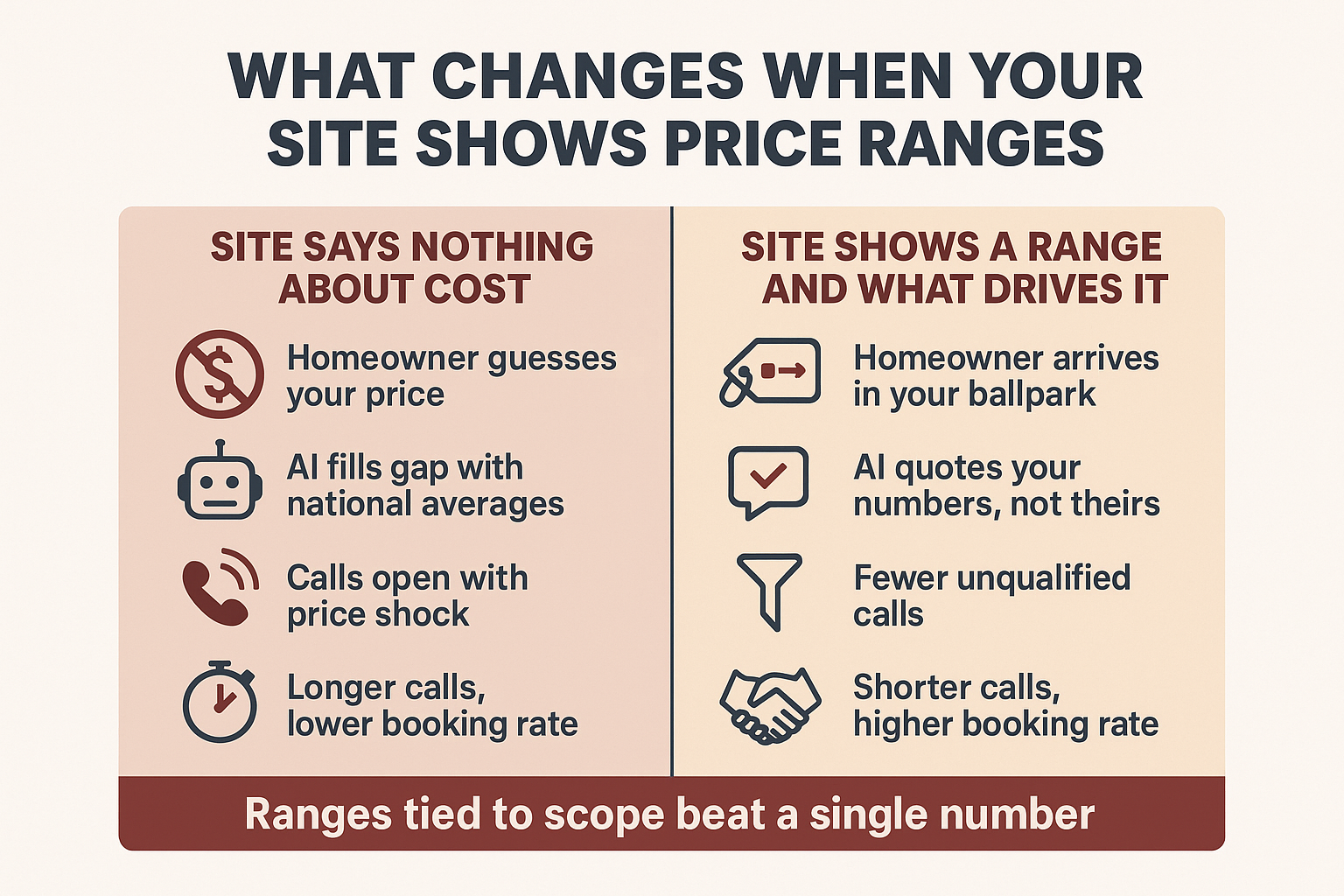
How to List Price Ranges on a Contractor Website Without Boxing Yourself In
A single number is a trap. A range tied to a scope holds up fine, and it reads as confidence rather than evasion.
The wording that works sounds like this: most panel upgrades in this area land between X and Y depending on service size and whether the meter has to move. You have given a real answer and named the variables in the same breath.
Honestly, the list of what pushes the number up or down is often more persuasive than the number itself. Three or four factors, in plain language, tells a homeowner you have done this a hundred times.
What to include on a cost page or FAQ:
- A range tied to a clearly described job, not a bare dollar figure
- The three or four variables that move the price, written the way you would say them on the phone
- What is included and what is billed separately, such as permits or disposal
- A plain statement that an on-site look sets the final number
- Your diagnostic or trip fee policy, and whether it applies to the job
One more thing worth addressing directly. Homeowners increasingly ask whether they can send photos first before committing to a visit. That request is a pricing question wearing a different hat, and answering it on the page, yes or no, with any fee attached, saves everyone a phone call.
Where a Range Works and Where Hedging Is Smarter
Not every job type deserves the same treatment. Here is how I think about it by category.
| Job Type | What Usually Belongs on the Page | Why |
|---|---|---|
| Repeatable service work (drain clearing, service call, standard swap) | A starting-at figure or a tight range | Scope barely moves, so a number is safe |
| Known-scope projects (panel upgrade, water heater replacement) | A range plus the two or three variables that shift it | Most of the cost is predictable before anyone shows up |
| Unknowns behind a wall (sewer line, dry rot, re-pipe) | A diagnostic fee plus a wide band | The honest answer is a wide band, and saying so builds trust |
| Emergency and after-hours | How after-hours pricing works, not a fixed number | Timing and access drive cost more than the repair does |
| High-ticket replacement (full HVAC system, whole roof) | A wide band plus a required on-site assessment | Long consideration cycle, and a wrong number follows you around |
| Remote photo assessment | A yes or no, and any fee attached | Homeowners ask this constantly and the site should answer it |
Will Showing Prices Scare Off Good Customers?
This is the pushback I hear most, and the homeowner research runs the other direction. Industry survey data on the homeowner’s roofing journey found roughly 65% of homeowners are more likely to contact a contractor whose website shows pricing, while only about 37% of contractors list starting prices or ranges.
That gap is the opportunity. Two thirds of the market wants the information and barely a third of the market gives it.
The lowball worry also misreads what homeowners are doing. They are not hunting for the cheapest number, they are hunting for a number they can trust. One painting customer wrote in a public review that quotes from four other companies were “jaw-droppingly high” and that the winning bid came in as the most competitive of the bunch, even accounting for how professional the crew was. Another homeowner described being upsold on sewer work they did not need by one company, then praised the contractor who charged a fraction of that quote and called it honesty.
Neither of those people was bargain hunting. They were looking for proof the number was fair.
So pair any pricing content with proof of outcomes. Reviews that mention the job type, the service area, and the fairness of the price do heavy lifting here, and they feed AI answers too. The review wording that gets a contractor named in AI answers covers how that works. If you are judging all of this on lead count alone, also worth knowing that cost per lead is the wrong number to grade by.
Frequently Asked Questions About Listing Price Ranges on a Contractor Website
Won’t my competitors just undercut me if I publish ranges?
Your competitors already know what you charge. They bid against you every week and they hear your numbers from homeowners during every estimate. The people the pricing page actually informs are homeowners, not the shop across town.
Should the same pricing language go on my Google Business Profile?
Yes, and this is where most contractors drop it. If your website says one thing and your profile says nothing, AI tools get an inconsistent picture of your business. Keeping cost language matched across the site, the profile, and your ad copy is exactly what AI search visibility is built to maintain.
What if a customer holds me to the low end of the range?
That happens when the range has no conditions attached. Tie the number to a described scope and name the variables, then the conversation becomes which end of the range this job lands on, which is a much better conversation to be having.
Homeowners keep asking if they can send photos before I come out. How should I handle that on the site?
Answer it plainly, one way or the other. A remote photo review is a pricing question in disguise, and a short paragraph saying whether you offer it, what it costs, and how accurate it is will save your office real time.
How do I find out which cost questions my own callers are actually asking?
Listen to the calls. Call recording and transcription with a monthly call intelligence report, which is what our call reporting produces, surfaces the top caller questions and the objections that showed up in lost calls. Those exact phrases are the ones that belong on your pricing or FAQ page.
Wondering what your own callers are asking about price?
Phil Fisk works directly with a small roster of owner-operated contractors across Monterey County and the Central Coast, and he goes through the monthly call intelligence report with each of them. That review is usually where a cost objection from a real call turns into the exact wording on a pricing or FAQ page. A 30 minute discovery call with Core6 is open for owners who want to find out whether their phone is asking questions their website never answers, and you can reach the Salinas office at (831) 789-9320.