
Direct Answer: AB 1738, signed September 18, 2026, requires most California cities and counties to offer remote video inspections on covered home projects. Larger jurisdictions must comply by January 1, 2028, smaller ones by July 1, 2028.
Your crew strips a roof in Salinas by 11 a.m. The deck is clean, the nails are in, and now three guys are standing around waiting on a nail inspection that might come at 2 p.m. or might come tomorrow morning.
That standby time is real money, and it shows up on every reroof, water heater changeout, and HVAC swap you run. California just changed the rules on it. AB 1738 was signed on September 18, 2026 and gives homeowners, and contractors with the homeowner’s written consent, the right to ask for a remote inspection on certain jobs.
I want to walk through what the law actually covers, when it starts binding building departments around Monterey County, and what I would do with that information between now and 2028. The date is the part most contractors are going to misread.
What the california remote building inspection law AB 1738 actually requires
AB 1738, authored by Assemblymember Juan Carrillo, was chaptered by the Secretary of State on September 18, 2026 as Chapter 271, Statutes of 2026, adding Health and Safety Code section 17970.9. You can read the bill history on CalMatters Digital Democracy.
The law requires covered cities and counties to offer a homeowner, or a contractor with the homeowner’s written consent, the option to request a remote inspection for all or part of an inspection required by a building permit. It does not strip inspectors of anything. The bill was written to preserve the authority and professional judgment of local inspectors, which means your inspector can still decide they need to be on site.
Covered work on one and two family dwellings includes:
- Heat pump water heaters
- Heat pump HVAC systems
- Reroofs
- Small rooftop solar with storage
It passed the Senate 29 to 6 and received final Assembly concurrence 68 to 0, so this was not a close fight. Plumbers, roofers, electricians, and HVAC companies are the trades most directly affected, and that is most of my client roster on the Central Coast.

The catch: your building department is not on the hook yet
This is the part I keep repeating to contractors who read a headline and assume the rules changed last week. Compliance is phased in, and nothing is required of local jurisdictions until 2028.
- Larger jurisdictions must offer the remote option by January 1, 2028
- Smaller jurisdictions get until July 1, 2028
I am not going to guess which bucket Salinas, Monterey, Seaside, Marina, Watsonville, King City, or San Benito County falls into, because the threshold language in the statute decides that, not me. If this affects how you bid work, call your building department and ask them directly which date applies to them and whether they already allow video inspections voluntarily.
Some departments around the Monterey Bay Area already run partial video inspections for simple items. Others will take the full two years. The law gives you a floor, not a start date you can advertise today.
One more thing worth confirming locally: the intent is that the remote option should not cost the homeowner more or create a longer wait than an in-person inspection. Fee schedules are set locally, so ask about fees before you promise a homeowner anything.
AB 1738 at a glance, and what to verify with your local department
Here is the short version of the law next to the questions I would actually ask a building official in Monterey County.
| Element | What the law says | What to confirm locally |
|---|---|---|
| Property type | One and two family dwellings | Whether your project type qualifies |
| Covered work | Heat pump water heaters, heat pump HVAC, reroofs, small rooftop solar with storage | Whether partial items on other permits are allowed too |
| Who can request | The homeowner, or a contractor with the homeowner’s written consent | What consent form or language they accept |
| Scope | All or part of an inspection required by a building permit | Which items still require an inspector on site |
| Larger jurisdictions | Must offer the option by January 1, 2028 | Whether your city or county is in this group |
| Smaller jurisdictions | Must offer the option by July 1, 2028 | Same question, plus any voluntary early rollout |
| Inspector authority | Preserved, including professional judgment | When they will require an in person follow up |
Run the standby math on your own numbers
Forget industry averages. Pull up your last reroof and ask what the inspection wait actually cost you.
The variables that drive it:
- Crew size held on site, loaded hourly cost including burden, not just wage
- Exposure risk on a torn off roof if the inspection slips past a weather window
- Return trip cost when a crew demobilizes and comes back the next morning
- Water heater jobs where the homeowner has no hot water until the sign off clears
- Schedule slip that pushes the next job and the next deposit
Cost swings a lot by trade and crew, so I am not going to hand you a number. But if a three person crew sits for four hours, you already know what that line item looks like on your own P and L, and for most contractors I talk to it is hundreds of dollars per occurrence rather than a rounding error.
Stack that across a season of reroofs and changeouts and the video option stops being a tech novelty. It is a scheduling tool. That is exactly how I would explain it to a homeowner who is trying to understand why your bid is different from the next guy’s.
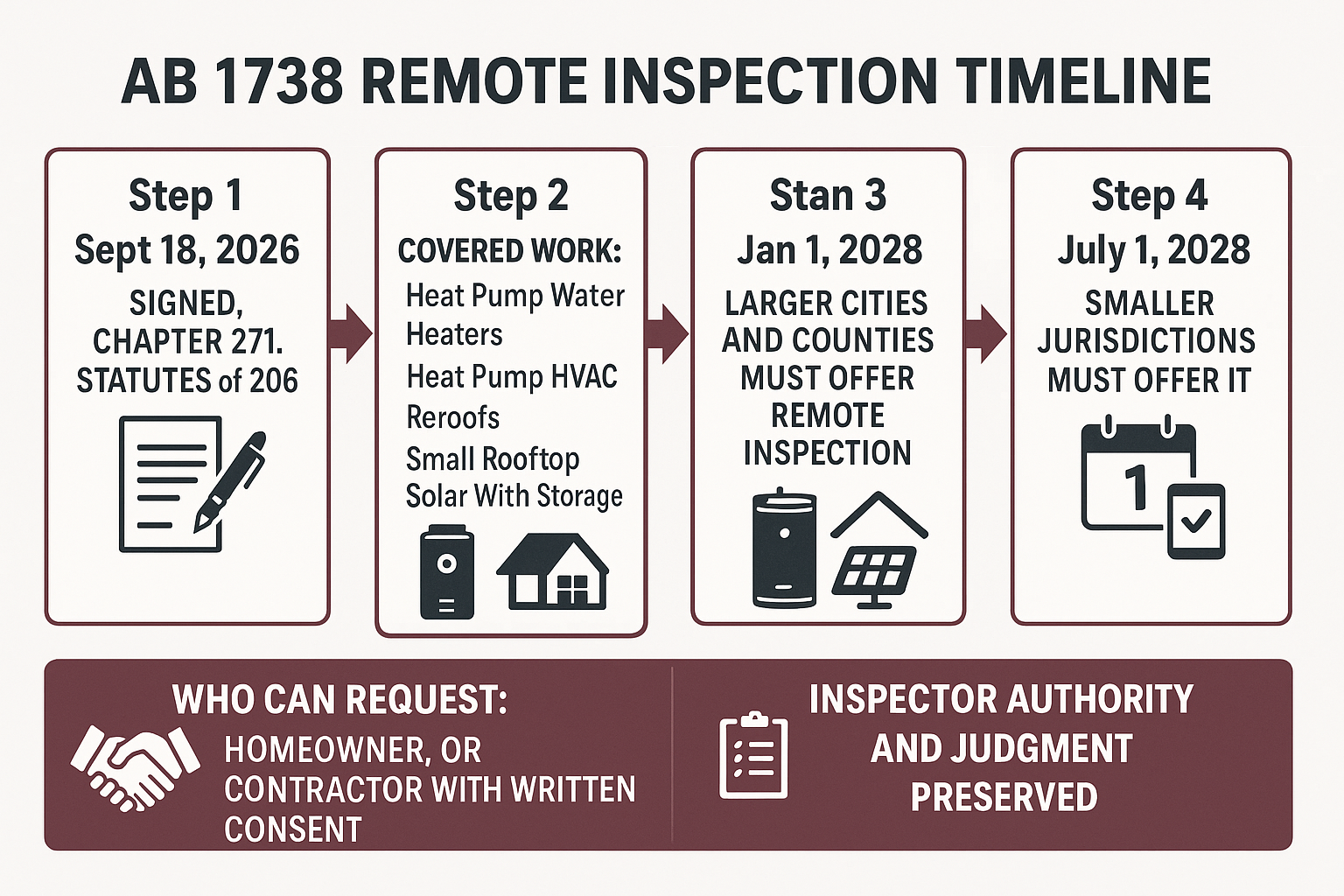
The AB 1738 timeline, start to compliance
A quick visual of the dates and covered work so you can see where 2026 ends and the compliance deadlines begin.
What I would put on your website now, and what I would leave off
Do not publish a page today that promises video inspections. Your jurisdiction may not offer them yet, and a promise you cannot keep turns into an angry call later.
What does work right now is content about inspection timing, because that is already what homeowners are nervous about. Nobody types “remote inspection for a heat pump water heater.” They type the problem, the way they say it out loud, which is closer to how homeowners actually search versus how trades talk.
Think about the real phrasing:
- Hot water only lasts five minutes and they want it fixed this week
- The roof is tarped and they want to know how long the house stays open
- They want to know who pulls the permit and who waits for the inspector
Those are page topics. If you only have room for two pieces of content a month, inspection and permit timing belongs near the top of your writing queue.
This also matters for how AI tools answer homeowner questions. When somebody asks ChatGPT or Google’s AI summary who handles permits and inspections on a Monterey reroof, the answer is assembled from content that exists. Our AI search visibility work is built around keeping that content, your Google Business Profile, your citations, and your ad copy saying the same accurate thing across every channel, which is the same reason some contractor sites show up strong in Google but vanish in AI answers.
And the questions worth writing about are not guesses. Call recordings and transcripts surface the objections that actually kill jobs, and permit and timeline anxiety comes up constantly on high ticket work. That feeds straight into which searches AI handles and which ones still ring your phone.
Frequently Asked Questions About AB 1738 Remote Inspections
Does this mean an inspector never has to come out on a reroof?
No. The law covers all or part of an inspection, and it specifically preserves the inspector’s authority and professional judgment. Expect some items to clear by video and others to still require boots on the deck.
Can I request the remote inspection myself, or does the homeowner have to do it?
A contractor can request it with the homeowner’s written consent. Ask your building department what form or wording they will accept, and get that consent signed at contract time rather than chasing it the morning of the inspection.
Is my city required to offer this yet?
Not yet. Larger jurisdictions have until January 1, 2028 and smaller ones until July 1, 2028. Some departments may roll it out earlier on their own, so call and ask instead of assuming either way.
Will a remote inspection cost the homeowner more?
The law is written so the remote option is not supposed to be a worse deal on cost or timing than an in-person inspection. Fees are still set locally, so verify the current fee schedule with your building department before you quote anything to a customer.
Should I start telling customers about this on estimates?
I would explain it as something coming, not something available. Saying “state law is phasing in a video inspection option through 2028, and I will tell you if the county offers it on your permit” is honest and it still makes you sound like the contractor who keeps up.
Thinking through what this changes for your 2027 schedule?
Permit and inspection questions come up on almost every high ticket job around Monterey County, and the contractors who answer them clearly on their own website tend to win the call. If you want a second set of eyes on how your site handles that, Core6 Marketing works with owner-operated contractors from Salinas to Watsonville and King City, and Phil Fisk keeps a short list of discovery calls open each month at (831) 789-9320.