
Direct Answer: AI tools like ChatGPT recommend only a tiny fraction of local contractors, about 1.2%, based on data accuracy, review consistency, and whether your website gives them something credible to cite.
A homeowner in Pacific Grove opens ChatGPT and types: ‘Who’s a good HVAC contractor near me?’ The AI doesn’t hand her a list of twelve options. It names one, maybe two, and presents them as the answer. If your company isn’t one of them, you don’t exist in that conversation.
This isn’t a Google ranking problem. It’s a different kind of visibility problem, and the numbers behind it are sharper than most contractor marketing conversations have caught up to yet. According to SOCi’s 2026 Local Visibility Index, which analyzed over 350,000 business locations, ChatGPT recommends just 1.2% of local businesses for any given query. Google’s local 3-Pack, for comparison, surfaces businesses roughly 36% of the time. That gap is enormous.
I want to walk through exactly why AI pre-selects the names it does, what it’s looking for before it trusts a contractor enough to recommend them, and what that means practically for trades businesses in Salinas, Monterey, Watsonville, and across the Central Coast.
The Queries That Now Live in AI Territory
Not every search has shifted to AI. The old ‘plumber near me’ search still largely preserves the traditional local pack on Google. But a different kind of question has moved almost entirely into AI Overviews and conversational tools, and it’s the question homeowners ask before they ever pick up a phone.
Whitespark’s Q2 2026 data found AI Overviews appearing in 97% of hybrid-intent queries, questions like ‘average cost of HVAC replacement in Monterey’ or ‘how long does a roof last in coastal California.’ BrightLocal’s 2026 research found consumer use of AI for local service discovery jumped from 6% to 45% in a single year, with ChatGPT leading at 31% and Google AI Mode at 23%.
That pre-purchase, cost-and-decision phase of the homeowner journey is now almost entirely an AI space. And AI Overviews appear in 92% of informational local queries, the ‘why does my AC make that noise’ and ‘what causes low water pressure in older Salinas homes’ type questions.
This matters because the contractor who shows up during that research phase is the one the homeowner already trusts by the time they’re ready to call. How AI search is changing who gets called for home repairs is a shift that’s already in motion, not something coming later.
What AI Is Actually Checking Before It Recommends Anyone
The contractors AI surfaces aren’t always the ones with the highest Google rankings or the biggest ad budgets. SOCi’s research found that the businesses AI recommends share three characteristics:
- Strong data accuracy across platforms, consistent business name, address, and phone number on Google Maps, Yelp, the BBB, and other directories
- Higher average ratings, ChatGPT-recommended businesses average 4.3 stars across platforms, not just on Google
- Consistent trust signals across multiple sources, AI cross-references before it commits to a name
This is where a lot of Central Coast contractors get quietly filtered out, even with strong Google reviews. A roofing contractor in Watsonville who built up solid Google rankings over five years may have a phone number on their BBB listing that hasn’t been updated since they switched carriers in 2019. A pest control company in Carmel Valley may have their address listed slightly differently across three directories, no suite number on one, an old zip code on another.
AI isn’t penalizing them for those discrepancies. It simply can’t verify them well enough to feel confident recommending them. Think of it as a confidence filter: AI needs to see the same business information reflected consistently before it will stake its answer on that name.
The fix here isn’t complicated, but it is specific. It starts with auditing every directory where your business data lives and bringing all of it into alignment. Your Google Business Profile is now functioning as an AI feed, not just a map listing, and inconsistencies upstream of it ripple into AI recommendations.
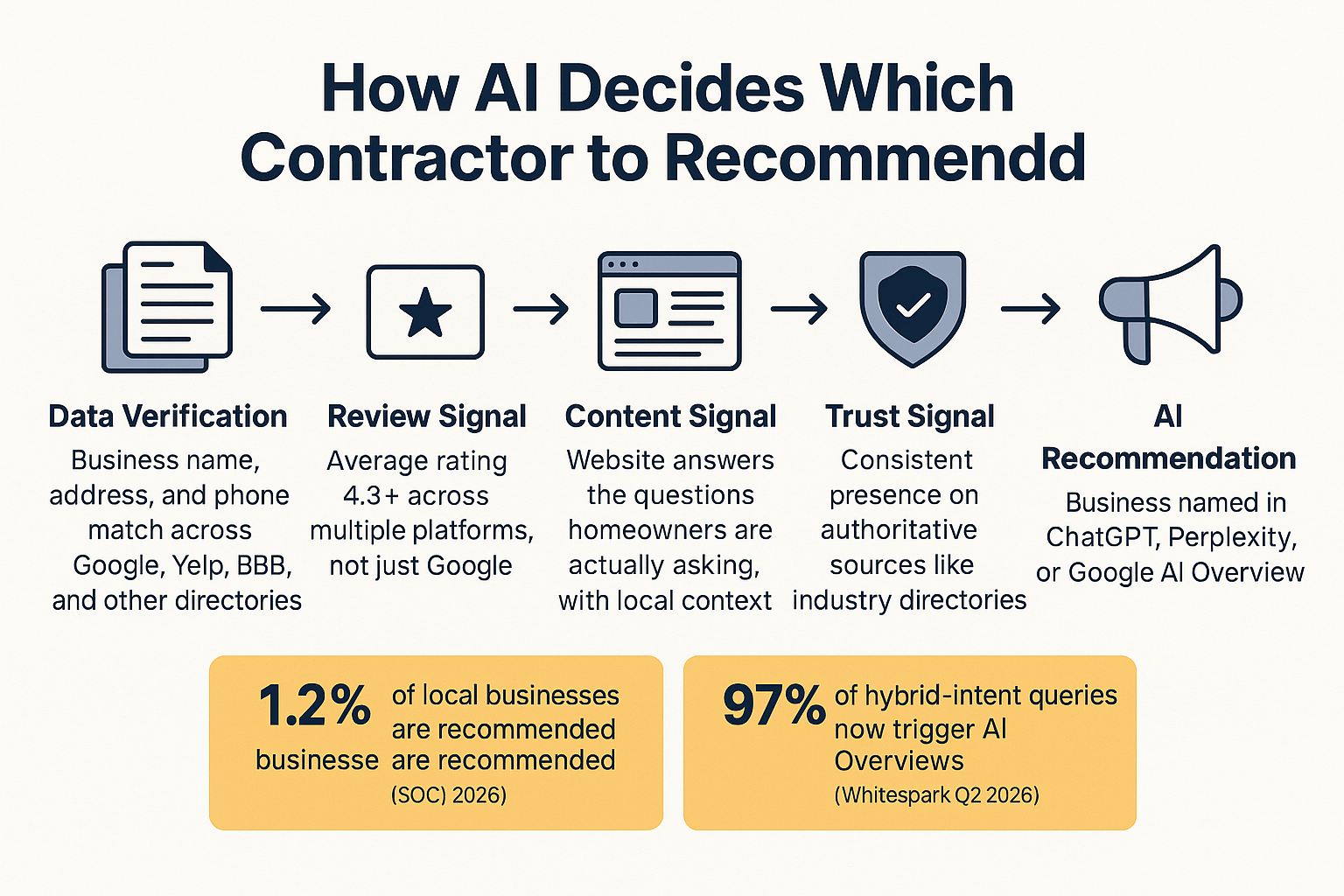
How AI Filters Local Contractors Before Making a Recommendation
This shows the confidence-filter process AI platforms use before recommending a local business, from data verification through to the final recommendation.
Giving AI Enough Material to Cite You With Confidence
Data hygiene gets you past the confidence filter. But content is what gets you cited.
AI Overviews appear in 92% of informational local queries. When a homeowner in Marina asks ChatGPT why their water heater is making a knocking sound, the AI pulls from websites that have already answered that question in plain language. A contractor whose site has five service pages and a generic ‘About Us’ gives AI nothing to work with. A contractor whose site includes a real explanation of what causes that knocking sound, written for a Central Coast homeowner, gives AI exactly what it needs to cite them as an authority.
This isn’t about publishing content for its own sake. It’s about matching the specific questions your customers are already asking before they call. I’ve written before about how the calls sitting in your voicemail are worth more than your blog, the language customers use when they describe a problem is the same language they type into AI tools. A plumbing company in Salinas that answers ‘what causes low water pressure in older Salinas homes’ on their website is speaking directly to that query.
Practically, ‘giving AI enough material’ looks like this:
- Answer the real pre-purchase questions your customers ask before they decide to call, cost ranges, timelines, what the process looks like
- Use local specificity, coastal climate, older housing stock in Salinas and Seaside, specific city names, so AI knows you’re relevant to this geography
- Write plainly, not technically, AI cites content homeowners can understand, not content written to impress search algorithms
- Cover the ‘why’ questions, not just the ‘what we do’ pages, ‘why does X happen’ queries are the ones triggering AI Overviews at the highest rate
The content you’re already sitting on, customer questions, common job scenarios, seasonal patterns specific to Monterey County, is exactly what AI needs to recommend you.
AI Visibility vs. Traditional Google Rankings: What’s Different
Traditional local SEO and AI visibility overlap in some areas but diverge in others. Here’s how the two compare across the factors that matter most for contractors on the Central Coast.
| Factor | Traditional Google Rankings | AI Recommendation (ChatGPT, Perplexity, etc.) |
|---|---|---|
| Business data consistency | Helpful but not critical | Critical, inconsistency removes you from consideration |
| Google reviews | High weight | One signal among several; multi-platform ratings matter more |
| Website content type | Service pages + keywords | Informational, question-answering content weighted heavily |
| Ad spend influence | Direct (Google Ads boost visibility) | None, AI doesn’t factor paid ads |
| Citation accuracy (BBB, Yelp, etc.) | Moderate weight | High weight, AI cross-references before recommending |
| Local specificity in content | Helpful for geo-targeting | Strong signal, AI uses it to match recommendations to location |
| How often you appear | ~36% of relevant searches (3-Pack) | ~1.2% of queries (ChatGPT), far more selective |
What AI Search Visibility Addresses That Standard SEO Doesn’t
Most local SEO work is still built around Google rankings. That work still matters. But it doesn’t automatically translate into AI visibility, and for contractors in Monterey County, the gap between the two is growing.
AI search visibility, the local SEO methodology we use at Core6 Marketing, was built specifically to address this gap. It covers Google Business Profile optimization, citation cleanup and consistency across directories, on-page content structured around the questions AI tools are actually pulling from, and visibility tracking across ChatGPT, Perplexity, and Gemini alongside traditional Google results.
For an electrician in Seaside or a general contractor in Carmel Valley, that means the work isn’t just about ranking on page one. It’s about being one of the 1.2% that AI trusts enough to name out loud.
If you want to understand how ChatGPT decides which plumber or roofer to recommend, the short answer is: it recommends whoever it can verify most confidently, and whoever has answered the question the homeowner is asking. Both of those are addressable. Neither requires a massive budget, they require the right work done in the right order.
Frequently Asked Questions About Contractor Visibility in AI Search
Does paying for Google Ads help you show up in ChatGPT or Perplexity?
No. AI tools don’t factor paid advertising into their recommendations. A contractor who spends nothing on ads but has consistent business data, strong multi-platform reviews, and useful content on their website will outrank a heavy ad spender in AI results every time.
If my Google reviews are strong, why wouldn’t AI recommend me?
Google reviews are one signal, but AI cross-references across multiple platforms before it commits to a recommendation. If your BBB listing has an old phone number, or your Yelp profile uses a slightly different business name, AI can’t verify you well enough to feel confident. SOCi’s research found that ChatGPT-recommended businesses average 4.3 stars across platforms, not just on Google. That’s a meaningful distinction.
What kind of content actually gets cited by AI?
The content that shows up most often in AI Overviews answers the questions homeowners ask before they decide to call, cost ranges, timelines, what causes a specific problem, how long something lasts. Whitespark’s Q2 2026 data found AI Overviews appear in 97% of hybrid-intent queries like ‘average cost of AC replacement in Monterey’ or ‘how long does a roof last in coastal California.’ A service page that says ‘we do HVAC repair in Salinas’ doesn’t answer those questions. A page that explains what drives HVAC replacement costs on the Monterey Peninsula does.
How fast is AI search actually growing for local contractor discovery?
BrightLocal’s 2026 research found consumer use of AI for local service discovery jumped from 6% to 45% in a single year. That’s not a slow trend, it’s a rapid shift that already affects how homeowners in Monterey County find contractors, especially during the research phase before they make a call.
Is this something a contractor can fix on their own, or does it require outside help?
Some of it is doable without outside help, auditing your own Google Business Profile, checking that your BBB and Yelp listings match, and updating any outdated contact information. The content side is harder to get right without a system, because it requires knowing which questions to answer and how to write for AI citation rather than just for search keywords. What Google’s 2026 updates actually mean for contractor content is a good place to understand what’s changed and why the old approach doesn’t fully apply anymore.
Want to Know Where You Stand in AI Search Right Now?
We work with owner-operated contractors across Monterey County, from Salinas and Seaside to Watsonville and King City, and the AI visibility gap is one of the first things we look at. If you want a straight answer on whether your business data is consistent, whether your content gives AI anything to work with, and what it would take to be one of the names that actually gets recommended, a Discovery Call with Phil Fisk is a good place to start. Book one at https://core6.marketing/work-with-us/.