
Direct Answer: AI Overviews now answer most informational searches like symptoms, costs, and repair-versus-replace. Direct searches like “plumber near me” still surface the local pack and still ring your phone.
The report looks fine and the phone is quieter. That is how most contractors in Salinas and Seaside describe this problem to me before we ever open an analytics tab.
Rankings held. Impressions held. Clicks quietly slid, and nobody could point to the update that caused it.
Here is the part that matters: that loss is not spread evenly across every search a homeowner runs. Some searches are gone from your traffic report for good. Others still work exactly the way they did five years ago, and knowing which is which decides what you write next.
The clicks fell, but the rankings never moved
When an AI Overview sits on top of a search result, the page ranking first still ranks first. It just gets skipped.
Ahrefs looked at 300,000 keywords in February 2026 and found that pages ranking first on a query with an AI Overview averaged a 58% lower click-through rate than the same position without one. That is not a ranking problem. That is an answer being handed over before the homeowner ever scrolls.
The bigger backdrop comes from SparkToro’s 2026 work with Datos clickstream data, which put the US zero-click share of Google searches at roughly 68%. Their analysis found that fewer than one third of Google searches still send a click to a website.
Two reactions are both wrong here. Panicking and rebuilding everything is one. Ignoring it because your map rankings look healthy is the other.
The useful move is to figure out which half of your searches lost traffic and why.
AI Overviews vs local pack for contractor searches: where the line actually sits
The split runs along intent, not industry.
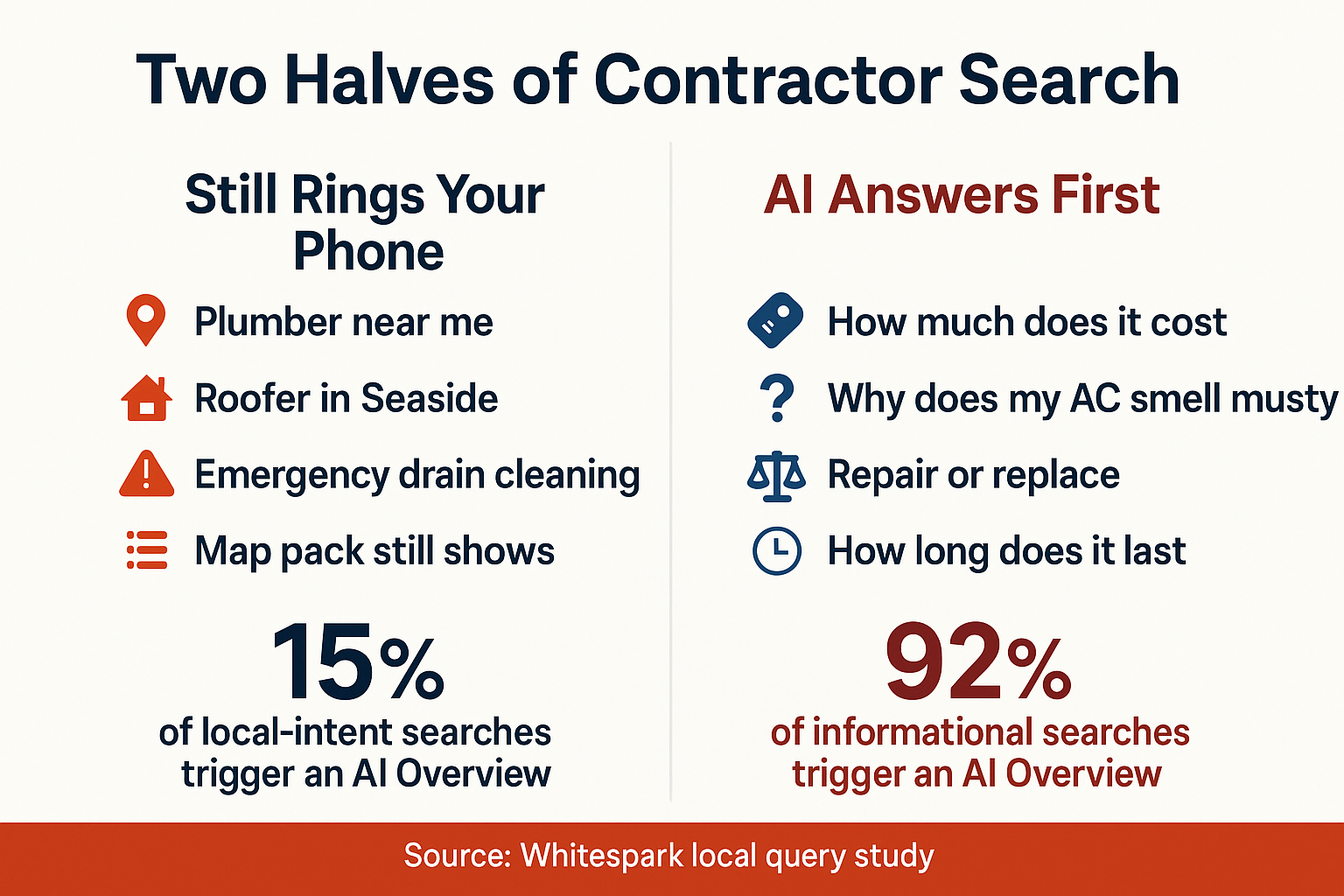
Whitespark tested local business queries and found AI Overviews appearing on 68% of them versus 39% for the local pack. But the headline hides the useful detail. Broken down by intent:
- Roughly 15% of local-intent searches triggered an AI Overview
- About 92% of informational searches triggered one
- Around 97% of hybrid questions, the ones that mix information with buying intent, triggered one
Local Falcon’s study of about 60,000 queries lines up with that. AI Overviews showed on 59.9% of “reason” style questions and only 17.2% of commercial ones.
In plain terms: “plumber near me” and “roofer in Seaside” still behave close to the old map pack. A homeowner with water coming through the ceiling is not reading an essay. They tap the first credible listing and call.
“How much does a roof replacement cost” and “why does my AC smell musty” are AI answer territory now. Those pages can still do their job, but the job changed. They win by getting cited and named inside the answer, not by earning the click.
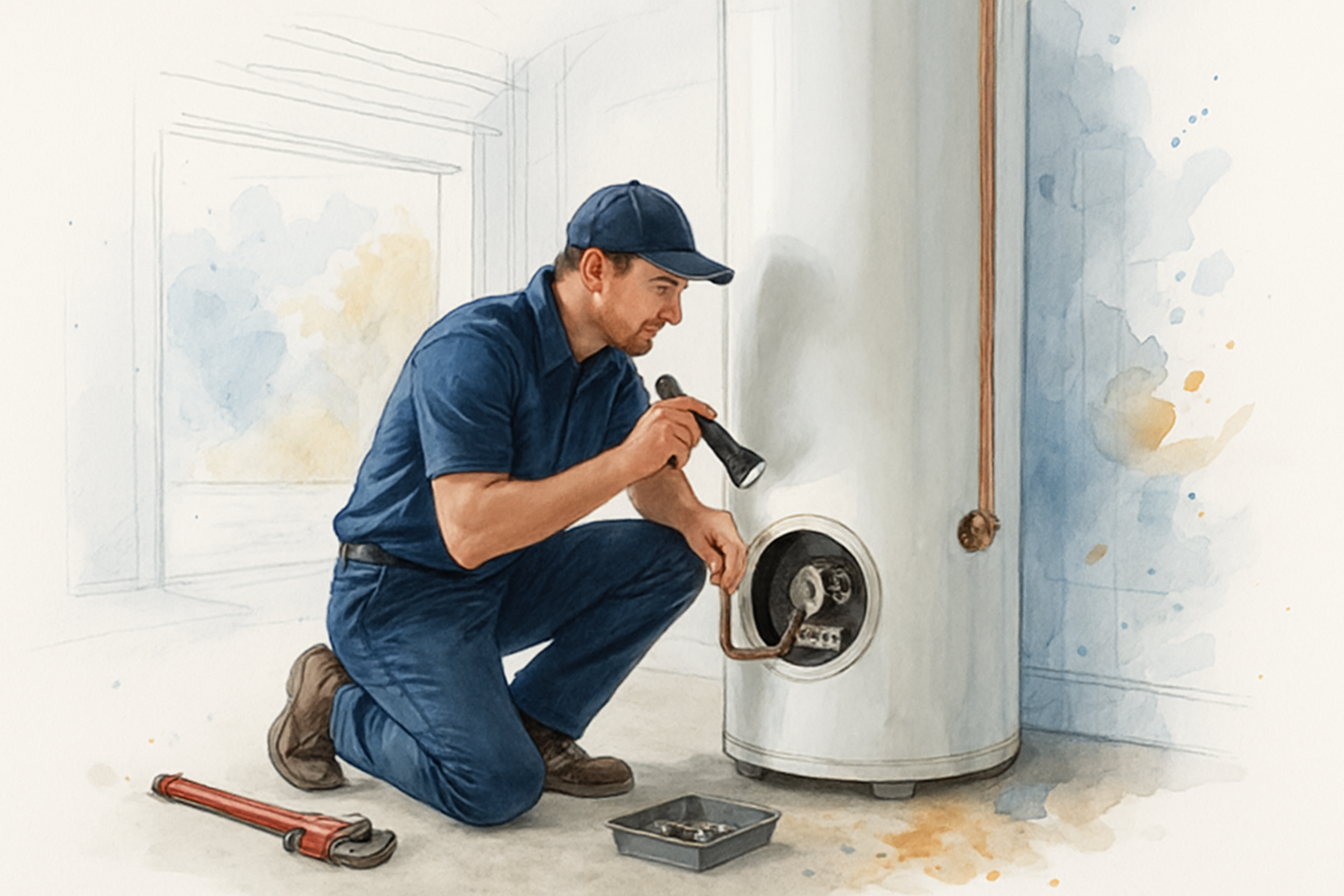
How homeowners here describe a problem before they type a trade name
Nobody starts with your trade name. They start with what is happening in their house.
One homeowner opened a call describing sewage backing up into the shower and tub at the same time. Another said their water heater was only a year and a half old and the hot water was lasting five minutes. A homeowner with a failing tree described it as “it’s seen better days,” not as declining canopy health.
Those are symptom searches, cost searches, and repair-versus-replace searches. That is exactly the half of the map where AI now answers first.
The emergency search behind it still rings the phone. But the homework search that comes before it is where a company either gets named or gets skipped, and most of that homework happens hours or days before anyone dials. We wrote more about that gap in how homeowners phrase problems versus how contractors name them.
Which surface answers which search
A quick read on where a homeowner search is likely to land and what that means for the page behind it.
| What the homeowner types | Surface that usually answers | What your page has to do |
|---|---|---|
| plumber near me | Local pack and map results | Hold rankings, answer the call fast |
| roofer in Seaside | Local pack and map results | City relevance, reviews, accurate profile data |
| how much does a roof replacement cost | AI Overview or AI chat answer | Be specific enough to be cited, not summarized |
| why does my AC smell musty | AI Overview or AI chat answer | Real field detail only your crew would know |
| should I repair or replace a 12 year old water heater | Hybrid, usually an AI answer with links | Name the tradeoffs and get your company named |
| emergency drain cleaning Salinas | Local pack, mostly unchanged | Availability, phone answered, clear pricing signals |
The two halves of contractor search
One picture of the split, so you can sort your own page list in about ten minutes.
This changes which pages are worth writing
Once you accept the split, your content list sorts itself into two piles with two different jobs.
Symptom, cost, lifespan, and repair-versus-replace pages have to be worth citing, not worth summarizing. If an AI can restate your whole page in two sentences, it will, and you get nothing. What survives that test:
- Failure patterns specific to this area, like coastal salt air on Monterey and Pacific Grove exteriors or hard water on Salinas Valley fixtures
- Real price factors with honest caveats, not a made-up flat number
- Job detail only your crew has, with the year, the city, and what you actually found
- Photos and measurements from your own trucks and phones
Service pages and city pages have a different job. They hold the local pack for direct-intent searches in Salinas, Marina, Watsonville, and Hollister, and they should stay tight and conversion focused.
One warning before you treat this line as permanent. Semrush found that in January 2025, 91.3% of queries triggering an AI Overview were informational. By October that share had dropped to 57.1% as commercial and transactional AI Overviews grew. The line is moving toward your money pages. If you only have room for two pages a month, here is how we prioritize them.
Run the test yourself, one city at a time
Most agency advice treats AI visibility as one national discipline. That is where a local contractor can get a real edge, because phrasing and city name change whether an AI answer even appears.
“Roof repair Salinas” can behave nothing like “how much to replace roof decking near Monterey.” Same trade, same customer, completely different surface.
So build a habit instead of a theory:
- List your ten highest-value homeowner questions, in the words a homeowner would use
- Run each one in plain Google, then again in an AI tool
- Repeat it once per city you serve, from Seaside to King City
- Note which surface came back, and whether any local company got named in the answer
That city-by-city record takes an afternoon and it tells you more than any national study will. It is also the input that drives AI search visibility, where website content, Google Business Profile data, and ad language all stay pointed at the same set of questions instead of drifting apart.
Why AI names one company and skips another
Getting named is not a writing trick. It tracks with data the machines can verify.
SOCi’s 2026 local visibility research found that businesses surfaced by AI had stronger data accuracy, higher average ratings, and more consistent trust signals across Google Maps, Yelp, Facebook, and their own sites. Locations ChatGPT recommended averaged 4.3 stars.
The same research found businesses with strong Google rankings but a thin presence everywhere else losing ground in AI recommendations. Ranking well in one place is no longer enough, which is why Yelp and Facebook profiles still matter even when Google is working.
On the demand side, BrightLocal’s 2026 consumer research showed AI use for local business recommendations jumping from 6% to 45% in a single year, and nearly all of those users checked real reviews behind whatever the AI told them.
Reviews carry weight here because they describe outcomes in plain language. A review of one Central Coast drainage crew reads, “They removed the old broken pipe and replaced it with a new corrugated storm drain pipe… drainage works perfectly now.” That sentence names the problem, the fix, and the result, which is exactly the kind of context an answer engine can use. If you want the checklist version, we covered what AI-powered local SEO checks before recommending a contractor.
Frequently Asked Questions About AI Overviews and Local Pack Results
If AI Overviews take the clicks, is blogging still worth it for a contractor?
Yes, but the target changed. A cost or symptom page now earns its keep by getting your company named and cited inside the answer, which sends a smaller number of much warmer visitors. Thin, general pages get summarized and forgotten. Pages with your own job detail, local failure patterns, and honest price factors are the ones that get pulled into answers.
Did my map pack rankings actually drop, or is something else going on?
Check the query type before you assume a ranking problem. Direct searches like “electrician Marina” mostly still show the local pack, so if those held and your total clicks fell, the loss is almost certainly on your informational pages.
How much does it cost to fix this?
There is no flat number, and anyone who quotes you one without looking at your site is guessing. Cost depends on how many cities you serve, how much existing content needs rewriting versus starting fresh, whether your business listings are consistent across directories, and whether you are also running paid search. The honest way to get a number is a short call where someone actually looks at your current pages and profile data.
How long before any of this shows up in the numbers?
We look for a first measurable ranking movement inside 30 days, but AI citations usually lag behind that. Review volume, listing accuracy, and content depth all feed the same signal, and those build over months, not weeks.
Should I just stop writing cost pages since AI answers those?
No. Cost questions are how homeowners start almost every big job, from an HVAC replacement to a re-roof. If you are not in that conversation, a competitor is, and the homeowner shows up to your estimate already anchored to someone else’s numbers.
Want to know which questions your callers are already asking?
The advantage in all of this is hearing the symptom questions before they become search queries. Every active SEO or Google Ads campaign we run includes call reporting, which records and transcribes inbound calls and delivers a plain-English monthly report naming the top caller questions, the objections that killed lost calls, and three prioritized action items, so you decide which cost and symptom pages to write next instead of guessing. Phil Fisk runs a small Monterey County roster directly out of Salinas with nothing outsourced overseas, and a 30-minute discovery call is available at (831) 789-9320 if you want to talk through where your own traffic went.