
Direct Answer: AI search results are now personalized, so two homeowners in the same city can get different contractor names for the same question. Consistent business info and specific reviews are what keep you in the mix.
A roofer I work with in Marina asked me a fair question last spring. A homeowner told him she found his company through an AI answer. Two streets over, a different homeowner with the same problem got two different company names, and his was not one of them.
Same city. Same question. Different answers. That is not a glitch, and it is not something a contractor did wrong.
AI search results are now personalized, and most contractors on the Central Coast have not been told that. In this piece I want to cover three things that actually matter: why the variation happens, why checking your own phone is the worst way to measure it, and what still moves the needle when there is no single ranking to chase.
Contractor visibility in AI search stopped being one ranking
At its May 2026 I/O announcements, Google described AI Mode drawing on personal context from a user’s own Google account. Reporting on that rollout noted the practical result: two people typing the same phrase in the same city can now see different results.
You can read Google’s own write-up of those changes in the Search at I/O 2026 announcement.
I want to be careful here, because nobody outside Google knows exactly which signals drive the variation. What we do know is the general shape of it:
- The same question can produce different company names for different people
- Personal account context is part of what the system draws on
- Location inside a county can matter, not just the city name typed
- There is no single position number to screenshot anymore
For a plumber in Salinas, that means the old habit of checking “where am I ranking” answers a question that no longer has one answer. The useful question became how often do I show up across many different versions of the same search.
This also explains why AI answers tend to name one or two companies instead of a list of ten. I wrote about that pattern in more detail in why AI gives out one or two contractor names and skips everyone else.

Checking your own phone is the least reliable test there is
This is where I see contractors get fooled, and it happens almost every week. An owner pulls up ChatGPT or Google on his own phone, sees his company named, and decides everything is fine.
He is logged into his own Google account. His own browsing history, his own business profile, and years of visits to his own website all sit inside that result. You are the worst possible test subject for your own visibility.
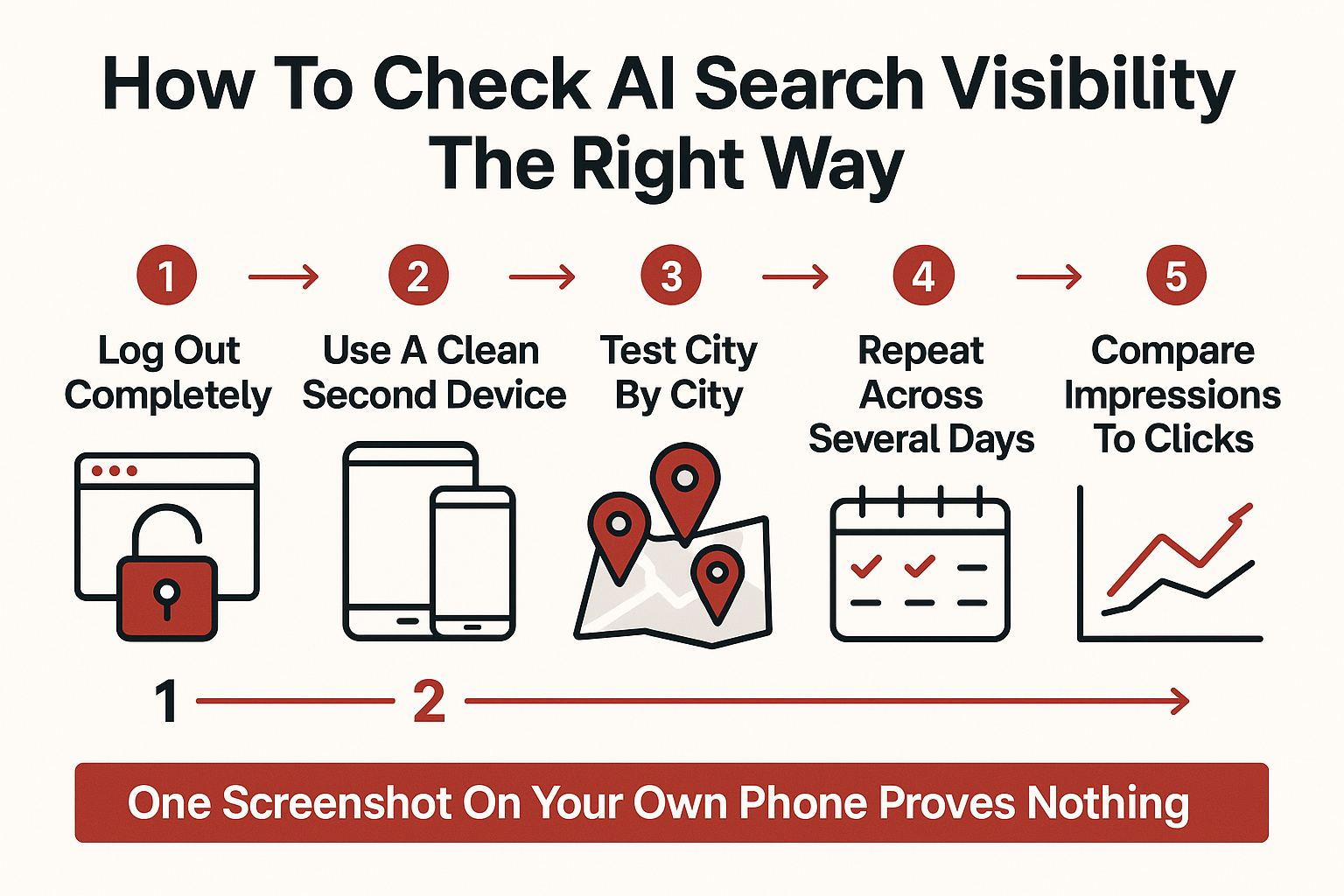
Here is the routine I actually use when I check a client’s market:
- Logged out, in a private window, with no account signed in
- On a second device that has never visited the client’s site
- City by city, phrased the way a homeowner in that city would phrase it
- Repeated across a few days, because single checks are noise
The city-by-city part matters more than people expect. “Water heater replacement Salinas” and the same question asked for Carmel Valley or Hollister can behave nothing alike, because the competitor set and the review depth in each place are different.
There is a second signal worth watching. If your impressions are climbing while clicks stay flat, that usually means an AI answer is sitting above your listing and handling the question before the homeowner ever scrolls. That is not a content failure. It is a placement change, and it calls for a different fix than writing more blog posts.
How to Test Your AI Visibility Without Fooling Yourself
Each of these tests answers a different question, and each has a trap that makes it useless if you skip a step.
| Test method | What it tells you | Trap to avoid |
|---|---|---|
| Logged out, private window | A closer look at what a stranger sees | Staying signed into your Google account |
| Second device, clean history | Whether you show up without prior contact | Using your own work phone |
| City by city phrasing | Which parts of the county you actually cover | Testing only your home city |
| Repeat over several days | Whether a result is stable or noise | Judging from one screenshot |
| Impressions vs clicks trend | Whether an AI answer sits above you | Blaming the content first |
The Checking Routine, Step by Step
This is the sequence I run for a Monterey County contractor before I change anything on the site.
The hedge against personalization is boring consistency
If you cannot control which version of the answer a given homeowner sees, the play is to be the name that holds up across all of them. And there is real evidence behind that.
SOCi’s 2026 local visibility research, as covered by Search Engine Land and Localogy, found that businesses with strong Google rankings but a thin or inconsistent presence everywhere else often dropped out of AI recommendations. Brands with matching, complete information across Google, Yelp, Facebook and their own site were surfaced more often. That same reporting put the average rating of ChatGPT-recommended locations at 4.3 stars.
That is the whole idea behind AI search visibility, which is the system we run on the local SEO side. In plain terms it comes down to:
- Every Google Business Profile field filled out and kept current, not set up once in 2019
- Name, address and phone matched across directories so a machine can verify you are one real company
- Schema markup that states what you do and where you work
- Brand mentions that put your company name in places beyond your own site
None of that is exciting. All of it is verification, and verification is what an AI system needs before it puts your name in front of somebody. I went deeper on the directory side of this in what to check off your site when you are strong on Google but invisible in AI answers.
Reviews gain importance when answers get personalized
I hear the opposite assumption a lot. If a machine is picking, reviews must matter less. The data says otherwise.
BrightLocal’s 2026 research found consumer use of AI tools for local business recommendations jumped to 45%, and that the large majority of those users still cross-check what the AI told them against real reviews before calling. So the AI answer gets you named, and the reviews decide whether the phone rings.
Wording is where most contractors leave money on the table. A wall of “great service, highly recommend” gives a system nothing specific to match against when somebody in Seaside asks a different question than somebody in Watsonville.
Reviews that carry three details do far more work:
- The trade (“tankless water heater install”, not “plumbing work”)
- The city or neighborhood where the job happened
- The job type, including the problem that started it
One review in a set I studied described a tankless unit failing on a Friday night, the company picking up immediately, and a courtesy call a half hour before arrival. That review answers a question a homeowner is actually asking. “Very professional” answers nothing. There is more on this in the review wording that gets a contractor named in AI answers.
Homeowners type sentences now, and keyword tools cannot see them
Conversational AI is good at full sentences, which is exactly how people describe a problem when they are stressed. Nobody types “drain line failure.”
They type something closer to how they would say it out loud:
- “Sewage is backing up into the shower and tub”
- “The toilet is backed up in both bathrooms at the same time”
- “Can I send photos first to get a remote assessment before committing to an on-site visit?”
Not one of those shows up in a keyword tool. But they show up constantly in phone calls and website form submissions, which is why we transcribe and read them instead of guessing.
That is the practical value of call intelligence for a contractor. The questions callers ask before booking become site content, the objections that killed a call get answered on the service page, and the phrasing homeowners use goes into ad headlines and profile posts. I covered this gap between trade language and homeowner language in nobody types hydro jetting into Google at 11 PM.
What not to chase, and who to be skeptical of
There are people selling AI answer hacks on the Central Coast right now. I would let those calls go to voicemail.
Google’s spam policies now cover attempts to manipulate generative AI responses, and Google shipped its third spam update of 2026 in August. Thin “best contractor in Salinas” pages and bulk mention-building carry real downside, and the downside lands on your domain, not the vendor’s.
Google’s own position is that working on visibility in its generative features is still SEO. It is not a separate discipline that needs a new acronym and a new invoice line. Anything sold as a shortcut into an AI answer is either ordinary work with a markup or something that can get you filtered out.
The honest version of this work is slower: complete profiles, matching information everywhere, specific reviews, and content built from real customer questions. That is the same list that worked before AI answers existed, which is the part nobody selling a hack wants to say out loud.
Frequently Asked Questions About Contractor Visibility in AI Search
If AI answers are personalized, is tracking my visibility pointless?
No, but the number you track changes. Instead of one ranking position, you are watching how often you appear across many logged-out checks, devices, and cities. It is a frequency measurement, not a position measurement.
My impressions went up but my calls did not. What happened?
Usually an AI answer is sitting above your listing and satisfying the question before the homeowner scrolls. The page is being seen, just not clicked. That calls for stronger profile and review signals so you get named inside the answer, not more blog posts.
How long before any of this shows up?
On the local SEO side we generally look for a first measurable ranking improvement within about 30 days, though AI answer visibility tends to lag behind ordinary rankings because it depends on information being verified in several places at once. Anyone promising a spot in an AI answer by a specific date is guessing.
What does this kind of work cost for a small contractor here?
It varies a lot with how many cities you serve and how far behind your profiles and reviews are. Monthly local SEO for an owner-operated Central Coast contractor commonly lands somewhere in the several hundred to low four figures range depending on scope, but that is general market context, not a quote. A discovery call is the only way to get a real number for your situation.
Do Yelp and Facebook still matter if my Google profile is strong?
Yes, and the 2026 research points the same direction: strong on Google but thin everywhere else is a common way to fall out of AI recommendations. Matching information across the places a machine can check is the point.
Want a straight read on how you show up across Monterey County?
This is manual, market-specific work, which is why Phil Fisk handles Central Coast contractor accounts himself rather than through account managers, out of Salinas, with nothing outsourced overseas. One client put it this way in a review: “With technology and algorithms constantly changing, it would be impossible for my organization to do it ourselves, but we can count on Phil to stay up to date on ALL of that information for us.” Discovery calls are open if you want to talk through what your own logged-out results look like, and Core6 can be reached at (831) 789-9320.