
Direct Answer: Run the same homeowner question in ChatGPT, Perplexity and Google AI Mode, once per town you serve, in a logged-out session. Log whether you were named, described correctly, and which sources were cited.
Your monthly report says you rank third for your main service in Salinas. Meanwhile a homeowner in Marina types a question into ChatGPT, gets two contractor names back, and neither one is yours.
That gap is real, and most owners have never checked it. Rank trackers read blue links and map positions. They do not read the inside of an AI answer, so nothing in a standard report tells you what an assistant says when someone asks who to call.
This is the hands-on test I run for contractors here in Monterey County, and you can do it yourself in about 15 minutes. I am not explaining why AI picks one contractor over another today. This is the procedure, the log sheet, and how to read what comes back.
Why your rank report can’t see inside an AI answer
A rank tracker checks a position. An AI answer is a paragraph of prose that names one or two businesses and skips everyone else.
Those are two different questions, and a strong answer to the first does not guarantee anything about the second. I have seen a plumbing company sitting in the Salinas map pack get left out of a plain-language ChatGPT recommendation for the same job in the same town.
Google is open about how this works. In its own developer documentation on AI features in Search, Google states that its generative AI experiences are built on the same core ranking and quality systems as regular Search.
So there is no separate AI trick to buy. What there is:
- Accurate, matching business information across every place an assistant can read it
- Proof that you actually work in that town, not just near it
- Reviews with enough detail to be worth quoting
If you want the deeper reasoning behind the picks, I covered that in how ChatGPT decides which plumber or roofer to recommend. Today we are just measuring.
Step 1: Set up a clean test session
This part takes two minutes and it is the step people skip. If you test while logged into your own account, the assistant already knows who you are and what you have searched. You will get a flattering answer that no homeowner would ever see.
Before you type a single prompt:
- Open a private or incognito window, or log out of your account entirely
- Turn web browsing or search on so the assistant pulls live sources instead of memory
- Do not mention your company name in the first prompt of a session
- Start a fresh chat for each town, not one long conversation
That last one matters more than it sounds. Once an assistant names your company in a chat, it tends to keep naming it for the rest of that conversation. You are testing cold answers, not warmed-up ones.
Keep a notepad or a spreadsheet open. You are going to generate a lot of results fast, and none of it counts if you do not write it down.

Step 2: Run three prompt types, because one prompt is not a test
Most owners type their own company name, see a paragraph come back, and decide they are fine. That is the least useful prompt of the three.
Run all three of these, in ChatGPT, Perplexity, and Google’s AI Mode, for each town.
1. The recommendation prompt. Phrase it the way a homeowner would, not the way a contractor would. “Who should I call about sewage backing up into my shower in Salinas?” beats “best sewer lateral contractor Salinas.” Homeowners describe the mess, not the trade term.
2. The brand prompt. Ask the assistant directly about your company by name. You are checking two things: does it know you exist, and are the details right. Wrong service area, wrong trade, dead hours, or a closed location all show up here.
3. The decision prompt. This is the question a homeowner asks before they ever type a company name. “Is it worth repairing a heat pump that quit or should I replace it?” or “How fast do I need a tree looked at after a storm?” Getting named inside a decision answer means you are being treated as the local authority, not just a listing.
Three prompts, three tools, one town. That is nine results per town, and it goes faster than you think.
Step 3: Run it town by town, because this is where the surprises are
Here is the part that catches Central Coast contractors off guard. A service area business can get named consistently for Salinas and vanish completely for Monterey or Carmel.
I have watched it happen with landscapers, roofers, and HVAC companies who cover the whole bay and assume the assistants know that. The assistants do not assume anything. They look for evidence tied to each town.
Run the same three prompts once for each place you actually take jobs:
- Salinas
- Monterey
- Pacific Grove
- Seaside
- Marina
- Carmel and Carmel Valley
- Watsonville
- Hollister
- King City
In every cell of your log, write three notes: were you named, was the description accurate, and which sources did the answer cite.
When you are named in one town and missing in the next, that is almost never a website problem. It is a coverage and evidence problem in the second town. There is nothing out there tying your business to that place, so the assistant has nothing to work with. I wrote more about that pattern in what a service area business profile should actually say.
What a Filled-In Test Grid Looks Like
This is a sample log partway through a test for a service area contractor. Notice how the same company reads strong in one town and disappears two exits up Highway 1.
| Town | Recommendation prompt | Brand prompt | Decision prompt |
|---|---|---|---|
| Salinas | Named 2nd of 3. Trade and hours correct. Cited Google profile and a review site. | Named. Service area listed correctly. Cited own website. | Named as an example. Cited a directory page. |
| Marina | Not named. Two competitors listed. Cited competitor sites and a review site. | Named, but service area listed as Salinas only. | Not named. Cited a national brand page. |
| Monterey | Not named. Cited a review site and a chamber listing. | Named. Wrong trade description. | Not named. |
| Watsonville | Named 1st. Description accurate. Cited Google profile and two reviews. | Named. All details correct. | Named with a direct review quote. |
| King City | Not named. Answer said it found limited local options. | Named. No service area mentioned at all. | Not named. |
The Three Prompt Test at a Glance
Here is the full test in one view, from setup through grading, so you can keep it beside you while you work through your towns.
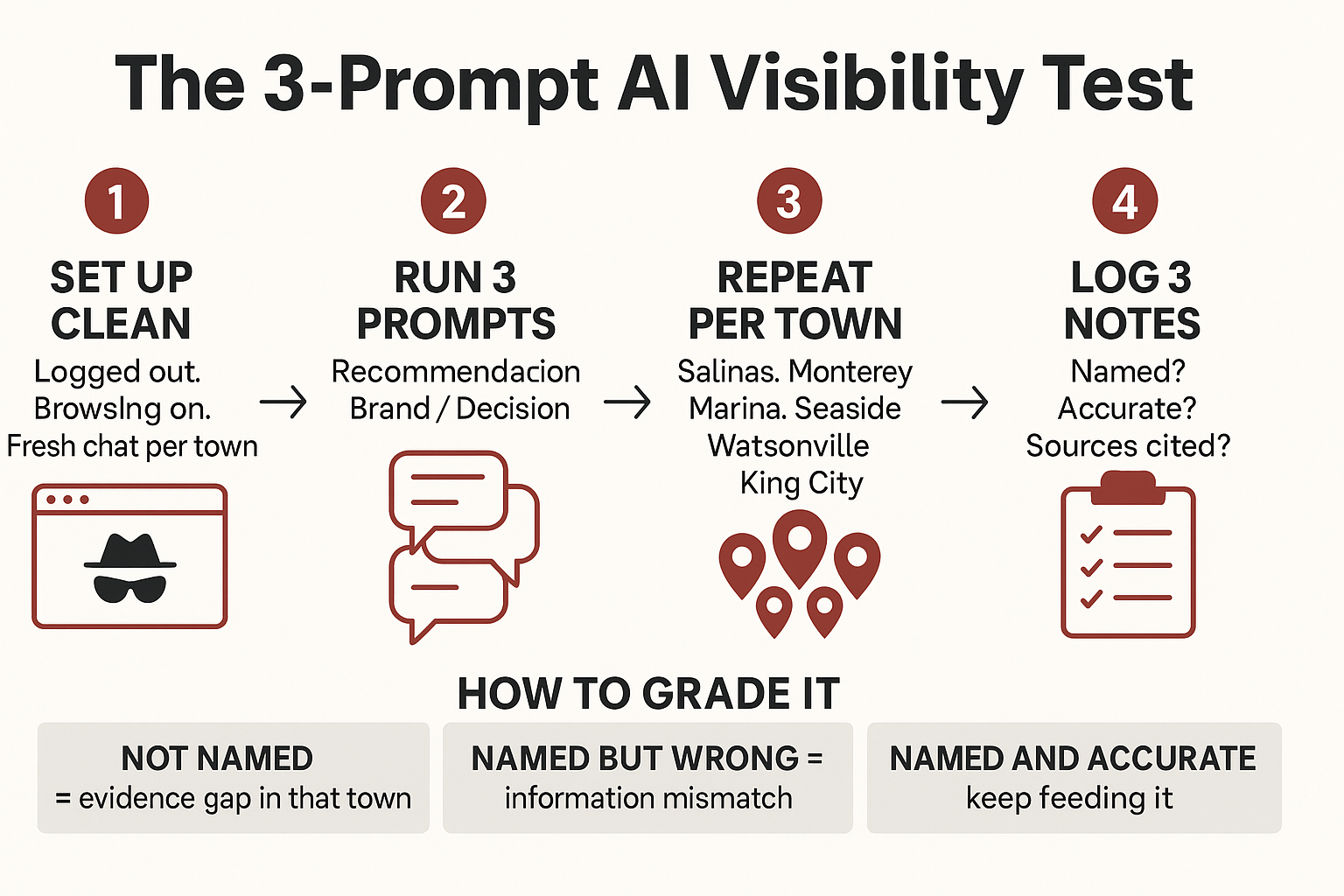
Step 4: Grade the answer instead of celebrating the name drop
Getting listed is the low bar. Getting described in a way that makes a homeowner pick up the phone is the real result.
When you read each answer, grade it on four things:
- Right trade. Does it say what you actually do, or a close cousin?
- Right service area. Does it cover the town the prompt asked about?
- Right type of work. Emergency repair, planned replacement, inspections, whatever your money jobs are.
- Reasonable hours and contact info. After-hours availability is a deciding factor for plumbing, HVAC, and tree work.
Now look at the sources listed under the answer. Honestly, that is the most useful part of the whole exercise. Those citations show you exactly which profiles, review pages, and directory listings the assistant trusted for that specific town.
If the service area or the services come back wrong, that traces to business information that does not match across your Google Business Profile, Maps, Yelp, Facebook, and your own site. That consistency work is the backbone of AI Search Sync, and I broke the checklist down in what to check when you are strong on Google but invisible in AI answers.
What to do when a town comes back blank
Most owners running this for the first time find at least one town where they simply do not exist. That is normal, and it is fixable.
Industry research through 2026 keeps pointing the same direction. Businesses with strong Google rankings but thin or conflicting presence on other trusted platforms tend to lose ground in AI recommendations, and the businesses these tools recommend skew toward higher review ratings.
Consumer behavior moved fast too. BrightLocal’s research found use of AI tools for local business recommendations jumped from 6 percent in 2025 to 45 percent in 2026, with ChatGPT the most used, and the large majority of those people go verify the recommendation against real reviews before they call.
So a blank cell is a data and proof problem, not a reason to buy a shortcut. The work is unglamorous:
- Make your service area match everywhere it is published
- Build real evidence of jobs in that town
- Get reviews from customers who live there
- Keep your profile active instead of letting it sit
Different assistants weigh those signals a little differently, which is why I have readers test more than one. Perplexity’s approach leans harder on citable sources than ChatGPT does.
The one lever you can pull this month: review language
Of everything on that fix list, reviews are the piece you can move fastest, and most contractors are asking for them wrong.
A review that says “great service, highly recommend” gives an assistant nothing to quote. A review that names the trade, the town, the job type, and the timing gives it raw material.
Here is a real review left for a Central Coast trade business, anonymized, and it is a good model for what to ask for:
> “Our tankless hot water heater broke down on a Friday night. I called and they picked up immediately… They showed up exactly when they said they would, and even gave a courtesy call a half hour before.”
Count what that one review hands over. The equipment, the timing, the response speed, the follow-through, and the outcome. An AI answer can repeat any of that.
So when you ask for a review, ask for the story. What broke, what town, how fast did we get there, what did we do. Most homeowners are happy to write it if you tell them what helps. Your profile is feeding these systems directly now, which I covered in why your Google Business Profile is an AI feed.
Where your test prompts should actually come from
One catch with this whole exercise: your prompts are only as good as your guess about how homeowners phrase things. And contractors guess in trade language almost every time.
The better source is your own phone. Call tracking with recording and transcription surfaces the top questions callers ask and the objections that killed the calls you lost. Core6 Clarity reports that back every month.
Once you have that, your test prompts stop being invented. They become the exact wording a homeowner in Salinas or Watsonville used last Tuesday before they booked somebody. That is a much sharper test, and the fixes it points to are the ones that change your call volume.
Frequently Asked Questions About Testing AI Visibility
How often should I re-run this test?
Once a quarter is plenty for most contractors. Run it sooner if you change your service area, move locations, or finish a push on reviews, since those are the changes most likely to move an answer.
Does it count if ChatGPT names my company only when I ask about it by name?
No. That is the brand prompt, and it only proves the assistant has heard of you. Homeowners do not type your name before they know you exist. The recommendation prompt is the one that matters for new work.
Why do I get a different answer than my wife does on the same question?
Account history, location, and session context all shape the response. That is exactly why the test has to run logged out in a fresh window. Two people asking the same thing can absolutely get two different contractor names.
I got named in Salinas but not Monterey. Is my website broken?
Usually not. A gap like that is almost always a coverage and evidence problem in the second town. There is nothing tying your business to Monterey in the sources the assistant trusts, so it reaches for a company that does have that evidence.
How long before fixes show up in AI answers?
It varies by how stale the underlying sources are. Profile and listing corrections tend to surface faster than review-driven changes, since reviews have to accumulate before they carry weight. Plan in months, not days.
Want a second set of eyes on your town-by-town results?
If you run this test across Monterey County and come back with blanks you cannot explain, that city-by-city check is something we walk through on a discovery call with Phil Fisk. We are based in Salinas and have spent more than twenty years on this specific market, so the towns on your log sheet are ones we know. Calendar link and phone are on the site whenever it is useful.