
Direct Answer: Yes. Google still drives most calls, but AI tools cross-check Yelp, Facebook and your website before naming a contractor. Stale or conflicting profiles can quietly remove you from consideration.
I get some version of this question almost every week from owners in Salinas, Monterey and Watsonville. The Google Business Profile is humming along and the phone rings. The Yelp page has eleven reviews, the newest one from 2019, and nobody has logged into the Facebook page since a crew guy set it up years ago.
The question underneath it is fair: is claiming and cleaning up profiles you never look at worth an hour of your week? For a long stretch, my honest answer was no. Put everything into Google and ignore the rest.
That answer changed somewhere between 2024 and now, and not because Yelp got more popular. It changed because AI tools started checking multiple sources before they name anybody, and a thin or contradictory profile has become a reason to skip you.
The short answer, and why it flipped
Yes, Yelp and Facebook still matter, but not for the reason most owners assume. They are not going to send you a pile of leads. They are verification pages.
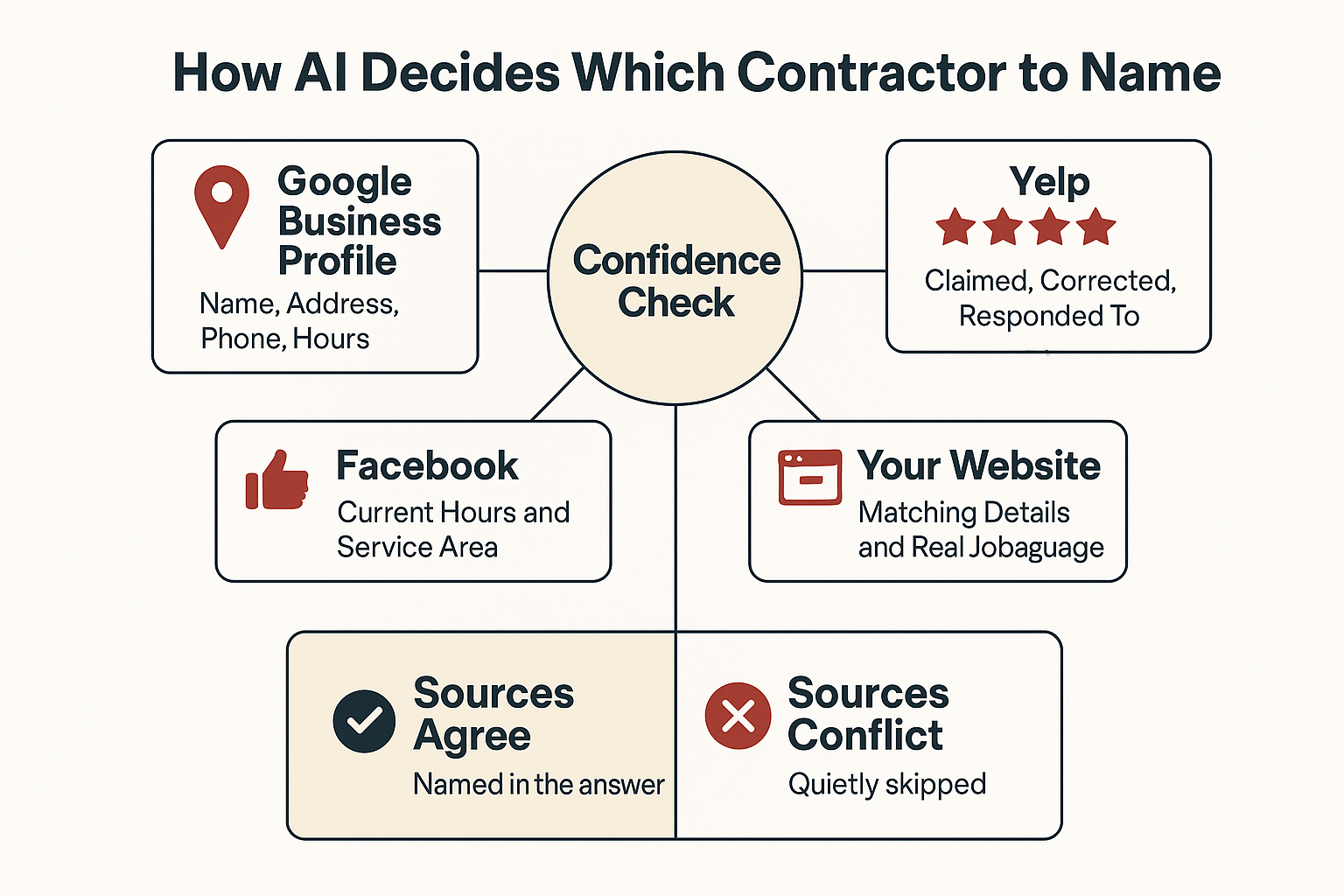
AI recommendation systems do not work like a ranking list where the strongest page wins. They behave more like a confidence check. The system gathers what it can find about your company across Google Maps, Yelp, Facebook, and your own site, and looks for agreement.
When the sources agree, you are a safe name to hand a homeowner. When they disagree, you are a risk, and the system just names somebody else.
That is the shift. In 2020, an abandoned Yelp page was dead weight. In 2026, it is a source of contradiction sitting in public where an answer engine can read it.
I want to be clear about something. None of this means Google matters less. Your Google profile is still where most of your calls come from, and it should still get most of your attention. The other platforms are supporting evidence, and supporting evidence only counts when it is accurate.
Far fewer contractors get named in an AI answer than in a map pack
This is the part that reframes the whole question. SOCi’s 2026 local visibility research, covered by Search Engine Land and Localogy, looked at how often businesses actually surface in AI recommendations versus traditional local search.
A few numbers worth sitting with:
- 35.9 percent of the locations studied appeared in Google’s 3-pack
- Only about 1.2 percent were named by ChatGPT
- Locations ChatGPT recommended averaged 4.3 stars
- Businesses with strong Google rankings but a thinner or conflicting presence elsewhere often lost out in AI recommendations
A map pack has room for three. An AI answer usually has room for one or two, and it often hands back a single name with a short reason attached.
So the competition is tighter by a wide margin. When the shortlist is that short, anything that creates doubt about who you are is enough to drop you. Not a penalty, not a ranking hit. You just do not come up.
I have written before about the two things that separate contractors AI recommends from contractors it skips, and consistency across sources is one of them every single time.

What conflicting information actually looks like on the Central Coast
When I say conflicting information, owners picture something dramatic. It is almost never dramatic. It is boring, small, and years old.
Here is what I actually find when I audit a Monterey County trade business:
- An old Salinas address on a Yelp page from before the shop moved off North Main
- A disconnected tracking number from a call line some agency set up in 2021 and never removed
- A Facebook page still listing service hours that ended two years ago
- The business name written three different ways across Monterey, Watsonville and Hollister directory listings, sometimes with “Inc,” sometimes with “& Sons,” sometimes neither
- A service area that says Monterey Peninsula on one profile and “Salinas Valley only” on another
None of that costs you a Google ranking. It costs you the confidence check.
This is the citation and business data side of AI search visibility, and I will be honest, it is unglamorous cleanup work. Nobody has ever called me excited about fixing a directory listing.
But it is the part that decides whether a system can verify your company is real and operating where you say it operates. If you want the mechanics of it, I broke that down in what to check when you’re strong on Google but invisible in AI answers.
How an AI Answer Builds Confidence in a Contractor
This is the mental model I use when explaining to owners why a quiet Yelp page still shows up in the decision.
Star count and review content do two different jobs
Owners track their star average. Almost nobody tracks what the reviews actually say, and the words are doing the heavier lifting.
A 4.8 or 4.9 average tells a system you are trusted. That is a trust signal, and it clears a bar. The SOCi data showing AI-recommended locations averaging 4.3 stars suggests there is a floor somewhere below which you stop getting named.
But a star rating does not connect you to a trade, a city, or a job type. The language inside the review does that.
Compare two reviews. One says “great job, highly recommend.” The other, from a real customer of a Central Coast utility contractor, reads:
> “Not only did they fix my sewer issue, but they also charged me a fraction of what the other company wanted. I truly appreciate their honesty.”
That second one names the problem (sewer), the comparison the homeowner made (another company’s quote), and the trait they valued (honesty). A generic five-star review supplies none of that.
A review that mentions replacing a storm drain in Prunedale gives a system something to work with when a Prunedale homeowner asks about drainage. “Great job” gives it nothing. I went deeper on this in the review wording that gets a contractor named in AI answers.
What each platform is actually for in 2026
Here is how I tell owners to think about the split so they stop spreading effort evenly across four platforms that do not deserve equal effort.
| Platform | Its real job now | How much time it deserves |
|---|---|---|
| Google Business Profile | Primary lead source and the main data record AI systems read | Most of it. Monthly updates, ongoing review flow, photos |
| Yelp | Verification page and a second stop for homeowners checking an AI recommendation | Claim it, fix the details, respond to reviews. No asking for reviews |
| Confirms you are still operating, with current hours and service area | One cleanup pass, then a check every few months | |
| Your own website | The source that explains what you do and where, in your customers’ words | Steady. This is where job type and city language lives |
The homeowner opens a second tab
Here is the piece that surprised me most. AI is not replacing reviews. It is creating a second look at them.
BrightLocal’s 2026 consumer research found consumer use of AI tools for local business recommendations jumped from 6 percent in 2025 to 45 percent in 2026. And of those AI users:
- 97 percent at least sometimes verify AI recommendations against real reviews
- 88 percent fact-check the reviews an AI tool cites
So the sequence is not what most owners picture. An AI tool produces one or two names, and then the homeowner opens a second tab to check them.
Think about a Carmel homeowner weighing a roof replacement that can easily run past $10,000 depending on the material, the pitch and the condition of the deck. That person is going to look. Of course they are.
And what they find matters. A Yelp page with three reviews from seven years ago and an address the business left behind reads like a company that may not still be around. You did not lose that job on price. You lost it on a page you forgot existed.
That is also why your Google Business Profile now works more like a live feed than a listing. Everything public is being read by both the machine and the homeowner.
What I’d actually do with that hour
You do not need to be active everywhere. You need to be accurate in two or three places your customers already use.
The practical version:
- Pick your two or three platforms. For most Monterey County trades that is Google, Yelp and Facebook, plus your own site
- Match the name, address, phone and service area exactly across all of them, down to punctuation and suite numbers
- Kill any old tracking numbers that no longer forward anywhere
- Keep your review flow pointed at Google as the primary profile
- Treat Yelp and Facebook as pages that need to be correct, not active
On Yelp specifically, the platform discourages businesses from asking customers for reviews. So the work there is claiming, correcting and responding, not soliciting.
And honestly, responding to an old critical review is usually more valuable than chasing a new positive one. A thoughtful reply from the owner on a three-year-old complaint tells a reader far more than another five stars.
One more thing, because someone always asks. Buying reviews does not work, and neither does paying a vendor to seed mentions across low-quality directories. Google’s spam policies treat that kind of thing as manipulation, and cleaning up after it takes longer than doing it right the first time.
Frequently Asked Questions About Contractor Reviews on Yelp and Facebook
My Yelp page has bad reviews and I never use it. Should I just delete it?
You generally cannot delete it, and trying to ignore it does not make it invisible to an AI tool or a homeowner. Claim it, correct the business details, and reply to the critical reviews like a professional. An owner response on an old complaint often does more for you than a new five-star review does.
Can I just ask my happy customers to post on Yelp too?
Yelp discourages businesses from soliciting reviews, so I do not recommend it. Keep asking for Google reviews, since that is your primary profile, and let Yelp stay accurate rather than active.
How many reviews do I need before AI tools start naming my company?
There is no published number, and anybody who gives you one is guessing. What the research does suggest is that rating matters as a floor, with AI-recommended locations in one 2026 study averaging 4.3 stars. Beyond that, the detail in the reviews, the job types and cities mentioned, does more work than the raw count.
How long does it take to clean up conflicting listings?
The work itself is not long, but directories update on their own schedules. Some changes show up in days, others take a few weeks to propagate. It is worth doing once and then checking once or twice a year, especially if you ever move shops or change phone numbers.
Does any of this help if I am already ranking well in the Google map pack?
It can. The SOCi 2026 data found plenty of businesses with strong Google rankings that still lost out in AI recommendations because their presence elsewhere was thin or contradictory. Strong on Google is the starting point, not the finish line.
Want a second set of eyes on how you show up outside of Google?
We have been working with Central Coast contractors out of Salinas for more than 20 years, veteran owned, with nothing outsourced overseas. Phil Fisk keeps a small roster and handles these accounts himself, so if you want someone to look at how your business reads across Yelp, Facebook and the directories covering Monterey County, a 30 minute discovery call is available. You can also reach the office at (831) 789-9320.