
Direct Answer: Buying marketing one service at a time leaves gaps between getting found, getting called, and getting booked. One program that covers all three is easier to judge by booked jobs.
You bought SEO from one company a couple of years back. Ads from somebody else after that. Maybe a new website in between. And you still can’t say which one of them put a crew on a job in Marina last month.
I hear a version of that most weeks from owners in Salinas, Monterey, and Hollister. Here’s my position, plainly: buying marketing one line item at a time is how the gaps form, and the gaps are where your jobs quietly go to your competitor.
This isn’t an argument for spending more. It’s an argument for buying an outcome instead of a channel. Below I’ll walk through where the menu approach breaks down in 2027, why being visible is only about half the job, and what questions actually tell you whether a marketing setup is working.
Why a menu of services leaves gaps now
Search split. Buyers in Monterey County still open Google and tap the map. A growing share of them also ask an AI assistant who to call and work off the two or three names it gives them.
That split is a problem for anyone buying marketing by the item. “SEO” from one vendor might mean blog posts and nothing else. “Ads” from another might run fine while the Google Business Profile sits half empty and the newest review is from 2023.
Here’s what I see fall through the cracks when the work is split up or bought piecemeal:
- Google Business Profile goes stale because nobody was hired to own it
- Reviews stop coming in, so the map pack and AI tools both lose their best evidence about you
- Service area pages exist for Salinas but not for Seaside, Carmel, or Gonzales
- Ads send traffic to a page that was never built to take a call
- Nobody tracks the phone, so every report is about clicks
AI tools recommend the company they understand best, and understanding comes from consistent signals across all of that, not one of it. I wrote more about that pattern in why AI gives out one or two contractor names. The short version: partial coverage reads as a partial business.

Getting found is only half of it
This is the part that gets the least attention and costs the most money. Plenty of contractors I talk to already get enough calls. They just lose too many of them.
Four moments decide whether a lead turns into a signed job:
- The first response. A callback at 4:30 for a 9:15 missed call is usually a lost job.
- The buyer’s questions. The same three or four come up on nearly every call in a given trade.
- The price conversation. How the number gets framed changes the answer more than the number does.
- The follow-up. Most estimates get one touch and then silence.
Fixing lead handling is usually the fastest growth available to an established contractor, because the demand is already there. You don’t have to rank for anything new. You just have to stop giving jobs away between the phone and the estimate.
A menu almost never includes this. You can buy visibility from a hundred vendors. Very few of them will tell you that your intake, not your rankings, is the bottleneck. And it’s also why cost per lead is the wrong number to judge marketing by. Cheap leads you don’t book aren’t cheap.
What each single service covers, and what it misses
Here’s how the gaps usually shake out when a contractor buys one piece at a time. None of these are bad buys. They’re just incomplete on their own.
| What you bought | What it covers | The gap it usually leaves |
|---|---|---|
| Local SEO only | Rankings, content, citations | No ad coverage for urgent jobs, no read on what happens after the call |
| Google Ads only | Immediate traffic for high-intent searches | Spend stops, calls stop. Nothing compounds, and organic stays flat |
| A new website only | A site that looks right | No ongoing search work, so traffic plateaus a few months after launch |
| Review requests only | More stars, better map signals | Visitors still land on a slow site and bounce before calling |
| Social posting only | Brand presence | Very little high-intent demand. Buyers searching for your trade never see it |
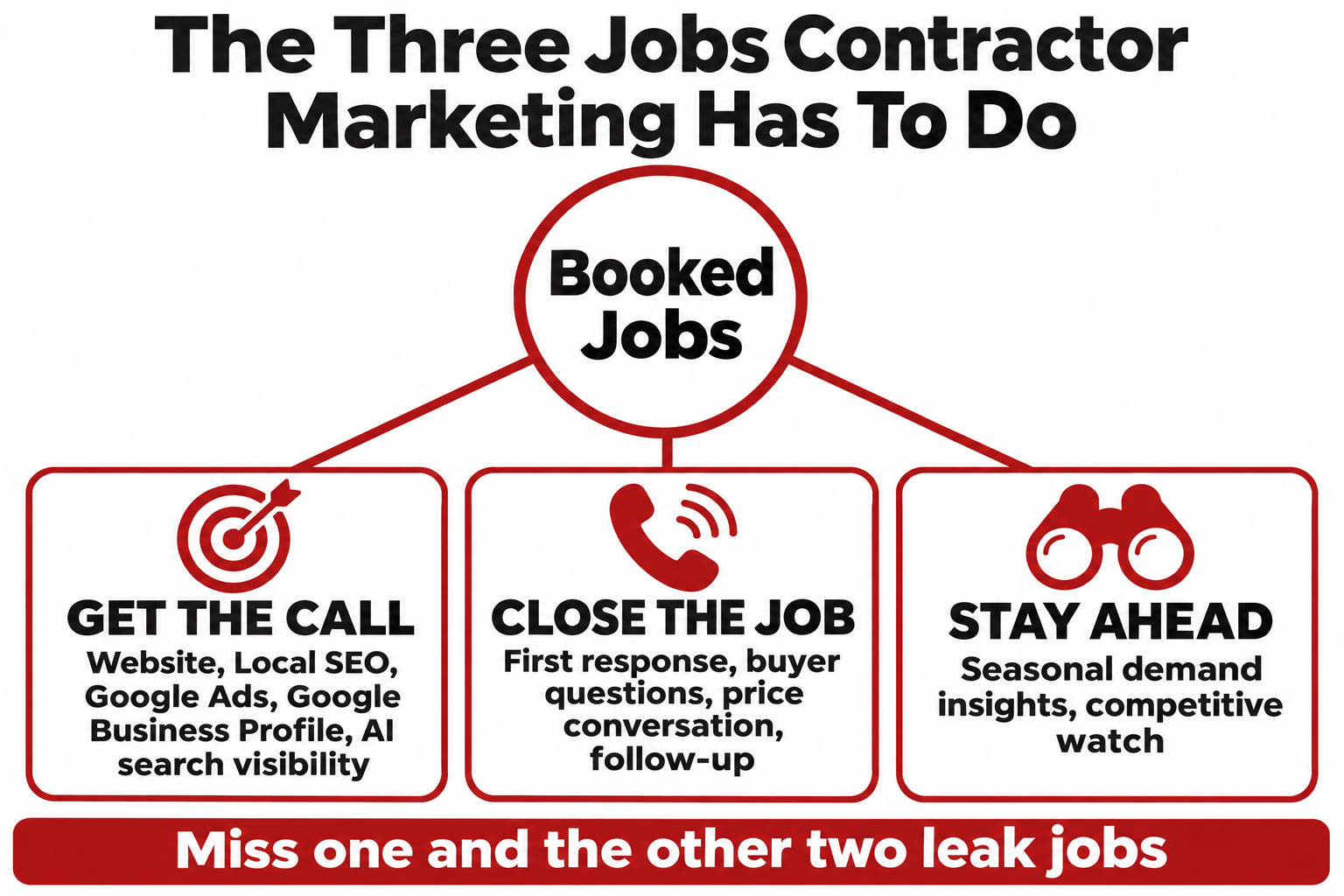
The three jobs your marketing has to do
Everything a contractor buys in marketing falls into one of three buckets. Problems show up when one of them is missing.
Seasons move faster than most Monterey County marketing plans
Work on the Central Coast runs on a calendar. Roofing and drainage calls spike with the first real rain. Landscaping and hardscape bids build through spring. Remodels in Carmel and Pebble Beach often get planned around the shoulder seasons when homeowners aren’t hosting.
The Bureau of Labor Statistics tracks construction employment for the Salinas metro area month by month in its Economy at a Glance data, and the seasonal shape is right there in the numbers. You already feel it in your schedule.
The trouble with buying marketing by the item is that nobody is watching the calendar on your behalf. An ads vendor runs the same campaign in November that they ran in July. An SEO vendor publishes a post about summer maintenance in October because it was next on a list.
Content and ads for a season need to be live 60 to 90 days before demand peaks, because rankings don’t move the week you need them. Planning that far out requires someone looking at your market, not just your account.
What I’d actually ask before signing anything
Whether you work with us or anyone else, these are the questions that separate a program from a line item. I’d ask every one of them.
- Am I locked in? Month to month is reasonable. Long contracts usually protect the agency, not you.
- Is there a setup fee? A one-time setup fee is reasonable when it is stated up front and you know what it covers.
- Do I own the website, the domain, and the ad account? If the answer is fuzzy, read who keeps the website and ad account when you leave before you sign.
- Will you work with my competitor? Ask directly. One company per trade in a service area is a real commitment and worth confirming.
- Who does the work, and where? Outsourced content and offshore builds are common, and they’re usually why the writing sounds like nobody who’s been to Salinas wrote it.
- What are you reporting on? Traffic is a step. Booked jobs are the number.
On cost, I’ll stay honest. Monthly pricing depends on how many service areas and service lines you want to grow and whether ads are part of the plan, so I won’t throw a number at you here. You can see a general range on the pricing page. A new site is a separate one-time project that starts at $3,500, and you own it outright. If you want more context on how search pricing gets set generally, what a contractor should pay for local SEO breaks down the factors.
Frequently Asked Questions About Buying Contractor Marketing as One Program
Can I just run a Google Ads campaign and nothing else?
People ask us this constantly, and it’s a fair question. Ads alone can work for a short seasonal push or a brand new service area. But the day you stop paying, the calls stop, and you’ve built nothing that keeps earning. Ads do their best work alongside a site and a profile that are already pulling their weight.
Do I have to rebuild my website to improve my rankings?
Not always. Some sites need a tune-up and tracking, not a teardown. The honest test is whether the site loads fast on a phone, has real pages for the cities you serve, and makes calling obvious. If it does, a rebuild is probably not where your money should go first. Here’s what happens to your rankings when you rebuild if you do go that route.
How long before I see anything move?
Most clients see their first measurable ranking gain within 30 days. That’s typical, not a guarantee, and a first ranking gain is not the same as a full schedule. Real compounding usually shows up over several months as content, reviews, and profile activity stack up.
What if my competitor already works with the same agency?
Then you’re both paying for the same insight, and only one of you can rank first. Ask any agency flat out whether they take more than one company per trade in your area. We don’t, and exclusivity holds for as long as you’re a client.
Is any of this different if I’m commercial instead of residential?
The channels are similar, but the weighting changes. Commercial buyers in Monterey County research longer, compare more, and often find you through an AI answer or a referral check rather than a map tap. Review depth and clear service area information matter even more there.
Thinking through your own setup?
If you’re an owner in Monterey County trying to figure out where your marketing has gaps, a 30-minute strategy session with Phil Fisk’s team covers where your leads come from, where they are being missed, and whether your territory is open. You can request a market review or reach us at (831) 789-9320 during the week. You’ll leave with a clearer picture either way.