
Direct Answer: California SB 1050 takes effect January 1, 2027. If your ad prominently features an AI generated synthetic performer, including an AI voiceover, it needs a clear and conspicuous disclosure in California.
If you made a video ad in the last year using one of those apps that reads your script in a smooth voice you never hired, California just changed the rules on you. SB 1050 takes effect January 1, 2027, and it covers more Salinas and Monterey contractors than most owners realize.
Most owners I talk to assume this is a Hollywood and national brand problem. It is not. The law reaches anyone who creates and causes an ad to be published through an advertising medium, including online platforms and digital ad networks, which is exactly what a YouTube pre-roll or a Facebook video ad is.
Here is my position, and I will back it up below. For a local trade on the Central Coast, the right move is not writing a disclaimer and moving on. It is auditing what is already running, then replacing the synthetic voice with your own, because your real voice and real job footage already outperform a fake spokesperson in this market.
What California’s AI ad disclosure law actually says
On September 16, 2026, Governor Newsom signed SB 1050 (Ashby) into law. It adds Section 17610 to the California Business and Professions Code and takes effect January 1, 2027. California is the second state in the nation to require this, after New York.
The core of it: if an advertisement prominently features an AI generated synthetic performer, it needs a clear and conspicuous disclosure. An AI voiceover counts as a synthetic performer. There does not have to be a face on screen.
A few details that matter for a contractor:
- It covers both audio-visual and audio-only ads, so a streaming radio spot is in play
- It applies broadly across advertising media, including online platforms and digital ad networks
- It reaches all covered ads that air or are otherwise disseminated in California, including nationally syndicated advertisements
- The disclosure uses prescribed language, so this is not wording you invent yourself
- Advertisers and agencies are expected to identify synthetic performers, keep records, and get the disclosure in place before the date
The law firm Morgan Lewis published a clear breakdown of the change, and Davis+Gilbert covered it as well. I am not an attorney and this is not legal advice. Read the statute with yours before you finalize anything.
The consequence, in plain terms
Skip the disclosure and the ad can be treated as false advertising, which carries unfair competition exposure. That is the part that should get an owner’s attention, because it is not a slap on the wrist from an ad platform. It is a legal category you do not want your company name attached to in Monterey County.
I am not going to put a dollar figure on it, because the real cost for a local contractor is rarely a penalty number. It is the time and the headache, plus a competitor down the road who now has something to point at.
Note the date, too. January 1, 2027 is the same day California’s sales tax change on software subscriptions kicks in. If you are already reviewing your software line items for that, handle your ad library in the same sitting.

Where AI voices hide in a contractor’s ad account
This is the part owners get wrong. They think, “I never hired an AI spokesperson,” and they stop looking. But synthetic voices sneak into ad accounts in ways nobody signed off on.
Places I would check first:
- YouTube pre-roll made in a video app where you typed a script and picked a voice from a dropdown
- Talking avatar videos, the ones with a person who looks almost real reading your service list
- Auto-generated video assets inside Performance Max campaigns, which can stitch together footage and narration without you reviewing it
- Streaming audio spots on Spotify or Pandora, since audio-only ads are covered too
- Reels and short-form ads a social vendor produced for you with narration you never recorded
That Performance Max item trips up more contractors than any of the others. If you have not looked at how search ads and Performance Max split your budget, you may not know what video assets Google built on your behalf.
And you cannot audit what you cannot open. If a past vendor still holds the login, start there, because who owns your website and ad account decides whether this is a two hour job or a two week one.
What to check in your ads before January 1
A quick reference for the ad formats most Central Coast trades are actually running. Scope calls are for your attorney, not me, but this is the triage order I would use.
| Ad element | Likely in scope? | What I would do before January 1 |
|---|---|---|
| Text-only Google search ad | No synthetic performer involved | Leave it. Spend your time on video and audio. |
| YouTube video with an app-generated voiceover | Yes, voiceover counts | Re-record in your own voice or add the prescribed disclosure. |
| AI avatar spokesperson on camera | Yes, this is the clearest case | Replace with you, a crew member, or a real customer. |
| Performance Max auto-built video asset | Possibly, depends on the narration | Open the asset, listen to it, turn off what you did not approve. |
| Streaming audio spot with a synthetic read | Yes, audio-only ads are covered | Record it yourself or disclose it properly. |
| Still-image ad with your own job photos | No performer, synthetic or otherwise | No action. This is the safest format you own. |
A five step check before the deadline
This is the order I would run it in, and it fits in one afternoon for most owner-operated shops.
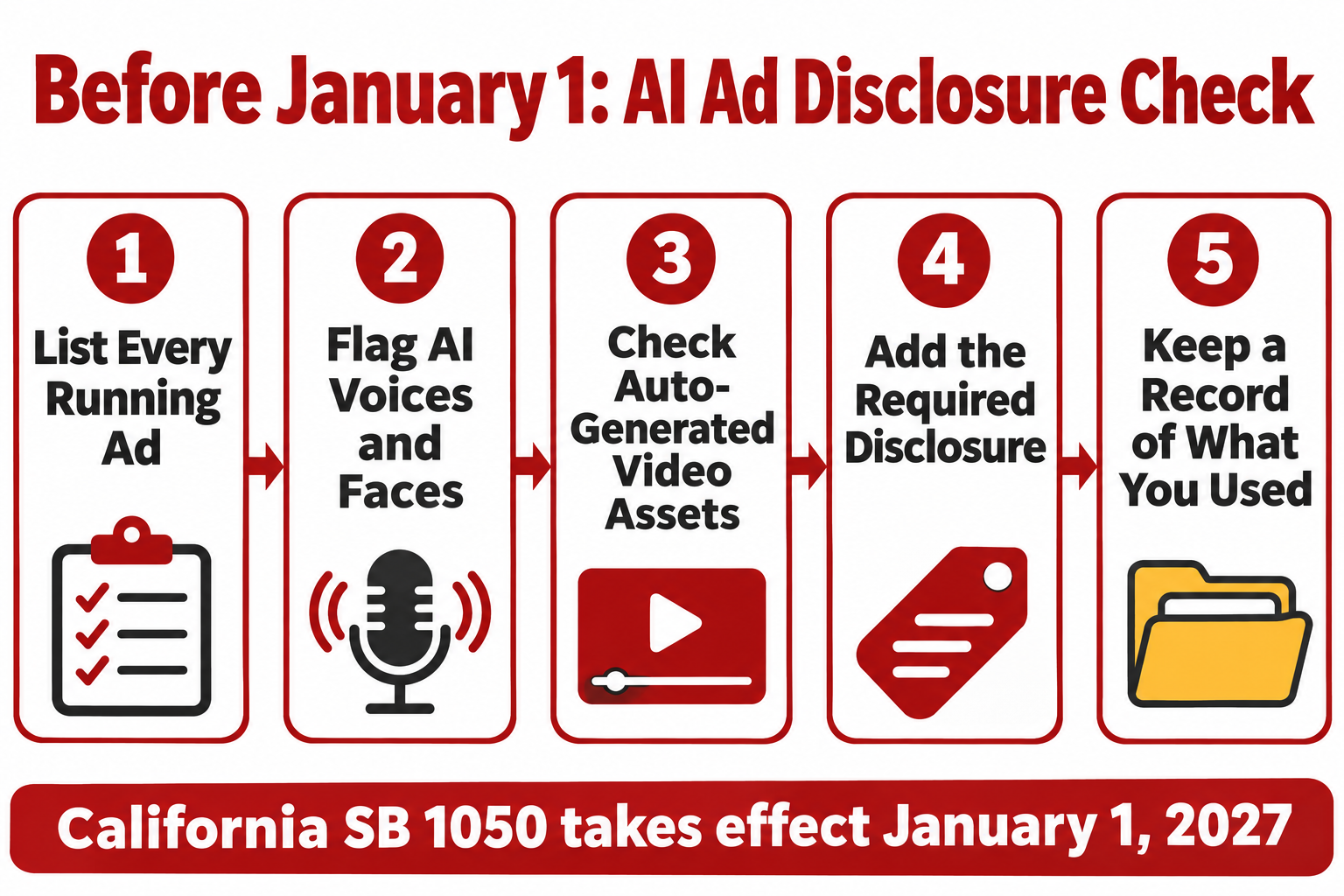
My take: the disclosure is the floor, not the plan
You can comply with this law and still run a weak ad. A disclosure on a synthetic spokesperson tells a homeowner in Seaside or Marina that the person selling them a roof is not a person at all. That is a strange first impression for a trade built on trust.
In this market, the ads that book jobs look like the work. A thirty second clip of your crew on a Carmel Valley driveway pour, shot on a phone, with you explaining what you are doing, beats a polished avatar every time.
Three reasons I keep landing on that:
- Nobody else has your footage. Your competitor can buy the same AI voice. He cannot buy the job you finished last Tuesday in Hollister.
- It is already paid for. The job photos sitting on your phone are content your competitors cannot copy.
- Buyers are getting sharp about this. The same people who complain about AI slop online are the ones scrolling past your ad.
If your web pages read like they were machine-made too, that is a separate problem worth running the AI slop test on while you are in cleanup mode.
So the honest recommendation: handle the disclosure where you genuinely need a synthetic voice, and get off synthetic voices everywhere else. One exception. If you have a video ad performing well and no time to reshoot before January, disclose it properly and reshoot in Q1.
Frequently Asked Questions About the California AI Ad Disclosure Law
I only run text search ads on Google. Does SB 1050 affect me?
A plain text search ad has no performer in it, synthetic or human, so it is not the target of this law. The thing to double check is whether any of your campaigns are also serving video or audio assets you did not personally review.
The AI voice is reading my own script. Does that make it okay?
The script is not what the law is looking at. It is looking at the performer, and an AI generated voice is a synthetic performer even when the words are yours.
My ads run in Monterey County but also in Gilroy and sometimes outside California. What then?
The law covers advertisements that air or are otherwise disseminated in California, including nationally syndicated advertisements. If California eyes and ears see or hear it, plan around it.
Can I just write my own disclaimer at the bottom of the video?
No. SB 1050 calls for a clear and conspicuous disclosure using prescribed language, so this is one of the few marketing tasks where you follow the statute word for word instead of writing your own version. Have your attorney confirm the exact wording and placement.
What is the simplest way for a small shop to get clear of this?
Stop using synthetic voices and avatars in your ads. Record the voiceover yourself on your phone in the truck. It takes about ten minutes, it sounds like the company homeowners are actually hiring, and there is nothing to disclose.
Who is responsible if my marketing vendor built the ad?
The law reaches those who create and cause an advertisement to be published through an advertising medium, which can pull in both the advertiser and the agency. Either way, it is your company name on the ad, so ask your vendor in writing what is running and whether any of it uses a synthetic performer.
Looking at your ads before January 1?
If you are a contractor in Salinas, Monterey, or anywhere else on the Central Coast and you are not sure what is running in your own ad accounts, a 30-minute strategy session with Phil Fisk’s team will give you a straight read on your market and where demand is coming from. You can request a market review or reach us at (831) 789-9320, Monday to Friday. We work with one company per trade in each service area, so availability depends on the territory.