
Direct Answer: There is no flat rate. A monthly local SEO number is set by how many cities you target, how competitive your trade is locally, how many services you push, and whether ads are part of the plan.
If you have been asked to price out local SEO for the company, you already found the problem. Almost nobody in this business publishes a number.
I watched this play out again last fall. An office manager at a Salinas trades company had three proposals on her desk, two of them with no itemized scope at all, and she had to walk into the owner’s office and explain the difference in one sentence. She could not, because the proposals did not give her anything to compare.
So this is not a price list. This is what a real quote is made of, so you can lay two of them side by side and see which one is actually bigger. I will cover the four things that move the monthly number, the deliverable list to demand in writing, why ad spend is a separate column, and what to measure at 30, 90, and 180 days.
Why You Cannot Find a Straight Answer on What SEO Costs
When we looked at who holds the map positions for contractor marketing in the Monterey and Salinas area, and in San Jose, none of them publish pricing. You have to book a call to find out anything.
The national agencies are a little more open. The ones that do publish contractor packages tend to show a spread that runs from the low thousands a month up past ten thousand, which is a wide enough range to be useless when you are trying to budget.
There are two honest reasons for the silence, and one dishonest one.
- The work genuinely scales with the market. Ranking in Gonzales is not the same job as ranking in Monterey.
- Scope varies more than price does. Two companies can charge the same and deliver completely different work.
- Some shops price by what they think you will pay. That one is on them, and it is why you vet before the owner hears a number.
The good news is the number is not mysterious once you know what it is built from. Think of it the way you think of a bid. Nobody quotes a re-pipe without knowing the square footage, the fixture count, and whether the slab is involved. Marketing pricing works the same way, and anyone who gives you a flat number before asking about your service area is guessing.
Scope Is the Price: The Four Things That Move the Monthly Number
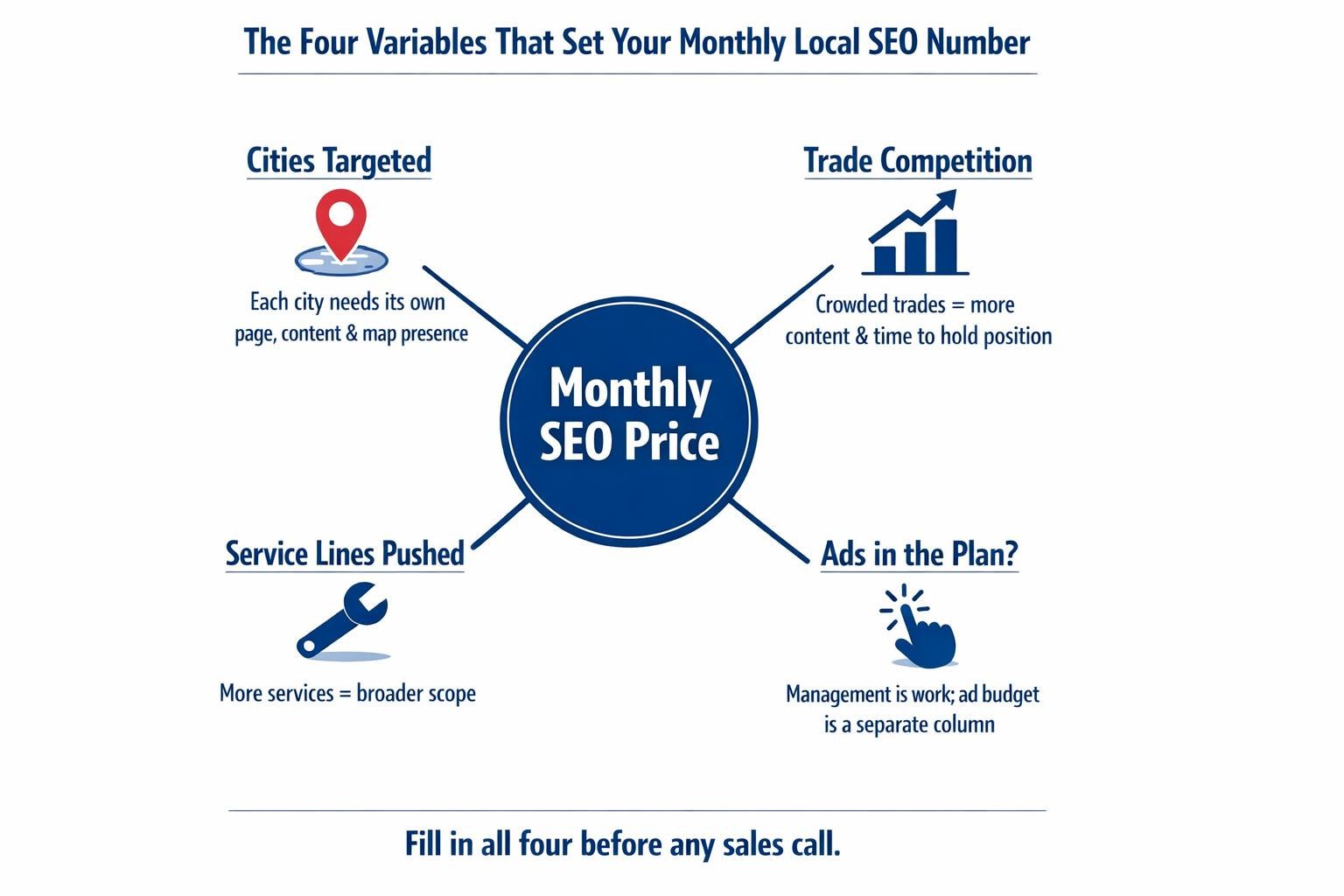
Fill these four answers in before any sales call. When you walk in knowing them, you can tell within ten minutes whether a quote is priced to your market or pulled off a shelf.
- How many cities you want to win in. Monterey only is one scope. Monterey, Seaside, Marina, Salinas, and down 101 to King City is a different scope entirely, because each city needs its own page, its own content, and its own map presence.
- How competitive your trade is here. Plumbing and HVAC in Salinas are crowded. Tree service and flooring in the smaller valley towns are thinner. Crowded means more content and more time to hold a position.
- How many service lines you are pushing. A roofer who only wants residential re-roofs needs less than one chasing re-roofs, repairs, gutters, and commercial.
- Whether Google Ads are part of the plan. Management is work. The ad budget itself is separate money, which I will get to.
We price by market rather than by package for exactly this reason. If you want a general monthly range in about a minute without a sales call, the pricing calculator gives you one.
Write your four answers down. Any proposal that does not reference them is not a quote for your business.

Two Proposals at the Same Price Can Be Completely Different Work
This is where comparison shopping goes sideways. The money varies less than the work does.
A monthly local SEO program can include keyword research for your trade and your cities, blog content on a set cadence, Google Business Profile management, on-page work on your service and city pages, 50 or more directory citations built, corrected, and monitored, lead tracking, and a report that lands on the first work day of the month.
Two quotes at the same monthly number can differ by most of that list. One shop is writing four pages a month and fixing your citations. The other is checking a dashboard and sending a PDF.
So ask for the deliverables in writing, month by month. Not a philosophy, not a strategy summary, a list of what arrives and when.
If a proposal cannot tell you what shows up each month, you have your answer, and you did not have to spend a dollar to get it. That alone will knock out one or two of the three proposals on your desk. It also protects the owner from the thing contractors complain about most, which is paying for months and never being able to point at what was done.
The Deliverable Checklist to Ask For in Writing
Hand this list to anyone quoting you. Ask them to answer every row in the proposal, not on the phone.
| Deliverable | What to ask for in writing | What it costs you if it is missing |
|---|---|---|
| Keyword and market research | Which terms, which cities, refreshed how often | You rank for phrases nobody in Monterey County types |
| Website content | How many pages or posts per month, and who writes them | Thin filler pages that never get found or never get read |
| Google Business Profile | Who posts, how often, who responds to reviews | A stale profile that slides out of the map pack |
| Directory citations | How many, built or only monitored, who fixes bad data | Old phone numbers and addresses sitting live on the web |
| On-page work | Which pages get touched, including city and service pages | A good-looking site Google cannot categorize |
| Lead and call tracking | What gets tracked, and who can see it besides the agency | No idea which channel made the phone ring |
| Reporting | What is in it, and which day of the month it arrives | A dashboard nobody in the office can read |
The Four Variables That Set Your Monthly Number
Before you compare quotes, define the scope you are actually buying. These four inputs move the price more than anything else.
Ad Spend Is Not an Agency Fee, and Mixing Them Up Costs You the Argument
This is the single most common reason an owner thinks marketing costs more than it does. He sees the agency invoice, then he sees the Google invoice, adds them together, and decides marketing is too expensive.
Keep two columns. Column one is the program fee, which covers the work. Column two is ad budget, which is billed separately and paid directly to Google. That money buys clicks. When you stop paying it, the clicks stop the same day.
That difference matters more every year, because paid leads keep getting more expensive. Industry data published by a lead vendor in late 2026 put average cost per lead for roofing around $107, up roughly 45% year over year, with plumbing near $66, electrical around $43, and landscaping around $37, each climbing at a similar clip. Treat those as directional, not gospel, since they are national averages and your market is its own animal.
The point for your budget is this: rented traffic gets more expensive over time, and owned visibility does not get repriced by an auction. Both have a place. We cover how to split them in SEO vs. paid ads for contractors, and why cost per lead is the wrong number to judge marketing by on its own.
The Real Question: How Will You Know It Worked?
A price only means something when you have something to judge it against. One industry survey published in early 2026 found roughly two thirds of home service businesses cannot connect marketing spend directly to revenue, which matches every conversation I have had in a Monterey County shop office.
So set the checkpoints before you sign anything.
- Month 1. Foundation work done and visible: profile cleaned up, citations corrected, tracking live, first content published. Most clients see their first measurable ranking gain within 30 days. That is typical, not a guarantee.
- Month 3. Movement on the terms that matter in the cities you named. More calls from organic search, not just more traffic. You should be able to name the search term that produced at least one booked job.
- Month 6. Booked work tied back to source. If nobody can tell you which jobs came from search by month six, the problem is the reporting, not the market.
Ask for reporting tied to booked jobs rather than impressions. Rankings and traffic are steps on the way to a job, and the only question the owner actually cares about is whether the trucks are busier.
If you want the mechanics behind those checkpoints, how local SEO actually works for Central Coast contractors walks through it, and review recency in the Salinas map pack explains one of the fastest levers available. The federal small business marketing guide is a reasonable sanity check on budgeting basics if you want a neutral source for the owner.
What Switching Usually Looks Like From the Client Side
Most of the owners we talk to in Salinas, Monterey, and Watsonville are not first-timers. They have paid somebody before and could not tell what they got for it.
One review from a client who had been through this a few times put it plainly: “We have used several different website companies and I’ve never recommended one before, but I definitely recommend Core6 Marketing!” That is what the switch usually feels like, less a leap of faith and more relief at finally being able to read the report.
When you present the quote to the owner, lead with the scope, not the price. Cities, trade, service lines, ads yes or no. Then the number. In that order, the number makes sense, and the conversation stops being about cost and starts being about how many more jobs the schedule can hold. All of this sits under one pillar, Demand Capture, which is simply making sure buyers and AI tools find you first.
Frequently Asked Questions About Contractor SEO Pricing
Is there a typical monthly price range for contractor SEO on the Central Coast?
Published national agency packages tend to run from the low thousands a month into five figures, and local shops mostly do not publish at all. Your number depends on cities, trade competition, service lines, and ads. The pricing calculator will give you a general range in about 60 seconds without a sales call.
Does a new website cost extra on top of the monthly program?
Yes. A website is a one-time project, separate from the monthly work. New sites start at $3,500, and you own the site outright when it is done. The final number depends on pages, service areas, and features, and it gets confirmed after the strategy session.
Is there a setup fee or a contract?
No setup fee here, and no long-term contract. We work month to month from day one. Some agencies charge an onboarding fee and require six or twelve months, so make sure you ask both questions in writing before you compare two monthly numbers.
How much should we budget for Google Ads on top of that?
That depends on how urgent your service is and how many cities you want covered. Ad spend is billed separately and goes straight to Google, so you control it. With lead costs climbing across roofing, plumbing, and electrical, it is worth deciding up front whether ads are for a seasonal push, a new service area, or year-round coverage.
What if our site is not on WordPress?
Still worth a conversation. We build on WordPress, but we will look at what you have and tell you honestly whether we can work with it or whether a rebuild makes more sense. A rebuild changes the budget, so it is better to know that before anyone quotes you a monthly number.
Want a Number Built for Your Market, Not a Package?
We run one program priced by market rather than tiered packages, with no setup fee, month to month from day one, and one company per trade in each service area across Monterey County and the rest of the Central Coast. The pricing calculator gives you a general monthly range in about 60 seconds, and the exact number comes after a 30-minute strategy session with Phil Fisk’s team. The office line is (831) 789-9320 if it is easier to ask a question first.