
Direct Answer: Rankings usually dip for a few weeks after a rebuild, then recover. Lasting drops come from missing redirects, deleted service pages, rewritten titles, or a staging site launched with search engines blocked.
A contractor calls me about eight weeks after his shiny new website went live. The site looks great. The phone is quieter than it was in March, and nobody can tell him why.
I have seen this pattern enough times around Monterey County to know where to look first. It is almost never the design. It is the handoff between the old site and the new one.
This article covers what actually breaks during a rebuild, the pre-launch list you can hand to whoever is building your site, and how timing your rebuild to your slow season protects your calls while rankings settle.
Why Calls Drop After a Website Redesign, Even a Good One
The causes are boring. That is the frustrating part, because boring problems are preventable problems.
Here is what I find when I audit a contractor site that lost ground after a rebuild:
- URLs changed with no redirects. The old plumbing repair page lived at one address for six years and earned links and rankings. The new site moved it and pointed nothing at the old address. Google finds a dead end.
- Service pages quietly dropped. Someone thought nine service pages looked cluttered and merged them into one. Those nine pages were nine separate chances to rank.
- Page titles rewritten for design reasons. A title tag that read like a search phrase got replaced with something short and clean that nobody searches for.
- Staging site launched with search engine blocking still on. Builders block staging sites so half-finished pages do not get indexed. If that switch never gets flipped back, your site is invisible, and it can stay that way for weeks.
- Name, address and phone changed format. “Suite” became “Ste.” or the tracking number replaced the main line everywhere without a plan.
None of that shows up in a design review. All of it shows up in your call volume.

The Pre-Launch List to Hand Your Web Builder
Whoever is building the site should be able to check every one of these off before launch day. If they cannot, that is useful information about who you hired.
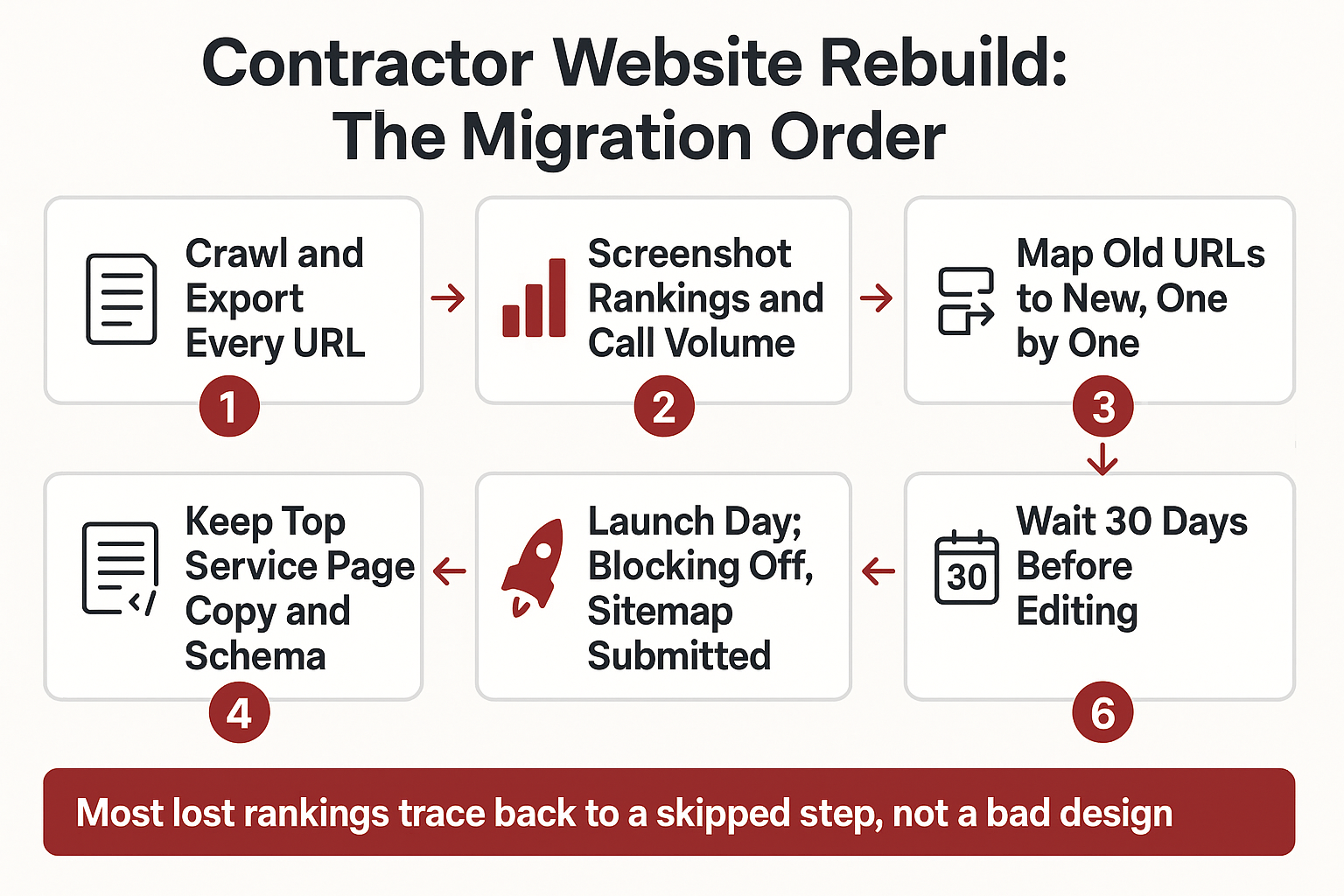
- Crawl and export every existing URL. You need the full list of what exists today, not what someone remembers building.
- Map old to new, one by one. Every old address gets a permanent redirect to the closest match on the new site. Not the homepage. The closest match.
- Keep the text on your highest-performing service pages. The layout can change. The words that earned the ranking should survive the move. Google itself walks through this in its guide to site moves with URL changes.
- Carry over business schema and your name, address and phone exactly. Character for character, matching your Google Business Profile.
- Turn off staging-site blocking and submit a fresh sitemap on launch day. Same day, not next week.
One more step, and it is the one contractors skip most: screenshot your current rankings and call volume before anything moves. Pull your top keyword positions and your last three months of call counts.
Without that baseline, you are arguing from memory two months later. With it, you can point at exactly which pages slid and when.
Timing a Rebuild Around Central Coast Demand
Rankings move for a few weeks after any migration. The question is whether those weeks land during your busy stretch. Here is roughly how I think about timing by trade in our market.
| Trade | Safer stretch to rebuild | Season worth avoiding |
|---|---|---|
| Landscaping | December through January | March through May spring cleanup rush |
| Tree service | Late summer, before winter storms | First heavy wind and rain weeks |
| HVAC | Shoulder months in spring and fall | First inland heat stretch in Salinas and King City |
| Roofing | Mid to late summer dry season | First significant rain of the season |
| Plumbing | No true off season, so plan for a quiet week | Holiday weeks with high call volume |
| Pest control | Winter lull | Warm-weather ant and rodent surges |
Rebuilding in January Costs Less Than Rebuilding in April
Timing is a real lever here, and it is one of the few parts of this you fully control.
A landscaping or tree service site that moves in January gives up almost nothing. The same move in April lands on top of the spring rush, when a two-week dip in a Carmel Valley or Pacific Grove search result is money on the floor.
HVAC works the same way. Moving a site during the shoulder months is a very different decision than moving it the week the first inland heat stretch hits Salinas and the King City corridor.
Expect a few weeks of ranking movement no matter how clean the migration is. Positions bounce, some pages get recrawled before others, and the picture looks worse at day 10 than it does at day 30.
Do not panic-edit during that window. I have watched owners rewrite titles, delete pages and change their business name formatting in week two because a keyword slipped three spots, and all that does is restart the clock. Give it a full month before you touch anything.
The Order These Steps Should Happen In
Most migration failures are sequencing failures. This is the order I want to see before, during, and after launch day.
An Unstable Site Loses Rankings the Slow Way
Not every ranking problem arrives on launch day. Some of them build up over a year.
One client described his old setup plainly in a review: “Our corporate website was a mess and constantly crashing.” That is a ranking problem, not just an annoyance.
A site that times out while Google is crawling it teaches search engines that it is unreliable. Same with a site that breaks after a plugin update, or one that sits unpatched for a year until something gives.
The damage does not show up as a cliff. It shows up as a slow slide that nobody can pin to a date, which is exactly why it goes unnoticed until someone finally looks. If you are trying to sort out whether your problem is technical or something else, how to tell if the content on your site is hurting your rankings is a decent place to start.
What a Rebuild Can Do to Your AI Visibility
There is a newer version of this problem worth knowing about.
A lot of redesigns replace detailed service copy with large photos and short taglines. It looks cleaner. It also strips out the exact material that language models were reading to describe your business.
When ChatGPT, Perplexity or Google’s AI Overviews name a contractor, they are pulling from specifics: what you install, which cities you cover, what a repair visit involves, how you handle after-hours calls. Replace three paragraphs about trenchless sewer work in Watsonville with a photo and the word “Sewer,” and there is nothing left to pull from.
That is how a company gets named less often after a site that looks better goes live. The connection between site content, local SEO signals and AI answers is the whole reason we treat those as one system, which is what AI search visibility refers to.
If you want more on how those tools evaluate a business, what AI-powered local SEO actually checks before recommending a contractor covers the checks that matter, and when AI Overviews name a contractor breaks down what happened behind that answer.
Frequently Asked Questions About Website Redesigns and Rankings
How long do rankings take to recover after a website redesign?
On a clean migration, most of the movement settles within two to four weeks. If you are still down significantly at 60 days, something structural is wrong, usually missing redirects or pages that never got recrawled. That is a diagnosable problem, not bad luck.
Do I have to keep my old URLs?
No, but every old URL needs a permanent redirect to its closest match on the new site. Redirecting everything to the homepage is the most common shortcut I see, and it throws away the ranking value those individual pages built up.
What does a contractor website rebuild cost on the Central Coast?
It varies a lot depending on how many service pages and service areas you cover, whether copy gets rewritten, and how much of the old site has to be mapped and migrated. A ten-page plumbing site and a forty-page remodeling site are not the same project. Pricing is worth getting quoted directly rather than guessing from a range you read online.
My designer says the new site is faster, so rankings should go up. Is that true?
Speed helps, but it does not replace what you removed. A fast site with half the service pages and no redirects will rank worse than the slow site it replaced. Speed is one signal among many.
Can I fix a rebuild that already went sideways?
Usually, yes. The fix starts with pulling the old URL list from an archive or your analytics history, adding the redirects that were missed, and restoring the service page copy that got cut. Recovery takes longer than prevention would have, but the rankings are rarely gone for good.
Thinking About Rebuilding Your Site This Year?
Migrations tend to fail at the seams between vendors, where the designer assumes the SEO person handled redirects and the SEO person assumes the designer did. We build custom WordPress sites for Monterey County contractors and keep them hosted and maintained by the same team running the marketing, which removes most of those seams. If you want a second set of eyes on a rebuild before or after it launches, Core6 is here at (831) 789-9320.