
Direct Answer: ChatGPT recommends businesses with consistent, verified trust signals across multiple platforms — not just a strong Google ranking. If your online presence is thin or inconsistent, AI skips you entirely.
I want you to think about the last homeowner in Salinas or Seaside who needed a plumber but never called you. Odds are decent they didn’t type anything into Google. According to BrightLocal’s 2026 Local Consumer Review Survey, 45% of consumers now use AI tools like ChatGPT, Gemini, or Perplexity to find local services — up from just 6% a year ago. That’s not a gradual shift. That’s a market that changed overnight.
The problem with AI search isn’t that it’s harder to rank in. It’s that it works differently than Google entirely. Google shows a page of results. ChatGPT gives back one or two names — sometimes just one. If you’re not in that answer, you’re not losing a position. You’re losing the conversation before it starts.
I’ve been watching this play out with contractors across the Monterey Bay Area, and the gap between who gets named and who doesn’t has very little to do with who does better work. It has everything to do with how AI reads your business online. This article breaks down exactly what AI is looking at — and where most contractor websites fall completely flat.
The Numbers Behind Why AI Ignores Most Local Contractors
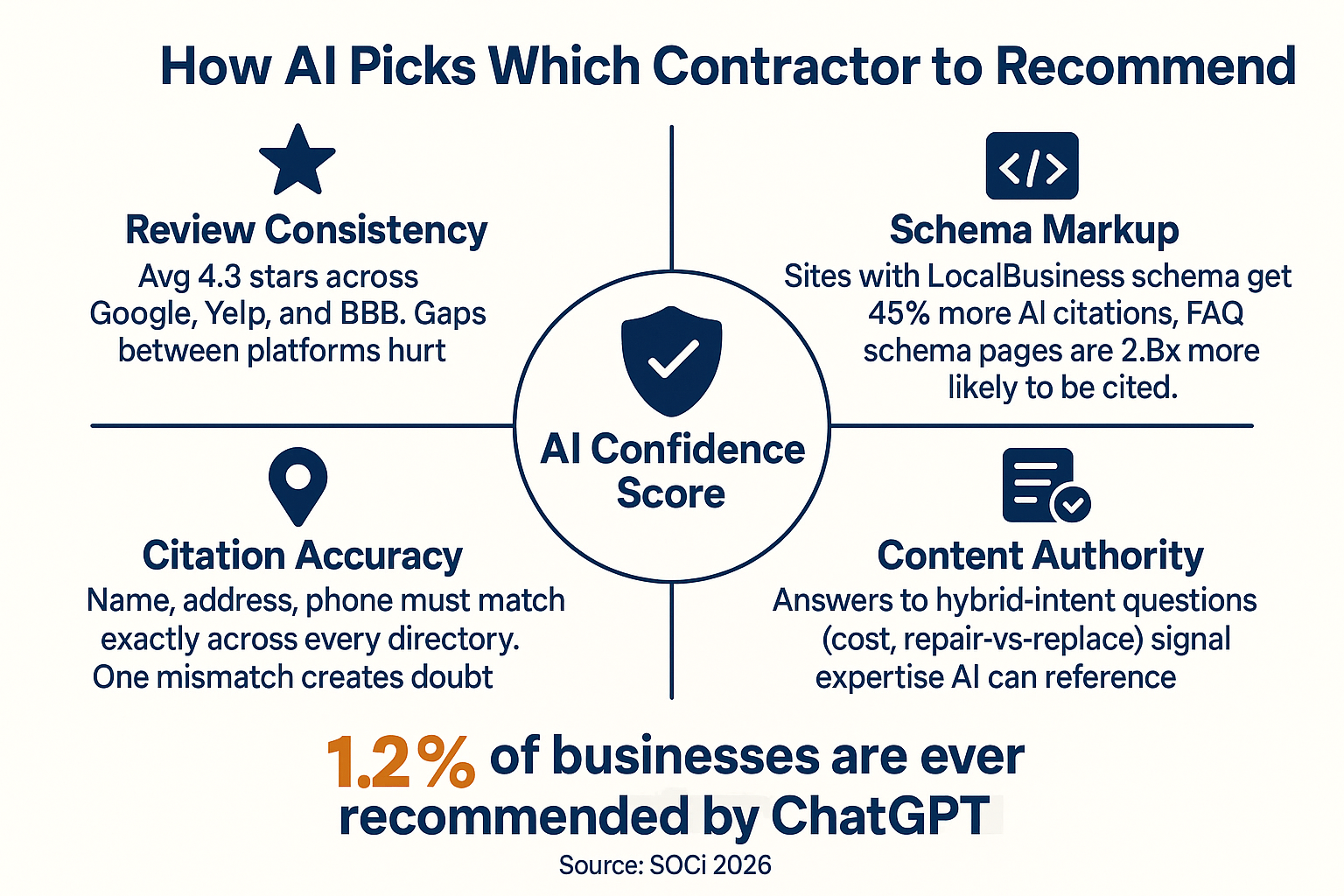
SOCi analyzed over 350,000 business locations and found that ChatGPT recommends just 1.2% of them. One in eighty. And before you think that’s a fluke — the traditional Google 3-Pack surfaces businesses roughly 36% of the time. AI is dramatically more selective.
For a roofing contractor in Watsonville or an HVAC company on the Monterey Peninsula, that gap is the whole story. Winning the 3-Pack used to mean you had a real shot at the phone ringing. AI recommendations play by a different set of rules entirely.
What AI is selecting for isn’t the biggest company or the highest ad spend. SOCi’s 2026 Local Visibility Index found that businesses recommended by AI averaged 4.3-star ratings with consistent, verifiable trust signals across multiple platforms — Google Maps, Yelp, the BBB, and the business’s own website. Businesses with strong Google rankings but thin external presence regularly lost AI visibility to competitors with less SEO polish but broader credibility signals.
For a landscaping company in Carmel Valley or an electrician in Seaside, that means your Google Business Profile alone isn’t the answer. AI cross-references everything it can find about your business — and if it can’t verify you from multiple sources, it skips you and names someone it can.
We cover the broader mechanics of this shift in how AI search is changing who gets called for home repairs, but the short version is this: AI behaves more like a confidence filter than a search engine.

You’re Already Losing AI-Referred Jobs — You Just Can’t See It
This is the part that surprises most contractors I talk to. A 177-session study of real ChatGPT users found that 38% of sessions where someone discovered a business through AI were later attributed to Google in analytics. Why? Because after ChatGPT named the contractor, the homeowner typed that name into Google to verify them before calling.
So your analytics says a Google search drove the call. But the original referral was ChatGPT. Your Google Ads campaign gets the credit. The AI channel stays invisible.
For a roofing contractor in Watsonville or a pest control company in Marina, that attribution gap could be masking a meaningful portion of your inbound calls. You have no idea how many jobs AI is sending your way — or how many it’s sending to your competitor instead.
The fix is simple, and it costs nothing to implement. Add a single intake question to every call and form: “How did you first hear about us?” Not just “how did you find us” — that usually gets “Google” regardless of what actually happened. Train whoever answers your phone to ask it and write down the answer. You’ll start seeing ChatGPT, Perplexity, and Gemini show up in your own data within weeks.
If you’re already running call tracking, this data becomes even more useful. Knowing whether your visibility in AI platforms is growing — separate from your paid campaigns — tells you something your standard analytics dashboard never will. Why most contractor Google Ads campaigns waste money on the wrong clicks is a related read if you’re trying to sort out where your calls are actually coming from.
How AI Decides Who to Recommend
This breakdown shows the four signals AI platforms weigh when deciding which local contractor to name — and how most contractor websites score on each one right now.
The Queries That Actually Precede a Call — And Where Contractors Go Missing
Most contractors I work with worry about “plumber near me” or “HVAC repair Salinas.” Those are real search terms, and they matter. But Whitespark’s Q2 2026 data found that AI Overviews appear in 97% of hybrid-intent queries — the searches where someone is both researching and getting ready to call.
Think about what those queries look like in practice:
- “Average cost of water heater replacement in Monterey”
- “Should I repair or replace my AC unit”
- “How long does a roof last in coastal California”
- “Is it worth fixing a furnace that’s 15 years old”
These are the questions homeowners in Pacific Grove and Carmel are asking before they ever dial a number. And AI is answering them — by pulling from websites that actually have that content and citing the businesses that provided it.
If your website is a five-page brochure with your services listed and a phone number, you have zero presence in these answers. You don’t get cited. The homeowner gets their information from your competitor’s site, and they call your competitor.
This is why content on your website matters in a way it never quite did before. It’s not about blogging for blogging’s sake. It’s about being the source AI uses when a homeowner in Monterey County asks the exact question that leads to a service call. That framing changes how you should think about how local SEO actually works for home service contractors on the Central Coast.
Google Search vs. AI Search: What’s Actually Different for Contractors
These aren’t just two versions of the same thing. The mechanics are different enough that doing well in one doesn’t automatically carry over to the other.
| Factor | Google Search | AI Search (ChatGPT, Gemini, Perplexity) |
|---|---|---|
| Results returned | Full page — 10+ listings | One to two names, sometimes just one |
| What drives visibility | Ranking signals, backlinks, GBP | Cross-platform trust signals, schema, content authority |
| GBP profile impact | High — essential for 3-Pack | Moderate — one input among many |
| Schema markup impact | Moderate | High — 45% more citations with LocalBusiness schema |
| Review platform scope | Google reviews weighted heavily | Google, Yelp, BBB, and others all counted |
| Content on your website | Helpful for rankings | Directly determines whether you get cited in answers |
| Attribution in analytics | Usually accurate | Often misattributed — AI-referred calls show as Google |
The One Technical Fix Most Contractor Websites Are Missing
Schema markup is the machine-readable layer on your website that tells AI platforms exactly who you are, where you work, and what you do. It’s not visible to human readers. But it’s one of the first things AI checks.
Semrush research found that sites with properly implemented LocalBusiness schema see a 45% higher AI citation rate. Pages with FAQ schema are 2.8 times more likely to be cited in AI-generated answers than pages without it. Those aren’t marginal differences.
Here’s the practical problem: most contractor websites built on generic themes — whether it’s a WordPress template, a GoDaddy site, or something thrown together in a weekend — ship with broken or partial schema. The code is technically there, but it’s missing fields, has incorrect business categories, or references a phone number that doesn’t match the one on your Google Business Profile. To AI, that looks like a business it can’t fully verify.
Fixing schema isn’t a glamorous project. But for a plumber in Salinas or a general contractor in Marina, it’s one of the highest-return technical changes you can make right now — before your competitors figure out the same thing.
This is foundational to what we do through AI search visibility, our approach to local SEO that specifically addresses visibility across AI-powered platforms alongside traditional Google rankings. If you want a broader picture of what that kind of work involves, what ‘AI marketing’ actually means for a plumber or HVAC company in 2026 is worth reading before you make any decisions.
And if you’re evaluating whether your current website is even worth fixing versus rebuilding, why the cheapest website will cost you the most jobs covers that question directly.
Frequently Asked Questions About Contractor Visibility in AI Search
Does my Google ranking have anything to do with whether ChatGPT recommends me?
It helps, but it’s not the main factor. AI platforms pull from a much wider set of signals than Google’s algorithm does. A contractor with a strong Google ranking but thin presence on Yelp, the BBB, and other platforms can still get skipped by AI entirely. Cross-platform consistency matters more than any single ranking.
How would I even know if ChatGPT is sending customers my way right now?
You probably wouldn’t — at least not from your analytics alone. About 38% of AI-referred calls get logged as Google searches because customers verify the business name on Google before dialing. The most reliable way to catch it is a simple intake question: ask every new caller how they first heard about you, and write it down. Over a few months, patterns emerge.
Is there anything I can do myself without hiring anyone?
A few things. First, make sure your business name, address, and phone number are identical everywhere — Google Business Profile, Yelp, your website footer, the BBB, every directory you’re listed on. Even small differences (“St.” vs. “Street”) create inconsistency that AI notices. Second, add a few pages or sections to your website that directly answer the questions homeowners ask before calling — cost questions, repair-versus-replace decisions, what to expect during a service visit. That content is exactly what AI pulls from when it cites a local contractor.
My competitor keeps showing up when I search for our services on ChatGPT. What are they doing differently?
Usually it comes down to one of three things: they have more consistent business data across platforms, they have properly implemented schema on their website, or they have content that directly answers the questions AI users are asking. Sometimes all three. The competitor showed up in ChatGPT article walks through exactly how to diagnose which gap is the biggest problem for your specific situation.
Does this affect all trades equally, or are some contractors more at risk?
Trades where homeowners research before calling are most exposed — HVAC, roofing, water heater replacement, anything with a significant cost decision attached. Those are the hybrid-intent queries where AI Overviews appear in 97% of searches. Emergency trades like plumbing and electrical still get a lot of direct “near me” searches, but even there, AI is starting to intercept the initial question.
Want to Know Where You Stand in AI Search Right Now?
We work exclusively with home service contractors on the Central Coast — from Salinas and Marina to Carmel Valley and Santa Cruz County — and this is exactly the kind of gap we audit during a Discovery Call. If you want a straight answer on why your competitor keeps showing up in ChatGPT and you don’t, book a 30-minute call with Phil at https://core6.marketing/work-with-us/.