
Direct Answer: California requires licensed contractors to include their license number in all advertising, and CSLB has said that includes websites and online postings, not just print and radio ads.
Most contractors I talk to in Monterey County know the license number belongs in their advertising. What almost nobody has done is actually walk every public surface and check.
The number usually sits in the website footer and nowhere else. Not in the Google Business Profile description, not on the Facebook page, not in the Google Ads copy, not on the truck door.
This is a small detail with real downside, and the fix touches the same places that decide whether search engines and AI tools trust your business at all. I want to walk through the rule, the surfaces people forget, and the name problem that quietly costs contractors visibility.
What the CSLB Advertising Requirements Actually Say
California Business and Professions Code section 7030.5 requires a licensed contractor to include the license number in construction contracts, subcontracts, calls for bid, and all forms of advertising as prescribed by the registrar.
The part people miss is how broadly that reads now. CSLB has publicly reminded licensees that advertising includes websites and online postings, not just newspaper, radio, and yard signs. Their own industry bulletin on license numbers on commercial vehicles and advertisements ties this together under sections 7027, 7029.5, and 7030.5 along with the board’s regulations.
Reported penalties for a first offense of the advertising requirement run in the range of $100 to $1,000 under those regulations. That is not the kind of number that sinks a business. But it is an easy citation to avoid, and it usually comes to light at the worst moment, in the middle of a dispute or a complaint.
A few things change the details:
- Your license classification
- Your business structure, whether sole owner, partnership, or corporation
- Whether you advertise under a DBA and whether that name is on the license record
I am a marketer, not your attorney. Confirm your own situation directly with CSLB before you make changes based on anything you read online, including this.
Where the Number Goes Missing, Because Nobody Audits This
Here is the pattern I see over and over on Central Coast contractor accounts. The license number lives in one place, usually the bottom of the homepage, and everything else was built by someone who never thought about it.
The usual gaps:
- Google Business Profile description with no number in the text
- Facebook and Yelp profiles built years ago by a family member
- Google Ads headlines and descriptions written for character count, not compliance
- Vehicle lettering that shows the business name and phone but not the number
- Estimates, proposals, and contracts generated from software templates
- Business cards and door hangers printed before the last license renewal
Vehicles deserve a second look. CSLB guidance treats commercial vehicles as advertising, and the display standard is stricter for some classifications than others, including C-36 plumbing, C-45 sign, and C-57 well drilling contractors.
So picture a homeowner in Salinas or Watsonville. They see your truck on North Main, look you up on their phone, land on your Google profile, click over to your site, and maybe check Yelp on the way. That is four surfaces before a single call. The number should be on all of them.

The Public Surfaces a Homeowner Sees Before They Call
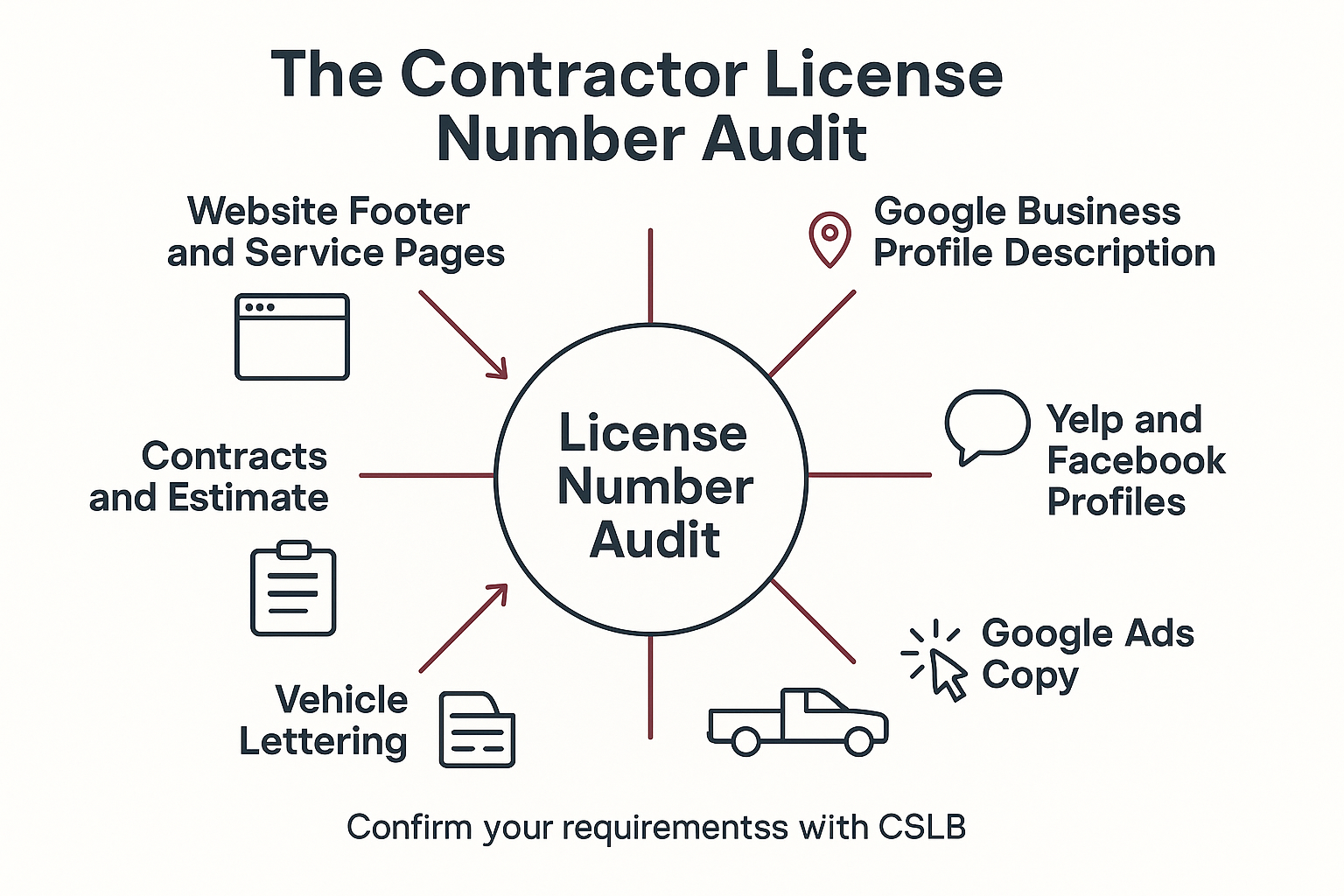
This is the walk I do on every new contractor account. Print it, then check each row against what is actually published today.
| Surface | Who sees it first | What is usually missing |
|---|---|---|
| Website footer and service pages | Homeowners comparing three bids | Number on the footer only, not on service or contact pages |
| Google Business Profile description | Anyone searching on a phone | No license number anywhere in the profile text |
| Yelp and Facebook pages | Homeowners who have been burned before | Old business name, old phone, no number |
| Google Ads copy | High-intent searchers ready to call | Character limits squeezed the number out |
| Vehicle lettering | Neighbors on the job street | Name and phone only, stricter rules for some classifications |
| Estimates and contracts | The buyer at signing | Template built by software, never updated |
A Six Point License Number Audit
Run this once a year and after any rebrand, phone change, or website rebuild.
The Name Question Matters More Than the Number
Here is the one that costs real money, and it has nothing to do with a fine.
Plenty of contractors are licensed under a personal name but advertise under a DBA that was never added to the CSLB record. That is a compliance problem to sort out with the board. It is also a search problem, and the search problem is bigger.
Think about what has to agree:
- The name on the license
- The name on the website
- The name on the Google Business Profile
- The name in hundreds of directory listings built up over 15 years
When Google and AI answer engines cross-check a business across those sources and find three different versions of the name, the safe move for those systems is to skip the business entirely. They are not going to recommend a contractor they cannot verify.
Name, address, and phone consistency is one of the pillars AI Search Sync is built on, for exactly this reason. It is unglamorous work. It is also why a sloppy Google Business Profile quietly costs contractors AI visibility even when the website ranks fine.
Why a License Number Reads as a Trust Signal to AI Tools
I want to be careful here, because this is verification, not a ranking trick. Adding a license number to your Google profile description does not move you up the map pack by itself.
What it does is give an automated system something checkable. Industry research through 2026 has shown consumer use of AI tools for local business recommendations climbing sharply, and businesses with decent Google rankings but conflicting information across Maps, Yelp, Facebook, and their own site tended to lose ground in those AI recommendations.
A license number, a matching legal name, and a classification anyone can look up are cheap signals. Most competing contractor sites in Monterey County handle them sloppily, which is the opportunity.
That is the same logic behind what separates the contractors AI recommends from the ones it skips. Consistency and proof beat clever copy. And it lines up with how homeowners here already behave. One homeowner described getting pushed into unnecessary work on a sewer job by another company, then went hunting for someone who would give a straight answer. People who have been burned check harder, and they check the license.
Three 2026 Changes That Touch What You Publish
A few new rules land on the same surfaces we just audited. Treat this as a heads up and get the current text from CSLB.
- AB 1327 requires home improvement contracts to include the contractor’s email address and to allow buyers to cancel by email, along with a phone number for completing the Notice of Cancellation. Practically, the email on your website contact form, your estimate, and your contract should all be the same working inbox that someone actually reads.
- SB 216 extends the workers’ compensation proof requirement to all license classifications on the 2026 timeline. An earlier phase already covered C-20 HVAC, D-49 tree service, C-8 concrete, and C-22 asbestos abatement.
- SB 779 raises minimum civil penalties for certain licensing violations starting mid-2026, with the reported minimum fine for unlicensed activity moving from $200 to $1,500.
One more advertising trap worth verifying before you publish. Claims about being bonded are restricted in contractor advertising, even though “licensed, bonded and insured” sits in the hero section of hundreds of contractor sites. Ask CSLB what you can say before you put it in a headline or an ad.
A website is often the first place a stale email address or an outdated claim gets caught. It is also the easiest thing to fix in an afternoon, which is more than you can say for most compliance work.
Frequently Asked Questions About CSLB Advertising Requirements
Is a license number in the website footer enough?
It is a start, and it is where most contractors stop. CSLB describes advertising broadly, covering websites and online postings, so I would rather see the number on the contact page, service pages, Google Business Profile description, and ad copy too. Confirm the specifics for your classification with CSLB.
Do I have to put my license number on my truck?
CSLB’s industry bulletin treats commercial vehicles as advertising and addresses license number display. Some classifications are held to a stricter standard than others, including C-36 plumbing, C-45 sign, and C-57 well drilling. Check your own classification before you order lettering.
What happens if my Google Business Profile name does not match my license?
Two problems at once. The mismatch may be something CSLB cares about if the DBA was never added to your record, and it definitely confuses search engines and AI tools that cross-check your business across Maps, Yelp, directories, and your website. When they find three versions of the name, the reliable outcome is that they leave you out of the answer.
How much does it cost to clean all of this up?
It depends almost entirely on how many listings exist and how long the business has been operating under more than one name. A five year old company with a tidy profile is a short project. A 20 year old company in Salinas with old phone numbers scattered across directories takes longer. Ask for a quote based on an actual audit, not a flat guess.
Does any of this help my rankings directly?
Not by itself. Think of it as removing reasons for a search engine or an AI tool to distrust you. The ranking work happens elsewhere, but it works better on a business that verifies cleanly.
Thinking about auditing your own listings?
This kind of cleanup touches the website, the Google Business Profile, the directory listings, and the ad copy at the same time, which is why we handle it as one connected system instead of four separate fixes. All of it is done here in Salinas, with nothing outsourced overseas. Phil Fisk takes a small number of Central Coast contractor accounts directly, and a short discovery call is usually where that review starts.