Direct Answer: AI is worth it for small trade businesses in three specific areas: answering after-hours calls, following up on leads faster, and turning customer conversations into marketing content.
Every contractor on the Central Coast has heard some version of the pitch: AI is going to transform your business, change the way you work, help you grow faster. But if you run a two-truck plumbing company in Salinas or a three-person HVAC shop in Seaside, none of that tells you what to actually do on Monday morning.
According to ServiceTitan’s 2026 State of the Trades report, only about 25% of residential contractors are using AI in a meaningful way today, even though 74% of those who are say the biggest value is efficiency. That gap is not because AI does not work. It is because no one has pointed contractors to the specific problems it actually solves.
This list covers four places where AI for a small trade business delivers real, measurable results, and one area where it is worth being careful. Nothing here requires a tech background or a stack of new software subscriptions.
1. Answering After-Hours Calls Before a Competitor Does
This is the most straightforward place AI earns its keep for a small trade business, and the numbers behind it are hard to ignore.
Research cited across contractor industry press consistently puts 35 to 45% of home service calls arriving outside business hours. And when a caller hits voicemail, 78% of them call a competitor within two minutes. For an HVAC company on the Monterey Peninsula or a plumber serving Hollister and the surrounding area, every unanswered call after 5 p.m. is a job that walked out the door before you even knew it came in.
AI-powered phone answering tools can pick up those calls, gather the caller’s information and job details, and send a text or email follow-up, all without additional office staff. Several of these tools integrate directly with scheduling software contractors already use, so there is no separate system to manage.
The starting point is simple: find out what percentage of your inbound calls are coming in after hours. The calls sitting in your voicemail are worth more than your blog, most contractors are surprised when they actually look at the data.
2. Following Up on Leads Before the Window Closes
Most contractors are running a job when a new lead comes in. A callback that happens two hours later often reaches a homeowner who has already booked someone else.
One contractor study found that when follow-up is slower than one hour, a competitor captures the lead about 15% of the time. That number compounds fast across a month of leads. AI-assisted follow-up, a text confirmation, an automated inquiry response, or a simple call-back scheduler, addresses exactly that window without requiring the owner to stop what they are doing.
The goal is not to replace the conversation. It is to hold the lead in place until you can have it. A cleaning service in Pacific Grove or a landscaper in Carmel Valley can keep a prospective customer engaged with a single well-timed automated message while the owner finishes the job they are on.
The contractors who benefit most here are not the ones with the fastest thumbs. They are the ones who have a consistent process that runs even when they are on a roof in Marina or under a sink in Watsonville.
3. Turning Customer Conversations into Marketing Content
This is where AI has a narrower but genuinely high-value role for small trade businesses, and it is the one most contractors overlook entirely.
Your inbound calls, form submissions, and reviews are already full of marketing material. Callers describe their problems in their own words. Form submissions show how homeowners write about what they need. Reviews capture the specific outcomes that mattered most. When AI is used to help structure and draft content from those sources, rather than generate generic articles about “the importance of regular HVAC maintenance,” the result is specific, credible, and hard for a competitor to copy.
That distinction matters for a practical reason. Google’s own guidance warns that AI-generated pages that add no original value can violate its scaled content abuse policy. Content built from your real customer language does not have that problem, because it is grounded in something no one else has access to.
I have seen this work consistently for contractors across Monterey County. The plumber in Salinas whose review mentioned a busted water heater at 11 p.m. on a Tuesday now has a page that ranks for exactly that kind of emergency search. Your customers already wrote your best SEO content, the work is in pulling it out and putting it somewhere Google and AI tools can find it.
For more on how this feeds into AI-powered search visibility, what AI-powered local SEO actually checks before recommending a contractor covers the mechanics in detail.
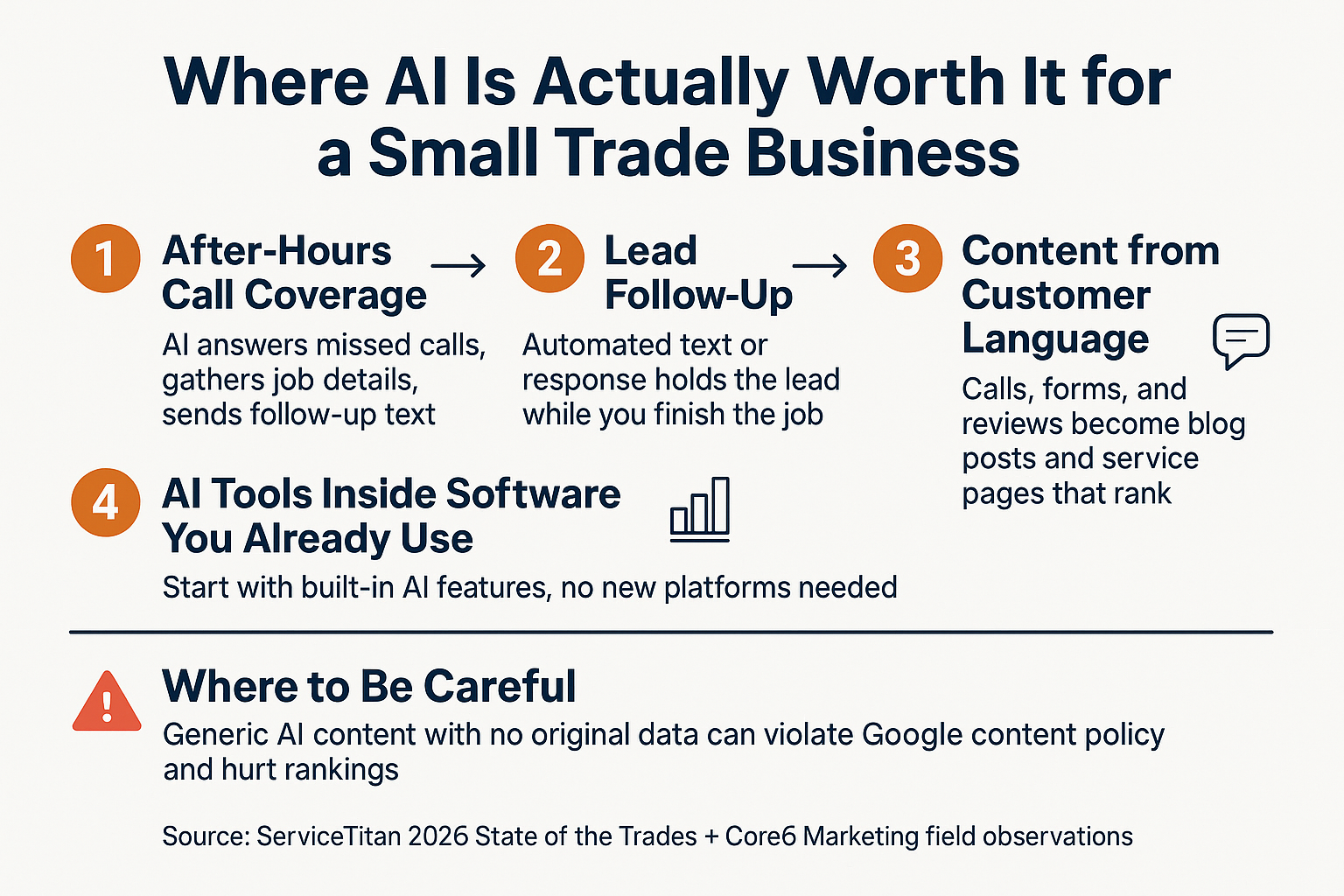
The Four AI Use Cases for Small Trade Businesses
This breaks down where AI delivers for contractors, and what each use case actually does on a practical level.
4. Using AI Features Already Built Into Software You Own
ServiceTitan’s 2026 research found that 44% of contractors cite training and integration as the main barrier to AI adoption, and 59% prefer AI embedded inside tools they already use rather than standalone apps.
That preference makes sense. A roofing contractor in Santa Cruz County does not need a separate AI subscription on top of their scheduling software, their invoicing tool, and their CRM. They need to know which AI features are already available inside what they are already paying for.
Most contractor software platforms, field service management tools, estimate builders, and CRM systems, have been adding AI features over the past 12 to 18 months. Those features handle things like:
- Drafting follow-up emails after a job closes
- Suggesting appointment times based on existing job patterns
- Flagging reviews that need a response
- Summarizing call transcripts into action items
Starting there costs nothing extra and requires no new learning curve. It is the most practical entry point for any small trade business looking to get real value from AI without adding complexity.
If you want to understand the difference between using AI tools and having an AI system, that distinction matters a lot once you move past the basics.
AI Use Case Comparison for Small Trade Businesses
Here is a quick reference for the four areas covered in this article, what each one solves, and what it requires from you to get started.
| AI Use Case | Problem It Solves | What It Requires |
|---|---|---|
| After-hours call answering | Missed calls going to competitors | An AI phone or text-back tool that integrates with your scheduling software |
| Lead follow-up automation | Leads going cold while you are on a job | Automated text or email response triggered by a new inquiry |
| Content from customer language | Generic marketing that does not rank or convert | Call recordings, form submissions, and reviews as source material |
| AI inside existing software | New subscriptions and training time | Check what AI features your current tools already include |
Where AI Is Not Worth It (Yet) for Most Small Contractors
Buying into a standalone AI platform that promises to handle your marketing from end to end is not where most small trade businesses should start. The technology exists, but the setup cost, learning curve, and ongoing management usually outweigh the benefit for an owner-operated shop with one to ten people.
The same goes for AI-generated content that is not grounded in your own customer data. I have reviewed contractor websites across Monterey County that are full of posts that sound like they were written by someone who has never seen a Central Coast job site. That content does not rank well, and it does not convert visitors into calls. What happens to contractor websites stuffed with AI content is not pretty from an SEO standpoint.
And because AI search tools like ChatGPT, Perplexity, and Google’s AI Overviews are now recommending specific contractors by name, what you publish online carries more weight than it did two years ago. How ChatGPT decides which plumber or roofer to recommend comes down to signals that generic AI content simply cannot build.
Frequently Asked Questions About AI for Small Trade Businesses
Do I need to hire a tech person to use AI tools in my contracting business?
No. The most practical AI tools for small trade businesses are either built into software you already use, or are standalone apps designed for non-technical owners. If you can set up a voicemail, you can set up most AI answering or follow-up tools. Start with what is already in your current software before adding anything new.
Will AI-generated content hurt my website’s Google rankings?
It can, if the content is generic and adds no original information. Google has been clear that AI-generated pages with no real value can be flagged under its scaled content abuse policy. Content built from your own call recordings, reviews, and customer language is a different story, it has original data behind it, and that is what both Google and AI search tools reward.
What is a realistic first step for a plumber or HVAC company in Monterey County?
Look at how many of your calls are coming in after hours. If more than 30% of your inbound calls arrive after 5 p.m., an AI answering or text-back tool will likely pay for itself within the first month. That is the clearest, fastest return on AI for most small trade businesses in this market.
Is AI useful for getting my business recommended by ChatGPT or Perplexity?
Yes, but not in the way most people expect. AI tools do not reward you for using AI, they reward you for having a strong, consistent presence across reviews, local directories, and well-written content that matches what homeowners actually search. Our AI Search Sync methodology is built specifically around making contractors visible in those AI-generated recommendations.
How do I know if the AI content on my site is actually helping or hurting me?
A few signals worth checking: Is your content answering specific questions your actual customers ask, or does it read like a generic overview? Are the pages generating calls, or just traffic? We offer a free AI content audit that scores whether a page reads as genuinely useful or as filler, that is usually the fastest way to get a straight answer.
Ready to Sort Out Which AI Tools Are Actually Worth Your Time?
If you run a home service business in Monterey County and you are tired of vague advice about AI, a Discovery Call with our team is a practical starting point. We work with contractors across the Central Coast, from Salinas and Marina to Hollister and Watsonville, and we can look at your specific operation and tell you exactly where AI is worth the effort and where it is not. Book a time that works for you at https://calendly.com/core6-marketing/30min.