Direct Answer: AI automation helps contractors produce content faster and cheaper, but it only works when the source material is original. Without real job data, local context, and customer language, automated content is generic and increasingly penalized.
The pitch sounds reasonable: use AI to write more content, faster, for less money. Research from Ahrefs found that AI-assisted content averages around $131 per post versus $611 for fully human-written content, and teams using AI publish a median of 17 articles per month compared to 12 for teams that don’t. For a roofing contractor in Salinas or a plumber on the Monterey Peninsula running a small crew without a marketing department, those numbers get attention fast.
But here’s what that comparison leaves out. The cost-per-post figure means nothing if the posts don’t actually do anything. And for contractors in Monterey County trying to rank in local search and get named by AI platforms like ChatGPT, Perplexity, or Google AI Overviews, the wrong kind of automated content doesn’t just fail to help, it actively works against you.
I’ve watched this play out with enough contractors on the Central Coast to know the dividing line. The question isn’t whether to use automation. It’s what you feed into it.
What Automation Actually Does Well
Automation is a production tool, not a source of original thought. When contractors understand that distinction, they start using it correctly.
What AI writing tools are genuinely good at:
- Turning raw notes into structured articles, a job description, a photo caption, a customer quote from a review, and a rough cost range can become a readable post in minutes
- Reformatting existing content, taking a long service page and turning it into an FAQ, or pulling bullet points from a detailed paragraph
- Drafting from transcripts, if you have a call recording or a form submission that describes a customer’s problem, an AI tool can draft from that in a fraction of the time it takes to write from scratch
- Maintaining consistent structure, headings, formatting, intro-to-close flow; automation handles this without effort
A roofer in Santa Cruz County who supplies the specifics of a job, the permit timeline at the county planning department, the material they used because of salt-air exposure on coastal homes, a line from a customer’s review, can feed that into an AI tool and get a solid draft back quickly. That draft contains something real because the inputs were real.
What you get in that case is speed applied to original material. That’s the legitimate use of this technology for contractor SEO content automation.

Where It Backfires, and Why Google Cares Now
The problem is what most contractors actually do with these tools. They skip the raw input step and ask AI to write an article about, say, HVAC tune-ups in Monterey County from scratch. The tool produces something grammatically clean, logically organized, and completely indistinguishable from what every other HVAC company in Fresno, Phoenix, or Portland could generate with the same prompt.
Google’s spam policies now explicitly flag content created to generate many pages without adding value for users as scaled content abuse. The policy doesn’t distinguish between human-written garbage and AI-generated garbage. It asks one question: does this content exist to help readers, or to game rankings?
The March 2026 Core Update sharpened that further, re-weighting visibility toward businesses doing real work, serving real customers, and representing that specifically online, according to post-update analysis. You can read more about what that shift means for local contractors in what Google’s 2026 updates actually mean for contractor content.
For contractors in Salinas, Monterey, or King City running automated city-page campaigns where the only thing that changes from page to page is the location name, the risk is not theoretical anymore. I’ve seen sites lose significant visibility after these updates, not because they published too much content, but because the content they published couldn’t survive the question: does this article say anything only this business could say?
The same logic applies to how AI platforms decide who to recommend. Perplexity and ChatGPT pull from sources that have verifiable, specific information attached to a real business. How Perplexity decides which contractor to recommend comes down to whether that business has left a clear, specific footprint across the web, not whether they published 17 generic posts last month.
The Automation Decision: A Practical Breakdown
This breakdown shows contractors exactly when automation adds value and when it produces content that hurts more than it helps.
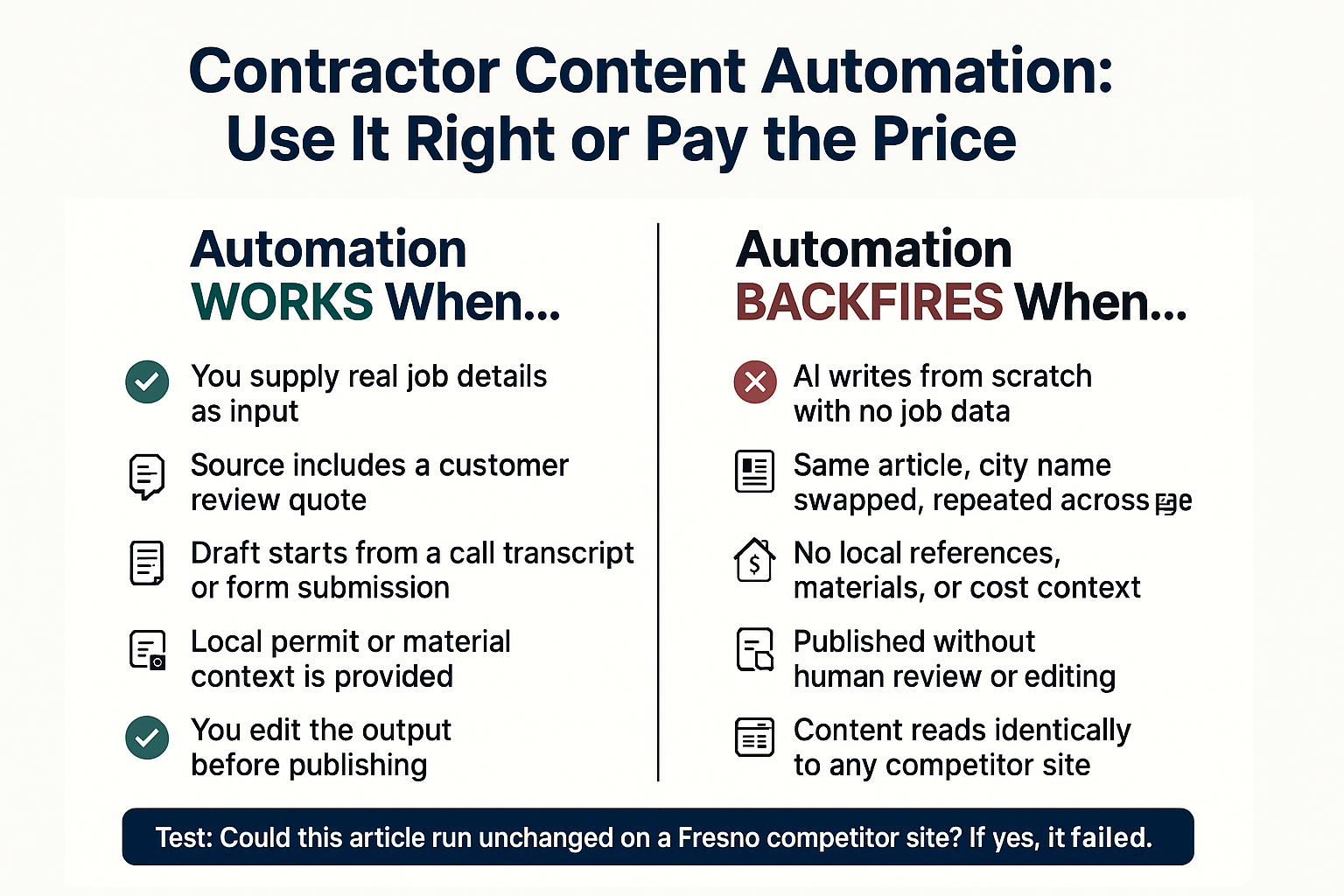
The Source Material That Automation Cannot Replace
There’s a simple test I use with contractors who ask me about this: if the article could run unchanged on a competitor’s website in Fresno or Phoenix with just a city-name swap, it failed.
What automation cannot produce on its own is anything that lives inside your actual business:
- Job-specific details, what you found when you opened up a ceiling in a Carmel Valley home, what failed and why, what the fix actually involved
- Local permit context, Monterey County permit timelines, what the county requires for a panel upgrade versus a straight replacement, what inspectors have been flagging lately
- Coastal material knowledge, roofing materials that hold up against salt-air corrosion on the Peninsula, HVAC performance differences in coastal humidity versus inland Salinas Valley heat, why certain flooring adhesives fail near the water
- Customer language from reviews, the exact words a homeowner used when they described what they valued, which is what AI search platforms are pattern-matching against when they decide who to recommend
- Call and form data, the questions people ask before they book, the objections that kill deals, the phrasing people use when they describe their problem in writing
None of that exists in a public dataset. None of it can be pulled from a general AI model. The three places your best marketing data already lives are your inbound calls, your form submissions, and your reviews, and when you feed that raw material into an automation workflow, you get something original. When you skip that step, you get content that looks like everyone else’s.
According to Google’s content guidelines on helpful content, the standard is consistent: content should demonstrate first-hand expertise and answer questions that come from actual experience with the subject. That standard doesn’t bend for efficiency.
Automated vs. Input-Driven Content: What Each Produces
This table shows the practical output difference between pure AI automation and automation built on real contractor input.
| Content Element | Pure AI Automation | AI + Real Contractor Input |
|---|---|---|
| Local specificity | Generic city-name references only | Actual neighborhoods, permit offices, local failure patterns |
| Customer language | Industry-standard terminology | Real review phrases, real caller questions |
| Job-level detail | Vague process descriptions | What the job involved, what was found, what it cost |
| AI platform citation potential | Low, indistinguishable from competitor content | Higher, verifiable, specific, tied to a real business |
| Google spam risk | Growing, especially for scaled city pages | Low, content has clear reader value |
| Reusable on competitor site? | Yes, with a city-name swap | No, tied to this business’s actual work |
Putting It Together Without Burning Hours
The practical workflow for contractors who want the speed benefits of automation without the visibility risk is straightforward, it just requires one extra step up front.
Before writing anything, collect the raw input:
- Pull two or three recent reviews and copy the exact language customers used
- Grab a call transcript or paraphrase a common question callers ask before booking
- Write three to four sentences about a specific job, what the customer had, what you found, what you did, and what it cost roughly
- Note anything locally specific: what the county required, what material you used because of the coastal environment, what the job timeline looked like
Feed that package into an AI writing tool with a clear prompt, edit the draft for accuracy and tone, and publish it. That process takes maybe 90 minutes total, produces something Google and AI platforms can actually verify as original, and doesn’t sound like the same article your competitor in Seaside just published.
If that workflow sounds like more work than just hitting a button and publishing whatever comes out, it is. But what happens to contractor websites stuffed with AI content is not a hypothetical anymore. The contractors building consistent local visibility in 2026 are the ones whose content contains something no competitor can copy without doing the same actual work.
Frequently Asked Questions About Contractor Content Automation
Is it okay to use AI tools to write contractor blog posts?
Yes, with conditions. AI tools work well when you supply original inputs, job details, local context, customer language from reviews or calls. What they can’t do is generate that original material on their own. If you’re publishing posts that start and finish with an AI prompt and no real-job input, you’re producing content that Google’s scaled content abuse policies are specifically built to catch.
Will Google penalize my contractor website for using AI content?
Google’s policy doesn’t penalize AI content specifically, it penalizes content that exists to manipulate rankings rather than help readers. The practical problem is that most AI-only content fails that test. If your posts lack genuine detail, local specificity, or anything a reader couldn’t find anywhere else, they’re at risk regardless of how they were written. The March 2026 Core Update made that risk more concrete.
What’s the difference between AI content and AI-assisted content?
AI content is produced by the tool from a generic prompt with no original input. AI-assisted content starts with something only you have, a specific job, a customer quote, a local permit detail, and uses automation to structure and draft from that material. The second approach produces something original. The first produces something interchangeable.
How does generic AI content hurt my visibility on ChatGPT or Perplexity?
AI platforms recommend contractors based on verifiable, specific information tied to a real business. Generic content doesn’t give them anything to verify. If your site says the same things in the same way as every other contractor site, there’s no reason for an AI platform to cite you over anyone else. Real job data, specific local references, and authentic customer language are what create a citable footprint. More on that at what AI-powered local SEO actually checks before recommending a contractor.
What if I don’t have time to collect raw input before every post?
Publish less, but make each piece count. One solid, input-driven post per month does more for local visibility than four generic ones. The contractors I’ve worked with in Monterey County who commit to one real, specific article per month consistently outperform those publishing higher volumes of thin content. Frequency matters less than originality when AI platforms and Google’s quality filters are the audience.
Want to Know If Your Current Content Is Working Against You?
We work with home service contractors across Monterey County, from Salinas and Seaside to Carmel Valley and King City, and we can tell within a few minutes whether a site’s content is building visibility or quietly accumulating risk. If you’re unsure where your current setup stands, a 30-minute discovery call with Phil Fisk is a good place to start: https://calendly.com/core6-marketing/30min.