
Direct Answer: Your inbound calls and reviews contain the exact words homeowners type into Google and ChatGPT. Turning that real language into site content is what a Voice of Customer Content Engine does — and it outperforms anything a prompt alone can produce.
Most contractors I talk to in Monterey County think they need to hire someone to come up with SEO content ideas. They’re sitting on a goldmine and treating it like scrap. Every call that comes in, every voicemail, every Google review — that’s your customers handing you the exact words they typed into a search bar right before they dialed.
The problem isn’t a lack of content material. The problem is that nobody has shown you how to treat those calls and reviews as a content system. A roofing contractor in Watsonville doesn’t need a copywriter brainstorming blog ideas. They need someone to pull three months of inbound call recordings and find the five questions every caller asks before they book an appointment.
That’s what a Voice of Customer Content Engine does. It takes what your customers are already telling you and turns it into content your site — and the AI platforms homeowners are now using to find contractors — can actually work with.
Why Generic AI Content Is Getting Contractors Penalized
Google has been explicit about this in its current content guidance: publishing pages at scale without adding real value risks a scaled content abuse penalty. And the enforcement focus is squarely on content that could have been written by anyone, about any market, for any contractor anywhere in the country.
I see this constantly. An HVAC company in Seaside has a blog full of articles with titles like ‘Tips for Keeping Your Home Comfortable Year-Round.’ Nobody searched that. Nobody called because of it. And increasingly, Google is simply not ranking it.
The fix isn’t better prompts. It’s better data going into the process. Specifically:
- A specific job type (‘furnace replacement in a 1970s Salinas home with no existing ductwork’)
- A real customer question pulled from a call recording (‘is it worth repairing my old furnace or should I just replace it?’)
- A geographic detail (‘we serve Marina, Seaside, and Carmel Valley’)
- A before-and-after outcome from an actual job
- A common objection captured from a lost call
That combination produces a page that AI systems can verify and cite. Generic prompts produce content that gives them nothing to work with. For a deeper look at why AI platforms skip some contractors entirely, this breakdown on why ChatGPT recommends your competitor explains the mechanics.
The Call Recordings Nobody Is Mining
Call recordings and transcripts are the most underused first-party data asset in contractor marketing. I’m not talking about listening to every call. I’m talking about a monthly review process that pulls patterns — the recurring questions, the same objections, the location questions that tell you exactly where your content has gaps.
Here’s what that looks like in practice. An electrician in Salinas gets three separate voicemails in one month asking whether a permit is required for an electrical panel upgrade. That’s not a coincidence. That’s a page. A homeowner in Hollister asks ‘do you guys work in Hollister or just Salinas?’ — that’s a location-plus-service signal that belongs on the site, probably on a dedicated Hollister service page or at minimum a clear mention in the service area content.
When you look at your phone calls as SEO content, the pattern becomes obvious fast. Homeowners don’t ask polished questions. They ask real ones. And when you answer those real questions on your site — in the same plain language your callers use — you create content no competitor can replicate, because no competitor took those exact calls.
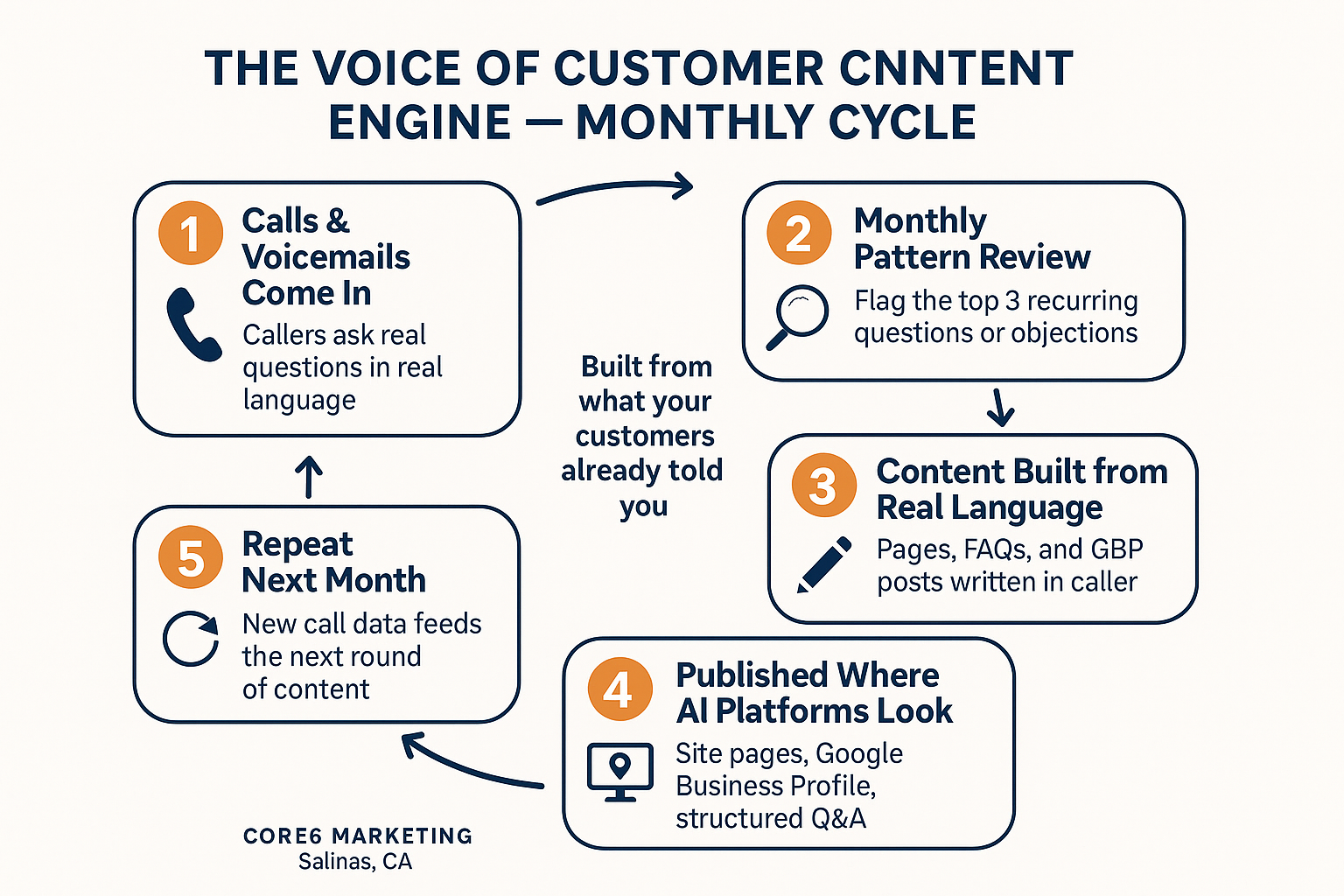
The goal isn’t to do this once. It’s to build a repeatable monthly process:
1. Log calls and flag recurring questions or objections
2. Identify the top three patterns from that month’s call data
3. Build content around those questions — a page, a GBP post, a FAQ addition
4. Publish it in the formats AI platforms actually pull from
5. Repeat the following month with new data
Over time, your site starts to read like it was written by someone who has taken hundreds of calls in your trade — because effectively, it was.

What AI Search Is Actually Pulling — And Why Your Content Needs Local Proof
AI search platforms — ChatGPT, Perplexity, Google’s AI Overviews — are not pulling from generic industry content when they recommend a local contractor. They’re looking for content with specific, verifiable, locally-grounded detail. Research from SOCi’s 2026 Local Visibility Index found that businesses surfaced by AI tools had stronger trust signals and more consistent, specific information across platforms than competitors who were skipped.
Generic content compiled from a prompt gives AI systems nothing to verify. Voice of Customer content gives them named geographies, real service scenarios, and concrete local proof.
Think about what that means for a plumber in Pacific Grove. A page that explains ‘what to do if your water heater is making a popping sound’ is a start. But a page that explains what causes that sound in older homes on the Monterey Peninsula — where water hardness from the municipal supply accelerates sediment buildup — is the kind of specific, locally-grounded answer an AI system can actually surface with confidence.
That specificity doesn’t come from a prompt. It comes from the calls your techs take every week. And it connects directly to why your Google Business Profile functions as an AI feed now, not just a directory listing — the specific details you publish there feed the same systems.
How a Voice of Customer Content Engine Works Month to Month
This shows the repeatable monthly cycle that turns inbound call data into published content — from raw call logs to AI-visible pages.
The Conversion Gap Between Real Language and Polished Language
There’s a specific place where the difference between agency-produced AI content and Voice of Customer content shows up fast: conversion. Not rankings — conversion. The calls a page actually generates.
Pages built from real customer language answer the question the homeowner actually typed, in the phrasing they actually used. Pages built from a prompt answer a polished version of the question that nobody searched.
Consider two roofing contractors in Watsonville. One has a page that says ‘we provide comprehensive roofing solutions for your peace of mind.’ The other has a page that explains ‘how long a roof inspection takes before filing an insurance claim’ — because that’s what their callers ask every time a storm comes through. The second contractor is answering a real question in real language. The first contractor is answering a question nobody asked.
This is also why contractor websites that rank but don’t generate calls are such a common problem on the Central Coast. Rankings are a prerequisite, not an outcome. The page still has to do the work of matching what the homeowner actually needs to hear.
And that match only happens when the content was built from real customer language — not a content calendar, not a keyword list, not a prompt.
Prompt-Generated Content vs. Voice of Customer Content
Here’s how the two approaches compare on the metrics that actually matter for a Central Coast contractor.
| Factor | Prompt-Generated Content | Voice of Customer Content |
|---|---|---|
| Source material | Generic industry knowledge | Real calls, reviews, and form submissions from your market |
| Language match | Polished but often off-phrase | Matches exact words homeowners type and say |
| Local specificity | Minimal or fabricated | Named cities, local conditions, real job scenarios |
| AI platform visibility | Low — nothing to verify | Higher — specific, consistent, locally-grounded |
| Google abuse risk | Higher — scales without added value | Lower — each page adds unique, verifiable detail |
| Conversion rate | Weaker — answers the wrong version of the question | Stronger — answers what callers actually asked |
| Repeatability | Requires constant new prompts | Feeds itself from ongoing call data each month |
A Content Calendar Tells You When. A Content System Tells You What.
Most contractors who’ve tried content marketing have a content calendar. They know they’re supposed to publish twice a month. What they don’t have is a system that tells them what to say.
The Voice of Customer Content Engine is that system. A calendar is just scheduling. A system is built from what your customers are already telling you — so you never sit down to write a page without knowing exactly what question it needs to answer.
Here’s what this looks like for a landscaping company in Carmel Valley. Their calls run heavy in spring and early summer. Recurring question: ‘do you handle water district rebates for drip irrigation?’ That’s not a blog topic someone brainstormed. That’s a page that answers a real question from a real homeowner who is already in buying mode — and who will call the contractor whose site answers it clearly.
For more on how AI systems are now being used to build and maintain this kind of content infrastructure — without requiring contractors to become tech people — this overview of what AI marketing actually means for trades in 2026 is worth reading.
Frequently Asked Questions About the Voice of Customer Content Engine
Do I need call recording software to do this?
You don’t need anything sophisticated to start. A simple notepad log of the questions you hear most often in a given week will get you moving. That said, actual call recordings and transcripts make the pattern-identification process much faster and more reliable. Core6 Clarity, our call tracking add-on, includes call recording, transcription, and a monthly Call Intelligence Report that pulls top caller questions, common objections, and voice-of-customer phrases — so the pattern work is done for you.
How is this different from just writing FAQ pages?
FAQ pages built from guesses are better than nothing. FAQ pages built from your actual call data are a different thing entirely. When three separate callers in one month ask whether you service Hollister, that question has demonstrated search demand behind it. A FAQ page built around what you assumed people might ask is speculative. One built from documented call patterns is evidence-based — and that specificity is exactly what AI search platforms are looking for when they decide who to recommend.
Will this work for AI search, or just Google?
Both — and the reason is the same for both. AI platforms like ChatGPT and Perplexity are looking for specific, verifiable, locally-grounded content when they surface a local contractor recommendation. Generic content gives those systems nothing to confirm. Content built from real customer language — with named geographies, real service scenarios, and concrete local detail — gives AI systems exactly the kind of signal they weight. If you want to understand the full picture of how AI search is changing who gets called for home repairs, that’s worth a read.
What if I don’t get that many inbound calls yet?
Reviews work the same way. A homeowner who leaves a Google review describing what broke, where the job was, and how the tech handled it is giving you usable Voice of Customer language — job type, location, outcome. Even five or six detailed reviews can surface two or three content angles you haven’t covered yet. Start there and add call data as volume grows.
How long before this kind of content starts ranking?
It depends on the competitiveness of the search term and how well the page is built. For specific, locally-focused questions — the kind your callers are actually asking — it’s reasonable to see measurable ranking movement within 30 to 60 days in markets like Salinas, Seaside, or Marina where competition at the hyperlocal level is often thinner than contractors expect. Broader terms take longer. But the more specific the question you’re answering, the faster a well-built page tends to move.
Want to Know What Your Calls Are Already Telling You?
We work with home service contractors across Monterey County — from Salinas and Marina to Carmel Valley and Hollister — and the same pattern shows up everywhere: the best content ideas are sitting in call logs that nobody has looked at. If you want to see what a Voice of Customer Content Engine would actually look like for your trade and your market, you can book a Discovery Call with Phil Fisk at https://core6.marketing/work-with-us/. No pitch deck, no jargon — just a straight conversation about what your calls are telling you and what to do with it.