Direct Answer: Your inbound calls, contact forms, and Google reviews already contain the exact questions homeowners search before hiring a contractor. Turning that data into content beats any generic blog post.
Most contractors I talk to believe they don’t have enough content to work with. They think they need to hire a writer or buy some tool that generates blog topics for them. But when I look at their call volume, their contact form inbox, and their Google reviews, I see the opposite problem — they’re sitting on more usable material than most marketing agencies ever touch.
A plumber in Salinas who fields 40 calls a month has 40 data points on exactly what homeowners in Monterey County are worried about, confused by, or trying to decide before they pick up the phone. That’s not a content library waiting to be written — it’s one that’s already been delivered. The only step missing is turning it into something that shows up when the next homeowner searches.
This article is about first-party data — the calls, forms, and reviews your business already generates — and why it produces better SEO content than anything assembled from a generic prompt or a competitor analysis. I’ll walk through what each source reveals, how to identify the patterns that matter, and what a realistic workflow looks like for a trade contractor who doesn’t have a marketing team.
Why Generic Content Fails Where Your Own Data Doesn’t
AI-generated content answers plausible questions with plausible language. The problem is that plausible isn’t the same as real. A blog post written from a generic prompt about ‘when to replace your water heater’ will sound reasonable — and it will sound identical to the other 300 posts on the same topic written by contractors across the country.
What it won’t have is the detail that makes it specific to someone in Marina asking whether their 12-year-old unit is worth repairing before summer. It won’t use the phrase a homeowner in Seaside typed into a contact form at 9 p.m. It won’t answer the question a caller in Salinas raised about whether the repair would be covered under their home warranty.
AI search platforms — ChatGPT, Perplexity, Google’s AI Overviews — are getting better at distinguishing content built from genuine local experience versus content assembled from aggregated web patterns. As we covered in how ChatGPT decides which plumber or roofer to recommend, the content that gets cited is the content that reflects real, specific knowledge. The content that doesn’t gets summarized away or skipped entirely.
Your calls and forms are specific by definition. They came from real homeowners in your actual service area, asking about real jobs they needed done. That specificity is exactly what search engines — and AI platforms — are rewarding right now.

What Each Source Actually Tells You
There are three sources of first-party data every contractor has access to right now. Each one reveals something different about how homeowners think and what they need to hear before they book.
Inbound calls and voicemails reveal the pre-purchase questions homeowners never voice once they’re on the job. A caller asking ‘I’m not sure if I need a full replacement or just a repair — what do you usually see with a 10-year-old unit?’ is handing you a content brief. That exact question — repair vs. replace — is likely being searched by dozens of their neighbors in Salinas or Pacific Grove every single month. A page that answers it plainly, in the language the homeowner already uses, is more useful to Google than any keyword-stuffed service page.
Contact form submissions capture how homeowners describe their problem in writing, which is often closer to the language they typed into a search bar than anything they’d say out loud. One homeowner might write ‘not sure if I need permits for this’ — which is a FAQ entry. Another writes ‘wanted to get your take before calling anyone’ — which tells you they’re comparison shopping and need content that builds trust before they call.
Google reviews are the only source you can quote directly, and they’re often the most underused. A review that mentions ‘showed up on time,’ ‘explained everything before starting,’ or ‘gave me a straight answer on price’ is a converted customer telling every future homeowner what they were hoping for when they called. That language belongs in your service pages and FAQ sections — not just sitting on a review widget at the bottom of your homepage.
For a deeper look at how review language specifically shapes search visibility, your customers already wrote your best SEO content breaks that down in detail.
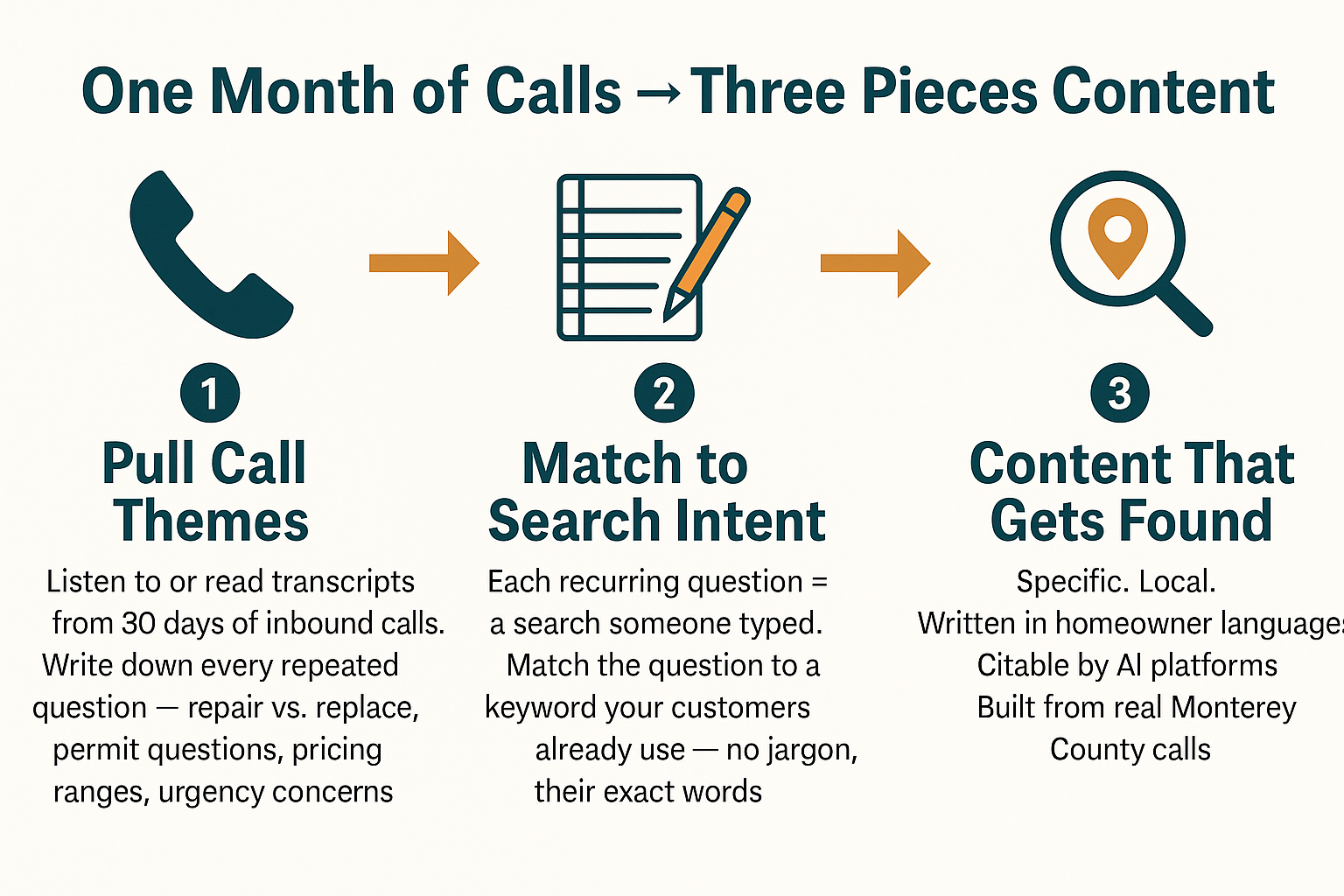
Turning One Month of Calls Into Three Pieces of Content
Here’s what this process actually looks like for an HVAC company or plumber operating in the Salinas Valley.
A Practical Workflow for a Trade Contractor Without a Marketing Team
The gap here isn’t awareness — most contractors I’ve spoken with on the Monterey Peninsula already know their calls are valuable. The gap is that nothing in their current workflow turns that call data into published content. That’s the piece that has to be built deliberately.
Here’s what a realistic monthly process looks like for a plumbing or HVAC company in the Salinas Valley:
- Week 1: Pull call recordings or transcripts from the past 30 days. If you don’t have call recording set up, start writing down recurring questions from memory — you already know what people ask.
- Week 2: Look for three questions that came up more than once. These are your three content opportunities for the month. Write each one down in the homeowner’s own words, not your technical version.
- Week 3: Decide the format for each. A quick factual question (‘Do you work in Carmel Valley?’) becomes an FAQ entry. A complex decision question (‘Should I repair or replace my 15-year-old furnace?’) becomes a short page or a section added to an existing service page. A process question (‘How long does a repipe usually take?’) might become a standalone post.
- Week 4: Write the content using the homeowner’s language as the starting point. Answer the question directly. Add one local detail — the climate factors in the Salinas Valley that affect HVAC lifespan, or the soil conditions in Marina that affect plumbing line wear.
Three pieces of content per month built this way will outperform 12 generic posts assembled from a content calendar that has nothing to do with what your actual customers are actually asking.
And if you want to understand how call data fits into a broader local SEO strategy, how local SEO actually works for home service contractors on the Central Coast gives that full picture.
First-Party Data Sources: What Each One Reveals
These three sources serve different purposes in your content strategy. Understanding what each one is best at helps you use all three rather than defaulting to just one.
| Data Source | What It Reveals | Best Content Format |
|---|---|---|
| Inbound calls & voicemails | Pre-purchase questions, objections, urgency drivers, pricing concerns | FAQ entries, service page sections, comparison posts (repair vs. replace) |
| Contact form submissions | How homeowners describe problems in writing, close to actual search language | Blog posts, location pages, how-it-works sections |
| Google reviews | Outcomes customers valued, trust signals, language that converts future callers | Service page copy, homepage proof points, FAQ answers |
Why This Matters More Now Than It Did Two Years Ago
Google’s direction on content quality has been moving steadily toward one question: did a real person with real experience write this? The Google 2026 updates for contractor content make clear that content demonstrating first-hand experience — specific jobs, specific locations, specific outcomes — is what earns rankings and AI citations.
Content built from your own calls and reviews passes that test automatically. It’s specific because it came from a real job in Watsonville or a real question from a homeowner in King City. It uses the language real people use because those real people wrote or said it. And according to research from the Stanford Internet Observatory, AI systems increasingly surface content that reflects genuine expertise and direct experience over content that simply mirrors other content already on the web.
For a contractor in Monterey County, this is an advantage over competitors who are still buying generic content packages or relying on agencies that write the same blog posts for clients in a dozen different markets. Your calls are local by definition. Your reviews are specific to your trade area. And that specificity is exactly what AI search platforms are selecting for when they decide who gets recommended.
The connection to our AI Search Sync approach is direct — when we build content strategies for contractors on the Central Coast, we start with what the business already knows, not with a keyword spreadsheet. The keyword data shapes distribution; the first-party data shapes the content itself.
Frequently Asked Questions About Using Call and Review Data for SEO
Do I need call recording software to do this?
It helps significantly. Without recordings or transcripts, you’re relying on memory, which means you’ll miss patterns. Basic call tracking tools can run anywhere from a small monthly fee up to a few hundred dollars depending on features. If you’re fielding more than 20 calls a month, having a record of what people asked is worth the investment — both for content and for understanding where calls are dropping off.
Can’t I just use AI to generate the content instead?
You can use AI to help format or polish content — but it can’t replace the source material. AI needs your call themes, your review language, and your form submissions as input. Without that, it generates content that sounds fine but has no local specificity and no connection to what your actual customers are asking. That’s the content Google and AI platforms are deprioritizing right now. We covered this in more depth in your contractor website’s AI slop problem.
How do I find recurring questions in my calls if I don’t have transcripts?
Start with what you already know. Write down the five questions you answer most often on calls. Then ask whoever answers your phones the same question. Between the two of you, you’ll likely surface eight to ten recurring themes that are accurate enough to build content around. That’s a solid starting point before you invest in any tracking tool.
Is it okay to quote a review directly in a blog post?
Yes — reviews are public and that’s appropriate use. Paraphrase calls and form submissions; quote reviews verbatim when the language is specific and compelling. Just don’t alter the wording to make it sound better than it does.
How long before this kind of content starts ranking?
It varies by how competitive the keyword is and how well the page is built. For lower-competition local queries — ‘furnace repair vs. replacement Salinas’ or ‘do I need a permit for a bathroom remodel in Monterey’ — specific, well-structured content can show measurable movement within 30 to 60 days. High-competition terms take longer regardless of content quality.
Want Help Building a System Around What Your Calls Already Know?
We work exclusively with home service contractors on the Central Coast, and the first thing we look at is what your inbound data is already telling you. If you’re fielding calls in Monterey County and none of that intelligence is making it into your content or your rankings, that’s a fixable problem. You can book a 30-minute discovery call with Phil at https://calendly.com/core6-marketing/30min — no pitch, just a real conversation about what your calls are worth and whether there’s a system worth building around them.