Direct Answer: ChatGPT recommends contractors based on review quality, business data completeness, and consistent information across platforms like Yelp, BBB, and Google — not just your Google ranking.
A homeowner in Salinas has a roof leak. Instead of opening Google, she opens ChatGPT and types: “Who’s the best roofing contractor near me?” ChatGPT answers her — with a name. Maybe yours. Probably not.
This used to be a niche behavior. It isn’t anymore. BrightLocal’s 2026 Local Consumer Review Survey found that 45% of consumers now use AI tools to find local services — up from just 6% the year before. A separate Scorpion national study found that 22% of homeowners now go to ChatGPT first, before Google, when they need a contractor. For a plumber in Salinas or an HVAC company on the Monterey Peninsula, that’s a real share of potential calls being routed through a system most contractors have never thought about.
The question I get from contractors all the time is: how does ChatGPT actually pick who it recommends? The answer isn’t mysterious, but it does require understanding a few things that most marketing agencies won’t bother to explain.
ChatGPT Doesn’t Show Ten Results — It Names One or Two
Google gives homeowners a list. ChatGPT gives them an answer.
That’s a meaningful difference. SOCi’s 2026 Local Visibility Index found that ChatGPT recommended only 1.2% of businesses in its study set, compared with 35.9% appearing in Google’s local 3-pack. Getting into that 1.2% isn’t a separate strategy you layer on top of everything else — it comes from the same foundations that drive strong local SEO.
But the stakes are different. If you’re not in Google’s top three, you still show up on page one. If ChatGPT doesn’t name you, you don’t exist in that conversation at all. The homeowner gets a recommendation and moves on. She doesn’t scroll.
What ChatGPT is doing, under the hood, is looking for businesses it can confidently recommend. It needs enough trust signals to clear its own internal threshold before it’ll attach a real contractor’s name to an answer. When there isn’t enough signal, it either gives a vague answer or names a competitor who left more of a digital trail. I’ve written more about this in Why ChatGPT Recommends Your Competitor and Not You if you want to go deeper on the competitive angle.
The practical takeaway: being partially visible online isn’t enough anymore. You either clear the confidence threshold or you don’t get named.

Where ChatGPT Actually Pulls Its Data
This is the part most contractors miss. Different AI platforms pull from different review sources — and they don’t all weight Google the same way.
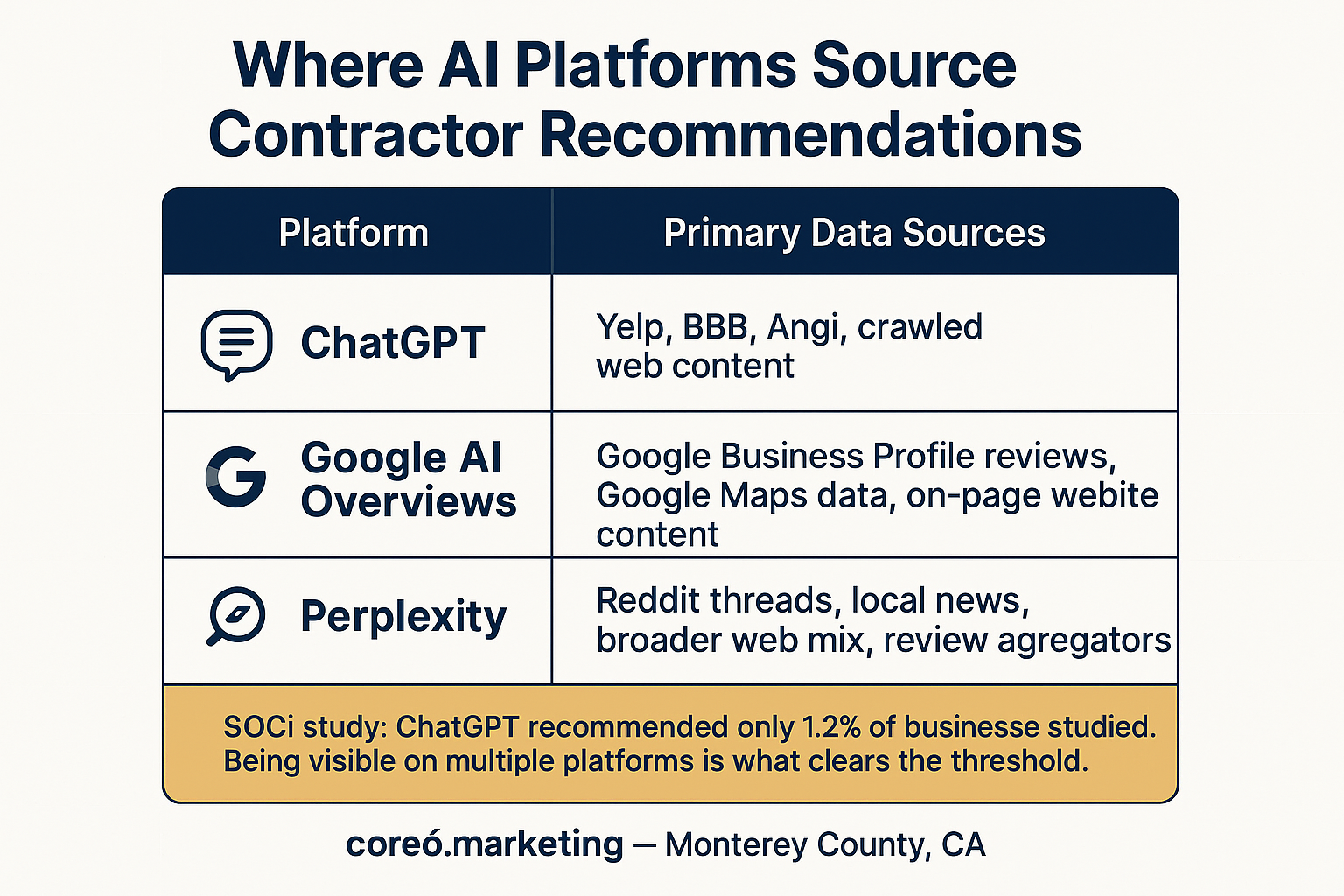
Google AI Overviews lean heavily on Google Business Profile reviews. That makes sense; Google trusts its own data. But ChatGPT draws significantly from Yelp, BBB, and Angi. Perplexity pulls from a broader mix that includes Reddit threads and local news coverage.
For a roofing contractor in Santa Cruz or an electrician in Seaside, that means:
- A thin Yelp profile with two reviews from 2019 is a gap in the data ChatGPT uses to evaluate you
- An unverified BBB listing signals to the system that your business data hasn’t been maintained
- No Angi presence at all — even if you’ve never paid for leads there — means one more platform where you’re invisible to the AI layer
Research suggests businesses recommended by ChatGPT average around 4.3 stars across these platforms. That number matters less as a target and more as context: the businesses getting named aren’t the ones gaming the system. They’re the ones who’ve consistently asked happy customers to leave reviews, across multiple platforms, over time.
One pattern I see repeatedly with contractors in Monterey County: they’ve built a solid Google review profile but completely ignored Yelp because they don’t like the platform. That’s a legitimate frustration — Yelp’s filtering algorithm is notoriously aggressive — but ignoring it creates a real blind spot in what ChatGPT can verify about you. I touched on how AI tools source different types of online content in Reddit Shows Up in AI Search — But Not the Way You Think, which is worth reading if this platform-diversity angle is new to you.
Where AI Search Platforms Get Their Contractor Data
Different AI platforms pull from different sources. Here’s how the major ones compare for home service contractors on the Central Coast.
Business Data Completeness Is the Part Nobody Talks About
Before ChatGPT will recommend a contractor, it has to be reasonably confident that contractor is real and actively serving the area. It does that by cross-referencing your business data across platforms.
Google says businesses with complete and accurate Business Profile information are more likely to appear in local search results — and the same logic applies to the AI recommendation layer sitting on top of it. Incomplete profiles, phone numbers that don’t match across directories, or a service-area description that conflicts with what your website says all give AI systems a reason to skip you.
This matters even more for service-area businesses. A landscaper in Watsonville or a pest control company in Hollister doesn’t have a storefront address to anchor the listing. The only thing proving you serve that area is your business data — your GBP service area settings, your website’s location language, and whether your citations across platforms tell a consistent story.
Common data problems I see on contractor profiles across the Monterey Bay Area:
- Phone number on Google doesn’t match the number on Yelp or the HVAC company’s website
- GBP service area set to a single city when the contractor works across three counties
- Business hours listed as “by appointment” with no further detail, which reads as incomplete to both users and AI systems
- NAP (name, address, phone) inconsistencies left behind from old directory listings that were never updated
Fixing these isn’t glamorous work. But it’s the foundation that everything else sits on. If an AI platform can’t verify your basic information, the quality of your reviews doesn’t matter — you won’t clear the threshold to begin with. This is a core part of what we address through AI Search Sync, our approach to building local visibility across both traditional and AI-powered search.
Your Google Business Profile Is Now an AI Feed, Not Just a Listing goes into more detail on how GBP specifically feeds into AI recommendations — it’s one of the more practical reads on this topic if you manage your own profile.
What AI Platforms Need to Recommend a Local Contractor
These are the signals that AI recommendation systems use to decide whether a contractor clears the confidence threshold. Contractors strong in all three areas are the ones getting named.
| Signal Type | What It Looks Like in Practice | Biggest Gap I See Locally |
|---|---|---|
| Review Volume & Recency | 4+ stars across Google, Yelp, and BBB with reviews from the past 90 days | Strong Google reviews, nothing on Yelp since 2021 |
| Business Data Consistency | Same name, address, phone, and service area across all platforms | GBP phone number doesn’t match the website footer |
| Website Content Clarity | Service pages that name specific cities and trades served | One generic ‘Service Area’ page with no location detail |
| Platform Presence | Active or verified listings on Google, Yelp, BBB, and Angi | Unclaimed Yelp profile, no BBB listing at all |
| Review Source Diversity | Reviews spread across platforms ChatGPT and Perplexity actually pull from | 100% of reviews on Google only |
Reviews Still Drive This — But the Platform Mix Has Changed
I want to be specific here because “get more reviews” is advice every agency gives and almost no one explains properly.
The review strategy that worked well in 2022 — focus everything on Google, ignore the rest — is no longer enough. ChatGPT doesn’t pull primarily from Google reviews. It cross-references Yelp, BBB, and Angi. If a plumber in Marina has 80 Google reviews and four Yelp reviews, ChatGPT sees a very incomplete picture.
The customer language in those reviews also matters more than most people realize. AI systems aren’t just looking at star ratings — they’re reading the text. A review that says “fixed our water heater same day, very professional” gives an AI system something to work with when a homeowner asks about water heater repair in Salinas. Generic reviews like “great company” contribute less signal.
This is why the content of reviews matters alongside the quantity. Your Customers Already Wrote Your Best SEO Content covers this in more detail — how the specific language customers use in reviews gets picked up by search and AI systems alike.
For contractors in Monterey County, the practical move is a simple ask: when a job goes well, tell the customer you’d appreciate a review, and mention one or two platforms — not just Google. Most happy customers will write one review. If you direct them to Google every single time, that’s all you’ll ever build.
Frequently Asked Questions About Getting Found on ChatGPT
Do I need to do something special to get on ChatGPT, or does it pull automatically?
ChatGPT pulls from existing sources — your Google Business Profile, Yelp, BBB, Angi, your website, and other public data. There’s no separate submission process. What you can control is the completeness and consistency of that data, and the volume and quality of reviews across those platforms. The AI recommendation happens automatically once you’ve built enough signal.
I have great Google reviews. Why isn’t ChatGPT recommending me?
Google reviews help with Google AI Overviews, but ChatGPT draws heavily from Yelp, BBB, and Angi — not primarily from Google. If those platforms are thin or unclaimed, ChatGPT sees an incomplete picture of your business. Strong Google reviews are a good start, but they don’t carry over automatically to what ChatGPT is reading.
How long does it take to start showing up in AI recommendations?
There’s no definitive timeline because AI systems update their data on their own crawl schedules. In our experience working with contractors on the Central Coast, cleaning up business data inconsistencies and building review volume across multiple platforms tends to show improvement in overall local visibility within 30 to 60 days — though AI-specific recommendation changes are harder to track in real time than traditional search rankings.
Does this replace regular local SEO, or is it something separate?
It’s not separate. The same foundations that drive strong local SEO — accurate business data, consistent citations, quality reviews, clear website content — are exactly what AI systems use to evaluate contractors. AI Search Sync, the approach we use at Core6, is built to address both layers at the same time rather than treating them as two different problems.
What if I’m a service-area business with no physical storefront? Does that hurt my chances?
It’s a real challenge, but not a disqualifying one. Service-area settings on your Google Business Profile, consistent location language on your website, and verified listings on secondary platforms all help AI systems confirm you’re actively serving a given area. The key is making sure every platform tells the same story about where you work — gaps in that data are where service-area businesses tend to lose ground.
Want to Know Where You Stand in AI Search Right Now?
We work specifically with home service contractors on the Central Coast — plumbers, roofers, HVAC companies, electricians, landscapers — and we look at this exact picture for every new client: review distribution across platforms, business data consistency, and where the gaps are that AI systems use to skip you. If you’re curious how your business looks to ChatGPT or Perplexity right now, a Discovery Call with Phil is a good place to start. You can book 30 minutes at https://calendly.com/core6-marketing/30min.