
Direct Answer: Using AI tools produces one-off outputs. Having an AI system produces a consistent, locally grounded content pipeline that builds search visibility over time — and the difference shows up in your rankings.
I’ve talked to a lot of contractors on the Monterey Peninsula who’ve started poking around with AI. They’ve used ChatGPT to crank out a blog post or run a job description through an AI writer. And honestly, that’s a reasonable place to start — but it’s not a content system, and the gap between the two is where most of them stall out.
Using an AI tool produces an output. Using an AI system produces a pipeline — something that keeps running, keeps publishing locally relevant content, and keeps compounding over time in the eyes of Google and AI search platforms. For a roofing contractor in Salinas or an HVAC company in Pacific Grove, that distinction is the difference between a website that slowly builds real search authority and one that just has more pages.
This article is about what that distinction actually looks like in practice — what goes into a real contractor SEO content automation approach versus the grab-and-go version most contractors settle for.
What ‘Using AI Tools’ Actually Looks Like
Most contractors I talk to who say they’re ‘doing AI marketing’ are doing some version of the same thing: they open ChatGPT, type in a prompt like ‘write a blog post about water heater installation in Salinas,’ and publish whatever comes back.
That’s using a tool. And the content it produces has a few predictable problems:
- It reads exactly like every other AI-generated post on every other plumbing site in every other city
- There’s nothing in it that only someone working in Monterey County would know — no reference to the older cast-iron supply lines common in Marina’s post-WWII housing stock, no mention of Seaside permit timelines, no voice from an actual customer call
- Google and AI platforms like Perplexity and ChatGPT are getting better at recognizing commodity content, and they’re increasingly likely to treat it as such
According to ServiceTitan’s 2026 AI in the Skilled Trades report, 46% of contractors were already using or experimenting with AI, and 51% said marketing and sales was where they saw the most measurable impact. But here’s the part that stuck with me: 59% said they preferred AI embedded in their existing workflows — not as a separate project they had to manage on top of running a business.
That preference makes complete sense. Contractors don’t want a new tool to learn. They want something that runs inside the operation they already have. That’s what separates a tool from a system.
If you’ve ever wondered why ChatGPT recommends your competitor and not you, the answer usually comes back to this: whoever their system is recommending has more specific, verifiable content online — not just more content.

What a Real AI Content System Is Built On
A system isn’t a better prompt. It’s a repeatable process that feeds AI the right inputs and routes the outputs through a quality filter before anything goes live.
The contractors who get the most out of AI-assisted marketing aren’t the ones using AI the most. They’re the ones giving it the best raw material. That raw material comes from actual jobs:
- A call transcript where a Seaside homeowner asked about permit timelines for a panel upgrade
- A job note about an unusual heat exchanger failure pattern in 1970s-era Pacific Grove homes
- Before-and-after photos from a Salinas bathroom renovation with a short written summary of what was wrong and what was done
- A recurring question from customers in Carmel Valley about whether their well water affects water heater longevity
That kind of input is what AI can actually do something useful with. Feed it that, and what comes out is specific, verifiable, and locally grounded. Something a homeowner in Monterey County would actually trust. Something Google and AI platforms can cite.
Feed it nothing — or just a generic topic — and what comes out is the same commodity material every other contractor in the country is publishing with the same prompts.
This is exactly what we mean when we say your phone calls are the best SEO content you’re not using. The raw material for a real content system is already sitting inside your business. The system just turns it into something searchable.
And that’s the core difference in approach: a tool takes a prompt and returns an output. A system takes real job data, runs it through AI with local editorial oversight, and publishes content that reflects genuine trade knowledge — content that holds up when a homeowner or an algorithm looks closely at it.
Tool vs. System: What Each Produces Over Time
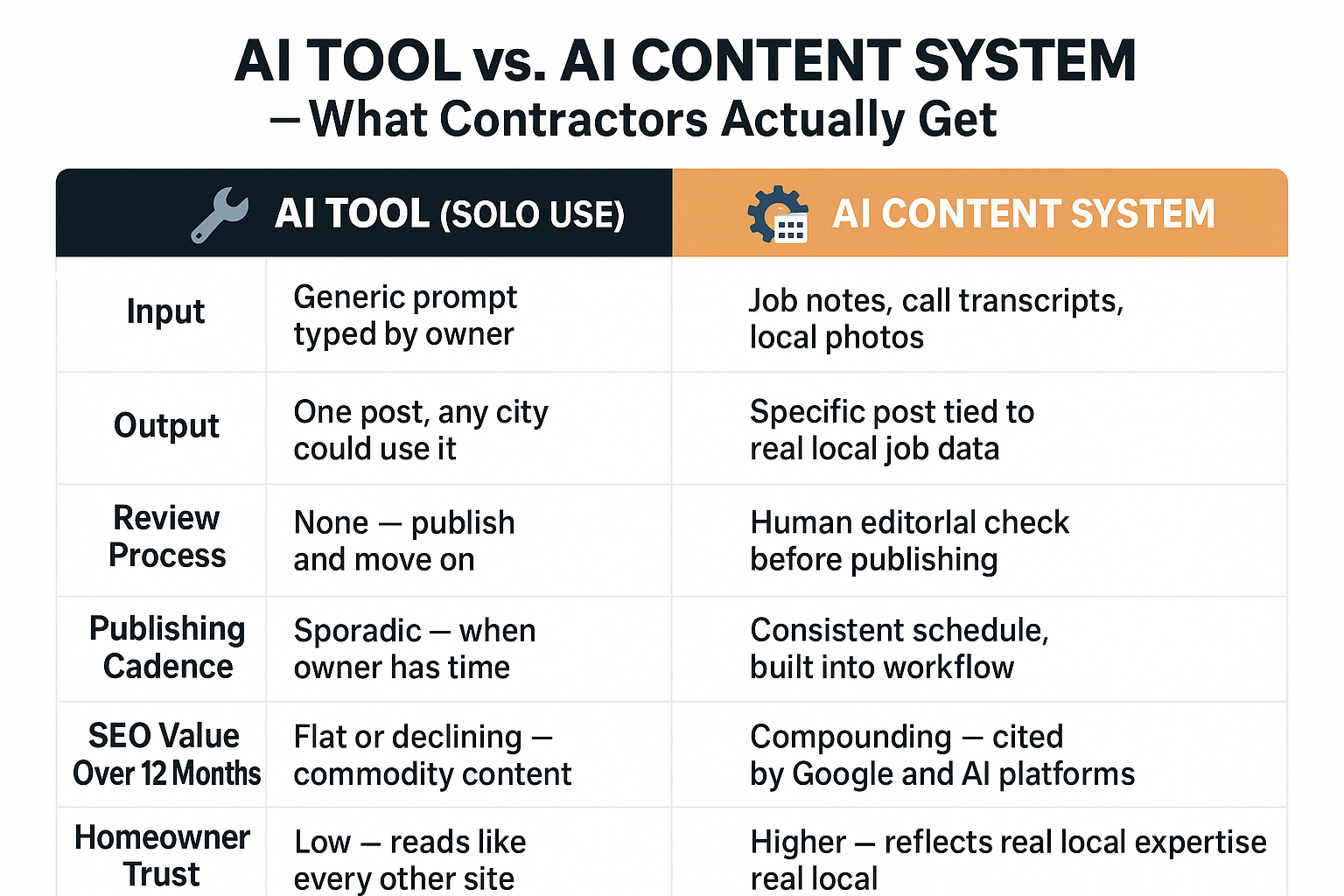
This comparison shows how the two approaches diverge in output quality, local specificity, and long-term SEO impact for contractors.
Why Volume Without a Filter Creates the Opposite of What You Want
There’s a version of AI content automation that I genuinely think hurts contractors — and it’s more common than it should be.
Some agencies are publishing 15 or more posts per month for their contractor clients using AI with no local sourcing, no human review, and no original trade knowledge behind any of it. The pitch sounds good: more content, more pages, more SEO. But the math doesn’t work the way they’re implying.
Google’s helpful content guidance has consistently moved toward rewarding depth and specificity over volume. AI-generated content that covers the same ground every other contractor site covers — with slightly different phrasing and a local city name dropped in — is increasingly easy for algorithms to recognize as commodity material. And it’s increasingly easy for homeowners to smell, too.
If you’ve ever wondered whether your own site has this problem, the article Your Contractor Website Has an AI Slop Problem (Here’s the Test) walks through exactly how to check.
A content system built on genuine inputs — real calls, real jobs, real local context — doesn’t need 15 posts a month to build authority. It needs fewer, more specific posts that reflect what you actually know about doing this work in Monterey County. That’s what compounds. That’s what gets cited by AI platforms when a homeowner in Carmel asks ChatGPT who to call for a panel upgrade.
For a deeper look at how AI search is already changing who gets called, How AI Search Is Changing Who Gets Called for Home Repairs covers the mechanics in plain terms.
How the Two Approaches Compare on Key Metrics
This isn’t an abstract comparison — these are the differences that show up in actual search performance and lead quality over a 6-to-12-month window.
| Factor | AI Tool (Ad Hoc) | AI Content System |
|---|---|---|
| Local specificity | Low — generic city mentions | High — real job data, local permit context, named neighborhoods |
| Publishing consistency | Sporadic — owner-dependent | Scheduled — runs whether owner has time or not |
| Human editorial oversight | None | Required before every publish |
| Google recognition over time | Flat or filtered out | Builds domain authority progressively |
| AI platform citations (ChatGPT, Perplexity) | Rarely cited — not specific enough | Citable — has verifiable local detail |
| Content useful after 2 years | Low — dates poorly | Higher — built around trade knowledge, not trends |
The Local Inputs That Make the Difference
I want to be concrete about what ‘local inputs’ actually means for a contractor in this market, because it’s not complicated — it’s just underused.
Think about what’s already happening in your business every day:
- A customer in Seaside called asking whether she needs a permit to replace a water heater in a condo — and your tech walked her through the Seaside Building Department’s process
- You completed a re-roof in Carmel Valley and noticed the deck had moisture damage from marine layer exposure that most inland contractors wouldn’t account for
- A homeowner in Marina asked whether their 1960s slab foundation would affect a bathroom remodel — a question you’ve answered a dozen times
Every one of those is raw material for content that no AI prompt from a competitor can replicate. It’s specific to this market, this housing stock, these permit jurisdictions. And when that knowledge is structured properly and published consistently, it’s the kind of content that AI platforms pull from when a homeowner asks a real question.
That’s the what AI marketing actually means for a plumber or HVAC company in 2026 version of this conversation — not chatbots and science fiction, but a system that takes what you already know and makes it findable by the people who need you.
The barrier, according to 44% of contractors in the ServiceTitan data, is training and integration. And that’s honest — building a system takes setup. But once it’s running inside your existing workflow, it stops feeling like a marketing project and starts feeling like part of how the business operates.
Frequently Asked Questions About Contractor SEO Content Automation
If I’ve already been publishing AI-generated blog posts, do I need to delete them?
Not necessarily all of them. The real question is whether they contain anything a homeowner in your specific market would find useful that they couldn’t find on a competitor’s site in Phoenix or Portland. If a post is genuinely thin — same generic advice, no local context, no trade depth — it may be worth consolidating or updating rather than just leaving it to accumulate. Deleting in bulk without a strategy can cause its own ranking issues, so it’s worth reviewing before acting.
How much content does a contractor actually need to publish to see SEO results?
There’s no universal number, but more isn’t automatically better. A consistent cadence of 2-4 well-sourced posts per month will outperform 15 thin posts per month over any meaningful timeframe. Google has been explicit about rewarding helpful, specific content. Volume for its own sake is not the goal.
Can I run an AI content system myself, or does it require an agency?
You can build parts of it yourself, but the hardest part isn’t the AI — it’s the editorial layer and the consistency. Most owner-operators on the Central Coast don’t have 3-4 hours a week to source job notes, structure prompts, review outputs for accuracy, and maintain a publishing schedule. That’s where the system breaks down without dedicated support behind it.
Will AI-generated content hurt my Google rankings?
AI-generated content that is generic, thin, and interchangeable with any other site in your category will eventually hurt you — or simply fail to help, which costs you time and opportunity. AI-assisted content that is locally grounded, editorially reviewed, and reflects real trade knowledge is treated by Google the same way any good content is: based on whether it’s actually useful to the person reading it.
What’s the connection between content automation and AI platforms recommending contractors?
When someone asks ChatGPT or Perplexity to recommend an HVAC company in Monterey County, those platforms pull from indexed content that contains specific, verifiable information about the business and its work. A contractor with a system publishing locally specific content over time builds a larger surface area for those citations. A contractor with a handful of generic AI posts has very little for those platforms to work with. Why your competitor showed up in ChatGPT covers this dynamic in more detail.
Ready to Build a Content System That Actually Works for Your Market?
If you’re a contractor on the Central Coast — Salinas, Monterey, Seaside, Pacific Grove, anywhere in this market — and you’re tired of guessing whether your website is building anything real, we’re happy to take a look at what you have and give you an honest read. Core6 Marketing works exclusively with home service contractors in this region, and we’ve been doing it long enough to know what actually moves the needle here versus what just looks good in a report. You can book a 30-minute discovery call with Phil directly at https://core6.marketing/work-with-us/.