
Direct Answer: Month one is setup and cleanup with early ranking movement. Months two and three turn call data into content. Months four through six is when call quality and AI visibility show up.
Most contractors I talk to in Monterey County have already paid somebody for marketing. The stories run the same way: money went out every month, a report came in full of charts, and the phone did not sound any different. Some of them bought shared leads and got calls for work they do not even perform.
So when an owner asks me about an AI marketing system for contractors, they are not really asking about strategy. They are asking a simpler question: when does the phone ring, and what am I supposed to be looking at in the meantime.
That is what this article covers. Month one through month six, what actually happens, what to measure at each stage, and what should make you nervous.
Month One Is Cleanup, and It Looks Like Nothing
The first 30 days are unglamorous. Nobody wants to hear that, but pretending otherwise is how vendors lose trust in month three.
Here is what the first month usually consists of:
- Business data cleanup. Old addresses, disconnected numbers, and half-dead directory listings from a shop that moved from Salinas to Marina five years ago.
- Google Business Profile fields filled out completely, not just the name and category.
- Name, address, and phone matched across the directories that AI tools and search engines check to verify a business is real.
- Tracking numbers installed and call recording turned on so there is a record of what people actually say.
- Schema markup added so software can read what the business does and where it works.
None of that produces a booked job. It produces the conditions under which everything later works. This is the foundation layer of AI search visibility, and skipping it is why a lot of contractor sites stay invisible no matter how many blog posts get published.
Our benchmark is first measurable ranking movement inside 30 days. Say that out loud with me: movement, not revenue. A map position climbing from 14 to 7 in Seaside is real progress and it pays nobody’s insurance bill yet.
If your provider promises booked jobs in week two, that is a sales number, not a plan.

Months Two and Three: The Calls Start Driving the Work
This is where a real system separates from a content mill. Once calls are being recorded and transcribed, the words customers use stop being a guess.
Homeowners do not call and ask about sewer lateral replacement. In home service call logs, they say things like water is coming through the ceiling from upstairs, or both toilets backed up at the same time, or the hot water only lasts five minutes and the unit is a year and a half old.
Those sentences become the work:
- Caller questions become page topics. The five things people ask before they book turn into headings on a service page.
- Objections from lost calls get answered in writing before the next caller raises them.
- Ad headlines borrow caller phrasing instead of agency phrasing.
- Google Business Profile posts repeat the same language.
The number to watch in this stretch is not raw call volume. It is qualified-call rate, meaning the share of calls that are actually your kind of job in your service area.
I have seen one home service business where that rate roughly doubled month over month, moving from 31 percent to 61 percent, during a period when same-day availability and clear upfront pricing were what callers asked about most before booking. That is an observed pattern in a specific situation, not a promise, and not something any agency should take sole credit for. But it shows what happens when the answers people want are already sitting on the page.
This is the loop content built from real customer questions runs on, and call recording is what feeds it. Our call reporting is how we capture it, and it is included with active SEO and Google Ads campaigns rather than sold separately.
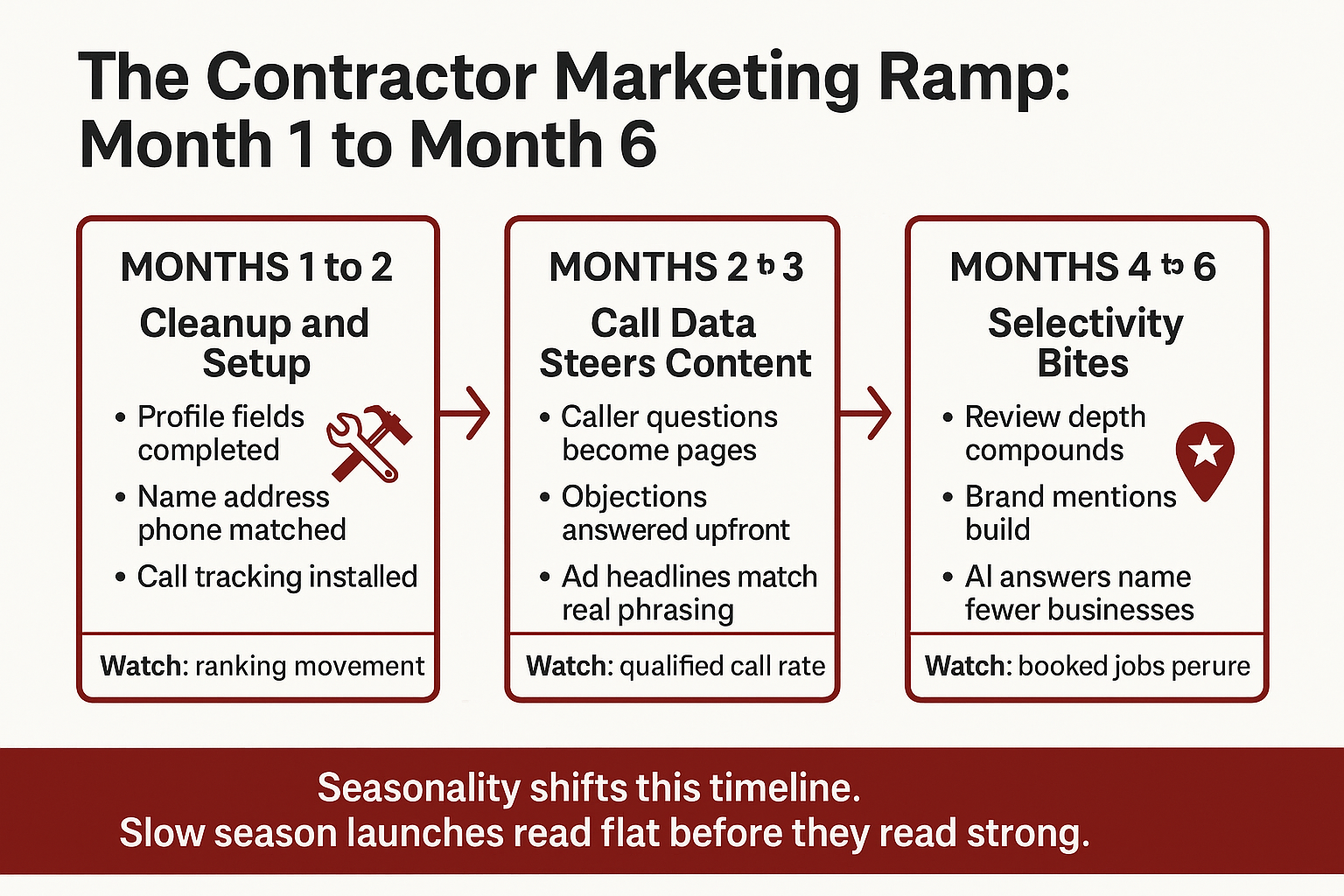
The Six Month Ramp at a Glance
Here is the same timeline in one view, including the number that matters at each stage.
Months Four Through Six: Fewer Names Get Said Out Loud
By month four, the question changes. It stops being whether you show up and becomes whether you get named.
Research on AI-generated local results has found that AI local packs surface only about a third as many businesses as a traditional Google three-pack. One 2026 study found ChatGPT recommended a small fraction of the locations that appeared in Google’s three-pack for the same query.
Think about what that means for a plumber in Pacific Grove. The old map pack gave three names. An AI answer may give one, maybe two, and then move on. Positions four through ten stop existing in any practical sense.
So months four through six are where everything from months one through three either pays off or does not:
- Reviews that name the trade, the city, and the job type give AI tools context to work with.
- Brand mentions across local news, directories, and press build the pattern of a business that keeps showing up.
- Pages that answer the actual question get quoted instead of skimmed past.
A review that says “great service” does almost nothing. A review that says a crew replaced a collapsed storm drain pipe on a Carmel Valley property and fixed the drainage does a lot. That is why review wording matters more now than review count alone, and why we go after the review language that gets a contractor named rather than just chasing five stars.
This is also the stretch where booked jobs start tracing cleanly back to a source, because six months of call recordings tell you which ad and which page produced which call.
What to Watch, Month by Month
Different stages call for different numbers. Judging month one by revenue is how good systems get killed early.
| Timeframe | What Is Happening | The Number That Matters |
|---|---|---|
| Month 1 | Data cleanup, profile completion, tracking installed | First ranking movement |
| Months 2 to 3 | Call transcripts turn into pages and ad copy | Qualified-call rate |
| Months 4 to 5 | Reviews and brand mentions build trust evidence | Calls that reach a quote |
| Month 6 | Sources become traceable end to end | Booked jobs per channel |
Central Coast Seasonality Bends the Whole Timeline
This part gets ignored constantly, and it is the single biggest reason a ramp reads wrong.
Demand on the Central Coast is not flat, and it is not the same for every trade:
- Landscaping and tree work spike after winter storms push through the Salinas Valley and limbs come down.
- HVAC replacement interest builds through late summer inland, where Hollister and King City run far hotter than anything on the Peninsula.
- Roofing inquiries cluster after the first real rain, when the leak everybody ignored in August finally shows itself.
If a tree service launches a system in July, months one through three land in the quiet half of the year. The numbers will look soft. Then February hits and the same system that looked flat looks like a machine.
That is not a rescue story, it is arithmetic. Read the ramp against your own season, not against a calendar. And if you are launching in your slow half, front-load the content that will be sitting there ready when demand turns.
Three Questions to Ask at the 60 Day Mark
By day 60 you should be able to get straight answers. If you cannot, that is information too.
Ask these:
- “Which specific ad or page produced my last five calls?” A vendor with call tracking answers this in a minute. A vendor without it changes the subject to impressions.
- “What are callers asking before they book, and what did you change because of it?” This separates a system that listens from a content schedule that runs on autopilot.
- “What did you fix on my profile and listings in month one?” There should be a list. If the answer is vague, the cleanup probably did not happen.
Things that should worry you: a big surge in month one that vanishes by month three, a report full of impressions and clicks with no call outcomes, and any provider who cannot connect a call to its source.
Complaints about marketing vendors and lead sellers filed with regulators tend to repeat the same themes, and the Federal Trade Commission’s business guidance is worth a read if you want to see the patterns spelled out. If you are still shopping, the questions to ask before handing over your budget cover this in more depth.
Frequently Asked Questions About Ramping an AI Marketing System
When should I expect the phone to actually ring more?
For most contractors it is somewhere in months three through six, and it depends heavily on your trade’s season and how competitive your city is. Ranking movement shows up much earlier, often inside 30 days, but movement and booked jobs are different things.
Why did my old agency show growing traffic while my calls stayed flat?
Traffic is easy to grow and easy to grow badly. If the pages pull in people outside your service area or people looking for work you do not do, the chart goes up and the phone does not. Without call tracking, nobody can tell the difference.
Is a qualified-call rate of 31 percent bad?
Not necessarily. It depends on how wide your ads and pages are cast. What matters is the direction over a few months. If it is climbing and your total volume is steady, the system is learning who your customer is.
Do I need a new website before any of this works?
Sometimes, sometimes not. If the current site loads fast on a phone and has real service pages, we usually work with it first. If it is a template brochure with one page for everything, content has nowhere to live. Rankings can wobble during a rebuild, which is covered in more detail in our piece on rebuilding a site.
What happens in month seven and beyond?
The loop keeps running. New call transcripts every month, new questions, new pages, and review language that keeps getting more specific. The compounding is the point, which is why month six is a checkpoint and not a finish line.
Thinking About What the Next Six Months Should Look Like?
If you run a home service business anywhere from Salinas to Carmel Valley and you want an honest read on where your ramp would start, Phil Fisk takes discovery calls directly rather than passing you to an account manager. Core6 works month to month, with no 12 month contract, so the timeline above is the only thing holding the relationship together. You can reach the office at (831) 789-9320.