
Direct Answer: If any competitor in your trade could publish your website content without changing a single sentence, you have an AI slop problem. Generic content hurts rankings and loses homeowners before they ever call.
Pull up your service pages right now and read one out loud. Not to yourself — actually read it aloud, the way a homeowner in Salinas or Monterey would read it before deciding whether to call you. Does it sound like you wrote it, or does it sound like everyone else?
If it mentions that you’re ‘committed to quality,’ that you ‘serve the surrounding areas,’ and that you ‘use the latest techniques,’ I already know the answer. That’s AI slop — content generated at scale, filled with sentences that could belong to any contractor in any city in the country.
This has become a real problem on the Central Coast. According to Ahrefs, 87% of marketers now use AI to help create content, and teams using AI publish a median of 17 articles per month. That volume is hard to argue with economically. But the side effect is that contractor websites in Salinas, Marina, and Seaside are starting to read like carbon copies of each other — and Google noticed.
The One-Sentence Test That Tells You Everything
Read your homepage or your main service page and ask yourself one question: could any competitor in your trade publish this exact page without changing a single sentence?
If the answer is yes, that page is commodity content. It doesn’t matter whether a human wrote it in 2018 or an AI generated it in 30 seconds last Tuesday — the result is the same. It gives no one a reason to trust you over the next contractor in the search results.
Google calls this ‘scaled content abuse’ — using AI to generate many pages without adding real value. Their spam systems specifically target it. Home service websites were among the hardest-hit categories in both the March and May 2026 core updates, which re-weighted rankings based on specificity, originality, and demonstrated local expertise. If your rankings dropped in that window, this is worth taking seriously.
The tell-tale signs are usually the same across every site I look at:
- Generic service descriptions that name the service but never explain the actual process
- City names dropped into otherwise identical paragraphs (‘We serve Salinas, Monterey, and Pacific Grove!’)
- Lists of benefits that no one could disagree with and no competitor would dispute
- Zero mention of what a job actually costs in this market
- No reference to anything local — not a code, not a permit office, not a neighborhood pattern
If three or more of those match your site, the test result is in.

Why Generic Content Fails Homeowners — Not Just Google
I want to be clear about something: this isn’t primarily an SEO problem. It’s a trust problem.
When a homeowner in Carmel Valley is deciding whether to call a roofer or a plumber, they’re doing research first. They’re reading to find proof that you actually know their situation — the age of the housing stock in their neighborhood, what a realistic repair costs in Monterey County, how a diagnostic actually works before any price is quoted.
AI-generated content almost never contains that detail. It can’t, because it wasn’t built from anything specific. It was built from averages, from what’s generally true about the trade, from the same Wikipedia-level summaries every other site is pulling from.
I’ve looked at dozens of contractor sites across the Monterey Bay Area, and the pattern is consistent. The pages that actually convert visitors into calls are the ones that mention real things:
- What permits the Salinas Building Department requires for certain electrical panel upgrades
- Why slab leaks are more common in older neighborhoods like East Salinas due to pipe age
- What a full HVAC replacement actually runs in Monterey County, framed honestly as a range based on system size and access
- What the job site looks like after the work is done
That kind of specificity is what builds trust before a phone call. A homeowner reading it thinks, this person has actually done this here. Generic content never creates that feeling.
If you want to see what this looks like on a trade-specific level, the breakdown in what makes an electrician’s website actually generate calls is a good read — the same principles apply across every trade.
The AI Slop Checklist: Does Your Site Pass?
This checklist covers the six markers I look for when reviewing a contractor site for generic AI content. The more boxes that get checked, the bigger the problem.
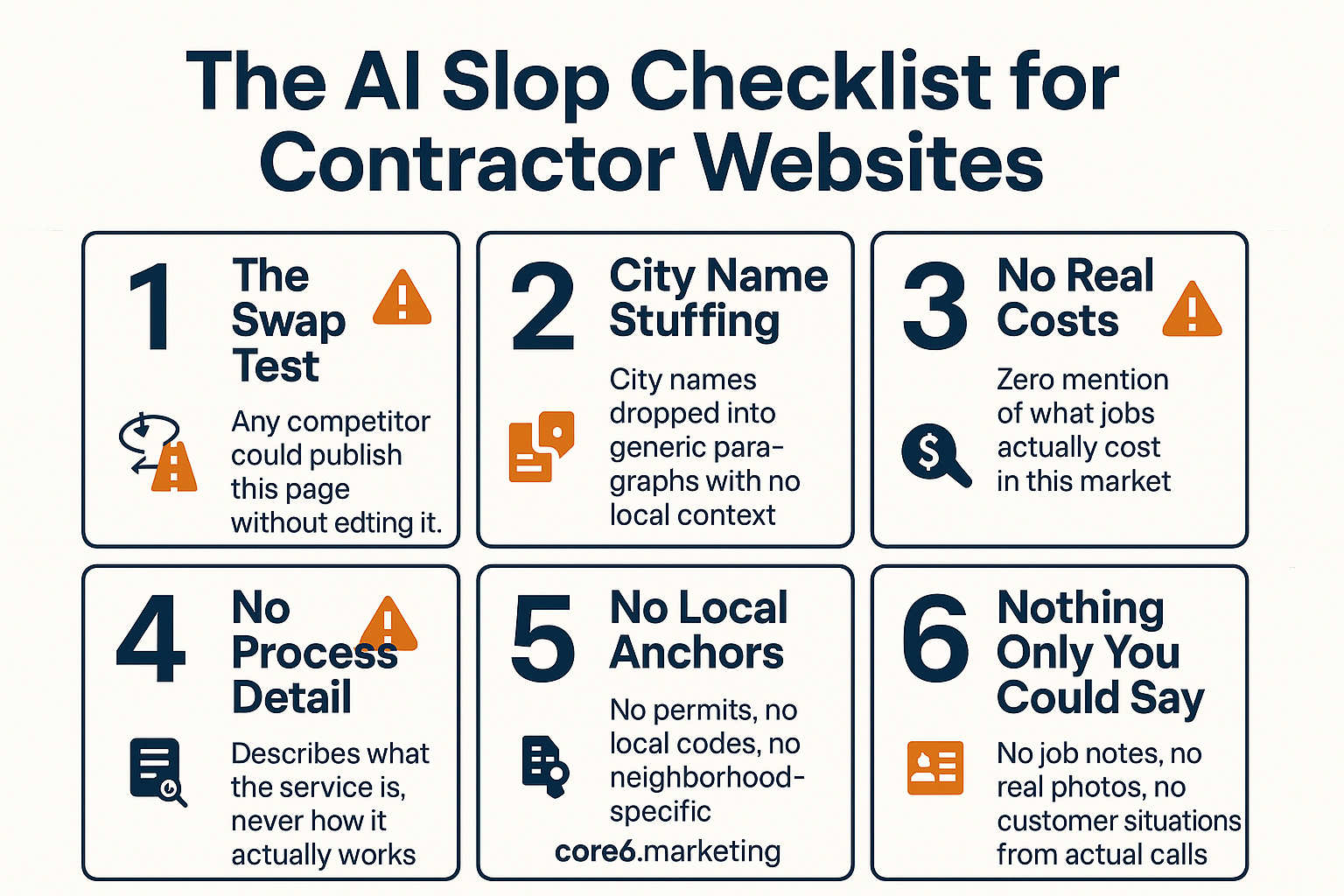 Contractor Website Has an AI Slop Problem (Here’s the Test)” />
The Fix Isn’t Better Prompts — It’s Better Inputs
A lot of contractors think the solution is finding a smarter AI tool or a better content service. I’ve seen that approach play out enough times to know it doesn’t work.
The real problem isn’t the tool — it’s what you’re feeding it. AI can structure a page, draft a paragraph, and format content efficiently. But it can only produce original, specific content when it starts with original, specific material.
The contractors whose websites hold rankings and convert visitors into calls are doing something their competitors aren’t: they’re feeding real job data into the content process. That means:
- Call recordings — the actual questions homeowners ask before booking
- Job notes — what was found on-site, what was done, what alternatives existed
- Real cost ranges — what jobs in Monterey County are actually running right now
- Before-and-after photos from specific jobs, with context
- Local failure patterns — why drain lines fail in certain soil conditions, why certain HVAC systems underperform in coastal humidity
Content built from that raw material passes every test — algorithmic and human — because no competitor has access to it. They don’t have your calls. They don’t have your job notes. They don’t know what the homeowner in Seaside asked about before she booked.
We wrote about this directly in your phone calls are the best SEO content you’re not using. The short version: most contractors are sitting on a library of specific, trust-building content from every call they’ve ever taken. Almost none of it is on their website.
This is also the core idea behind how AI search is changing who gets called for home repairs — AI-powered search platforms like ChatGPT and Perplexity are pulling from the same pool of content. If your content is generic, it gets ignored by both Google and AI search summaries. If it’s specific, both favor it.
Generic AI Content vs. Specific Content: What the Difference Looks Like
This is what the same topic looks like when handled generically versus when it’s built from real job knowledge. One of these gets ignored. The other builds trust.
| Topic | Generic AI Version | Specific, Trust-Building Version |
|---|---|---|
| Service cost | ‘Prices vary based on the scope of work. Contact us for a free estimate.’ | ‘A standard panel upgrade in Salinas typically runs somewhere in the range of $2,500–$4,500 depending on amperage and whether the Salinas Building Department requires a new meter base — which they often do on older homes.’ |
| Service process | ‘Our technicians will diagnose the issue and provide a solution that fits your needs.’ | ‘We start with a camera inspection on drain calls before quoting anything. About 40% of the time in older East Salinas homes, what looks like a clog is actually a partially collapsed line.’ |
| Local relevance | ‘We proudly serve Salinas, Monterey, Pacific Grove, and the surrounding areas.’ | ‘Coastal humidity on the Monterey Peninsula accelerates condenser coil corrosion — we see it in systems less than 8 years old in Marina and Seaside more than anywhere else in the county.’ |
| Social proof | ‘We are committed to customer satisfaction and quality workmanship.’ | ‘The homeowner in Carmel Valley had been quoted twice before calling us. Both previous quotes missed the secondary leak behind the drywall — we found it on the camera pass.’ |
What This Means for AI Search — Not Just Google
Google rankings are only part of the picture now. A growing share of homeowners are asking ChatGPT, Perplexity, or Gemini which contractor to call before they ever open a search results page.
Those AI platforms pull from the same content pool. Generic, interchangeable pages don’t get cited in AI answers — there’s nothing to cite. Specific, detailed pages that answer real questions with real local context do get surfaced, because the AI has something concrete to pull from.
I covered this in depth in why ChatGPT recommends your competitor and not you. The core issue is the same: if your content could belong to anyone, AI has no reason to surface your name specifically.
Our AI search visibility methodology is built around this exact problem — getting contractors ranked in traditional search and visible in AI-generated answers by ensuring every piece of content is specific enough to be worth citing. But that only works if the underlying content has something real to say. No technical optimization rescues a page that has nothing original on it.
Frequently Asked Questions About AI Slop on Contractor Websites
Can Google actually tell if my content was written by AI?
Google has said publicly that it’s not trying to penalize AI-written content specifically — it’s targeting content that is generic, unhelpful, and mass-produced without adding real value. That’s what they call ‘scaled content abuse.’ An AI-written page that contains specific local knowledge, real cost context, and actual trade expertise is treated the same as a well-written human page. A page that reads like it came from a template — whether AI wrote it or a human did — is what gets caught.
My rankings dropped after the March or May 2026 updates. Is this the reason?
It’s possible. Both updates specifically re-weighted home service sites based on specificity and originality. If your pages are generic, that’s a likely contributor. But ranking drops can have multiple causes — thin content is one, technical issues are another, and competitor gains can look like a loss even when you didn’t change anything. A page-by-page content audit is the honest starting point.
Is it okay to use AI to write my website content at all?
Yes — but the AI needs real inputs to work from. If you give it your actual call recordings, job notes, real photos, and local cost observations, it can structure and draft that material efficiently. If you give it nothing but a service name and a city, you’ll get commodity content every time. The tool isn’t the problem. What you feed it is.
How do I know if my website content is specific enough?
Run the swap test: read the page and ask whether any other contractor in your trade could publish it without changing a sentence. If yes, it’s not specific enough. Also check whether you mention real local cost ranges, reference a specific local permit or code requirement, or describe how your diagnostic process actually works on a job — not just what service you offer. Those details are what separates a useful page from a placeholder.
Does this problem affect my Google Business Profile too, or just my website?
Mostly your website. Your Google Business Profile is driven by reviews, categories, and citations — not written content in the same way. That said, the posts you publish to your GBP face the same issue: generic posts get ignored, specific ones (a real job, a real question answered, a real before-and-after) get engagement.
Want a Straight Answer on What Your Site Actually Looks Like?
If you’re not sure whether your contractor website passes the swap test, we’re happy to take a look on a Discovery Call. We work with owner-operated contractors across Monterey County, Salinas, Santa Cruz, and the broader Central Coast — and we’ve reviewed enough sites at this point to tell you in the first 15 minutes whether your content is working for you or against you. Book a time with Phil directly at https://core6.marketing/work-with-us/.