
Direct Answer: Standing out as a local contractor in 2026 comes down to five things: a specific website, an active Google Business Profile, consistent reviews, clean citations, and real social presence — not just more content.
If you’re a plumber, roofer, HVAC tech, or landscaper on the Central Coast, you’ve probably noticed the market feels more crowded than it did five years ago. And you’re not imagining it. Since COVID, a wave of tradespeople went out on their own — stimulus money, layoffs, and low barriers to entry pushed dozens of new operators into every local service market, including right here in Monterey County.
I’ve watched this play out firsthand. A market that once had a handful of established players now has dozens of businesses competing for the same searches. And recently the problem got a new layer: AI content tools made it cheap and fast to publish generic service pages and clone city landing pages at scale. Teams using AI now publish a median of 17 articles a month versus 12 for teams that don’t — which means the real competitor isn’t just the guy two towns over anymore. It’s every contractor who bought a content subscription and started flooding local search with filler.
The good news: most of that content is garbage, and both Google and AI search tools are starting to treat it that way. The contractors who win in 2026 won’t be the ones publishing the most — they’ll be the ones whose digital presence is built from things no template can fake. Here are five specific things you can do right now to stay visible, stay trusted, and keep your phone ringing.
Why Standing Out as a Local Contractor Is Harder Than Ever
Before we get to the list, it helps to understand what you’re actually competing against now — because the landscape shifted in a way most contractors haven’t fully registered.
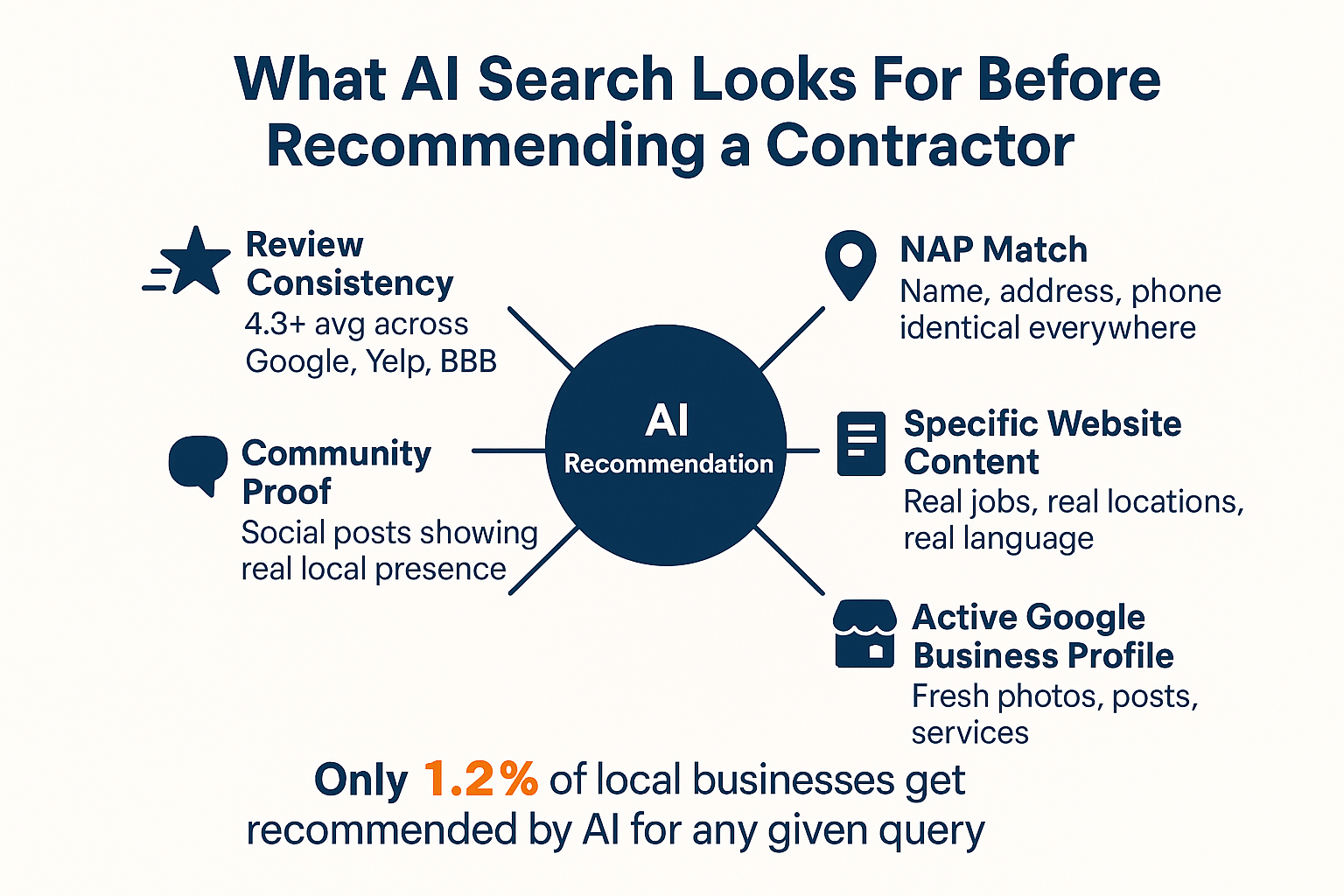
The AI search piece is the newer wrinkle, and it matters a lot. Research analyzing over 350,000 business locations found that AI tools like ChatGPT currently recommend only about 1.2% of local businesses for any given query. Put that in contractor terms: if there are 80 plumbing companies across the Monterey Bay Area, AI is effectively naming just one of them.
Most contractors’ instinct is to respond to more competition by publishing more content. But Google’s own policies now treat mass AI-generated pages that don’t add real value as a quality violation — and recent core updates have reportedly penalized thin AI content while rewarding demonstrated expertise. Pumping out generic city pages doesn’t just waste money. It can actively damage rankings that were already working.
The real differentiator is specificity. Homeowners describe their problems in specific language — they mention the system’s age, the neighborhood, the noise it’s been making since last winter. Content that reflects that specific local reality outperforms templated pages because it’s the kind of thing AI systems can actually cite, and homeowners can actually trust. We cover this in more detail in how AI search is changing who gets called for home repairs.
With that framing in place — here’s what to actually do about it.
1. Update Your Website Frequently — With Real, Specific Content
Every new page on your website is a potential door for a customer to find you. But it only works as a door if it says something a competitor’s templated page doesn’t.
That means blog posts written about real jobs — not hypothetical ones. FAQs that use the exact language homeowners use when they call. Service pages that mention specific neighborhoods, specific equipment brands, specific problems you’ve actually solved in Seaside or Salinas or Carmel Valley.
Here’s what actually moves the needle:
– Blog posts tied to real local scenarios (e.g., “Why Older Homes in Pacific Grove Need Panel Inspections Before Adding EV Chargers”)
– Geo-pages that describe your real service presence in a city — not just a page with the city name swapped in
– FAQs built from actual customer questions, not guessed ones
– Service pages updated when your offerings, pricing context, or service area change
The goal isn’t volume. It’s pages that couldn’t have been written by someone who’s never set foot in Monterey County. We’ve written more on this in the content you’re already sitting on and not using for SEO — because most contractors have more raw material than they realize.
And if you’re worried your current site is already leaning too hard on AI-generated filler, this test can tell you quickly.

2. Keep Your Google Business Profile Current
Your Google Business Profile (GBP) is often the first impression a homeowner gets — and sometimes the only one before they call. It’s also one of the strongest signals both Google and AI tools use to verify that your business is real, active, and locally relevant.
A stale GBP with photos from 2021 and a services list that hasn’t been touched sends the wrong signal. Fresh activity matters more than most contractors expect.
Specifically:
– Add new job photos at least twice a month — real work, real locations, not stock images
– Review your services list every quarter and make sure it reflects what you actually offer right now
– Post GBP updates regularly — seasonal service reminders, completed project highlights, answered FAQs
– Respond to every question in the Q&A section before a stranger answers it for you
For contractors in Salinas, Monterey, and across the Peninsula, GBP is often what separates businesses that show up in the local 3-pack from those that don’t. We’ve written a full breakdown of why your Google Business Profile is now an AI feed, not just a listing — worth reading if you haven’t touched your profile in a while.
3. Build a Consistent Review Record Across Multiple Platforms
Reviews do two things now that they didn’t used to do as clearly.
First, they influence AI recommendations directly. Research on AI-recommended local businesses found they average 4.3 stars, and consistent reviews across Google, Yelp, and BBB appear to strengthen AI confidence in a business. Second — and this is the part most contractors miss — homeowners now double-check AI recommendations against real reviews before calling. So review depth and consistency matter twice over.
The contractors I see doing this well have built the review request into their job-completion workflow. Not an awkward ask at the end of a call — a simple, frictionless link texted or emailed when the job is done and the customer is happy.
A few things that matter:
– Ask consistently — not just when you remember to
– Respond to every review, positive or negative, within a few days
– Spread reviews across platforms — Google is primary, but Yelp and BBB count too
– Don’t chase quantity at the expense of authenticity — a handful of detailed, specific reviews outperforms 50 generic five-stars
For more on how customer language in reviews can actually feed your SEO, see your customers already wrote your best SEO content.
What AI Search Actually Looks For in a Local Business
These are the core signals AI tools check before recommending a contractor — and where most local businesses fall short.
4. Audit and Fix Your NAP Citations
NAP stands for Name, Address, Phone number — and it needs to match exactly, everywhere your business appears online.
This sounds tedious because it is. But it matters more than most contractors realize, especially now. When AI tools like ChatGPT or Perplexity evaluate whether to recommend a local business, they cross-reference business data across dozens of directories and data sources. Inconsistent NAP data — an old phone number on Yelp, a misspelled street on Angi, a different business name on a directory from 2018 — quietly disqualifies a contractor without them ever knowing why.
An NAP audit should look at:
– Google Business Profile (primary source — everything else should match this)
– Yelp, BBB, Angi, HomeAdvisor — high-traffic directories that AI tools actively reference
– Industry-specific directories — ACCA for HVAC, NRCA for roofing, and similar
– Local directories — Monterey County-specific listings, Chamber of Commerce profiles, local newspapers
Fix errors before building new citations. One accurate listing is worth more than ten inconsistent ones. And as we cover in how ChatGPT decides which plumber or roofer to recommend, this kind of verified data consistency is one of the clearest signals that separates recommended businesses from ignored ones.
High-Impact Citation Sources for Central Coast Contractors
Not all citations carry equal weight. These are the platforms that matter most for contractors competing in Monterey County and the surrounding region.
| Platform | Why It Matters | Priority Level |
|---|---|---|
| Google Business Profile | Primary source — AI tools anchor to this first | Critical |
| BBB (Better Business Bureau) | Trust signal; AI tools cite accreditation status | High |
| Yelp | High-traffic; frequently cross-referenced by AI | High |
| Angi / HomeAdvisor | Wide reach; inconsistent data here hurts overall NAP | High |
| Chamber of Commerce Listings | Local authority signal; Salinas Valley and Pajaro Valley Chambers especially relevant | Medium |
| Industry Association Directories | ACCA, NRCA, PHCC, etc. — niche trust signals | Medium |
| Apple Maps / Bing Places | Secondary search surfaces; still indexed by AI tools | Medium |
5. Post Regularly on Social Profiles — And Make It Local
Social media isn’t just for brand awareness anymore. Consistent, authentic social activity is one of the few digital signals that no AI tool can fake or template — because it shows real presence in real communities.
That distinction matters. A landscaping company in Watsonville that posts photos from actual jobs in the Pajaro Valley, tags local neighborhoods, and occasionally mentions community events looks very different to both homeowners and AI tools than a contractor running a generic “5 Tips for Your Lawn” post from a content calendar they bought online.
What actually works:
– Before-and-after photos from real local jobs — specific neighborhoods or landmarks when appropriate
– Team content — crew on the job, recognizable faces, real people
– Community involvement — local events, sponsorships, anything that shows you’re genuinely part of this area
– Answered questions — post the questions customers ask most, then answer them directly
The cadence matters less than the consistency. Posting two or three times a week with real content beats posting daily with filler. And on the Monterey Peninsula, where community identity is strong, local specificity in your social presence carries more weight than it might in a larger anonymous market.
This also connects back to your website content strategy. The language customers use in comments and messages is the same language they use when they search — and your phone calls are some of the best SEO content you’re not using. Real local engagement feeds everything.
Frequently Asked Questions About Standing Out as a Local Contractor
Do I really need to worry about AI search, or is Google still what matters most?
Google still drives the majority of local search traffic — that hasn’t changed. But AI tools like ChatGPT and Perplexity are becoming a real part of how homeowners research contractors before calling. The important thing is that the same signals that help you rank in Google — active GBP, consistent NAP, specific content, strong reviews — are also what AI tools use to decide who to recommend. You’re not building two separate strategies. You’re building one digital presence that works across both.
Is publishing a lot of content still useful, or is more content actually hurting contractors now?
Volume without substance is actively risky now. Google’s recent core updates have penalized thin, AI-generated content, and AI search tools ignore generic pages that don’t demonstrate real local expertise. A single well-written page about a specific job type in a specific Monterey County city will outperform ten templated city pages. Publish less, but make what you publish specific and real. We go deeper on this in what Google’s 2026 updates actually mean for contractor content.
How often should I be updating my Google Business Profile?
At minimum, post a GBP update once a week and add new job photos at least twice a month. Review your services list quarterly. The goal is a profile that looks actively managed — not one that was set up in 2020 and forgotten.
My reviews are mostly on Google. Do I need them on other platforms too?
Yes, and this matters more than it used to. AI tools appear to weight businesses that have consistent review records across multiple platforms — Google, Yelp, and BBB are the three most important for most contractors. A business with 80 Google reviews and nothing elsewhere looks narrower to an AI tool than one with 50 across all three. Start asking customers to leave reviews on whichever platform they’re most comfortable with, not just Google.
Can a smaller local contractor actually compete with larger regional companies online?
Yes — and often more effectively, because local specificity is an advantage that bigger operators running a national playbook can’t replicate. A pest control company in Salinas that writes about the specific pests common to the Salinas Valley microclimate, names neighborhoods, and has reviews from recognizable local zip codes will outperform a regional chain’s generic California landing page. The internet rewards specificity, and specificity is something a local owner-operator naturally has more of.
Ready to Build a Digital Presence That Actually Holds Up?
The contractors who stay visible over the next few years won’t be the ones publishing the most content — they’ll be the ones whose digital presence is built from things no competitor can copy: real job details, real customer language, verified data that matches everywhere, and a review record that reflects actual work done in actual Monterey County communities. If you want to see where your current presence stands and what’s worth fixing first, Core6 Marketing works exclusively with home service contractors on the Central Coast and can walk you through exactly that. Book a discovery call with Phil at https://core6.marketing/work-with-us/.