
Direct Answer: AI assistants like ChatGPT and Gemini now recommend specific local contractors by name. Businesses with structured, consistent online information get named. Those without it don’t.
A homeowner in Carmel Valley has a slow drain that turned into a backed-up bathroom on a Saturday morning. She doesn’t open Google and scroll through ten blue links. She opens ChatGPT, types ‘best plumber near me in Carmel Valley CA,’ and calls whoever the AI names first.
That shift happened fast. Consumer use of AI tools to find local service businesses jumped from roughly 6% in 2025 to 45% in 2026 — a single year. For plumbers, roofers, HVAC companies, and electricians on the Monterey Bay Area, that means a real and growing share of inbound calls now starts with an AI assistant, not a Google search.
The contractors showing up in those AI answers aren’t necessarily the biggest operations or the ones with the most reviews. They’re the ones whose business information is structured in a way that machines can read and trust. I want to explain exactly what that means — and what it costs you if your information isn’t.
AI Assistants Name One or Two Businesses — Not Ten
Traditional Google search returns a list. You might rank third or fifth and still get a call. AI answer engines don’t work that way. ChatGPT, Gemini, and Perplexity synthesize available data and surface one or two business names as a direct answer. If you’re not one of them, you don’t exist in that interaction.
According to the SOCi 2026 Local Visibility Index, ChatGPT currently recommends only about 1.2% of all local business locations for any given query. That’s an incredibly narrow window. And the businesses making it through that window aren’t winning because of ad spend or because they’ve been around the longest.
They’re winning because their business information is machine-readable — meaning it’s structured, consistent, and formatted in a way that AI systems can parse and trust. In practical terms, that comes down to three things:
- Schema markup on your website — structured code that tells search engines and AI systems exactly what your business does, where you serve, and how to reach you
- Consistent NAP data — your business name, address, and phone number matching exactly across your website, Google Business Profile, Yelp, BBB, and every other directory where you appear
- Answer-formatted content on your service pages — written to directly answer the questions homeowners actually ask, not just stuffed with keywords
I’ve written more about how local SEO actually works for home service contractors on the Central Coast if you want the deeper background. But the short version: the foundation that made you visible on Google in 2019 is the same foundation that makes you visible to AI in 2026 — it just needs to be built to a higher standard now.

Your Google Business Profile Is Now an AI Data Source
Most contractors think of their Google Business Profile as a Google thing — something that affects where they rank in Maps or local search. That’s only part of the picture now.
ChatGPT pulls heavily from GBP data when answering local queries. So does Gemini. Perplexity uses it for real-time local availability data. An HVAC company in Salinas with an incomplete or outdated GBP isn’t just losing visibility on Google — it’s feeding bad or missing data to every AI system a homeowner might use to find a contractor.
Five GBP fields carry the most weight with AI systems right now:
- Business categories — your primary and secondary categories tell AI what type of work you do. A roofing contractor in Marina listed only under ‘General Contractor’ will be invisible to AI queries specifically looking for roofing help.
- Service list — each service you add becomes a data point AI can match to a homeowner’s query. If ‘water heater replacement’ isn’t listed, don’t expect to show up when someone asks ChatGPT who handles water heaters in Seaside.
- Review content — AI doesn’t just count your stars. It reads what reviews say (more on this below).
- Q&A section — the questions and answers on your profile are often pulled directly into AI responses. If the Q&A is empty, you’re leaving that space blank for a competitor to fill.
- Recent post activity — posts signal that your business is active and current. AI systems, especially Perplexity, weight recency when determining whether a business is still operating.
If you want to understand why an incomplete digital presence costs you more than just Google rankings, this piece on why contractor websites rank but don’t ring covers the gap between visibility and actual calls.
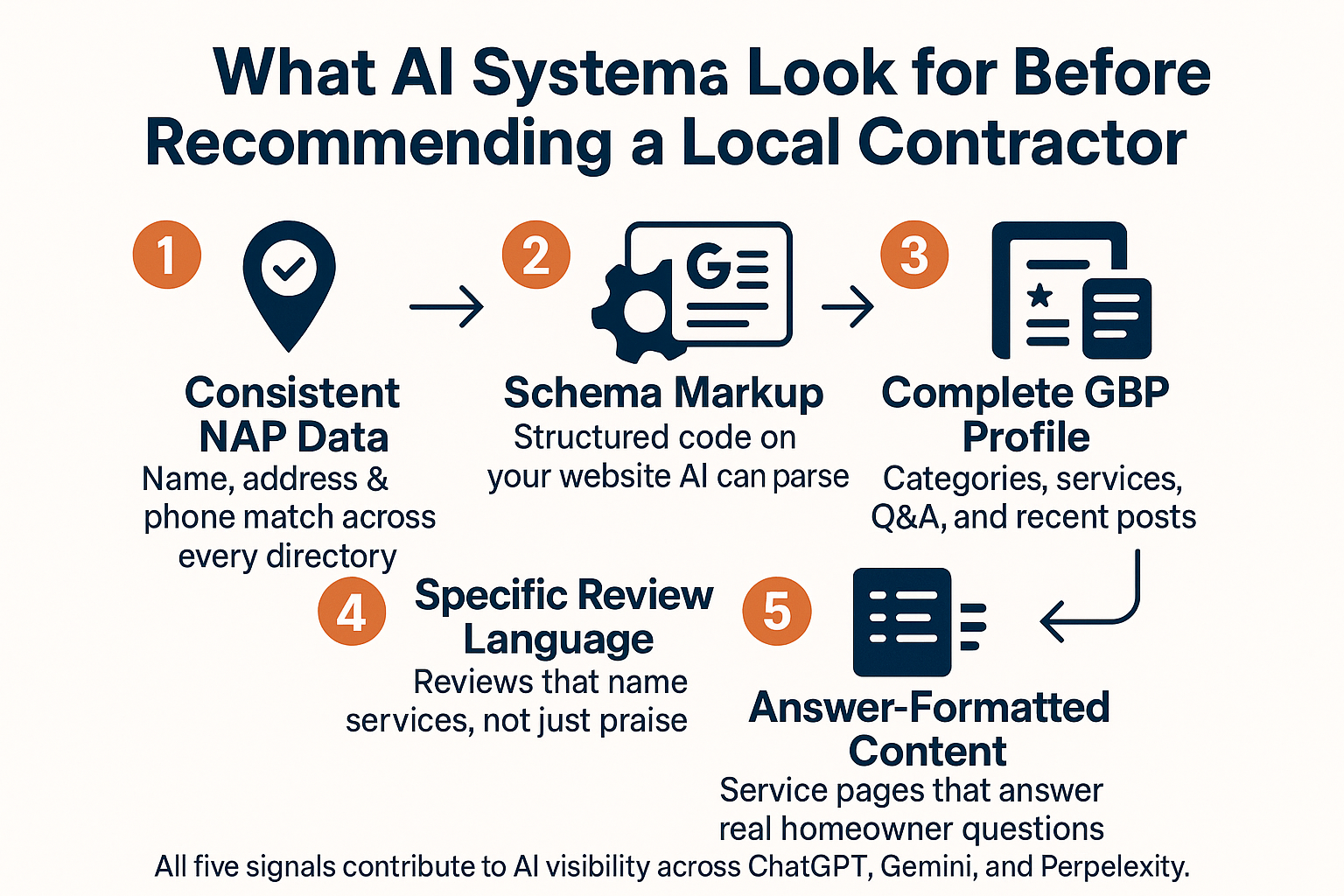
What AI Systems Look for Before Recommending a Local Contractor
This breakdown shows the five data signals AI search engines rely on most when deciding which local contractor to recommend for a home service query.
Reviews Do Something Different for AI Than They Do for Google
When a homeowner searches Google Maps, your star rating and review count both matter. AI answer engines work differently. They read review content and use it to describe your business in their response.
I’ve seen this play out in a way that surprises most contractors. A pest control company in Watsonville with 30 reviews that specifically mention services by name — ‘they found the source of our termite problem in one visit,’ ‘handled the rodent issue in our crawl space same week’ — is more likely to be cited by an AI assistant than a competitor with 80 generic five-star reviews that just say ‘great service’ and ‘highly recommend.’
The reason is straightforward: AI systems are trying to answer a specific question. When a homeowner in Watsonville asks ‘who handles termite problems near me,’ ChatGPT is looking for a business whose reviews actually mention termites. Generic praise doesn’t give it anything to work with.
The practical implication is that the language your customers use in reviews becomes the language AI uses to describe your business. If you want to be recommended for emergency HVAC repair in Monterey, you need reviews that mention emergency HVAC repair in Monterey.
This doesn’t mean coaching customers to write keyword-stuffed reviews. It means making it easy for happy customers to leave detailed feedback — and asking them right after the job, when the specifics are fresh. Your competitor may already be showing up in ChatGPT for exactly this reason.
Traditional Local SEO vs. AI Search Visibility: What’s Different
The table below shows where traditional local SEO and AI search visibility overlap — and where they diverge. Both matter in 2026.
| Factor | Traditional Google SEO | AI Search Visibility |
|---|---|---|
| Review count | High importance | Moderate — content matters more than count |
| Review content / language | Low importance | High importance — AI reads and cites it |
| Schema markup on website | Helpful | Critical for machine readability |
| GBP completeness | Important for Maps ranking | Important for AI data sourcing |
| Consistent NAP across directories | Important | Very high importance — AI cross-references sources |
| Answer-formatted service page content | Helpful for featured snippets | High importance — AI pulls direct answers |
| Recent GBP post activity | Minor signal | Signals active business to real-time AI tools like Perplexity |
| Backlinks | High importance | Moderate — less weight in AI local recommendations |
What a Local SEO Strategy Built for 2026 Actually Looks Like
Most of what passes for local SEO in our market is still built for 2019. It’s focused on Google rankings, a few directory listings, and occasional review requests. That work still has value — but it leaves a growing portion of search behavior completely uncovered.
The methodology we built at Core6 — AI search visibility — addresses this directly. It covers traditional Google ranking signals alongside visibility across ChatGPT, Perplexity, and Gemini. That means Google Business Profile optimization, citation consistency across the directories AI systems pull from, schema markup, and service page content written to answer the questions real homeowners ask.
This isn’t a theoretical approach. AI marketing for local businesses is already determining which electrician in Pacific Grove gets called and which one doesn’t — and the window to get positioned is narrowing as more contractors pay attention to it.
If you want to understand where your current visibility stands across both Google and AI search, that’s exactly what we start with on a Discovery Call. We look at what the major AI platforms are currently saying about your business — or not saying — and build from there.
Frequently Asked Questions About AI Search and Local Contractor Visibility
Does my business need to be on ChatGPT or do anything special to show up there?
You can’t create a profile on ChatGPT the way you can on Google. AI systems pull from sources that already exist — your Google Business Profile, your website, your directory listings, and your reviews. The work happens on those platforms, not on the AI tool itself. If those sources are complete, consistent, and well-structured, you’re a candidate to be recommended. If they’re not, the AI simply won’t have enough reliable data to name you.
I already rank well on Google. Doesn’t that mean I’ll show up in AI searches too?
Not automatically. Google rankings and AI recommendations are related but not the same. A strong Google Maps presence helps — ChatGPT and Gemini do pull GBP data. But AI systems also weight factors that traditional SEO doesn’t prioritize as heavily, like the specificity of your review language, your schema markup, and whether your service page content directly answers natural-language questions. Ranking well on Google is a good starting point, but it doesn’t guarantee AI visibility.
How quickly could changes to my GBP or website affect AI recommendations?
It varies by platform. Perplexity updates more frequently because it pulls real-time data. ChatGPT and Gemini work from data that refreshes on a slower cycle. In our experience working with contractors on the Central Coast, meaningful ranking improvement on Google can show up within 30 days of structured work — but AI visibility tends to build over several months as your updated information propagates across the sources these systems trust.
A homeowner told me she found us through ChatGPT. Should I be doing something differently to track that?
Yes. Standard Google Analytics won’t separate AI-referred traffic cleanly. Call tracking is the most reliable way to understand where your inbound calls are actually coming from — including which calls came after an AI search versus a Google search versus a direct visit. If you’re not tracking calls with dedicated numbers and recording those conversations, you’re flying blind on attribution.
Is this only relevant for certain trades, or does it apply to all home service contractors?
It applies across the board. I’ve seen it affect roofers in Salinas, HVAC companies on the Monterey Peninsula, electricians in Santa Cruz, and landscapers in Carmel Valley. Any trade where a homeowner might describe a problem to an AI assistant and ask for a recommendation is affected. The trades with longer sales cycles — roofing, remodels, HVAC replacements — may feel it first, because those homeowners tend to research more before calling.
Want to Know Where Your Business Stands in AI Search Right Now?
We work exclusively with home service contractors on the Monterey Bay Area and Central Coast, and we built AI search visibility specifically for this moment — when the way homeowners find a roofer in Marina or an electrician in Pacific Grove is changing faster than most contractors realize. If you want to see what ChatGPT, Gemini, and Perplexity are currently saying about your business — and what it would take to show up consistently — book a Discovery Call with Phil at https://core6.marketing/work-with-us/.