
Direct Answer: Usually it is review recency, not your star average. Google and homeowners both weigh recent reviews heavily. Ten reviews from the last 90 days move the Salinas map pack more than 200 from 2021.
You have 80 Google reviews and a 4.8 average. The shop two miles up the road has 31 reviews and sits above you in the map pack for your main service in Salinas. That math does not feel fair, and most owners I talk to assume Google broke something.
It did not. In almost every Monterey County profile I pull up with this complaint, the stars are fine and the date stamps are the problem. The newest review is from 2023, collected during one push after a good season, and nothing has landed since.
Below is what changed, what a recent review is actually worth now, and a review habit your crew can keep during a January rush without anyone babysitting it.
Why am I not showing up in the Google map pack with good reviews?
Lifetime review count used to carry a profile for years. It does not anymore, and 2026 is the year that showed up clearly in the data.
The 2026 round of local search ranking factor surveys moved review recency from the back of the list into the top handful of individual map factors. That was the biggest single jump in that study, and it lines up with what I see on client profiles.
Homeowners run the same filter without thinking about it. Consumer survey work published in early 2026 (vendor data, so hold the exact figures loosely) reported that about three out of four shoppers read only reviews from the last three months, and the share who say they require 4.5 stars or higher nearly doubled from the prior year.
So here is what a stale profile looks like from both sides:
- Google sees a business with no fresh proof it is still operating at the same level
- The homeowner scrolls, sees 2023 on the top review, and reads that as a company coasting
- A younger shop with eight reviews from this quarter reads as the active one
Ten reviews in the last 90 days from customers in Salinas, Prunedale, and Spreckels will move your map placement more than 200 reviews from 2021 ever will. The old ones still count toward your average. They just stopped doing the heavy lifting.
No, AI did not quietly replace the map pack
Some owners read a headline about ChatGPT replacing Google and stopped asking for reviews altogether. That is the most expensive reaction I have seen to this story.
A 2025 study of local-intent searches found the map pack appeared in roughly 93% of them, while AI Overviews appeared in about 15%. Contractor surveys on how many homeowners use AI to find a contractor landed anywhere from 3% to 22% depending on who ran them, which tells you nobody has a clean number yet.
What matters for your week: the AI answers and the map results read the same evidence. Fresh, specific reviews help you in both places, so the work pays twice. If you want the longer version of that split, I wrote about which homeowner searches AI answers and which ones still ring your phone.
Back to the map, because that is where the calls still come from.
A review habit your crew can keep during a busy week
Most owners ask for reviews when they remember, usually after a big job. That produces a cluster, then eight quiet months. Google notices the gap, and so does the homeowner reading your profile at 9pm with a leak.
The habit that works is small and boring:
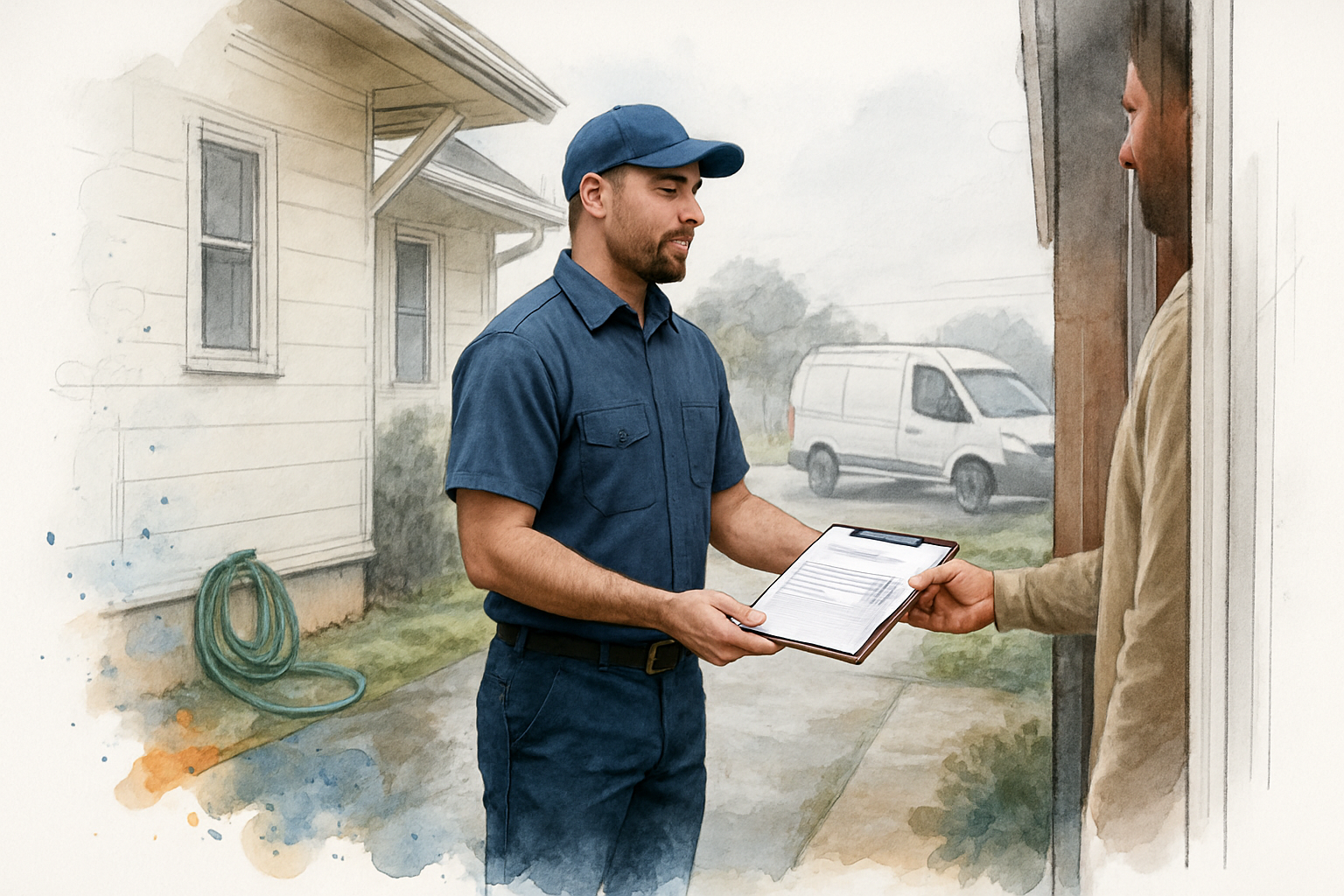
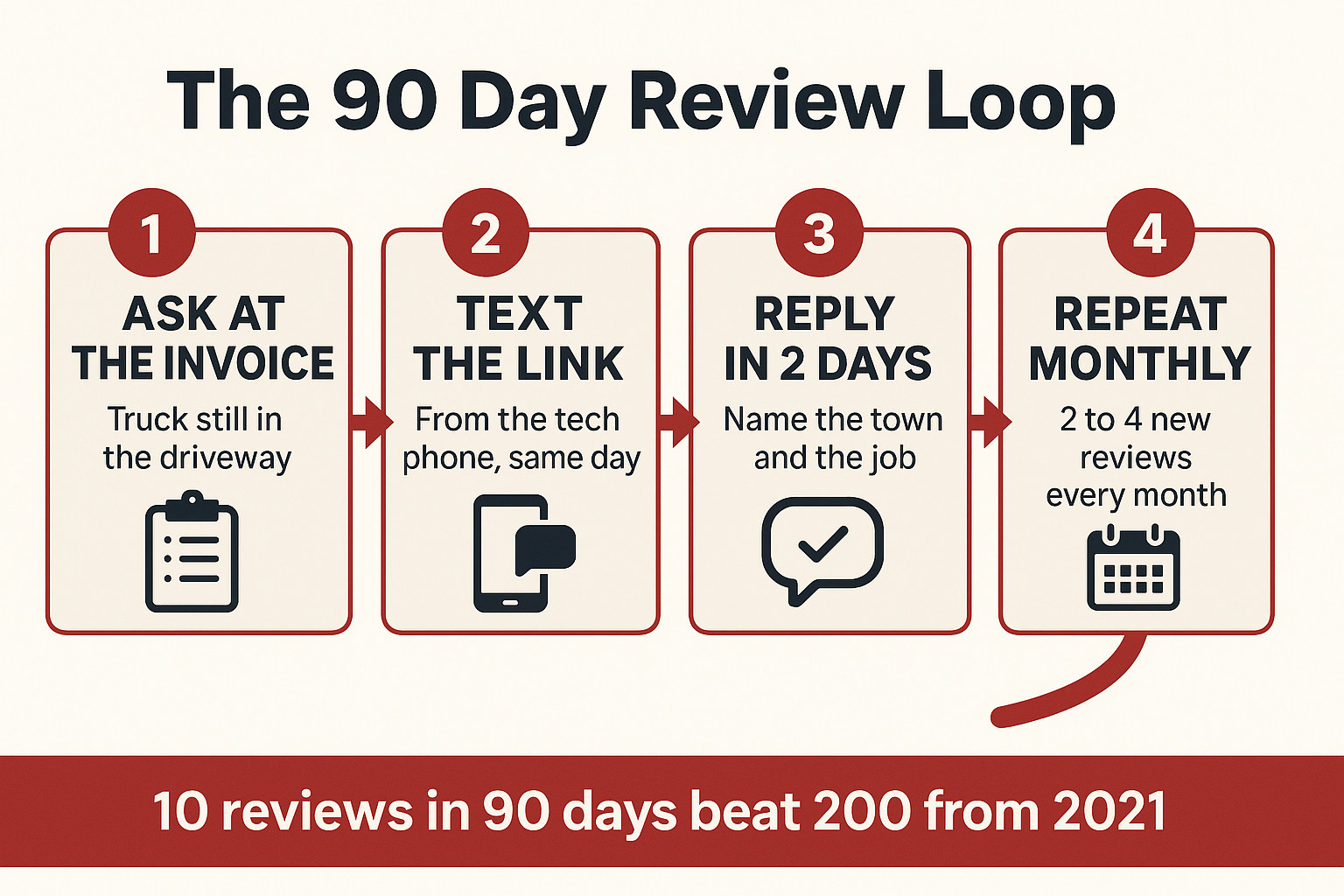
- Ask at the invoice, while the truck is still in the driveway and the customer is happy
- Send the link by text from the tech’s phone, not from the office three days later
- Aim for 2 to 4 reviews a month, every month, instead of 20 in one week
- Ask the customer to mention the town and the job in a sentence
- Reply within two days, with the town and the job named in your reply
That last one is where the review text earns its keep. In the 2026 ranking factor data, review sentiment sits far down the list for map placement but near the very top for whether a reader picks you.
A review that says “water heater replacement in Seaside” does work that “great service, highly recommend” never will. It tells a homeowner in Seaside you have done this exact job on their street, and it tells Google and the AI tools what you do and where.
The review cadence that keeps a profile current
This is the loop I hand owners who want a habit the crew can run without reminders.
What a review is worth, by age
This is a plain-language read on how review age plays out, based on the 2026 ranking factor work and consumer survey data. Treat it as direction, not a formula.
| Review age | Effect on map placement | Effect on the homeowner reading it |
|---|---|---|
| Last 30 days | Strongest signal you are active | Read first, trusted most |
| 31 to 90 days | Still carrying real weight | Most shoppers stop reading past here |
| 3 to 12 months | Fading | Skimmed, if seen at all |
| 1 to 3 years | Counts toward your average, little else | Reads as a company that was busy then |
| 3+ years | Background noise | Can raise a doubt rather than settle one |
Storm season decides who sits in the pack when the leak calls land
Here is the timing piece most Central Coast trades miss. NOAA’s 1991 to 2020 normals show 87% to 89% of the year’s rain falls between October and March at every station in this area, with January the wettest month across the board.
Search demand follows. In the broader San Francisco to San Jose market, roof repair searches tend to peak in December, and roof leak repair peaks in February.
NOAA’s Climate Prediction Center issued an El Nino advisory in October 2026 and called a strong to very strong event likely through January to March 2027, with roughly 50% to 60% odds of a wetter than normal December through February near the California coast. Those are odds and a forecast, not a promise of anything.
Play it out anyway. If you are a roofer, tree service, or drainage contractor and you take 40 jobs in December without asking a single customer for a review, you walk into February with the same stale profile you have now. The December customer who leaves a review is the reason the February caller finds you instead of the shop on the next block.
Ask during the rush. It is the worst time to remember and the best time to ask.
What a lost map spot costs this year compared to last
Some owners hear all this and decide review chasing is not worth the trouble. The math has shifted against that view.
Harvard’s Joint Center for Housing Studies projects homeowner improvement and repair spending growth slowing from 2.1% in Q3 2026 to about 0.5% by Q2 2027. NAHB’s remodeling market index for the West sat at 49 in Q3 2026, just under the line that separates expansion from contraction.
Field-level reporting from service software vendors in late 2026 pointed the same direction: revenue held up mostly through larger invoices, not more jobs.
Fewer jobs are coming through, and each one is worth more. So every call that goes to the company sitting above you on the map is a bigger loss than it was a year ago.
Two other places worth a look while you are at it: the reviews you have on Yelp and Facebook, and the questions customers ask on your phone calls, which usually spell out exactly what your review requests should be prompting people to mention.
Frequently Asked Questions About Review Recency and the Map Pack
How many new reviews do I need to climb back into the map pack?
There is no fixed number, and anyone giving you one is guessing. What I look for is a steady drip: 2 to 4 new reviews a month from customers in the towns you actually serve. A profile with ten reviews from the last 90 days usually outperforms a quiet profile with four times the lifetime count.
Do my old reviews still help me at all?
They hold your star average up, and that still matters because a growing share of shoppers filter for 4.5 stars or better. They just do very little for map placement or for a homeowner deciding who to call tonight.
Is it worth replying to reviews, or is that just for show?
Reply to all of them, good and bad, within about two days. It does not move the map much on its own, but review sentiment ranks near the top of what makes a reader pick you, and a reply that names the town and the job gives both the homeowner and the AI tools one more clear piece of evidence about what you do and where.
Can I just buy reviews or run a contest to catch up fast?
No. Google filters batches that show up out of nowhere, and a cluster of five star reviews posted in one week looks exactly like what it is. The slow drip wins because it is the only pattern that matches a real business.
My competitor has fewer reviews and worse ratings but still outranks me. What gives?
Recency is one piece. Proximity to the searcher, profile completeness, categories, and the content on your website all feed the same map result. But when a profile with worse stars is sitting above yours, the newest review date is the first thing I check, and it is usually the answer.
Want someone keeping the review flow steady for you?
Keeping a Google Business Profile current and the reviews landing month after month is part of Demand Capture, the work we run for Salinas contractors and shops across Monterey County. We partner with one company per trade in each service area, we work month to month with no long-term contract, and most clients see their first measurable ranking gain within 30 days. One owner on the Central Coast put it this way: “Since partnering with them, we’ve seen a significant increase in web traffic, stronger search rankings, and a noticeable boost in lead quality.” If your territory is still open, a 30-minute strategy session with Phil Fisk’s team will tell you where you stand, and the pricing page gives you a general range in about a minute.