
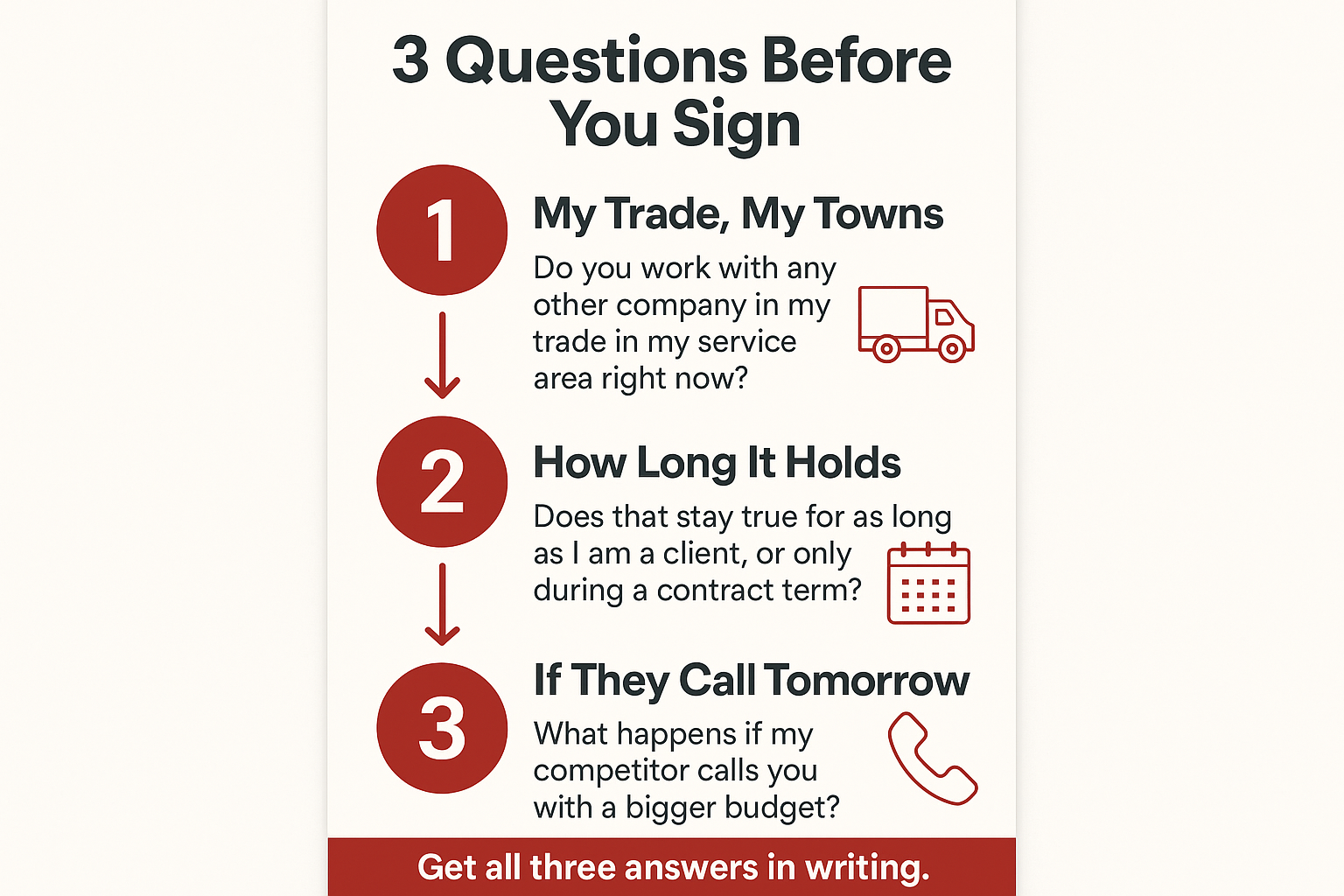
Direct Answer: Ask three things in writing: do you work with other companies in my trade and service area, how long does that protection hold, and what happens if my competitor calls you tomorrow.
Picture two plumbing companies in Salinas. Both have been in business fifteen years, both run three trucks, and both want the call when a homeowner’s water heater quits on a Sunday.
On the first of the month, both owners write a marketing check. And both checks land in the same office.
Neither one knows. That’s the part that gets me. Most contractors never ask the question, and most agencies never volunteer the answer. This article walks through the questions to ask a marketing agency about that exact problem, and what a straight answer sounds like.
The question almost nobody asks a marketing agency
I sit in a lot of strategy sessions with owners around Monterey County. They ask about price. They ask about contract length. They ask how fast they’ll see movement.
Almost nobody asks whether we already work with a company in their trade in their town. It’s the first thing I’d ask if I were buying.
When I looked at the agencies competing for contractor marketing work in the Monterey and Salinas corridor, and up through San Jose, none of them published any territory policy at all. One sells across the whole country while holding strong map positions right here in our county.
That doesn’t make them crooks. It makes them a vendor with a business model that happens to put two of your checks in the same drawer. Three roofers in one county, same agency, same keyword list, same map.
The owners I talk to say it plainly. They don’t want their money helping a rival get the job.

The math on page one in Monterey County
This isn’t a philosophy problem. It’s arithmetic.
When a homeowner in Monterey or Marina searches for your trade, the visible slots are tiny:
- The Google map pack shows three businesses. Everyone else is behind a tap.
- AI answers usually name two or three companies, then stop.
- Paid results put you in the same auction as every other advertiser bidding on that ZIP code.
So picture two HVAC companies in Seaside, both clients of the same agency, both chasing those three map slots. The agency cannot push both of you to the top. One of you gets the better spot and the other one pays for the view.
It gets worse in ads. Two clients bidding on the same keyword in the same city is the same auction, and the agency collects from both while the cost per click climbs. Google’s own guidance on local ranking is built around relevance, distance, and prominence for a single business, not for two businesses in a tie.
Same thing happens in AI results, which is part of why ChatGPT recommends your competitor and not you. The tools pick a short list. There is no second place that pays.
So ask the obvious question: when both of us want the same slot, who do you put first?
Three questions to ask a marketing agency before you sign
You don’t need a lawyer for this. You need five minutes on the phone and an email that repeats the answers back.
Read these straight off the page:
- “Do you currently work with any other company in my trade inside my service area?” Name the trade and name the cities. Salinas, Monterey, Carmel, Seaside, Marina. Vague areas hide a lot.
- “If I sign, for how long does that stay true?” Through the first year? Through the contract? For as long as I’m a client? These are three very different promises.
- “If my biggest competitor calls you tomorrow with a bigger budget, what happens?” Listen for whether the answer has a dollar amount in it.
Then send one email: “Confirming what we discussed.” If the policy is real, they’ll confirm it in writing in an hour. If it isn’t, you’ll get a phone call instead of a reply.
While you have them on the phone, ask who owns the website and the ad account when you leave. That one surprises people too, and I broke it down in this piece on leaving your agency.
The three questions, in order
Here’s the sequence I’d use on a first call with any agency, whoever it is.
Exclusivity and a long contract are not the same thing
Here’s where owners get turned around. An agency offers you exclusivity, then says it only applies if you sign for twelve months.
Those two things protect different people. Exclusivity protects you. It means your money isn’t being spent on both sides of the street. A long contract protects the agency. It means they keep billing you while you figure out whether any of it worked.
Month-to-month terms are common enough now that they’re barely worth bragging about. Plenty of shops in this market advertise no long-term contracts. The combination that’s actually rare is exclusivity in your trade and your service area with no lock-in behind it.
If a vendor will only protect your territory in exchange for a year of your money, they’ve told you which one they care about.
What a straight answer sounds like
I’ve heard every version of these. Use this as your ear test on the call.
| What you ask | A dodge sounds like | A straight answer sounds like |
|---|---|---|
| Do you work with other companies in my trade here? | “We keep all our clients separate.” | “No. Here are the trades and cities we have taken in Monterey County.” |
| How long does that hold? | “As long as things are going well.” | “For as long as you’re a client, in writing.” |
| What if my competitor calls you? | “We’d have a conversation about it.” | “We turn them down and tell them the territory is taken.” |
| Do I have to sign a term to get it? | “Exclusivity requires a 12-month agreement.” | “No term required. Month to month.” |
Frequently Asked Questions About Agency Exclusivity
Is it legal for an agency to work with two competing contractors?
Yes, completely legal. There’s no rule against it, which is exactly why it has to be a written policy, not an assumption. If nobody put it in writing, assume it isn’t true.
How do I find out if my current agency already works for a competitor?
Ask them directly and ask for the answer by email. You can also look at their portfolio or case studies and check whether any of the companies listed work the same towns you do. Watch for sites in your trade across Salinas, Monterey, and Watsonville that share the same page structure and the same writing rhythm.
What counts as my service area for exclusivity purposes?
Name the cities, not the county. “Monterey County” is loose enough to drive a truck through. Salinas, Seaside, Marina, Monterey, Pacific Grove, and Carmel is a real answer that both sides can hold each other to.
If the agency drops my competitor to take me on, is that a good sign?
It tells you the policy is real, which is good. It also tells you they’ll do the same to you if the policy ever changes, so ask what triggers a territory opening back up.
Does exclusivity actually move my rankings?
Not by itself. It just means nobody is funding both sides of the same map fight with your money. The ranking work still has to be good, which is a separate conversation about how local SEO actually works here on the Central Coast.
Find out whether your territory is still open
We work with one company per trade in each service area, and that holds for as long as you’re a client, with no long-term contract behind it. A 30-minute strategy session with Phil Fisk’s team is where a Monterey County owner finds out whether their trade and cities are still available, and you’ll leave with a clear read on your market either way. If you want to see how we judge our own work before you call, our Real Customer Standard lays it out, and you can request a market review when the timing suits you.