
Direct Answer: Google is moving Local Services Ads into the main Google Ads platform as a pay-per-lead campaign type. Your ads and billing model stay. The separate dashboard, manual bidding, and old reports go away.
If you run trucks out of Salinas, Seaside, or Watsonville, you may have seen a headline saying Google is killing Local Services Ads. That is not what is happening, and the difference matters to your budget.
Google is folding Local Services Ads into the main Google Ads platform as a Performance Max campaign type built around pay-per-lead goals. Industry reporting through mid 2026 describes the first phase covering selected U.S. home service categories, including HVAC, plumbing, electrical, and roofing. Your ads keep showing at the top of Search and Maps, and homeowners see no difference.
What you lose is the standalone dashboard, the manual bidding levers, and your old LSA reports. I have watched enough platform migrations in Monterey County to know the damage usually comes from the stuff nobody writes down before the switch. Let’s cover what actually changes, the missed call rule that can cost you real money, and what I would record this week.
What’s changing with local services ads for contractors, and what isn’t
The short version: the storefront stays, the back office moves. Reporting describes budgets, service areas, job types, and ad schedules carrying over automatically instead of needing a rebuild.
What stays the same:
- Your ads still appear at the top of Search and Maps, above the standard text ads
- You still pay per lead, not per click
- Lead disputes and exclusivity still work the way they do now
- Screening requirements for the program do not go away
What goes away:
- The separate LSA dashboard and app flow you have been checking between jobs
- Manual bidding control, replaced by automated bidding inside Google Ads
- Historical LSA reports, which are not expected to follow you into the new platform
Timing is rolling out account by account, so treat any date you read as reported rather than fixed. Your account notifications are the real answer for your business.
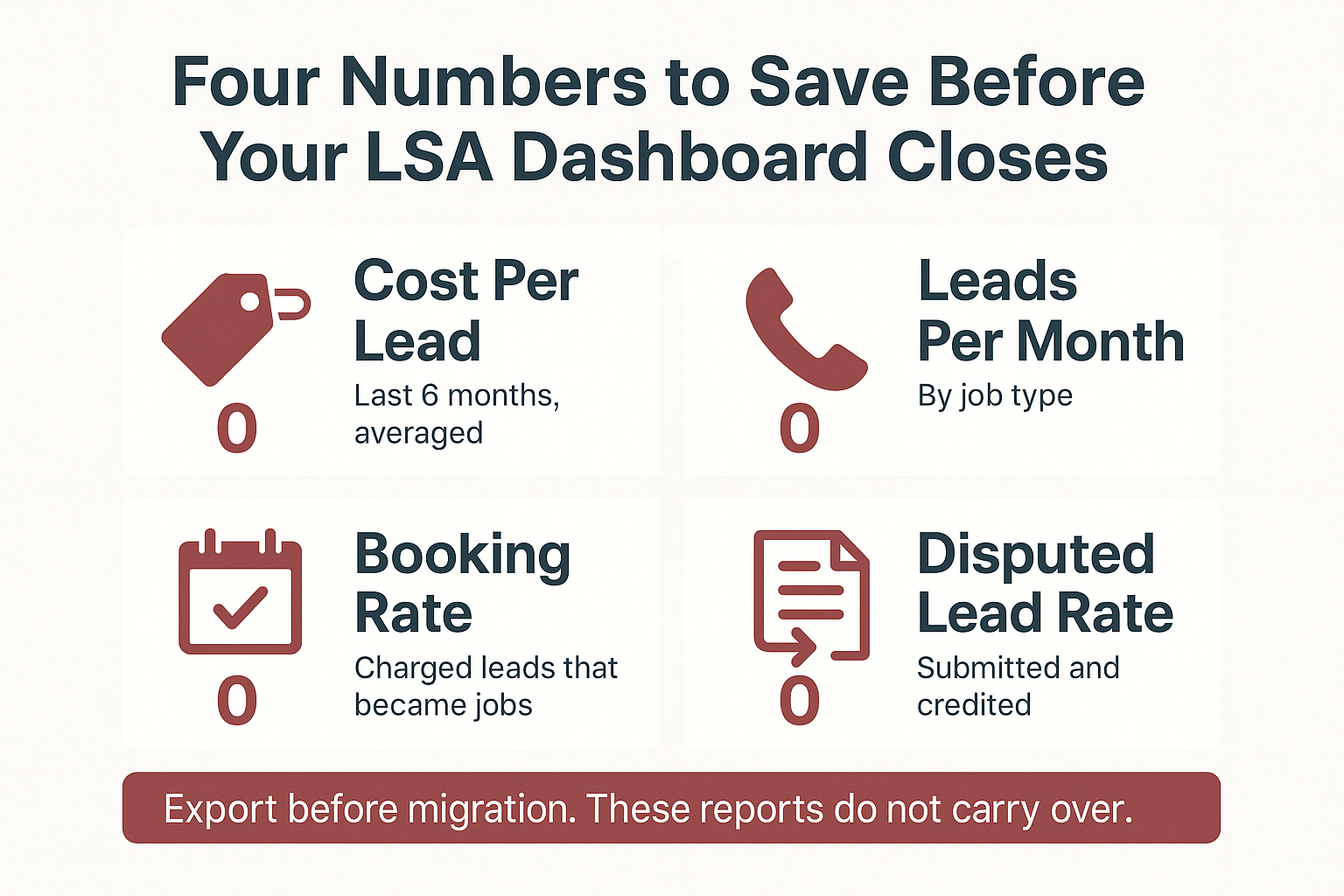
The one job worth doing right now is pulling a record of your current numbers before the old reports close. Cost per lead, leads per month, booking rate, and disputed lead rate. Without those four, you will have no honest way to tell whether the new setup is doing better or worse than the old one six months from now.

The missed call rule is the part that costs money
Here is the change I would lose sleep over if I ran two trucks. Reporting in late August 2026 describes Google tightening how a charged lead gets defined, so that a missed call during your stated business hours can count as a valid lead once the caller stays on the line past a short threshold of roughly 20 seconds.
If that holds, your published hours stop being a marketing detail and become a budget decision. Agency and trade write-ups described the change taking effect October 1, with advice to review advertised hours, lunch coverage, and how fast missed calls get returned. That reporting is secondhand, so check your own account notifications before you act on a date.
Run the math honestly. If your profile says open until 6 but your phone rolls to voicemail from 3 to 6 whenever both crews are out, you are now advertising three hours a day of coverage you do not have.
And think about who is calling in those hours. The homeowner describing sewage backing up into the shower and tub is not leaving a voicemail. She is calling the next name on the list, and under this rule that unanswered ring may still land on your invoice.
Your options are straightforward:
- Shorten your listed hours to the window you can actually answer
- Add real coverage, whether that is an answering service or a dedicated office person
- Set a return-call standard in minutes, not hours, and hold the crew to it
The migration at a glance
Here is how I would line up each change against the decision it forces on your end.
| What’s changing | What it means on your end | What I’d check now |
|---|---|---|
| LSA moves into Google Ads as a pay-per-lead campaign | Same placement, different control panel | Confirm you have access to the Google Ads account, not just the LSA login |
| Manual bidding retired | Automation sets the bid, you set the inputs | Tighten service area, job types, and schedule |
| Historical LSA reports not carried over | Your old benchmark disappears | Export or screenshot cost per lead, lead volume, and booking rate |
| Missed calls may count as charged leads | Published hours become a spend decision | Match listed hours to real phone coverage |
| Google Guaranteed shifting to Google Verified | The badge sells less than it used to | Strengthen reviews, hours, specialties, and payment details on your profile |
Four numbers to write down before the old reports close
These are the only benchmarks that let you judge the new setup against the old one. Save them somewhere outside the platform.
The badge is doing less of the selling now
The Google Guaranteed label has been transitioning to a Google Verified badge, with the customer reimbursement policy discontinued. Coverage from late 2025 forward notes that license, insurance, and background check screening stays in place, while the refund promise is gone. Reporting in 2026 also notes that Better Business Bureau accreditation stopped showing as a callout on profiles, with Google pointing advertisers toward details like hours, specialties, and accepted payment methods instead.
If you spent real money on accreditation and licensing assuming the badge would carry the trust for you, that assumption needs a revision. Screening still gates the door. Google’s own Local Services documentation describes checks that can include business registration, insurance, license verification, and minimum review requirements.
So you still have to pass. You just get less persuasion out of passing. The selling now falls to your review content, your hours, your specialties, and what a homeowner finds when they look you up after seeing the ad.
That is also where this change pays you twice. The same profile fields and review language that feed the paid placement feed the map pack and the AI answer. Research summarized in 2026 found 45% of consumers now use AI tools for local business recommendations, and that 97% of AI users at least sometimes check those recommendations against real reviews.
That same research found businesses with strong Google rankings but inconsistent details across Maps, Yelp, Facebook, and their own site frequently dropped out of AI recommendations entirely. Keeping one source of truth across those channels is the idea behind AI search visibility, and it is the cheapest problem on this list to fix. Reviews that name the trade, the city, and the specific job give both systems something to work with, which is exactly the review wording that gets a contractor named in AI answers.
How to judge pay-per-lead when you lose the bidding levers
Plenty of contractors around here got burned paying aggregators for shared contacts, including calls for work they do not perform. I understand the reflex to distrust anything billed per lead.
The difference with this channel is exclusivity and dispute rights, not some guarantee against junk. You will still get the occasional lead that has no business reaching you, and you will still need to dispute it.
With automation handling the bid, the levers you have left are short:
- Service area
- Job types
- Hours
- Answer rate
- Lead disputes
Service area is where I see the most money wasted. Published analyses put average contractor cost per lead across trades somewhere in the neighborhood of fifty dollars, but those come from national data sets, and a Carmel Valley roofing lead and a King City handyman lead do not price the same. Treat any published figure as general market context.
The honest measure is booked revenue per charged lead, not the cost-per-lead number on a report. A roofing job in Pacific Grove absorbs a lot of lead cost. A small handyman call does not, and a service radius stretched to Hollister because it looked like free reach is the fastest way to buy calls you did not want.
If you are not sure how wide your radius should run, I wrote about the geography side of that in no storefront, big service area.
Why call recording turns into an accounting tool
People ask on our website all the time whether call tracking is worth paying for. Under a rule where an unanswered ring can become a charged lead, the answer changes.
You need to know three things you cannot get from a billing summary:
- Which calls actually went unanswered, and at what hour
- What callers asked before booking, so your profile and ads use their words
- Which objections showed up in the calls you lost
I have seen what that data does when somebody actually reads it. One local trade business watched its qualified-call rate roughly double month over month, from 31% to 61%, during a stretch when same-day availability and clear upfront pricing were the factors callers named most before booking. Nothing about the ad changed. The answers did.
Our monthly call reporting is how we handle that on active SEO and Google Ads campaigns, included rather than sold as an add-on: recorded and transcribed calls, a live dashboard, and a monthly plain-English report with three prioritized action items. One client put the ongoing side of it plainly: “They manage all of our online advertising, SEO, and website development, and the results have been consistently impressive.”
Frequently Asked Questions About the Local Services Ads Migration
Do I have to rebuild my Local Services Ads campaign?
Based on reporting so far, no. Budgets, service areas, job types, and ad schedules are described as carrying over automatically into the new Google Ads campaign. What you should rebuild is your own record keeping, since historical LSA reports are not expected to follow you.
Will homeowners in Salinas or Monterey notice anything different?
No. The ads keep appearing at the top of Search and Maps the same way, with the same lead form and call flow. The change is on the advertiser side of the screen.
If I miss a call, am I really going to get charged for it?
That is what reporting in August 2026 describes: a missed call during your stated business hours can count as a valid lead if the caller stays on the line past roughly 20 seconds. That reporting is secondhand, so confirm it against the notifications in your own account before you change anything.
Should I shorten my business hours to protect my budget?
Shorten them if you cannot answer them. Listing hours you do not cover was always a trust problem with homeowners, and now it may be a billing problem too. If you want the longer hours, add the coverage first.
Does losing the Google Guaranteed refund promise mean the screening stopped mattering?
Not at all. Google’s documentation still describes screening that can include business registration, insurance, license checks, and minimum review requirements. You still have to pass to be in the program. The badge just does less persuading once you are in.
What does any of this have to do with AI search?
The same profile details and review content that feed the paid placement feed the map pack and AI answers. Cleaning up inconsistent hours, service areas, and business details across Maps, Yelp, Facebook, and your own site helps all three at once.
Want a second set of eyes before your account migrates?
If you run a trade business anywhere from Watsonville down to King City and you would rather check your hours, service area, and answer rate before the switch than after a surprise invoice, Phil Fisk takes discovery calls with Central Coast contractors. Office line is (831) 789-9320, Monday through Friday. Bring your current cost per lead and booking rate if you still have them.