
Direct Answer: Starting January 1, 2027, SB 342 lets a contractor who was duly licensed when the contract was signed recover pay for work performed while licensed, on specified public works, commercial, and multifamily projects.
A renewal notice goes to an old address. Your license sits lapsed for five weeks while you are three months into a job in Salinas. Under the old rule, that paperwork slip could wipe out every dollar on the project, and the other side could demand back everything they already paid you.
That changed. Governor Newsom signed SB 342 (Umberg) on September 30, 2026, and the amendments take effect January 1, 2027.
Below is what the bill actually does, which projects it covers, and why your license status is also a marketing problem on the Central Coast, not only a legal one. I am not an attorney, and nothing here is legal advice. Talk to a construction lawyer about your specific contract.
What SB 342 changes about a California contractor license lapse and getting paid
Business and Professions Code Section 7031 has long been the harshest rule in California construction. Unless a contractor fit within a limited substantial compliance exception, Section 7031 historically prevented recovery of compensation for work performed unless the contractor could prove it was duly licensed “at all times” during performance.
It also let the contracting party recover all compensation already paid if the contractor was unlicensed at any point. Not the portion tied to the lapse. All of it.
SB 342 softens that on specified projects. Effective January 1, 2027:
- A contractor who was duly licensed when the contract was signed may recover pay for the work performed while licensed.
- A customer’s disgorgement claim is limited to amounts paid for work done while unlicensed.
- The relief applies to a defined list of project types, not to every job you run.
The signing was announced in the Governor’s legislative update on September 30, 2026.
For a Seaside electrician who let a license sit lapsed for three weeks on a six month tenant improvement, the exposure goes from the entire contract to the slice of work done during those three weeks. That is a real difference in dollars.
Which projects the new rule actually covers
This is where contractors get tripped up, so read the list carefully. The amendments apply to:
- Public works
- Commercial and institutional work
- Common interest developments
- Multifamily projects of four or more units
That covers a lot of what gets built around Monterey County. School and city work in Salinas. Hotel and restaurant tenant improvements in Monterey and Carmel. HOA and condo work in Pacific Grove. Apartment construction in Marina and Watsonville.
What is not named in that list matters just as much. A standard single family remodel in Carmel Valley, a residential reroof in Hollister, a home repipe in Prunedale: those are not on the list of specified projects.
If most of your revenue comes from homeowners, your exposure under Section 7031 has not changed. The old “at all times” standard is still the one that governs your work. A duplex or triplex does not reach the four unit threshold either.
So the practical read for a lot of owner-operated shops on the Central Coast is this: the relief is real, and it is narrower than the headlines suggest. Know which bucket each contract falls into before you assume you are protected.
Where the relief applies and where it does not
A quick reference for the project types named in the amendment, based on the bill as signed. Confirm your specific situation with a construction attorney.
| Project type | Named in SB 342 | What that means for payment |
|---|---|---|
| Public works (city, county, school district) | Yes | Pay recoverable for work performed while licensed, if licensed at contract signing |
| Commercial and institutional work | Yes | Disgorgement limited to amounts paid for the unlicensed period |
| Common interest developments (HOA, condo) | Yes | Same relief as commercial work |
| Multifamily, four or more units | Yes | Same relief; four units is the floor |
| Single family home remodel or repair | Not named | Historical “at all times” standard still applies |
| Duplex or triplex | Not named | Below the four unit threshold in the amendment |
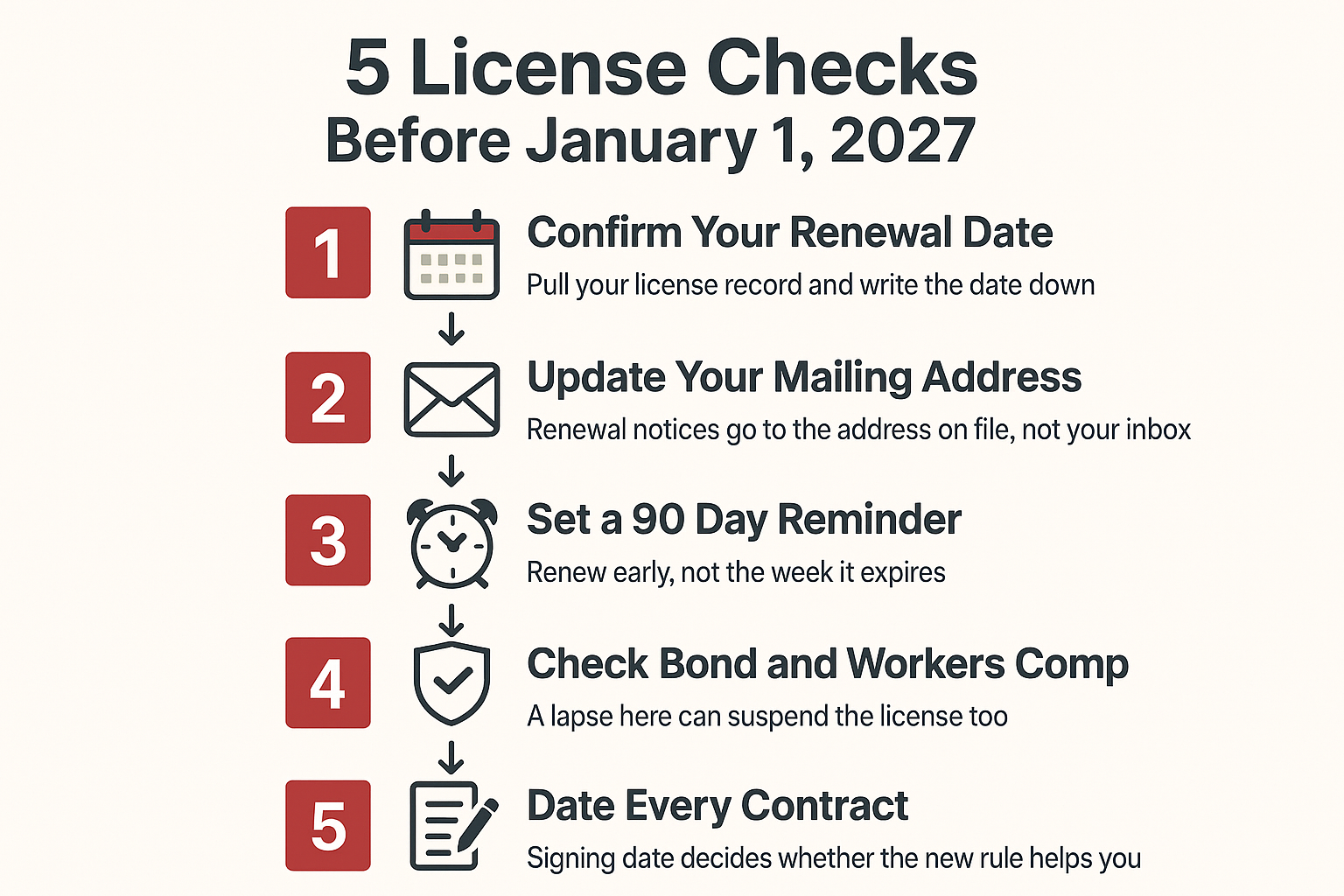
Five things to square away before January 1, 2027
None of this is complicated. It is the kind of thing that slides for a year because no one owns it.
The part nobody connects: a lapse shows up online before it shows up in court
Here is the angle I care about, because it is the one I see every week. A license lapse is a public record. It is searchable the same day by anyone who wants to check you.
When people land on our site, a steady share of their questions are vetting questions before anything else. They want to know how long we have been around, whether we are local, who they would actually be talking to. One visitor asked how big the company is and how stable it is before asking about a single service.
Homeowners and property managers do the same thing to you. A general contractor who left us a review put it plainly: he keeps business local to support the community, and that drove the whole decision. That instinct runs both ways. People check.
And now there is a second reader. When ChatGPT or Google’s AI Overview puts your name in front of someone searching “commercial plumber Monterey,” the homeowner’s next move is to verify you. A lapsed status, a license number missing from your site, or a number that does not match your Google Business Profile all create friction at exactly the wrong moment.
That consistency work is a real part of what contractor marketing on the Central Coast looks like in 2026, and it is one of the pillars inside AI Search Sync: matching your name, address, phone, and license number across the places search engines and AI tools pull from. If you have never audited it, start with whether your license number shows up everywhere your business does online.
What I would do in the next 60 days
Short list. None of it takes long.
- Pull your license record and confirm the expiration date yourself instead of trusting memory.
- Fix the address on file if you have moved shops or changed your mailing setup.
- Renew early. Most licenses run on a two year cycle, so a 90 day reminder gives you room if something gets kicked back.
- Check your bond and workers comp certificates. A lapse on either side can suspend the license even when you paid the renewal.
- Put the signing date on every contract and keep a copy. Under the new rule, that date is what decides whether the relief applies to you at all.
Then spend twenty minutes on the public side. Your license number should be on your website footer, your contact page, your Google Business Profile, and your ads. Mismatched details are a quiet trust killer for anyone checking you out after an AI tool names you in Monterey.
Frequently Asked Questions About SB 342 and Contractor License Lapses
When does SB 342 take effect?
January 1, 2027. It was signed on September 30, 2026. Work and disputes before that date are governed by the prior version of Section 7031.
Does this help me if I only do single family residential work?
Probably not. The amendments apply to public works, commercial and institutional work, common interest developments, and multifamily projects of four or more units. A standard house remodel in Carmel or a repipe in Salinas is not on that list, so the historical “at all times” standard still applies. Ask a construction attorney about your specific contracts.
What if my license was already lapsed when I signed the contract?
The relief is built around being duly licensed when the contract was signed. If you were not licensed at signing, do not assume SB 342 helps you. That is a question for a lawyer, not a marketer.
Does a lapse hurt my Google rankings or AI visibility?
Not directly. What hurts is the inconsistency it creates. If your license number is missing or does not match across your site, your Google Business Profile, and directory listings, you look harder to verify to both search engines and the people checking you out. Consistent business details are one of the things that separate the contractors AI recommends from the ones it skips.
Should I put my license number on every page of my website?
At minimum it belongs in the footer, on your contact page, and anywhere you advertise. California advertising rules are specific about this, and it doubles as a trust signal for anyone doing a quick background check before they call.
Want a second set of eyes on how your business shows up online?
If you run a trade business anywhere from Watsonville down to King City and you are not sure your license number, phone number, and business details line up across your site, your Google profile, and the directories, that is worth an hour of someone’s attention. Phil Fisk keeps a short roster of Central Coast contractor clients and handles discovery calls himself at (831) 789-9320. Core6 Marketing has availability for a handful of new accounts this quarter if the timing works out.