
Direct Answer: There is no official benchmark. Vendor data puts home services answer rates near 52% and plumbing booking rates around 43%. Your own tracked number matters far more than any published average.
Ask a plumbing or HVAC owner in Salinas how many leads he got last month and you get an answer in about four seconds. Ask what share of those calls turned into booked jobs and the room goes quiet.
That gap is the most expensive thing in a lot of the shops I look at around Monterey County. A leak you measure gets fixed. The one nobody measures just keeps running.
So here is my position up front: before you buy another lead, split your phone numbers into two buckets and fix the cheaper one first. I will give you the published benchmarks, tell you where each came from and how old it is, and show you how to get your own number inside a week.
Why nobody can hand you a clean contractor call booking rate benchmark
I went looking for a trade-by-trade booking rate benchmark published by anyone serving contractors on the Central Coast. I came up empty. The question gets asked constantly and answered almost nowhere.
What does exist comes from software vendors reporting on their own customers, which is a self-selected group. Treat these as rough context, not as a scoreboard:
- Invoca’s July 2026 home services benchmarks (vendor data): a person answers only about 52% of inbound home services calls on average, with HVAC answer rates reported as low as 34%.
- ServiceTitan data from 2022 (vendor data, now dated): a plumbing call booking rate of 43%, with small shops booking 9% of calls after 6pm versus 26% during peak hours.
The reassuring part is that these numbers are worse than most owners expect. If you have been avoiding this measurement because you assume your team books everything and you would rather not find out, the published averages give you a lot of room.
But none of that tells you how your shop in Marina or Prunedale is doing in January. Your own tracked number is the only benchmark that pays you anything.
There are two rates here, and they take different work to fix
Most owners lump everything into one idea called “leads.” That is why the problem never gets solved. There are two separate rates, and the after-hours gap in that older plumbing data separates them cleanly.
Answer rate: did a live person pick up the phone. A call that rings out is a coverage and scheduling problem. No amount of sales training fixes a phone nobody answers at 6:40pm on a Tuesday.
Booking rate: of the calls a person did answer, how many turned into a scheduled job. That is a conversation problem. It gets fixed with the team, not with the schedule.
If you are in the field most days, you are not hearing those calls. I have sat with owners who were certain their office handled every call well and found out the first 60 seconds was the whole problem: no question about what the caller actually needed, no clear next step, no time offered.
Start by splitting one week of calls into those two buckets. You will know immediately which one is costing you more, and the fix for each is completely different. This is the same reason most contractor websites rank but don’t ring: the traffic shows up and the handoff fails.
What you see in the call log, and which rate it belongs to
Pull last week’s calls and sort each one into a row. This is the fastest way to see whether you have a coverage problem or a conversation problem.
| What happened on the call | Which rate it hits | What usually fixes it |
|---|---|---|
| Rang out after 5pm or on Saturday | Answer rate | Rotating phone duty, an after-hours plan, or a real answering process |
| Went to voicemail during a storm surge | Answer rate | Overflow coverage on wet weeks, planned before the rain starts |
| Answered by a tech in a crawlspace | Both | Route incoming calls to someone who can actually talk and book |
| Caller asked price, then hung up | Booking rate | A prepared price conversation and honest ranges |
| Quoted at the estimate, never heard back | Booking rate | Follow-up on day two and day seven, every time |
| Booked, then canceled before the visit | Booking rate | Confirmation call and a clear arrival window |
How to get your own number in seven days
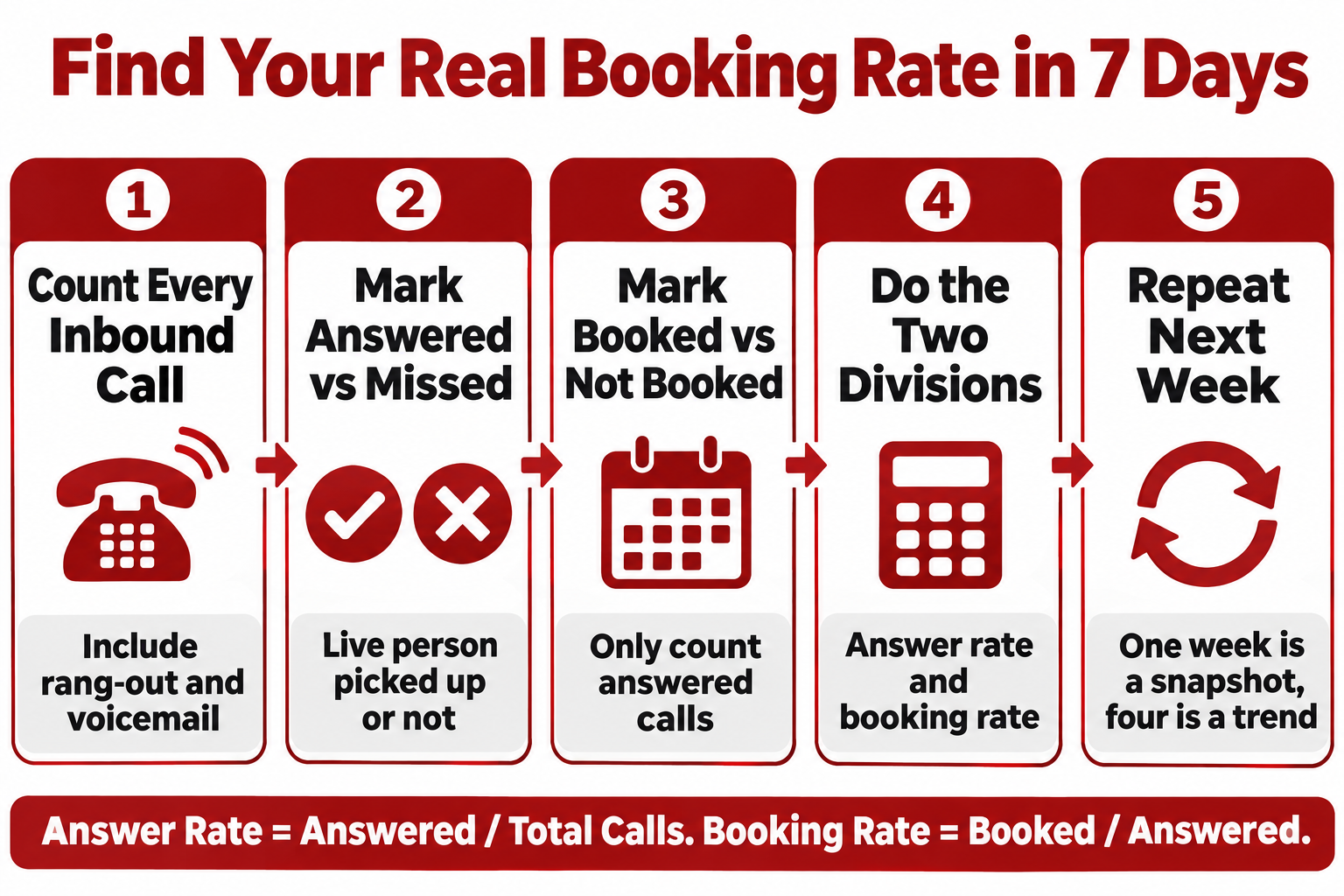
You do not need new software to start. A tally sheet by the phone and a Friday afternoon will get you a number you can trust more than any published average.
The arithmetic that should slow you down before you buy more leads
Here is the math that changes minds. Say your shop takes 40 calls a month and books half of them. That is 20 jobs.
When the schedule gets thin, the instinct is to buy more leads. To get 20 more jobs at a 50% booking rate, you need 40 more calls, and you pay for every one of them.
Now move the booking rate from 50% to 65% on the same 40 calls. That is six more booked jobs a month with zero additional ad spend. Same marketing, same phone, better first 60 seconds.
I am not saying demand never needs work. Plenty of shops in Monterey County genuinely do need more calls, and that is a real fix. But buying twice the leads to cover a conversation problem means paying twice as much to solve something that costs nothing but attention.
This is also why cost per lead is the wrong number to judge marketing by. A $60 lead that books is cheap. A $25 lead that rings out at 6pm is not a lead at all.
Speed to callback: what is actually known and what is marketing noise
You have heard the pitch. Somebody has told you that 78% of customers hire the first company that responds. I have chased that number and it has no traceable original source. I will not quote it, and you should push back when somebody does.
What does exist is a June 2026 study published in Management Science using Fiverr data, which found a one-hour reply delay cut the odds of getting hired by 46%. That is real research, but it is academic and it is from outside the trades. A homeowner with a flooded laundry room in Seaside is not a freelance buyer.
So here is the honest version. There is no clean, trade-specific study proving an exact speed threshold for plumbing or HVAC. Urgency still wins work anyway, for a reason you already know from your own crews: a homeowner with no heat in January keeps dialing down the search results until a person answers.
You do not need a statistic to act on that. You need to know how many of your calls go unanswered this week.
Winter is when a weak booking rate costs the most in Monterey County
This is the season where the number hurts. NOAA climate normals show January as the wettest month at every Central Coast station, and repair demand stacks up right behind the rain.
Regional search patterns line up with it:
- Furnace repair searches peak in December
- Roof repair peaks in December
- Roof leak repair peaks in February, after the ground is already saturated
These are also your highest-value calls of the year, and they land in the weeks your techs are most buried. That is exactly when a missed call becomes a job your competitor books.
There is a bigger reason to care. Harvard’s Joint Center for Housing Studies projects homeowner improvement and repair spending growth slowing to 0.5% by the second quarter of 2027. Fewer jobs in play means each one in your call log is worth more.
When an owner tells me he does not need more leads, he needs techs, I agree with him. Then I ask to look at the call log, because the booked jobs are usually already sitting in there. Those calls are also the best raw material you have for content that answers what buyers actually ask, whether you work out of Monterey or down the valley.
Frequently Asked Questions About Call Booking Rates
So what is a good booking rate for a plumbing or HVAC shop?
Nobody publishes a verified trade-by-trade benchmark, and I will not invent one. The dated vendor figure for plumbing was 43%, so if you are measuring in that range you are around the reported average. What matters more is the direction your own number moves over three to four months.
Can I track this without buying new software?
Yes. A tally sheet by the phone works for a week. Count total calls, mark which ones a live person answered, then mark which answered calls got on the schedule. Two divisions and you have both rates.
Is it worth answering calls after 6pm?
The older plumbing data showed small shops booking 9% of after-hours calls versus 26% during peak hours, which tells you those calls are getting handled badly, not that they are worthless. During a wet January in Monterey County, an after-hours call is often an emergency job at full value. Figure out what your own after-hours calls are worth before you decide to let them ring.
Is a low answer rate my agency’s problem or mine?
Mostly yours, and that is good news because you control it. An agency can make the phone ring. Only your team can pick it up. What a marketing partner should be doing is showing you clearly where calls are stalling so you are not guessing.
Does raising my booking rate mean lowering my prices?
Usually not. A lot of lost calls are lost before price ever comes up, because nobody asked the right question or offered a time. Being upfront about ranges tends to help, and we wrote about what posting price ranges does to calls if you want to think that through.
Want to know what your shop actually books?
Booking more of the calls you already get is the part of our program we call Conversion Intelligence, and your team always does the closing. We just show you where the jobs are slipping away. If you run a plumbing, HVAC, or other contracting business in Monterey County and want a 30-minute strategy session that looks at where revenue is leaking before anyone talks about spending more on demand, we are at (831) 789-9320.