
Direct Answer: If your agency is publishing content fast but your phone stays quiet, check these five signs: generic copy, no local specifics, mismatched metrics, no real job photos, and zero customer language in the text.
I talk to contractors across Monterey County every week, and one complaint comes up constantly: ‘We’ve been paying for content for months, and our phone still isn’t ringing.’ When I dig into what’s actually been published on their site, the pattern is almost always the same. Paragraphs that sound polished. Topics that look relevant. And absolutely nothing a homeowner in Salinas or Seaside couldn’t read on any other contractor’s site in the country.
That’s AI slop, content generated at volume using AI tools with no original input, no local research, and no connection to how your actual customers talk. It fills word counts. It does not fill your call log.
If you’re paying an agency and not seeing results, here are five specific signs worth checking right now. You don’t need any technical background to spot them.
1. Their Publishing Pace Doesn’t Match the Work Required
If your agency is pushing out three to five blog articles a week, that should raise a question: what research is going into each one?
A legitimate piece of content for a plumbing company in Monterey County takes real time. Someone needs to understand the local market, know that Salinas homes see different seasonal demand than a property in Carmel Valley, and understand what questions homeowners actually ask before they call. That work doesn’t happen in ten minutes.
When I see a high-volume publishing schedule paired with zero city-specific references, zero trade-specific detail, and zero language that sounds like it came from a real customer conversation, the content almost certainly came from an AI tool with a generic prompt and no human review. Volume is not strategy. A slower pace with real source material beats a fast pace built on nothing.
Ask your agency: what raw material goes into each piece before any writing starts?
2. Your Content Reads the Same as Every Competitor’s
Try this right now. Search your trade plus your city, open three competitor websites, and read the homepage copy on each one.
If you see the same phrases, the same topic order, and the same generic claims with no local specifics, you’re looking at the result of templated AI content. And so is Google.
Google’s 2026 core updates specifically re-weighted away from this pattern in the home services category. The March 2026 update hit hard for contractors whose content had no originality signal. That includes no first-hand experience, no location detail, and no real customer language.
The fix isn’t to write differently for the sake of it. It’s to use source material that is genuinely yours: your call recordings, your form submissions, your customer reviews. An AI tool working from those inputs produces something different from every competitor. An AI tool working from a generic prompt produces the same article everyone else already has.
3. Your Click-Through Rate Is Dropping While Impressions Hold
This one requires a quick look inside Google Search Console, but it’s worth doing. If your impressions are flat or growing but your click-through rate is declining, that’s a specific signal.
It usually means AI Overviews are appearing above your result and answering the query before anyone clicks. That’s not a penalty. But it does mean your content isn’t being pulled into those answers, either. If it were, you’d still get visibility even without the click.
How AI search is changing who gets called for home repairs covers this dynamic in detail, but the short version is this: AI systems pull from content that has specific, attributable information. Generic filler doesn’t make the cut. If your content isn’t sourced from real customer questions and real job details, it won’t show up in AI answers, and it won’t earn clicks from traditional results either.
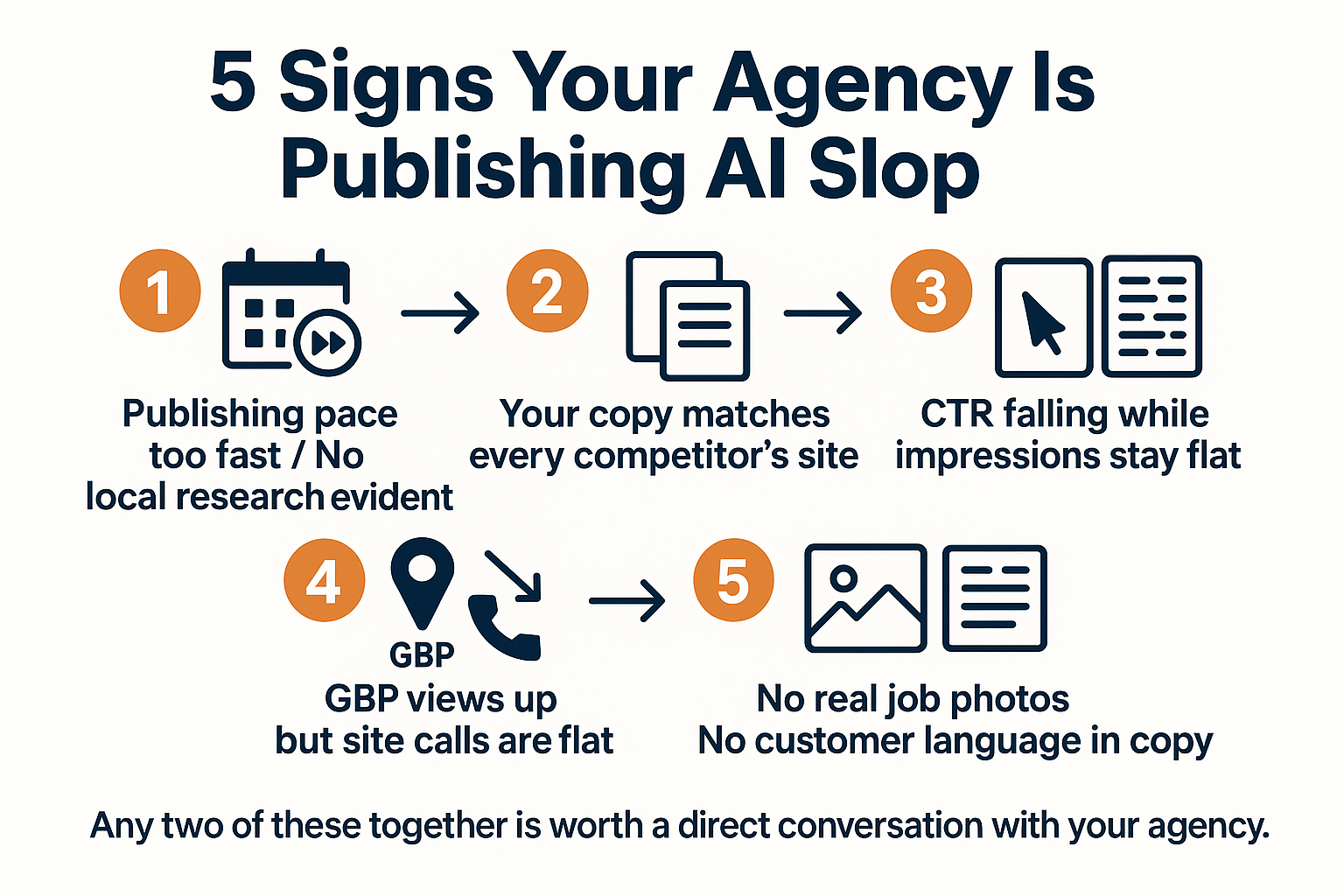
5 Signs at a Glance
Here’s a quick reference you can screenshot and bring to your next conversation with your agency.
4. Your Google Business Profile Views Are Up but Calls Are Flat
This is one of the most common patterns I see with contractors in Salinas, Seaside, and Marina. GBP impressions are climbing. Calls from the website are not moving.
That gap almost always points to a site that isn’t doing its job when people land on it. Either the content doesn’t answer what the homeowner came to find out, the page loads slowly on mobile, or there’s nothing on the site that builds enough trust to make someone pick up the phone.
Real customer language in your content does a lot of that trust-building work. When a homeowner in Watsonville reads copy that uses the same words they’d use to describe their problem, the site feels different. It feels like you actually understand what they’re dealing with. Your customers already wrote your best SEO content, but only if your agency is actually using it.
AI-generated filler doesn’t create that recognition. It reads like a company brochure. And brochures don’t make phones ring.
5. No Real Photos, No Local Specifics, No Review Language Anywhere
This one you can check in about 60 seconds. Pull up your own site and look for three things:
- Actual photos of completed jobs your crew did, not stock images of tools or smiling workers in hard hats
- Local references by city or neighborhood, Carmel, Pacific Grove, King City, wherever you actually work
- Language that sounds like your customers wrote it, not a marketing template
If none of those are present, your content has no originality signal. And originality signal is exactly what both Google and AI platforms use to decide whether your content is worth surfacing. What happens to contractor websites stuffed with AI content is worth reading if you want the full picture on how this plays out in rankings.
The contractors I’ve seen hold ground through Google’s 2026 algorithm shifts are the ones whose content came from somewhere real: call recordings, form submissions, and reviews. That source material is unique to your business and your market. No AI tool running on a generic prompt can replicate it.
What Real Content vs. AI Slop Looks Like Side by Side
If you’re not sure which category your current content falls into, this comparison is a fast gut check.
| What to Look For | AI Slop | Real Content |
|---|---|---|
| City or neighborhood references | None, or just the city name dropped once | Specific cities woven in naturally throughout |
| Customer language | Generic phrases like ‘quality service’ and ‘professional team’ | Words your actual callers and reviewers use |
| Job photos | Stock images or AI-generated visuals | Photos from real jobs your crew completed |
| Publishing pace | 3-5 articles per week, all short and interchangeable | Slower cadence, each piece tied to a real customer question |
| Local market knowledge | Nothing that couldn’t be written from any city in the U.S. | Seasonal detail, local permit context, regional demand patterns |
Frequently Asked Questions About AI Slop and Contractor Content
Can AI-written content hurt my rankings?
It depends on the quality of the input. AI tools used with real source material, real customer questions, and human review can produce useful content. But AI tools used with no original input, no local research, and no editing produce generic filler. Google’s systems are increasingly good at identifying that pattern, and the March 2026 Core Update specifically targeted it in home services. If your content could have been written by anyone, about any contractor, in any city, that’s a problem.
How do I know if my agency is actually doing real work or just running prompts?
Ask them one question: what source material goes into each piece of content before any writing starts? A legitimate answer names specific inputs, like your call recordings, your customer reviews, your seasonal service patterns. A vague answer about ‘research’ and ‘keyword tools’ is usually a sign the process starts and ends with a prompt.
What if I’m already seeing some organic traffic? Does that mean the content is working?
Not necessarily. Traffic and calls are different things. A lot of contractors in Monterey County come to us with decent impression numbers and almost no inbound calls from the site. The content is pulling in clicks on broad queries that don’t convert, while missing the specific local searches that actually drive bookings. Your organic click-through rate tells a more honest story than raw impressions.
Does AI-generated content affect how AI search tools like ChatGPT or Perplexity recommend contractors?
Yes, and this is underappreciated. AI platforms pull from content that has specific, verifiable, attributable detail. Generic content gets summarized past or skipped entirely. If your site reads the same as 50 other contractor sites, there’s no reason for an AI answer to cite yours specifically. How Perplexity decides which contractor to recommend goes into the mechanics of this in detail.
What’s the one question I should ask my agency right now?
‘Show me the three most recent pieces of content you published for my site, and tell me exactly what source material you started from.’ If they can’t answer that clearly, or if the content has no local references, no customer language, and no job-specific detail, you have your answer.
Want to Know What’s Actually on Your Site?
If any two of these signs rang true, it’s worth getting a straight answer about what your agency is actually producing and why it isn’t generating calls. We work with home service contractors across Monterey County, from Salinas and Seaside to Hollister and King City, and we’re happy to take a look at your current content with no obligation. Book a discovery call with Phil Fisk at https://core6.marketing/work-with-us/ and we’ll tell you exactly what we see.