
Direct Answer: SEO builds organic traffic over months; paid ads generate calls immediately. Most contractors on the Central Coast need both — but the right one to start with depends on how fast you need the phone to ring.
Most contractors I talk to on the Central Coast have been told the same thing at some point: ‘You need to be doing SEO and internet marketing.’ What they rarely get told is what that actually means for a roofing company in Salinas or a landscaping business in Hollister — or which one they should be spending money on right now.
SEO and paid search are not the same tool used for different budgets. They work on completely different timelines, solve different problems, and fail in completely different ways. Getting sold on the wrong one is how contractors end up six months in with a thinner wallet and the same quiet phone.
I want to break this down the way I’d explain it to a contractor sitting across from me — with real timelines, real failure modes, and a clear way to figure out which problem you’re actually solving.
The Core Difference: One Buys Speed, One Builds Equity
The clearest way I know to separate these two is this: Google Ads buys you time; SEO buys you independence.
A general contractor in Monterey County who needs calls starting next month has a Google Ads problem. You can have a campaign running and showing up on search results within a few days. You pay for each click, the calls come in, and the moment you stop paying, the calls stop too.
A contractor who wants to stop paying per click in 18 to 24 months and own their inbound traffic — that’s an SEO problem. Organic rankings, once you earn them, don’t disappear the moment you stop writing a check. That’s the trade-off: SEO takes longer to build, but what it builds is yours.
Most owner-operators on the Central Coast need both running at the same time, at least for a while. But understanding which problem is most urgent right now changes where this month’s money should go. Buying SEO when you need calls in 30 days is a mistake. Running paid ads forever because you never invested in organic is an expensive one too. For a deeper look at how local SEO actually works for home service contractors, that article covers the mechanics in detail.
What the SEO Timeline Actually Looks Like in This Market
I won’t sugarcoat the timeline, because most agencies do and it sets contractors up for disappointment.
For competitive terms — things like ‘HVAC contractor Salinas’ or ‘roofer Monterey’ — getting to page one in Google organic results realistically takes three to six months of consistent work. That’s not a guess; that’s what we see across the contractor clients we work with on the Central Coast. Content, backlinks, and authority all take time to accumulate.
That said, not everything takes that long. Two areas where movement tends to show up faster:
- Google Business Profile improvements — correcting your service area, adding photos, and cleaning up your category listings can affect your local map pack ranking in 30 days or less
- Citation corrections — fixing inconsistent NAP data (name, address, phone) across directories reinforces your local signals fairly quickly
These aren’t shortcuts to page-one rankings for high-competition keywords, but they’re real, measurable progress. A pest control company in Watsonville we worked with saw their GBP views climb meaningfully within the first month just from profile optimization — before any of the longer-term content work had time to kick in.
If you don’t have traffic right now and can’t afford to wait six months, you need paid search running while SEO builds. The two are not mutually exclusive — they’re complementary.
How Paid Search Fails (And Why Most Contractors Don’t Notice Until It’s Too Late)
Google Ads has a failure mode that SEO doesn’t, and it’s quiet enough that most contractors miss it until they’ve already burned through a few thousand dollars.
A campaign that isn’t actively managed degrades over time. Keyword match types drift, Quality Scores drop, and competitors adjust their bids. A roofing contractor in Santa Cruz County can be paying significantly more per lead in month six than month one — not because their market got harder, but because no one went back in and tuned the campaign.
I’ve seen campaigns running on broad match keywords that were pulling in clicks from people searching for roofing shingles at a hardware store — not homeowners looking for a roofer. Every one of those clicks cost money and produced nothing. That’s not a hypothetical; it’s a real pattern we see when contractors come to us after trying to manage ads themselves or after working with a generalist agency that wasn’t watching the account closely.
If you want to understand exactly where contractor ad spend goes wrong, this breakdown of why contractor Google Ads campaigns waste money on the wrong clicks is worth reading. And if you’re trying to understand what running ads actually costs in this market, here’s what contractors typically pay for Google Ads and why it varies depending on trade and geography.
The short version: paid search works well when someone is actively managing it. Left alone, it bleeds.
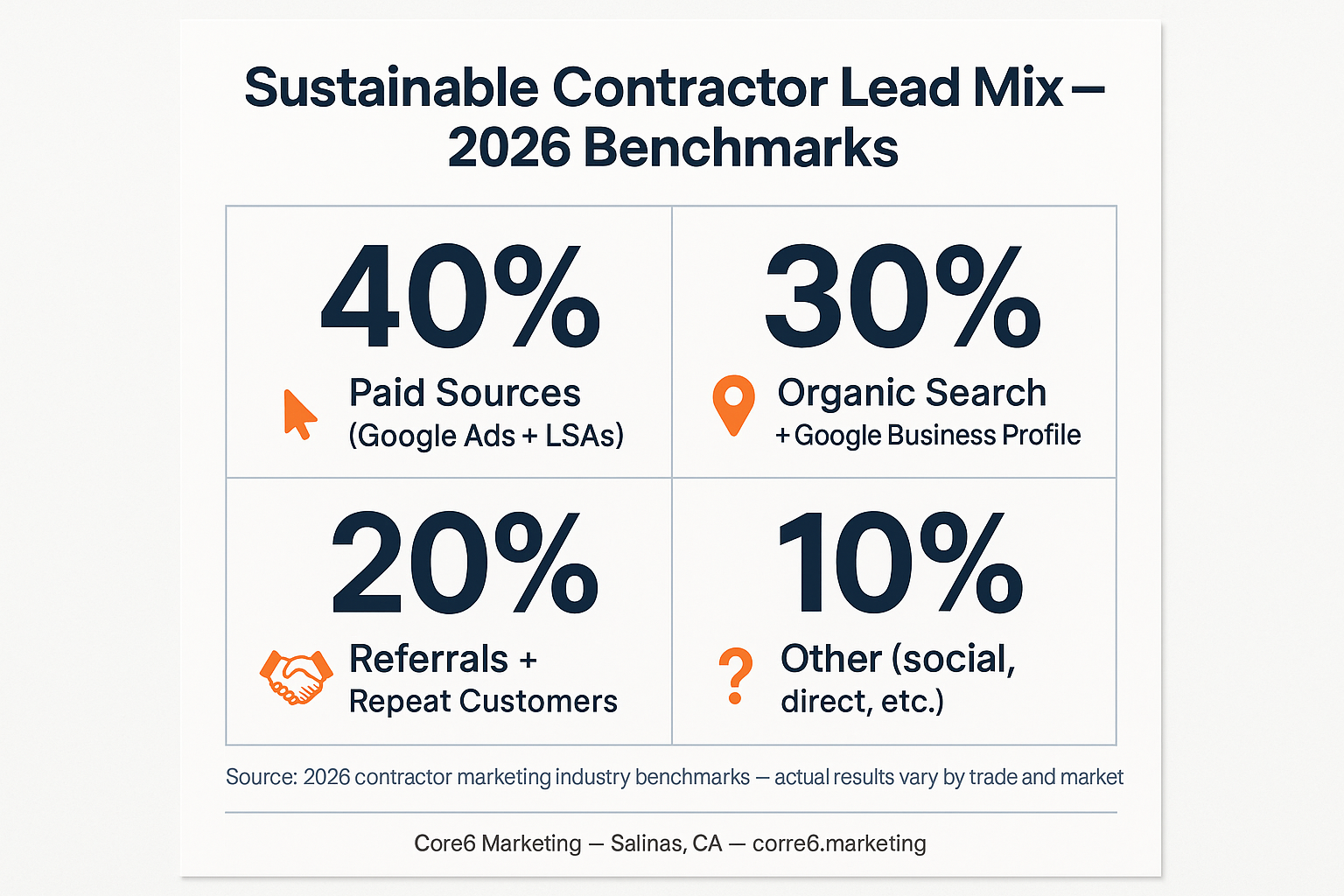
The Contractor Lead Mix: Where Your Calls Should Come From
Industry benchmarks for 2026 suggest a sustainable lead mix for a home service contractor looks something like this. Most Central Coast contractors with fewer than 20 employees won’t hit this balance immediately — but knowing the target helps you decide where this month’s marketing dollar goes.
Which One Should You Start With? A Simple Way to Decide
The question I get asked most often is some version of: ‘Should I do SEO or Google Ads first?’ Here’s the honest answer: it depends on one thing — how fast do you need the phone to ring?
If you have jobs on the books for the next 60 days and you’re planning for six months from now, start with SEO. Build the foundation. Give it time to compound.
If you need calls this month and your pipeline is thin, start with Google Ads. Get targeted, managed, and measured — and start building SEO in parallel so you’re not paying per click forever.
Here’s a practical breakdown of how the two compare across the factors that matter most to a working contractor:
- Time to first lead: Paid ads — days to weeks. SEO — three to six months for meaningful organic volume.
- Cost structure: Paid ads are ongoing — you pay per click. SEO has upfront and monthly costs, but the traffic it builds doesn’t disappear when you stop paying.
- Lead quality: Both can produce quality leads, but SEO leads often convert at a higher rate because the person found you organically and already has some level of trust.
- Market dependency: In competitive markets like the Monterey Peninsula, paid search is more expensive per click. In secondary markets like King City or Hollister, the cost per lead through ads is generally lower — and SEO competition is less fierce too.
- Long-term stability: Organic rankings are more durable. Paid traffic is rented. Once you stop the ad spend, the calls stop with it.
For most owner-operated contractors I’ve worked with on the Central Coast, the right answer at some point is both running together — with paid search carrying the load while SEO builds underneath it.
SEO vs. Google Ads: Side-by-Side for Contractors
Here’s a quick-reference comparison for a contractor trying to make a practical decision, not a theoretical one.
| Factor | Local SEO | Google Ads (PPC) |
|---|---|---|
| Time to first leads | 3–6 months for competitive terms; GBP improvements in ~30 days | Days to weeks after launch |
| Monthly cost structure | Ongoing SEO management fees; no per-click charge | Management fee + ad spend (you pay per click) |
| What happens if you pause | Rankings hold, though they may drift over time | Calls stop immediately |
| Lead quality | Generally higher intent — organic searchers self-qualify | High intent, but depends on keyword targeting quality |
| Best fit for | Contractors building long-term owned traffic | Contractors who need calls now or have a new website |
| Failure mode | Slow start; easy to underestimate the timeline | Campaign drift, wasted spend if not actively managed |
| AI search visibility | Yes — strong SEO signals carry over to ChatGPT, Perplexity, Gemini | No — paid ads do not appear in AI search platforms |
One Thing Most Contractors Miss: SEO Now Includes AI Search
There’s a shift happening in how people find local contractors that wasn’t on most agencies’ radar two years ago. More and more homeowners are typing questions into ChatGPT, Perplexity, or Google’s AI Overviews — and getting a direct answer with a contractor recommendation — before they ever click on a search result.
If your business isn’t showing up in those answers, you’re invisible to a growing slice of people who are actively looking for what you do. This isn’t a future problem; it’s already affecting which plumbers and roofers get called in Monterey County right now.
Our AI search visibility methodology addresses this directly — it’s built to get contractors visible not just in traditional Google rankings, but across the AI-powered platforms that are reshaping local search. If you want to understand what’s actually changing and why it matters, this article on how AI search is changing who gets called for home repairs breaks it down without the tech jargon. And if you’re wondering whether your competitor is already showing up in ChatGPT when you’re not, that article explains exactly how that happens.
Paid ads don’t help you here — they don’t appear in AI search results at all. This is one more reason SEO isn’t optional for contractors who want durable visibility over time.
Frequently Asked Questions About SEO and Internet Marketing for Contractors
I’m a new contractor in Salinas with a brand new website. Should I start with SEO or ads?
Start with Google Ads to get calls while your site and SEO are getting established. A brand new site has zero authority in Google’s eyes — it’ll take time to rank. Ads put you in front of local homeowners immediately. Run SEO in parallel so you’re building something that doesn’t require a per-click payment forever.
How long before I see real leads from SEO?
For competitive keywords like ‘electrician Monterey’ or ‘HVAC repair Salinas,’ expect three to six months before organic rankings are driving consistent lead volume. Google Business Profile improvements and citation cleanup can show movement faster — sometimes within 30 days — but page-one rankings take time to earn.
Is it true that once I rank in Google, I don’t have to keep paying?
Mostly true, but with a caveat. Organic rankings are far more stable than paid traffic — they don’t vanish the second you pause a campaign. But they do require maintenance. Competitors are working on their rankings too, and Google’s algorithm updates regularly. Completely abandoning SEO after you rank is a risk; ongoing maintenance is typically much lower-cost than getting there initially.
Can I just run Google Ads and skip SEO entirely?
You can, but it’s expensive over time. Ad costs in competitive markets like the Monterey Peninsula tend to rise as more contractors bid on the same keywords. If your entire lead flow depends on paid traffic and your cost per lead climbs from month to month, you’re in a fragile position. SEO gives you a traffic source that doesn’t invoice you every month.
Do AI tools like ChatGPT now affect whether I get found by customers?
Yes, and it’s becoming more significant. More homeowners are using AI search tools to find local contractors, and the businesses that show up there are the ones with strong local SEO signals — reviews, citations, and relevant content. Paid ads don’t transfer to AI platforms at all. What AI marketing actually means for a plumber or HVAC company is a good read if you want to understand what this actually changes for your business.
What’s a realistic monthly budget for both SEO and ads for a small contractor?
Costs vary considerably by trade, market, and how competitive your target keywords are. A general contractor in Carmel competing for higher-value remodel jobs will see different numbers than a handyman in King City. Rather than giving a range that won’t fit your situation, it’s worth having a real conversation about your specific trade and market. What I can say is that for most owner-operators, the combined investment in both channels is often far lower than what they’re spending on lead aggregators like Angi or HomeAdvisor — and the leads are exclusively yours.
Ready to Figure Out Which One You Actually Need Right Now?
If you’re a contractor in Monterey County, Salinas, Santa Cruz, or anywhere on the Central Coast and you’re not sure whether your marketing dollar should be going into SEO, paid search, or both — that’s exactly the kind of conversation we have every day. Core6 Marketing has worked with more than 38 contractor clients on the Central Coast, and we’ve been doing this locally for over 20 years with zero work outsourced overseas. Book a discovery call with Phil Fisk at https://core6.marketing/work-with-us/ and walk away with a clear picture of where your leads are actually coming from — and where they should be.