
Direct Answer: Usually it’s distance, not reviews. Google Maps ranks on how close you are to the searcher, plus your primary category, service list, and service area. Reviews help, but they cannot beat proximity.
I hear the same sentence from Salinas shops almost every week. “We have 80 reviews and a 4.9, and we still don’t show up on the map.” Usually it comes from the person running the office, who got handed marketing on top of billing, scheduling, and the phones, and who honestly cannot tell what is working.
Here is the part that trips people up. Your reviews are not the thing holding you back, and the fix is almost never on your website.
I want to walk through what actually decides map ranking in Monterey County, what you can change today in about twenty minutes, and the one factor nobody can buy their way out of.
Why Is My Business Not Showing on Google Maps When the Website Ranks Fine?
Because you are looking at two separate scoreboards.
The map results (the pin pack near the top of the page) and the blue links below them are ranked by two different systems. They use different signals and they move independently.
In our own rank tracking across Salinas search terms, I regularly see the exact same keyword land in two very different places. Strong map position, buried organic position. Or the reverse.
That is why a contractor can be on page three of one and near the top of the other for the same phrase, on the same day.
What drives each one is different too:
- Map results lean on your Google Business Profile, how close you are to the searcher, your categories and services, and your reviews.
- Organic results lean on your website pages, your content, your site speed, and the links pointing at you.
- Both care that your name, address, and phone number match everywhere online.
So when the owner asks why the map is quiet, the answer is rarely “add another page to the site.” The answer is almost always sitting inside the profile. Fix the profile first, then worry about the website. For the other side of that coin, why contractor websites rank but don’t ring is worth a read.

Distance Is the Lever Nobody Can Buy
Of everything that moves map ranking, how close your business sits to the person searching is the heaviest weight. Google says as much in its own guidance on how local results are ranked, which lists relevance, distance, and prominence as the three factors.
On the Central Coast, that one factor explains most of the complaints I get.
A Salinas shop can hold a top three map spot all day long for searches made in Salinas. Then a homeowner in Pacific Grove, about 20 miles away, searches the same words and the shop is nowhere on the map.
Nothing broke. The searcher just moved.
That is also why the owner keeps seeing a competitor from two towns over and assumes something is wrong. That competitor is probably winning searches near their own address, not near yours.
So split the problem into two piles:
- What you cannot change: where the customer is standing, where your shop sits, how many competitors are between you and them.
- What you can change: your primary category, your service list, your service area, your review flow, and whether your website has a real page for Marina, Seaside, Monterey, and Carmel instead of one page that lists every town in a sentence.
If you want more Peninsula calls out of a Salinas address, the work is city pages, reviews that name the town the job was in, and ads for the gaps. Not another round of fiddling with the homepage. We cover how that works for shops with a wide service area and no storefront in this breakdown of service area businesses.
Where the Problem Usually Lives
Before you change anything, match what you are seeing to what is probably causing it. Most of these land on the profile, not the site.
| What you’re seeing | What’s usually behind it | Where the fix lives |
|---|---|---|
| Top three in Salinas, gone in Pacific Grove | Distance from the searcher | City pages, local reviews, paid search |
| Great reviews, no map spot at all | Wrong or missing primary category | Google Business Profile |
| Website ranks, map doesn’t | Two different ranking systems | Profile first, website second |
| Ranked last year, slipped this year | Stale reviews, inactive profile | Google Business Profile |
| Show up for one service, not the others | Services not listed with descriptions | Google Business Profile |
| Two pins for one shop | Duplicate profile | Google Business Profile |
The Three Fields Almost Every Profile Gets Wrong
When I open up a contractor’s profile in Monterey County, the gaps are in the same three spots nearly every time. These are the fields that decide which searches you are even eligible for. If they are wrong, no amount of reviews will put you on the map.
Here is the order I would run it in. Twenty minutes, one sitting.
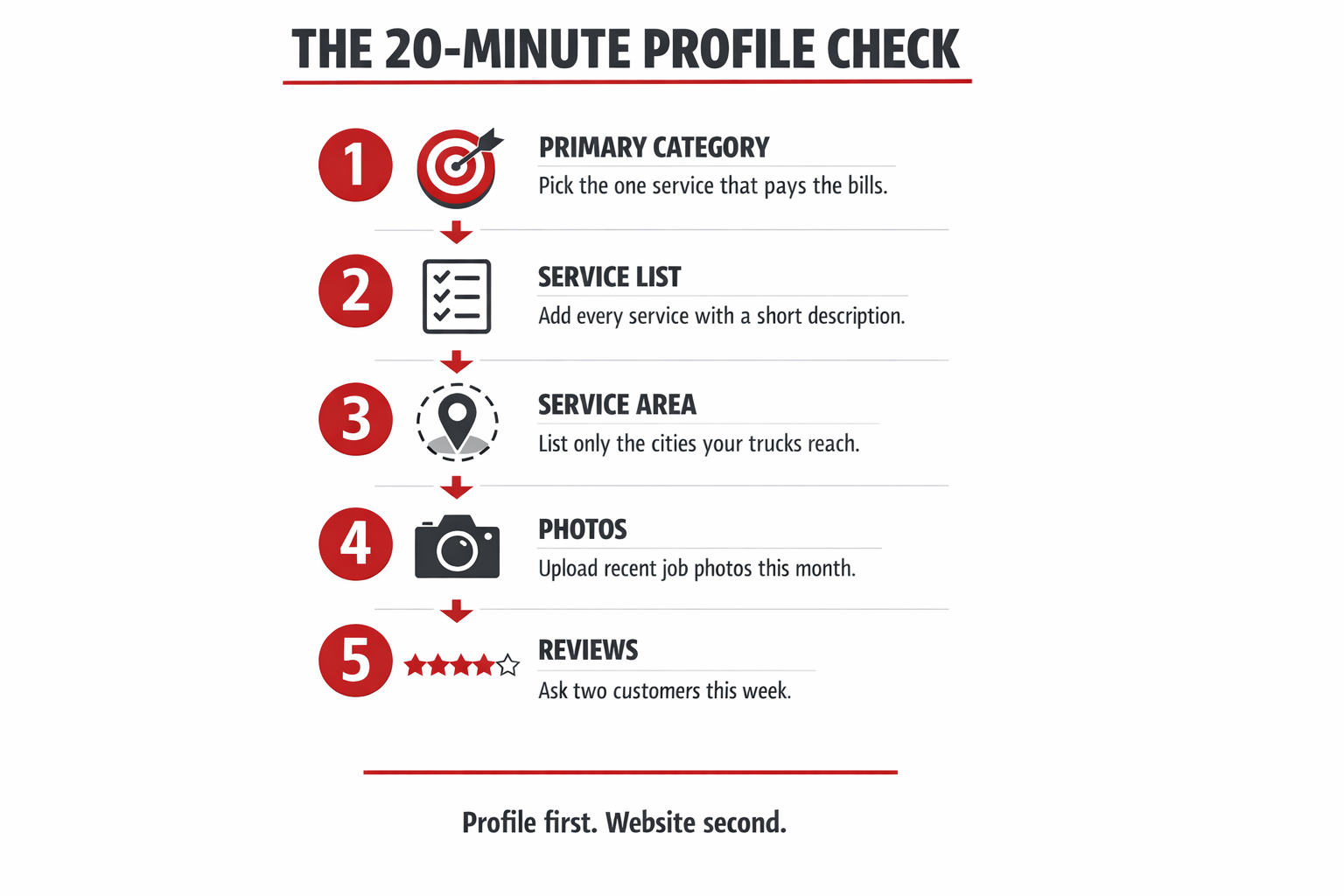
- Primary category. You get one, and it carries the most weight. Pick the one that matches the service that actually pays your bills, not the broadest option. A roofing company set to “Contractor” is competing in the wrong race.
- Additional categories. Add the ones you truly perform. Do not stack ten categories hoping something sticks. That dilutes you and can look off to Google.
- Services. Add each service as its own line item with a short written description in plain words. Most profiles have three generic services or none. This is the cheapest ranking work available and almost nobody does it.
- Service area. List the cities you actually drive to. Salinas, Marina, Seaside, Monterey, Carmel-by-the-Sea, Gonzales, Soledad. Do not list half the state. A bloated service area does not extend your reach.
- Photos. Add recent job photos. A profile that has not had a new photo since 2024 reads as dormant.
- Duplicates. Search your business name and make sure there is only one pin. An old listing from a previous address splits your signals, which we broke down here.
The only piece that needs the owner is the service list. Print it, hand it to him, ask him to cross off what you do not sell and add what you do. The rest you can finish without him.
The 20-Minute Profile Check
Run these five steps in order the next time you have a quiet stretch between calls.
Last Year’s Five Stars Are Not Carrying This Year’s Calls
This is the one I have the hardest time getting owners to act on. The reviews are good, so the subject feels closed.
But review recency is now doing the work review count used to do. A 4.8 profile stocked with reviews from 2023 behaves differently than a 4.8 with fresh reviews every month, both in the map and with the homeowner reading them.
A February 2026 consumer survey from a review research firm (vendor data, so read it as a signal, not gospel) found 31% of people now require a 4.5 rating or better, up from 17%, and that 74% only look at reviews from the last three months.
So here is the sentence to read to the owner: a customer in Monterey scrolling your profile today may never see the 40 great reviews you earned two years ago.
Treat review flow like truck service. Not a campaign, a maintenance item.
- Two review requests a week beats forty in one push.
- Ask on the day the job closes, while the crew is still packing up.
- Reviews that name the town and the specific job carry more weight than “great service.”
- Respond to every one, good or bad, within a few days.
We went deeper on the recency problem in this post about stale reviews and the Salinas map pack.
And No, AI Did Not Replace the Map
If you have been getting cold calls telling you the map is dead and you need an AI package, slow down.
One widely cited 2025 local search study found the map pack appeared on roughly 93% of searches with local intent, while AI Overviews appeared on about 15%. Google’s own search documentation, updated in late 2025, says nothing special is required for AI features beyond normal search work and keeping your Business Profile current.
So you are not choosing between two projects. The same work wins both.
- A correct primary category helps the map and helps AI tools understand what you do.
- Services written out in plain words feed both.
- Fresh, specific reviews are evidence for both.
- Consistent business information across directories is the backbone of both.
That is what we mean by Demand Capture: be the company buyers and AI find first, using one set of work instead of two. If you want the split between what AI answers and what still rings your phone, we mapped it out here.
The map pack is still where the calls come from in Salinas and across Monterey County. Take care of it first.
Frequently Asked Questions About Google Maps Ranking in Monterey County
How long after I fix my profile will I see movement on the map?
Category and service changes can show within days, though Google sometimes takes a few weeks to settle. Review and photo activity builds slower, over 30 to 90 days. If nothing has moved in two months, something else is wrong, usually a duplicate listing or a category mismatch.
I show up when I search from the shop but not from home. Which one is real?
Both are real, and that is the whole point. Google is showing you results based on where your phone is standing. Searching your own business from your own desk is the least useful test there is, because Google already knows you and knows where you are.
Should I add every category Google offers me?
No. Add only the categories that match work you actually perform and want more of. Stacking categories you do not really do spreads your relevance thin and can get your profile flagged. One sharp primary category plus two or three honest secondary ones beats ten.
Does hiding my address hurt my map ranking?
If you work out of your home or run crews from a yard, Google wants you set up as a service area business with the address hidden. Showing a residential address when you do not take walk-ins can cause more problems than it solves. The ranking tradeoff is that you get measured from your registered location either way, so where you are based still matters.
My competitor has fewer reviews and ranks above me. How?
Nine times out of ten, they are closer to the people searching, or their primary category is a tighter match than yours. Reviews are one of three main factors, not the only one. Check their category and their address against yours before you assume they are doing something clever.
Do I still need a website if my profile is strong?
Yes. Google reads your website to decide what your profile is about, and a thin site caps how far your map ranking can go. It also matters for every town outside your immediate area, where a real page for that city is one of the few ways to overcome distance.
Want to See Where Your Salinas Profile Actually Stands?
Google Business Profile management runs as part of the ongoing work for every Core6 client, including categories, services, photos, posts, and review responses, and we report that work next to booked jobs instead of as a task list. If you want a read on where your profile sits against the other shops in your trade around Salinas or Monterey, a 30-minute strategy session with Phil Fisk’s team covers that, along with whether your territory is still open. You can request a market review when the timing suits you.