
Direct Answer: For most Monterey County contractors, Search ads come first because buyer intent is highest there. Performance Max extends reach after Search is fully funded, not instead of it.
An owner in Seaside called me a while back with a question I hear constantly. He was spending a few thousand a month on Google Ads, his rep kept pushing him toward a new campaign type, and he could not tell what any of it was doing for his schedule.
This is a budget allocation question, not a cost question. The dollars are already committed. The real decision is which bucket they land in.
I want to walk through the three buckets that compete for a Monterey County contractor’s ad spend, what each one is genuinely good at, and how the calendar on this coast should shape the split.
AdWords for Contractors Comes Down to Three Buckets
When owners search adwords for contractors, they are usually not hunting for a price. They are trying to figure out where the money should sit now that Google keeps adding options.
There are three buckets pulling at the same monthly number:
- Search ads: text ads that appear when a homeowner types a problem into Google.
- Performance Max: one campaign that spreads budget across Search, Maps, YouTube, Gmail, Display, and Discover.
- Pay per lead: the Local Services Ads channel, where you are billed per lead instead of per click.
They are not interchangeable. Each one reaches a buyer at a different point, and that point decides what the money is worth.
In a county this spread out, geography makes the split sharper. A plumber working Marina, Seaside, and north Salinas does not want to fund clicks from people down 101 in King City, and the three buckets handle that boundary very differently.
Why I Fund Search First for the Trades
Picture a homeowner off Blanco Road typing “water heater leaking Salinas” into their phone. That person is not researching. They have a wet garage floor and they are going to call somebody in the next ten minutes.
That is the cheapest buyer you will ever reach, because you are not paying to create demand. You are paying to be in front of demand that already exists.
Search gives you control that the other buckets do not:
- Geo targeting down to the ZIP codes you actually work, so Carmel Valley does not quietly eat budget meant for Prunedale.
- High intent keywords only, instead of broad terms that pull in renters and tire kickers.
- Call tracking before launch, so every ring traces back to the ad that caused it.
Our position is Search first, every time. Once the high intent searches in your service area are covered during the hours your phone gets answered, then we talk about reach.
If you are also weighing organic against paid, I covered that split in SEO vs. Paid Ads for Contractors.

What Performance Max Is Actually Good At
Performance Max is not a scam and it is not a replacement for Search. It is a reach tool.
It earns its place when the job has a longer decision window. Think bathroom remodels in Pacific Grove, ADU builds in Salinas, a reroof in Watsonville that a couple talks about for six weeks before anyone picks up the phone. Those buyers circle back several times, and Performance Max keeps your name in front of them on YouTube and across the web between visits.
Where it gives me trouble:
- It absorbs people who were already searching your brand name and reports them as new wins.
- Search term visibility is limited, so you see less of what you paid for.
- Left alone, it will drift toward cheap impressions instead of booked work.
So the rule I use is simple. Performance Max runs after Search is fully funded in your service area, never before, and its results get read separately from Search so one does not take credit for the other.
Automation makes the changes faster. A person who knows this market still reviews them.
Comparing the Three Buckets Side by Side
Here is how I explain the trade-offs to owners before we touch a budget.
| Bucket | Best At | Where It Gets Expensive |
|---|---|---|
| Search ads | Emergency and urgent-need jobs where the homeowner is ready to call now | Competitive keywords with no ZIP-level targeting or negative keyword control |
| Performance Max | Longer consideration jobs like remodels, roofs, and ADUs across multiple Google surfaces | Running it before Search is covered, or letting it claim brand searches as new leads |
| Pay per lead | Filling gaps with billed-per-lead volume | Shared leads, disputes that eat admin time, and limited control over job types |
The Pay Per Lead Channel Is Moving Into Google Ads
This one is live right now, so it belongs in any budget conversation this season.
Reporting through the fall of 2026 describes Google folding Local Services Ads into Google Ads as a Performance Max campaign type with pay per lead goals. The rollout started in August 2026 for selected United States home service categories and continues into 2027, with manual cost per lead bidding being retired in favor of standard Google Ads bidding.
If you have run that channel separately for years, the thing to protect is control of your own budget and your own history. Before your account gets moved, check:
- Business name and address accuracy, matching your license and your Google Business Profile exactly.
- Service area and job type settings, since broader defaults can pull leads you do not want.
- Where your lead history and disputes live, and whether you can export them.
One warning worth repeating: editing profile details can trigger re-verification. Discovering that in the middle of your busy season is a bad day. I broke the checklist down further in Google Is Moving Local Services Ads.
How the Buckets Stack Up
A quick visual of the order I fund things in, and what each bucket is there to do.
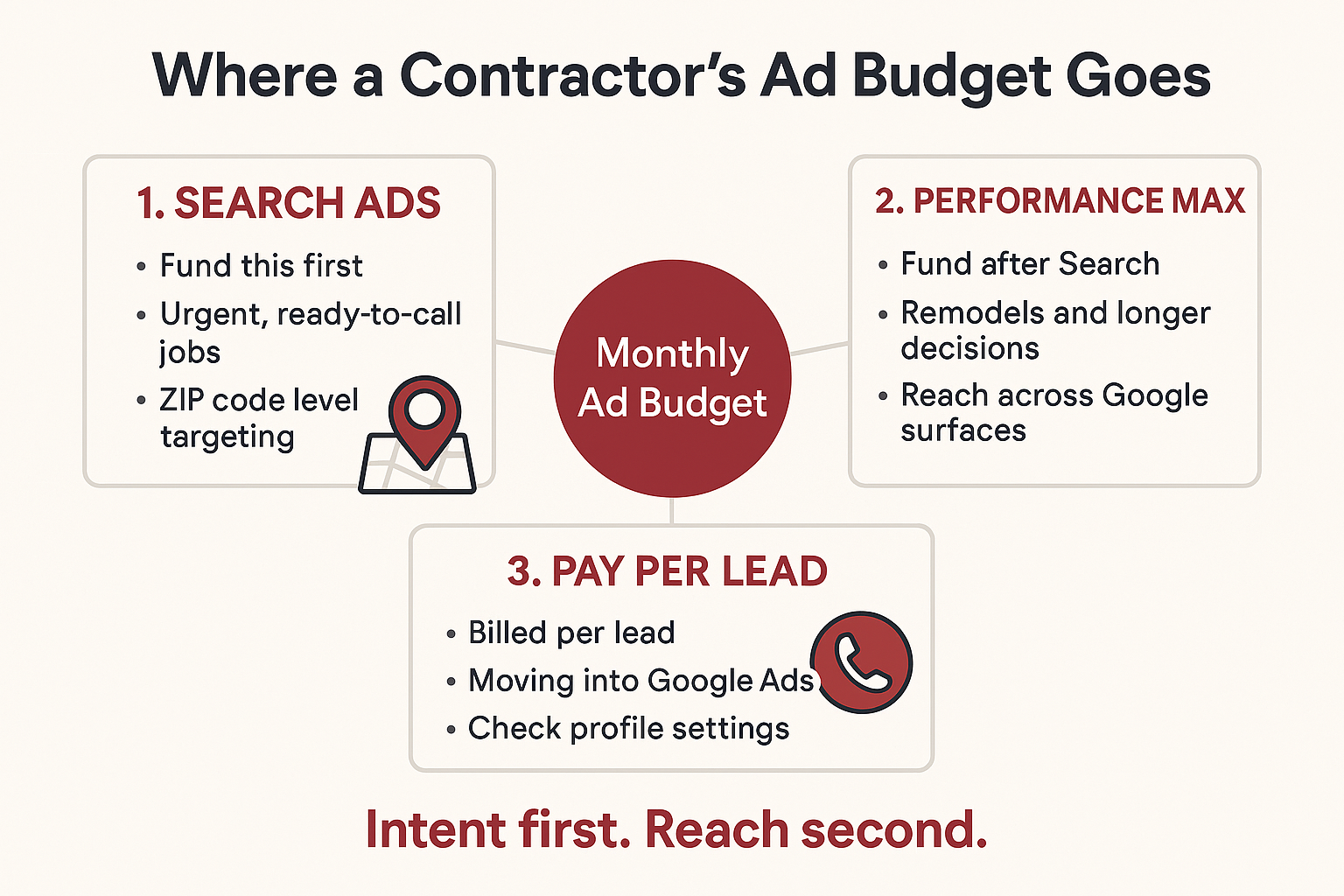
Flat Monthly Spend Is a Mistake on This Coast
Campaign type matters. Timing matters just as much, and most owners get this wrong by spending the same amount every month.
Local search data for the broader San Francisco, Oakland, and San Jose market shows furnace repair searches peaking in December at several times their August level. Roof repair peaks in December as well. Bathroom remodel searches peak in January, when people are indoors and staring at a tub they hate.
The weather backs it up. Across the stations in our area, January is the wettest month, and roughly 87% to 89% of annual rainfall arrives October through March, according to the NOAA U.S. Climate Normals.
So a flat budget means two things at once:
- You underbid in December, when a Monterey homeowner with no heat will call whoever appears first.
- You overpay in July, when the same searches are a fraction of their winter volume.
Shape the spend instead. Pull dollars forward into the weeks before your trade’s demand arrives, not the weeks after. That is the whole idea behind planning a season ahead rather than reacting to last month’s report.
Campaign Type Arguments End When Attribution Starts
Here is the part that settles every one of these debates. Most owners I meet cannot tell which half of their ad spend worked, so the argument stays theoretical.
We trace every call and form submission back to the ad that drove it, and the reporting comes in plain language tied to booked work. Once an owner can see that Search produced twelve booked jobs in December and Performance Max produced two inquiries and a lot of video views, the budget split stops being a debate.
Two things to watch while you read those numbers:
- Separate brand searches from new demand. People already looking for you by name are not a win the ad bought.
- Judge by booked jobs, not lead count. I wrote about why in Cost Per Lead Is the Wrong Number.
Automation is fine. Unreviewed automation is how a budget meant for Salinas and Marina quietly ends up buying impressions somewhere you do not send trucks.
Frequently Asked Questions About Contractor Ad Budgets
Should I run Performance Max at all if my budget is small?
Usually not yet. If your Search campaign still runs out of budget before the end of the day in your core ZIP codes, every dollar moved to Performance Max is a dollar taken away from a homeowner who was ready to call. Cover high intent Search first, then expand.
Will Google move my Local Services Ads account automatically?
Reporting describes a staged rollout that began in August 2026 for selected United States home service categories and continues into 2027. You generally do not choose the timing, which is why I tell owners to verify business name, address, service areas, and job types now rather than mid season.
How much should a Monterey County contractor budget for Google Ads?
It depends on your trade, how many cities you want to cover, and how competitive your keywords are. A plumber covering Salinas and Marina needs a very different number than a roofer trying to own all of Monterey and Santa Cruz counties. Our published pricing calculator gives a general monthly range in about a minute, and the exact figure comes after a strategy session.
Can I just shut ads off in the slow months?
You can, and some trades do. The risk is losing campaign history and bidding momentum right before demand climbs. I would rather scale spend down to a floor through the dry months and scale it back up starting in October, when the rain and the search volume both return.
Do ads help my organic rankings?
No, paid clicks do not improve organic position. What ads do is cover you while local SEO and AI search visibility build, and let you own more of page one once they have. What contractor marketing on the Central Coast looks like in 2026 goes deeper on how the pieces fit together.
Thinking Through Your Own Ad Split?
If you are a Monterey County contractor trying to decide where next quarter’s ad dollars should sit, a strategy session with Phil Fisk covers your market, your competitors, and whether your territory is still open. You can also run the numbers yourself first on the pricing calculator, which gives a general monthly range in about 60 seconds. Core6 is reachable at (831) 789-9320, Monday through Friday.