Direct Answer: Perplexity recommends contractors whose online presence shows up across multiple trusted sources in real time. If your website, reviews, and directory listings don’t give it enough corroboration, you simply don’t get mentioned.
Something changed in how homeowners find contractors, and most of the trades on the Central Coast haven’t caught up yet. When a homeowner in Salinas types ‘who does HVAC repair near me’ into Perplexity, they get a recommended business name with inline citations, not a list of ten blue links to scroll through. One contractor gets the call. The others don’t exist in that moment.
Perplexity is not Google. It does not rank pages in a traditional sense. It reads the live web in real time, pulls the sources it trusts most, and generates a confident recommendation. If your business is not in those sources, you are not in the answer.
I want to explain exactly how this works, because the mechanics matter. And once you understand how Perplexity makes its decision, the path to showing up in those answers becomes pretty clear, even for a contractor who has never thought about AI search before.
Perplexity Reads the Live Web Right Now, Not a Snapshot
This is the detail that separates Perplexity from tools like ChatGPT when it comes to local contractor recommendations. ChatGPT’s base model works from a pre-trained dataset, it knows what was on the internet up to a certain cutoff date. Perplexity, by contrast, runs live web retrieval every time someone asks a question. It goes out, reads current pages, and builds its answer from what it finds in that moment.
For contractors in Monterey County, that distinction is meaningful. A plumber in Marina who updates their website today, fills out their BBB profile this week, and asks three customers for detailed reviews over the next weekend could theoretically start appearing in Perplexity recommendations within days. Not months. Days.
Most contractors I talk to assume AI visibility works like traditional SEO, where you plant seeds and wait six months to see movement. Perplexity is closer to a live press check. It wants to know what the web says about you right now. If you’ve been putting off fixing your online presence, that timeline is actually good news.
To understand more about how AI search is changing who gets called for home repairs, the shift is happening faster than most contractors realize.

The Confidence Filter: Why Perplexity Skips Most Contractors
Perplexity is not running a popularity contest. It is running a confidence check. Before it recommends a contractor by name, it needs enough corroboration from independent sources to feel confident the recommendation is accurate and trustworthy.
A contractor whose only clean online presence is their own website gives Perplexity a single data point. One source. That is not enough to build a confident recommendation on. But a contractor whose information is consistent across a dozen trusted platforms, including the BBB, Yelp, local chamber directories like the Salinas Valley Chamber of Commerce, trade-specific directories, and Google Business Profile, gives Perplexity a pattern it can trust.
Think of it this way: if ten independent sources all agree that a specific roofing contractor serves Watsonville and does quality work, Perplexity can say that with confidence. If only the contractor’s own website makes that claim, it has no way to verify it.
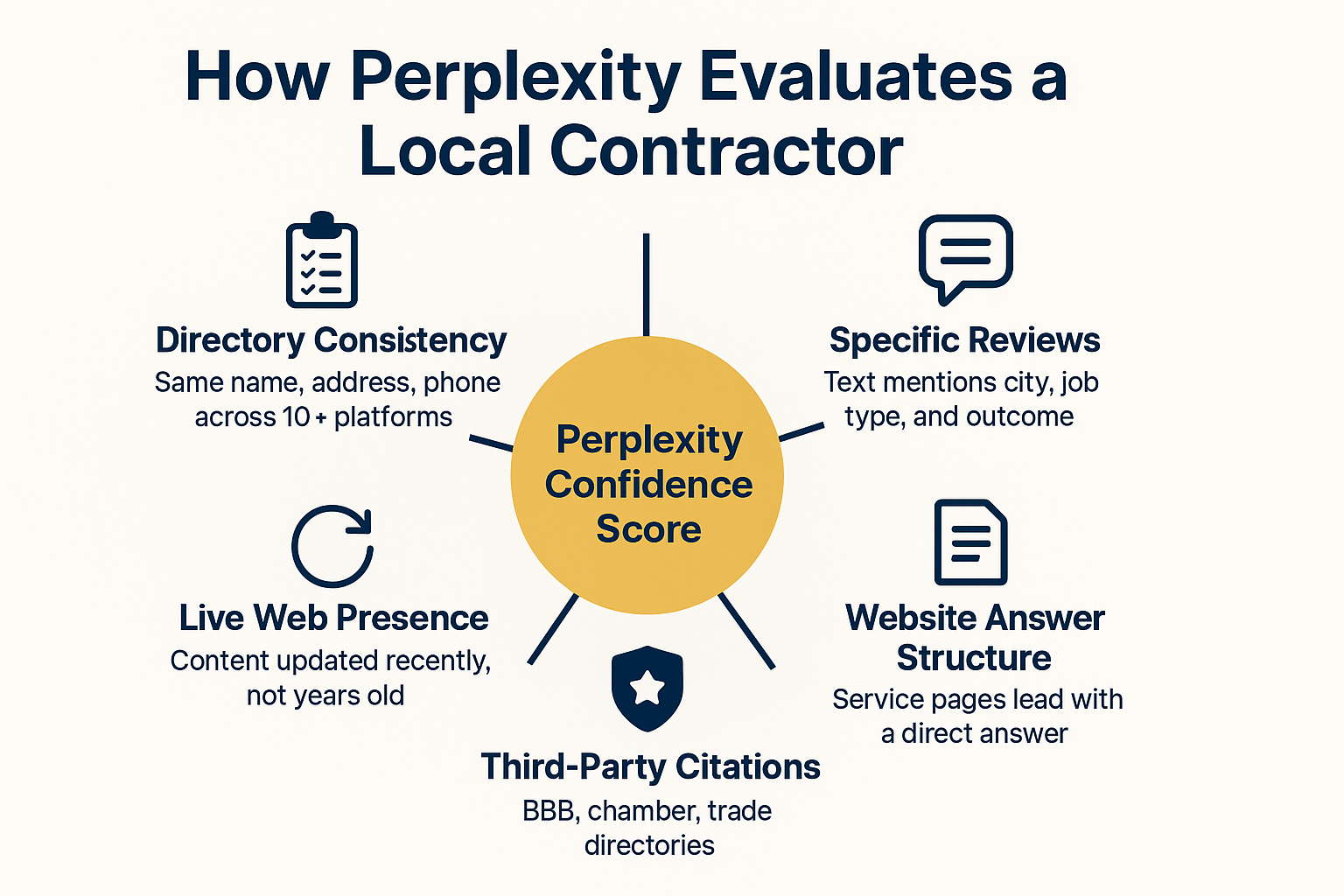
The signals Perplexity weights most heavily include:
- Directory listings on recognized platforms with consistent business name, address, and phone number
- Review platform presence on Yelp, Google, and trade-specific sites
- Third-party mentions on BBB, chamber directories, and regional press
- Website content that directly answers the questions homeowners actually ask
- Specific, text-based reviews that include verifiable details like service type, city, and outcome
This is why citation management and Google Business Profile optimization matter so much more now than they did three years ago. It is not just about Google anymore.
What Perplexity Looks For Before Recommending a Contractor
This breakdown shows the five signals Perplexity weighs when deciding whether to cite a local contractor in its answers.
Why Review Language Matters More Than Review Count
I’ve seen contractors with 80 five-star Google reviews barely show up in AI search answers, while a competitor with 30 reviews gets cited by name. The difference almost always comes down to what those reviews actually say.
Perplexity can extract meaning from review text. A review that reads ‘replaced our water heater in Marina on a Saturday morning, had the job done by noon’ gives the AI a specific, verifiable claim to work with. A service type, a city, a timeframe. That is usable signal. A review that reads ‘great service, highly recommend’ gives Perplexity almost nothing to work with.
According to research from BrightLocal’s Local Consumer Review Survey, detailed reviews consistently influence consumer decisions more than rating alone, and the same logic applies to how AI models process that content.
For contractors in Monterey County, this means one practical change: ask for specific reviews after every job. Not ‘please leave us a review.’ Something like: ‘If you have a minute, would you mention what we did and where you’re located? It helps other homeowners in the area find us.’ That one prompt can turn a generic five-star into a review that builds real AI visibility.
The language your customers use in reviews is also your best source of real-world content for service pages, which feeds directly into how Perplexity reads your site. We cover that connection in more depth in what your customers already wrote as your best SEO content.
Your Service Page Structure Is Either Getting You Cited or Getting You Skipped
When Perplexity retrieves pages from the live web, it is looking for content it can extract and quote with confidence. The structure of your service pages determines whether that happens.
Pages that open with a paragraph about the company’s history, core values, or how long they’ve been in business are poor candidates for extraction. Perplexity is trying to answer a specific homeowner question. If your page doesn’t address that question in the first two or three sentences, the engine moves on to a page that does.
The pages Perplexity cites tend to share a few structural traits:
- They open with a direct answer to a question a homeowner would actually type
- They name the service area explicitly, ‘We serve Seaside, Sand City, and Pacific Grove’, not just ‘the Monterey Bay area’
- They include specifics about the job, what the service involves, how long it typically takes, what triggers the need for it
- They are written for a person, not for a search engine
The good news is that fixing this does not require a full website redesign. It usually means rewriting the opening paragraph of your key service pages. Lead with the answer, then follow with your credentials and company background.
This connects directly to a broader pattern we’ve seen: why AI gives out one or two contractor names and skips everyone else. The contractors who get cited are the ones whose content is structured to answer a question, not to impress a visitor.
Perplexity Visibility: What Helps vs. What Doesn’t
This quick reference shows which online presence factors actually influence Perplexity recommendations for local contractors, and which ones do almost nothing.
| Online Factor | Impact on Perplexity Visibility | Why It Matters |
|---|---|---|
| Specific text-based reviews mentioning city and service type | High | Gives Perplexity verifiable, extractable claims |
| Generic 5-star reviews with no text | Very Low | No usable content for AI to cite |
| Consistent NAP across 10+ directories | High | Creates a pattern of corroboration Perplexity trusts |
| Service pages that open with a direct answer | High | Perplexity extracts pages that answer questions first |
| Service pages that open with company history | Low | Not structured for AI extraction |
| BBB and chamber directory listings | Medium-High | Trusted third-party sources carry citation weight |
| Website-only presence with no third-party listings | Low | Single data point, not enough for a confident recommendation |
| Google Business Profile with recent posts and photos | Medium-High | Live, updated signals the AI can pull in real time |
Frequently Asked Questions About Perplexity Local Contractor Recommendations
How is Perplexity different from Google when it comes to finding local contractors?
Google returns a ranked list of pages and lets you click through. Perplexity reads those pages for you, synthesizes the information, and delivers one answer with the sources it trusted most. For local contractors, that means the decision of who gets mentioned happens before the homeowner ever clicks anything. If you are not in the sources Perplexity retrieves, you are not part of the answer.
How fast can a contractor start showing up in Perplexity recommendations?
Because Perplexity retrieves live web content rather than working from a pre-trained snapshot, the timeline is much shorter than traditional SEO. A contractor who improves their directory listings, updates service pages, and collects a few specific reviews could start appearing in relevant answers within days to a few weeks. That said, it depends on how competitive the query is and how much corroboration already exists for your business across trusted sources.
Do I need to be on a lot of different directories for this to work?
Yes, but quality matters more than quantity. Perplexity is looking for consistent information across recognized platforms, BBB, Yelp, Google Business Profile, your local chamber directory, and trade-specific directories like Angi or HomeAdvisor (even if you don’t pay for leads there, having a clean listing helps). A profile on a dozen trusted sites that all agree on your business name, address, phone number, and service area is far more useful than profiles on fifty obscure directories with inconsistent information.
Can Perplexity read my Google reviews?
It can access review platforms that are publicly indexed. Google reviews are generally accessible, as are Yelp reviews, BBB reviews, and others. The more important question is whether those reviews contain usable content. Specific reviews that name the service, the city, and a clear outcome give Perplexity something to cite. Blank star ratings with no text do not.
My website ranks well on Google already. Doesn’t that mean Perplexity will find me too?
Not automatically. Good Google rankings help because Perplexity does pull from pages that appear in search results. But ranking is not enough on its own. Perplexity also checks whether the content on your page is structured to answer a direct question, and whether your business has corroboration across third-party sources. A contractor who ranks on page one but has thin service page content and no real directory presence can still be skipped by Perplexity entirely.
Is this something I can fix myself, or does it require a marketing agency?
Some of it you can do yourself. Asking customers for specific reviews, claiming and updating directory listings, and rewriting the opening paragraph of your service pages are all practical tasks. The harder part is knowing which directories actually carry weight with AI engines, making sure your business information is perfectly consistent across all of them, and structuring your website content in a way that gets extracted and cited. That’s where having a system matters more than doing individual tasks. We explain the difference in what it means to have an AI system rather than just using AI tools.
Want to Know Where Your Business Actually Stands with AI Search?
We work with contractors across Monterey County, from Salinas and Marina to Watsonville and Carmel Valley, to build the kind of online presence that gets cited by Perplexity, ChatGPT, and Google AI Overviews. Our AI Search Sync approach covers the directory consistency, content structure, and review strategy that makes the difference between getting recommended and getting skipped. If you want an honest look at where you stand, Phil is available for a no-pressure discovery call at https://calendly.com/core6-marketing/30min.