Direct Answer: An AI-built website is better than nothing for a brand-new contractor, but for any established home service business in Monterey County that wants consistent inbound calls, a templated site is a ceiling, not a foundation.
I get the question at least a few times a month, usually from a plumber or HVAC contractor in Salinas who just saw an ad: Can’t I just use Durable or Wix AI to build my own website for free? It’s a fair question. Platforms like Lovable, Durable, and Wix AI can generate something that looks like a contractor website in under an hour. The price gap versus a professionally built site is real — we’re talking somewhere between free and a couple hundred dollars a year on one end, versus several thousand dollars for a purpose-built site on the other.
I’m not going to wave that off. The appeal is legitimate, and contractors deserve a straight answer rather than agency hand-waving. So here’s what I’ve actually seen working with home service businesses across Monterey County — what those AI platforms deliver, where they consistently fall short, and how to think about the decision based on where your business actually is right now.
What AI Website Builders Are Actually Good At
I’ll give credit where it’s due. AI website builders are genuinely good at layout and aesthetics. Feed one of these platforms a prompt like “HVAC contractor serving the Monterey Bay Area” and it will generate something that looks professional in minutes — clean fonts, organized sections, stock photos of technicians, a contact form.
For a contractor who has never had a website at all, that’s a real step forward. If you’re a solo handyman just getting started in Marina or Seaside and you need a basic web presence while you build your client base, an AI-built site checks that box without a significant upfront cost.
But here’s where I’d pump the brakes: looking like a website and functioning like one are two different things. What these platforms generate is the shell. They can’t supply:
- Photos of your actual jobs in Carmel Valley or on the Monterey Peninsula
- Your real customer reviews with dates and names
- Specific service-area language that means something to a local homeowner
- Trade-specific content that reflects what work actually looks like in this market
The platform fills those gaps with placeholder language — copy that sounds like every other contractor in the country. And homeowners notice. Before anyone picks up the phone, they’re asking themselves three questions: Do you serve my area? Can you handle this specific job? Can I trust you? A generic AI-built template rarely answers all three in any credible way.
The Trust Problem That Templates Can’t Solve
One of the clearest patterns I’ve seen across homeowner feedback is that trust signals matter more than design. A homeowner in Pacific Grove or Watsonville isn’t comparing your site’s color palette to your competitor’s. They’re looking at whether your reviews have dates. Whether there are photos of real local jobs. Whether they can see a technician’s face and name.
An AI-built site generated from a prompt has none of that — because the platform doesn’t have access to your real jobs, your real customers, or your local reputation. It’s working from a generic description, and the output reflects that.
I’ve seen this play out in form submissions we review for clients. Homeowners describe the same pattern repeatedly: they visited two or three websites before calling, and the deciding factor was whether the site felt like it belonged to a real local business. Reviews with specifics. Photos that matched the type of work they needed. A service area list that included their neighborhood.
This is also why what your customers say in reviews and calls is some of the most valuable raw material a contractor site can use. An AI website builder doesn’t have any of that — and no prompt you write can substitute for it.
Where AI-Built Contractor Sites Break Down in Search
Search performance is where I see AI-built contractor sites fall apart most visibly, and it’s worth understanding why before making a decision based on upfront cost alone.
Google’s current guidance explicitly flags scaled content that doesn’t add value for users as a spam risk. A templated site built without original local content sits close to that line. A page that says “serving the Monterey Bay Area” without any specifics — no real neighborhoods, no trade-specific local knowledge, no original content — gives search engines very little reason to surface it over a competitor with something more substantive. Google’s 2026 content guidance for contractors goes into this in more detail if you want the technical side.
The structural problem runs deeper than just content quality. An AI website builder starts from a prompt, not from your actual business. It doesn’t know that roofing projects in the Salinas Valley often involve a mix of flat commercial and pitched residential work. It doesn’t know that HVAC contractors near the coast deal with salt-air corrosion issues that inland competitors in places like Hollister or King City simply don’t face. That kind of trade-plus-market specificity is what makes a page credible to both a homeowner and a search engine — and no AI platform can generate it without someone supplying that raw material first.
Search is also evolving beyond traditional Google results. AI platforms like ChatGPT and Perplexity are now part of how homeowners find contractors — and those systems pull from sources with substance, not placeholder text. A site that has nothing original to say about its local market will be invisible there too.
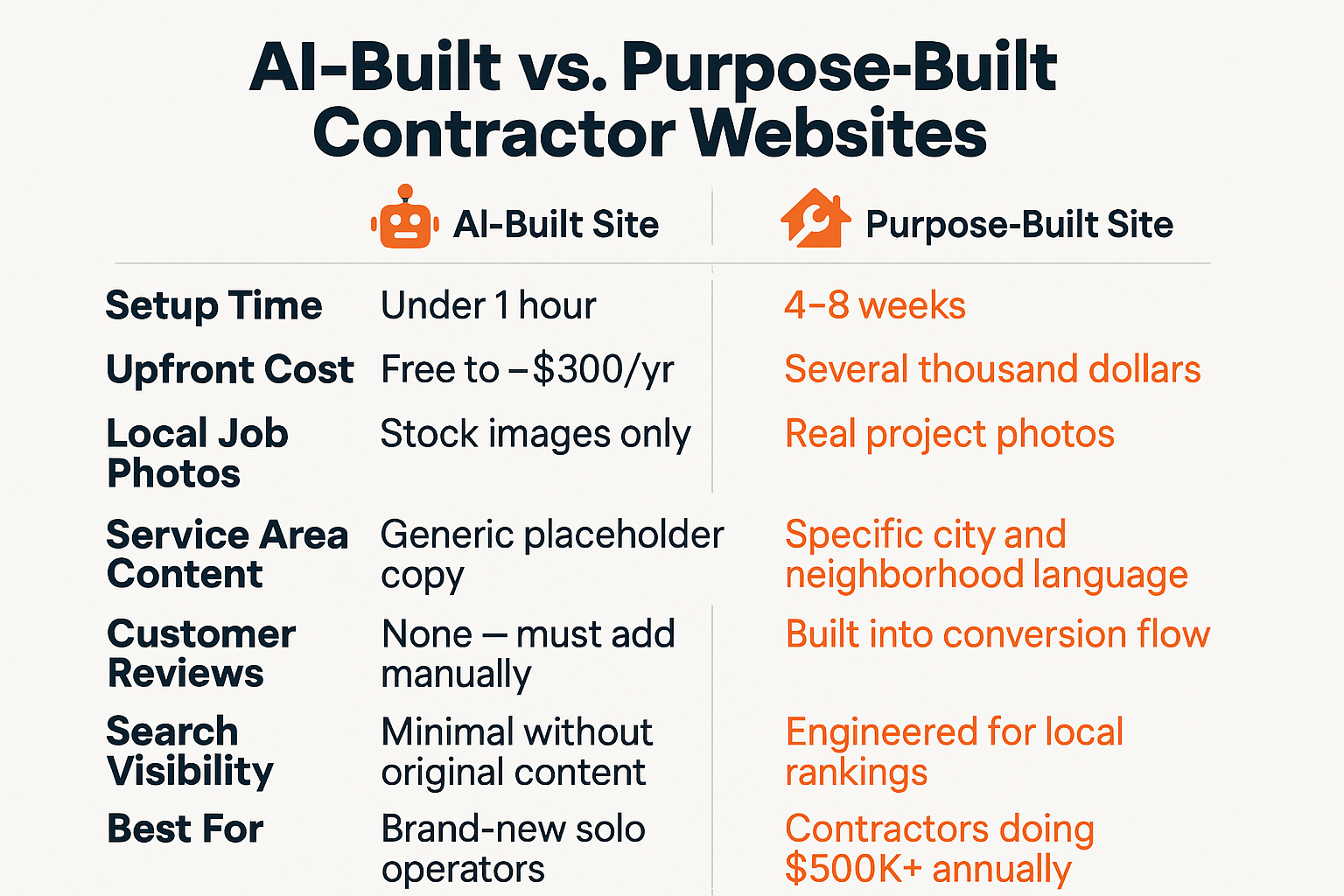
AI-Built vs. Purpose-Built: What Each Actually Delivers
This comparison covers the areas that matter most when a contractor is deciding between an AI-generated site and a professionally built one.
Quick Reference: Which Option Fits Where You Are
This isn’t a one-size-fits-all decision. Here’s how I’d frame it based on business stage.
| Business Stage | AI-Built Site | Purpose-Built Site |
|---|---|---|
| Brand-new, solo operator, under $200K revenue | Fine as a placeholder | Probably not yet — hold off |
| Growing, 2–5 employees, $300K–$500K revenue | Starting to limit you | Worth a serious conversation |
| Established, $500K–$3M+ revenue | A ceiling, not a starting point | Should already have one |
| Wanting consistent inbound calls from search | Won’t get you there | Built for exactly this |
The Honest Middle-Ground Answer
I want to be direct about something: an AI-built site is not a scam. For a brand-new sole operator who needs a web presence while building their first client base, it’s a reasonable stopgap. The platforms work as advertised for what they actually do.
But for a contractor doing $500,000 or more in annual revenue who wants the phone to ring consistently, a templated site is a ceiling — and often a frustrating one, because it looks like it should be working. It has all the visual elements of a real website. It just lacks the conversion architecture, original local content, and trust signals that separate a site that generates calls from one that generates traffic.
The gap between looks like a website and generates inbound calls is exactly where most AI-built contractor sites stop. And if you’re already doing real volume — running a roofing crew in Santa Cruz County, managing an HVAC dispatch in Salinas, running a plumbing operation across the Monterey Peninsula — that gap is costing you jobs.
We wrote a longer breakdown of why contractor websites rank but don’t ring that gets into the conversion side in more detail. It’s worth reading if you’ve already got a site that’s pulling some traffic but not generating calls at the rate you’d expect.
What a Purpose-Built Contractor Site Actually Does Differently
When we build a site for a contractor on the Central Coast, we’re not starting from a template prompt. We’re starting from the contractor’s actual business — their real service areas, their trade-specific knowledge, the questions their customers ask before they call.
According to Google’s own guidance on helpful content, a page that demonstrates first-hand expertise and speaks to a specific audience performs better than one that’s generically assembled. That principle applies directly to contractor websites.
For an HVAC contractor near the coast, that means content that addresses salt-air corrosion — a genuine concern for equipment installed in Pacific Grove, Seaside, or Marina that simply isn’t a factor for competitors operating in Hollister. For a roofer in the Salinas Valley, it means pages that reflect the actual mix of flat and pitched roofing work common to that market.
That specificity is also what feeds visibility in AI search. Platforms like ChatGPT and Perplexity are increasingly part of how homeowners find local contractors — and those systems pull from sources that have something real and specific to say. Your Google Business Profile is now an AI feed, not just a directory listing, and the same logic applies to your website. Generic placeholder content doesn’t feed those systems. Original, locally grounded content does.
Frequently Asked Questions About AI-Built Contractor Websites
Can I start with an AI-built site and upgrade later?
Yes, and for a brand-new contractor that’s a reasonable sequence. The caution is that many contractors stay on those platforms longer than they should because the site looks fine. By the time you realize it’s not generating calls, you’ve lost months of potential ranking ground to a competitor who invested earlier. If you’re already past the $300K–$400K revenue mark, skipping the AI-built phase and going straight to a purpose-built site is usually the better move.
What does a professional contractor website actually cost in Monterey County?
Costs vary based on scope, number of service pages, and what’s included — but purpose-built contractor sites in this market generally run several thousand dollars for the build, with ongoing hosting and maintenance on top of that. The better question is what a well-built site generates in inbound jobs over 12 months compared to what a free platform generates. For most established contractors, the math tilts toward the professional build fairly quickly.
Will an AI-built site rank on Google at all?
It can rank for very low-competition searches, but competing for terms like “HVAC contractor Salinas” or “roofer Monterey County” against established businesses with original content, strong Google Business Profiles, and real local backlinks is a different story. Templated sites with generic content are at a structural disadvantage in competitive local searches. Google is actively deprioritizing content that doesn’t add specific, original value — and a site built from a one-line prompt rarely clears that bar.
What about AI site builders that let me add my own content?
That helps — meaningfully. If you take an AI-built template and then invest the time to write real, specific content about your actual services, service areas, and trade knowledge, you’ve addressed one of the biggest structural weaknesses. The remaining gaps are usually in conversion architecture and technical SEO. But if you’re willing to put in that content work, you’re already doing most of what makes a professional build valuable — and it may be worth just doing it right from the start.
Is my current site actually the problem, or is it something else?
That’s the right question to ask. Sometimes a contractor’s site is fine and the real gap is their Google Business Profile, their citation consistency, or the absence of any real local SEO effort. How local SEO actually works for home service contractors on the Central Coast is a good place to start sorting that out before making any website decision.
Want to Know Where Your Current Site Actually Stands?
If you’re a contractor in Monterey County — whether you’re on an AI-built template or a site you’ve had for years — and you’re not sure whether your website is working for you or just sitting there, that’s worth a real conversation. Core6 Marketing has worked with home service contractors across the Central Coast for more than 20 years, and a Discovery Call with our team starts with an honest read on what you actually have, not a sales pitch for what we offer. You can book a time directly at https://calendly.com/core6-marketing/30min.