
Direct Answer: Write the pages that answer the questions that kill deals first: cost, timing, repair versus replace, warranty. Then service area pages for towns you actually work in. Then proof pages about real jobs.
You have maybe two hours a month for content. Not twelve posts, not the content calendar somebody sold you at a trade show. Two pages, if the week cooperates.
I work with owner-operated shops across Monterey County, from Salinas out to Carmel Valley and up through Watsonville. The question I get is almost never what to write. It is what to write first.
The order I use is short. Write the pages that answer the questions killing deals before the phone even rings, then the towns you actually drive to, then proof of the work you finished. Whatever a keyword tool spit out can wait.
Why an AI content strategy for contractors is about order, not volume
A one-truck plumber in Prunedale is not going to out-publish a franchise. That was never the plan. With two pages a month, sequencing does the work that volume does for bigger shops.
Here is the part that changed my thinking on order. A local search study from Whitespark found AI Overviews appearing on 92 percent of informational queries and 97 percent of hybrid queries that mix a question with buying intent, but on only 15 percent of straight local-intent searches.
Read that as two different battlefields:
- “How much does it cost to replace a roof” is now answer-engine territory, and the answer gets assembled from pages like yours
- “Roofer near me” still behaves a lot like the old map pack, driven by your Google Business Profile, reviews, and citation consistency
- The first one shapes the decision before anybody calls the second one
That split is why the profile side of things belongs to your local SEO work, what we call AI Search Sync, while your two pages a month go toward the questions being asked earlier in the process. If you want the wider view of how those pieces fit, what a real AI content strategy looks like for a trade business covers the system. This article is only about the order you build it in.

First: the questions that kill deals before the call
Pull your last thirty call recordings or form submissions and you will find the same handful of worries over and over. Those worries are your first six pages.
They almost always cluster here:
- What does this cost, and what makes the number move
- How long does it take, start to finish, including the wait for a part
- Repair or replace, and how to tell which side of the line a homeowner is on
- Warranty and lifespan, especially when something failed earlier than expected
- What happens if something goes wrong after the crew leaves
Use the words homeowners actually use. In tree care, nobody types “declining canopy health.” They say it’s seen better days. And one of the most common calls in that trade is a homeowner whose insurance carrier is threatening to cancel over limbs hanging above the roof.
That second one is a full page by itself, and almost nobody in the trade has written it. Same with the plumbing caller who says the hot water only lasts five minutes and the unit is a year and a half old. That is a warranty and expectations page waiting to be written.
On cost pages, publish a range plus the factors that move it, not a fake-precise number. Age of the home, access, permit timing in your city, and material choice all swing the figure, and saying so honestly reads as more credible than a single number that turns out wrong. This is the same idea behind your customers already wrote your best SEO content.
Second: service area pages for the towns you actually drive to
A Salinas plumber running jobs in Prunedale, Marina, and Hollister needs three real pages, not three copies with the town name swapped. Copy-paste town pages are the exact pattern Google’s spam policies on scaled content abuse call out.
A page for a town earns its keep when it carries things only a local crew would know:
- Typical drive time and response window from your shop to that area
- The housing stock and its vintage, since a mid-century Salinas neighborhood and a newer Hollister tract create different problems
- Common failures you see there, in plain terms, not a list of services
- Jobs you have actually completed in that town, with enough detail to be believable
You already know that older neighborhoods on the peninsula behave differently than the newer builds inland. Write the difference down. That is the page.
One caution from experience: publish these one at a time, as you can write them well. Ten thin town pages dropped in a single week is one of the fastest ways to look automated, which is what happens to contractor sites stuffed with AI content.
The Order, on One Page
This is the priority I hand contractors when they only have room for two pieces a month.
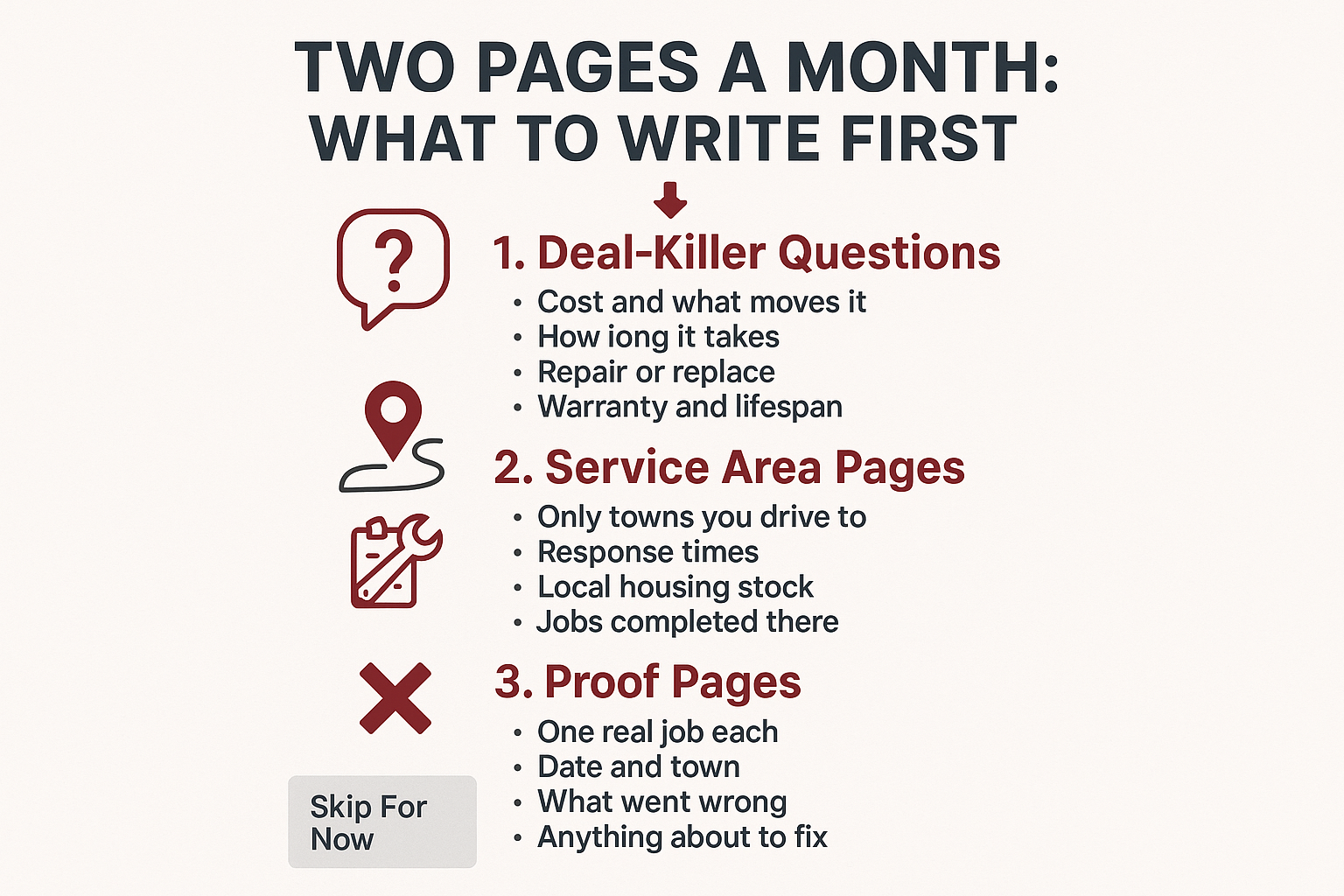
Third: proof pages a competitor cannot copy
Once the big questions and your real towns are covered, move to job writeups. One job, one page, and it does not need to be long.
What makes them work:
- The month and the town, not “recently in the area”
- What the homeowner described first, in their words, anonymized
- What you actually found once you opened it up
- What it took to fix, including anything that went sideways
A homeowner in Monterey County reading that page is deciding whether you have seen their exact problem before. An AI system reading it is looking for something specific enough to cite. Both get what they need from the same 400 words.
And this is the only category of content nobody else can produce, because they did not do the work. Everything else on the internet about your trade can be regenerated in ten seconds. Your Tuesday job in Marina cannot. That difference is most of what separates the contractors AI recommends from the ones it skips.
Six Months at Two Pages a Month
Here is how that sequence looks laid out for a Salinas plumbing shop working the Monterey Bay Area. Swap the trade and the towns for your own.
| Month | Page One | Page Two |
|---|---|---|
| Month 1 | What drives the cost of a water heater replacement | Repair or replace: how to tell with a leaking heater |
| Month 2 | How long a sewer line repair actually takes | Warranty questions homeowners ask us most |
| Month 3 | Plumbing in Prunedale: what we see and how fast we get there | Job writeup: two bathrooms backing up at once |
| Month 4 | Plumbing in Marina: older homes and common failures | What happens if something goes wrong after we leave |
| Month 5 | Plumbing in Hollister: drive time and service window | Job writeup: water through a kitchen ceiling |
| Month 6 | What a repipe costs and what changes the number | Job writeup: hot water lasting five minutes on a newer unit |
What does not make the cut
With only two slots a month, the cost of writing the wrong page is high. These are the ones I tell owners to skip:
- National trend commentary about your industry
- Holiday and seasonal filler with no job attached to it
- Generic tips roundups that could run anywhere
- Anything about the trade rather than about the customer’s problem
The test takes five seconds. If a contractor two counties away could publish the piece unchanged with their logo on it, it is not one of your two. Write the version only you can write, and check your existing pages against the same standard using how to tell if your content is hurting your rankings.
Frequently Asked Questions About Prioritizing Contractor Content
Is two pages a month really enough to move rankings?
It is enough when the pages are the right ones. Twenty-four pages a year that each answer a real question beats a hundred generic posts, because the generic ones compete with everything else on the internet and the specific ones do not.
Where do I find the questions to write about if I don’t track calls?
Read your last twenty text threads and form submissions and write down the first sentence of each one. That first sentence is usually the page title. Call recording and transcription makes this faster and turns caller phrasing into a monthly list, but you can start with your phone and a notepad this week.
Should I write cost pages if my prices change?
Yes, but write them as ranges plus the factors that move the number. Access, age of the home, materials, and permit timing all swing a quote, and explaining that is more useful than a single figure. Point readers to a real conversation for the exact number.
Can I use AI to draft these pages?
For structure and cleanup, sure. For the substance, no, because the substance is what you found under the house last Thursday and a model does not know that. We cover the line between the two in more detail in our writing on where automation helps and where it backfires.
Ready to Put Your Two Pages a Month in the Right Order?
Most of the contractors I talk to in Monterey County are not short on things to say. They are short on a list that tells them which one goes first. Phil Fisk at Core6 Marketing works directly with a small roster of Central Coast contractors and takes 30 minute discovery calls if you want a second set of eyes on your sequencing. The office line is (831) 789-9320.