
Direct Answer: Homeowners search by symptom, not service. They type what they see, like water coming through the ceiling. Trade terms belong on your page, just not in the headline that has to catch them.
It is 11 PM in Salinas and a homeowner is standing in a hallway watching a brown ring spread across the ceiling. They pull out their phone and type what they see. They do not type the name of the service that fixes it.
I have read enough call transcripts and form submissions from Monterey County contractors to know how wide that gap gets. Homeowners describe symptoms. Contractor websites are built around trade terms. The search never connects.
This article is narrow on purpose. It is about vocabulary: which words go on the page, in what order, and why a jargon headline quietly loses searches that were already headed your way.
Homeowner Search Language vs Trade Terms: What People Actually Type
Here are real phrasings, paraphrased and stripped of any identifying detail, from homeowners calling plumbers about an emergency:
- Sewage backing up into the shower and the tub
- Water coming through the ceiling from upstairs
- The toilet backed up in both bathrooms at the same time
- It has only been a year and a half and the hot water lasts five minutes
Not one of those people said hydro jetting. Nobody said sewer lateral, tankless descaling, or camera inspection. Those are the words on the service page, and they are the right words for the job, just not the words that start the search.
The fourth one is worth sitting with. That homeowner is describing a scaling problem in a tankless unit, which is common in parts of Monterey County where hard water runs through the tap. But the page that could win that call is usually titled something like “Tankless Water Heater Maintenance,” which is a phrase that homeowner will never type.
When the words on the page do not match the words in the search box, you lose the click before you ever get a chance to explain what you do. The fix is not dumbing down your site. It is ordering the words differently.

Every Trade Has the Same Gap, Not Just Plumbing
Tree care shows it clearly. A homeowner describing a dying oak said it has seen better days. That is the actual phrase. Now compare it to the phrase sitting on most arborist websites: declining tree health.
Those two phrases mean the same thing and share almost no words. A search engine can bridge that. A page with zero symptom language on it gives the search engine nothing to bridge with.
Then there is the one almost nobody writes about. Another homeowner said their insurance was threatening to cancel because of overhanging trees. That is a full content topic, it is urgent, and it leads to real high-ticket work.
In Carmel Valley and up the ridgelines around Salinas, that call comes in regularly. Limbs over the roofline, defensible space concerns, a carrier letter with a deadline on it. Cal Fire publishes the state’s defensible space requirements at readyforwildfire.org, and homeowners are reading that language before they call anyone.
The same mismatch runs through every trade we work with:
- Electrical: “the breaker keeps tripping” instead of panel load evaluation
- HVAC: “one room never gets cold” instead of duct balancing
- Flooring: “the boards are cupping by the slider” instead of moisture mitigation
- Pest: “there are mounds all over the back lawn” instead of rodent abatement
Symptom Phrase, Trade Term, and Where Each One Belongs
This is how I map it out before writing a page. The left column earns the click. The middle column earns the trust. The right column is the part most sites get backward.
| What the homeowner types | The trade term | Where each one belongs |
|---|---|---|
| Water coming through the ceiling from upstairs | Pressurized supply line leak | Symptom in the H1, trade term named once in the second paragraph |
| Sewage backing up into the shower and tub | Main line blockage, hydro jetting | Symptom in the headline, jetting explained in one short paragraph below |
| Toilet backed up in both bathrooms at the same time | Sewer lateral obstruction | FAQ question in plain words, answer introduces the lateral |
| Hot water only lasts five minutes | Tankless scaling or undersized unit | Blog title uses the symptom, service page link sits in the body |
| It has seen better days | Tree health assessment | Photo captions and FAQ, arborist term used once |
| Insurance is threatening to cancel over overhanging trees | Clearance pruning, hazard reduction | Its own page, symptom phrasing in the headline |
How to Build the Bridge on a Single Page
You do not have to pick a side between plain words and trade words. You stack them in a specific order.
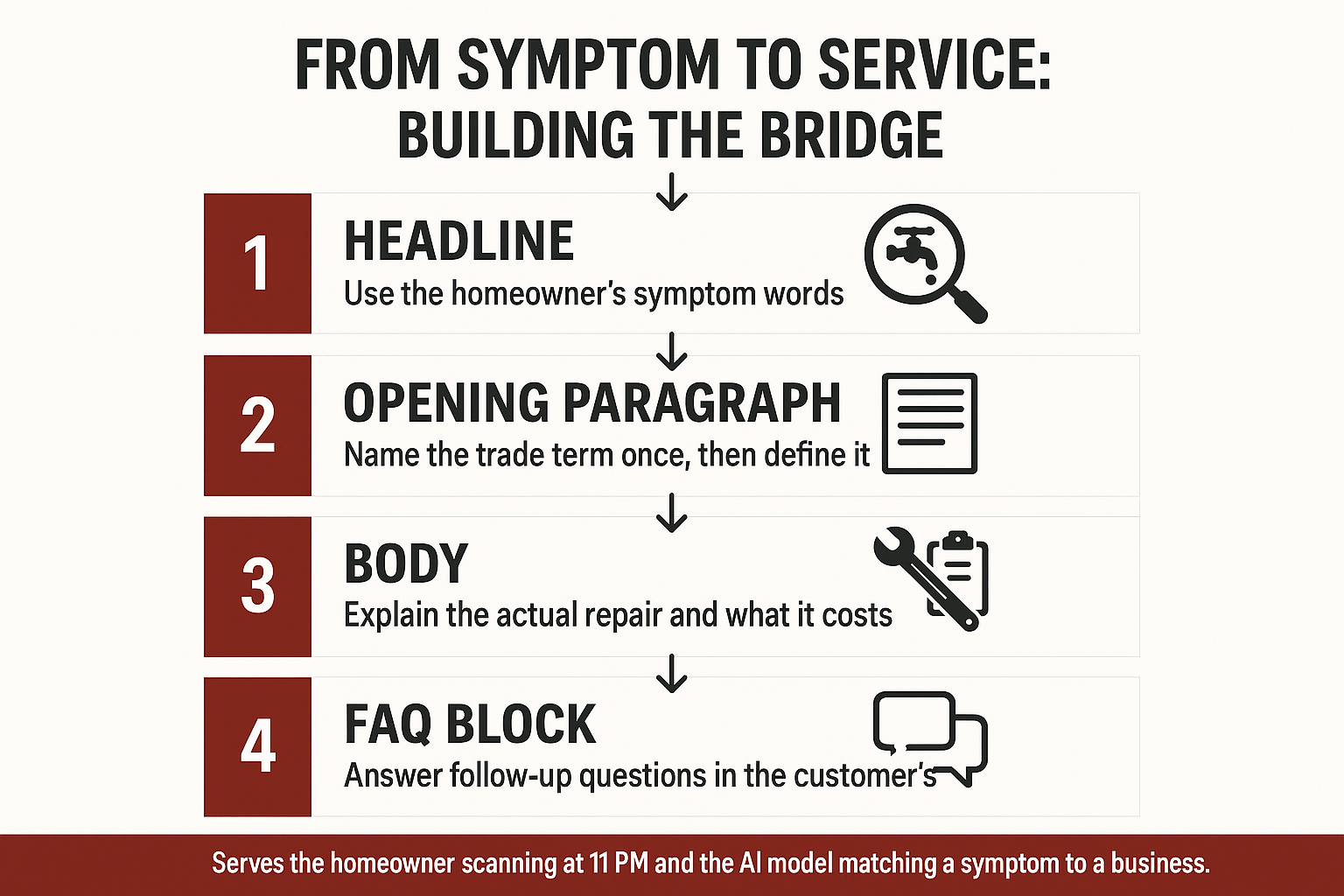
Keep the Trade Term. Just Move It Down the Page.
I am not telling anyone to strip the technical language out. Trade terms are proof you know the work, and they matter to the person comparing three bids.
The order is what changes:
- Headline carries the symptom, in the homeowner’s words
- First or second paragraph names the trade term once, then explains it in one sentence
- Body covers what the repair involves and what drives the price
- FAQ block answers the follow-up questions using the phrasing people actually use out loud
That structure serves two readers at once. The homeowner scanning at 11 PM sees their own problem in the headline and keeps reading. The AI model trying to match a symptom query to a local business finds both the symptom and the service on the same page, which is exactly the connection it needs to recommend you.
This matters more now than it did three years ago. Answer engines are pulling from pages that define terms clearly, which Google itself points to in its guidance on creating helpful content. Our AI Search Sync work runs on the same idea, keeping the symptom language and the service language lined up across the website, the Google Business Profile, and ad copy so nothing contradicts anything else.
If you want the wider view on that shift, we covered it in how AI search is changing who gets called for home repairs.
Some of Your Best Pages Answer Logistics, Not Symptoms
Not every high-value question is about a broken thing. Some are about how you operate, and they convert just as well.
One homeowner asked whether they could send photos first and get a remote look before committing to an on-site visit. That is a policy question, and it needs to be answered in writing on the site. If it lives only in your head, every caller has to ask it, and some of them just call the next company instead.
Another described a frustrating experience with a company that pushed unnecessary work on a sewer issue. That is an objection, and objections are worth answering out loud on the page before the phone ever rings.
Questions like these are usually missing from contractor sites entirely:
- Do you charge for the estimate, and is it credited if I book
- Can I text photos before scheduling
- What happens if the diagnosis changes once you open the wall
- Do you work weekends in Pacific Grove or is that after-hours pricing
One client review that stuck with me described the value plainly, saying we “explain everything in detail.” That is what these pages do. They explain before the call so the call is shorter and warmer.
We get deeper into building this into a real publishing plan in what a real AI content strategy looks like for a trade business, and the profile side of it in your Google Business Profile is now an AI feed.
Frequently Asked Questions About Homeowner Search Language vs Trade Terms
Will using plain symptom language make my company look less professional?
No, as long as the trade term shows up right after it. A headline that says “Sewage Backing Up Into Your Shower” followed by a paragraph explaining main line blockages and jetting reads as more competent, not less. You met the homeowner where they are, then showed them you know the work.
How do I find the exact phrases my customers use?
Three places, and you already own all of them. Your inbound phone calls, your website form submissions, and your reviews. Keyword tools give you search volume, but they will not hand you the sentence a homeowner said at 11 PM while standing in two inches of water.
Should I build a separate page for every symptom phrase?
Not usually. Group related symptoms onto one strong page and let the FAQ block carry the variations. The exception is a topic with its own motivation behind it, like the insurance-driven tree clearance example, which deserves its own page because the reader’s reason for searching is completely different.
How long before this kind of rewrite shows up in rankings?
Timelines vary by how competitive the term is and how much authority the site already has. In our work across Monterey County, we generally look for the first measurable movement around 30 days, with the bigger gains showing up over several months of consistent publishing.
Does any of this help with AI answers, or only regular Google?
Both, and arguably the AI side benefits more. Answer engines are matching a described problem to a business, so a page containing the symptom, the service, and the service area in plain language is far easier for them to use than one written entirely in trade shorthand.
Ready to Put Your Customers’ Words on Your Own Pages?
Our monthly call reporting exists partly to surface these exact phrases, which is a different job than any keyword tool performs. It reads what people actually said before they booked, and what they said when they did not. If you run a home service business anywhere from Watsonville down to King City and want to talk through where the vocabulary gap is on your site, discovery calls are open at (831) 789-9320.