Direct Answer: Your best marketing data comes from three sources you already own: inbound phone calls, website form submissions, and Google reviews. Most contractors never use any of them strategically.
Most contractors I talk to in Monterey County assume their marketing problem is a budget problem. Spend more on ads, get more leads. But when I look at what they’re actually sitting on, the bigger issue is almost always a data problem. They have first party data worth more than any agency report they’ve ever paid for, and it’s going untouched.
This data doesn’t come from a tool, a vendor, or a dashboard someone else controls. It comes from three sources that already exist inside your business: the phone calls coming in, the forms people fill out on your website, and the reviews customers leave after the job. Each one tells a different part of the story about why people hire you, and what’s stopping others from doing the same.
I’m going to walk through each source, what it actually reveals, and why treating all three as separate problems is costing contractors in Salinas, Monterey, and across the Central Coast real money.
Your Calls Are a Content Brief You’re Not Reading
Call data is the most underused first party data source I see across every trade we work with, from plumbers in Seaside to HVAC companies on the Monterey Peninsula. When a homeowner calls and asks “do you charge extra for weekends?” or “how fast can you get out here?”, that’s not just a service inquiry. That’s a content brief.
If dozens of callers are asking the same question, it means Google searches phrased around that question exist, and no one is answering them on the contractor’s website. I’ve seen this pattern repeatedly: a roofing contractor in Salinas fielding the same question about emergency tarping three times a week, but their site says nothing about it. The callers who don’t call are the ones who typed that question into Google, found nothing useful, and booked someone else.
Paraphrasing those call patterns into service page copy and blog content is one of the fastest ways to close the gap between what a site says and what homeowners actually want to know. We wrote about this in more depth in The Calls Sitting in Your Voicemail Are Worth More Than Your Blog. The short version: every recurring question on your call log is a keyword hiding in plain sight.

Form Submissions Show You How People Write When They’re Ready
Phone calls tell you what people worry about out loud. Form submissions show you how people describe their problem in writing when they’ve decided to reach out but haven’t committed to calling yet. Those two things are different, and both matter.
A homeowner who fills out a contact form on a flooring contractor’s site in Watsonville might write something like: “our laminate is buckling near the sliding door and we had it installed two years ago.” That’s not a keyword anyone optimized for. But it’s exactly the kind of specific, problem-focused phrase that triggers AI Overviews on hybrid-intent searches, because it matches how real people describe real problems.
When that language gets paraphrased and built into blog content or a service page FAQ, it outperforms keyword-stuffed copy every time. Not because it’s clever, but because it’s authentic. Google and AI tools like Perplexity and Gemini are increasingly built to surface content that sounds like it came from someone who actually knows the subject. Your Customers Already Wrote Your Best SEO Content covers exactly how this plays out when a contractor takes form language seriously.
The frustrating part is that most contractors never look at their form submissions as a group. They answer each one individually and move on. Reviewing them monthly for patterns takes maybe 20 minutes and produces more usable content material than most agencies generate in a quarter.
What Each First Party Source Actually Tells You
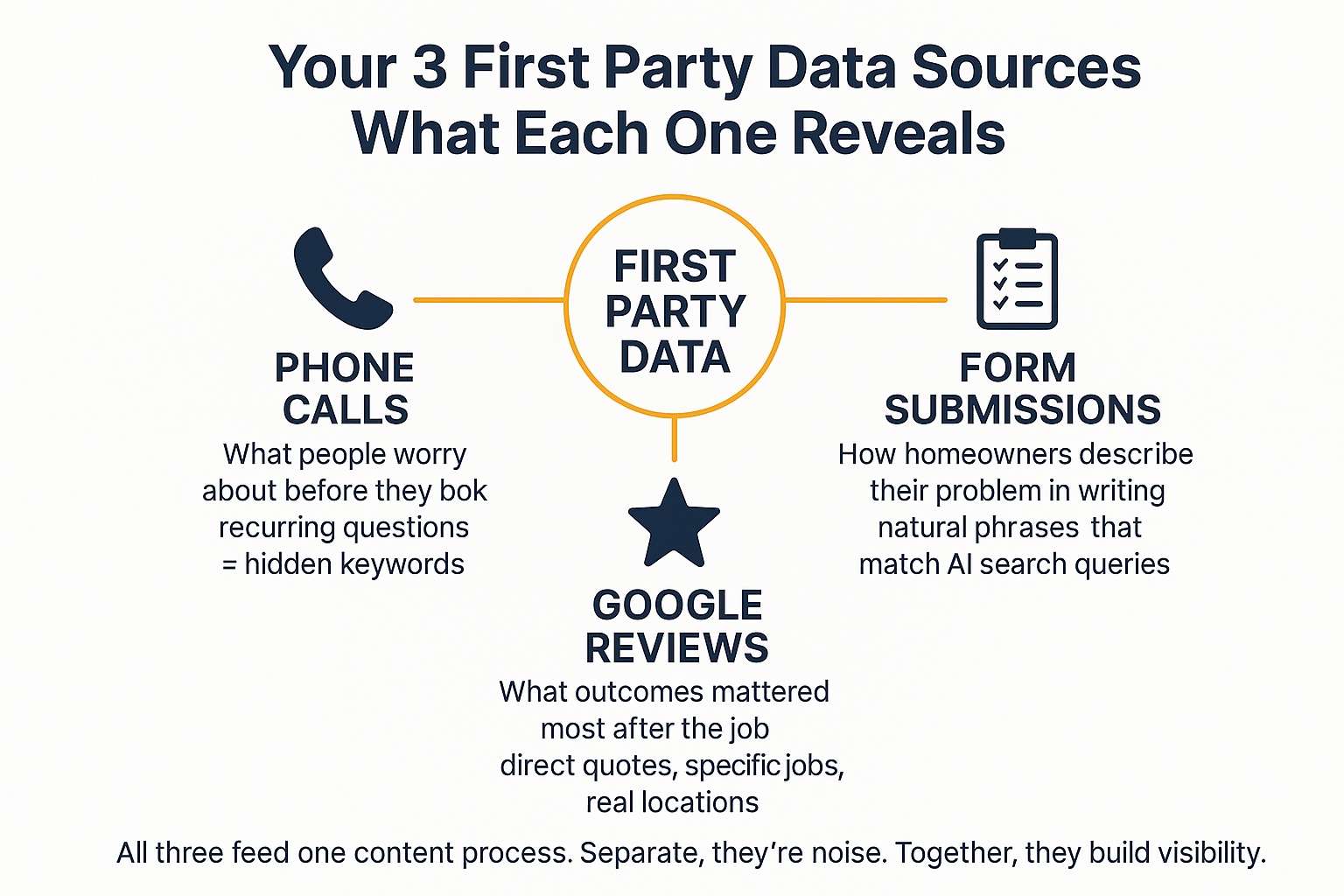
These three data sources each reveal a different stage of the customer’s thinking. Here’s how they break down.
Reviews Are the Only Source You Can Quote Directly, and They’re Getting More Important
Reviews have always mattered for local SEO. What’s changed is how much they matter for AI visibility specifically. Research from SOCi’s 2026 Local Visibility Index found that businesses recommended by AI tools had stronger review signals across platforms than those that showed up in traditional Google results but got skipped by AI.
A pest control company in Salinas with 40 reviews that describe specific jobs, name the technician, and mention the neighborhood is feeding AI systems a richer picture of who they are and where they operate than a competitor with 200 generic five-star ratings that say “great service!” The detail inside the review is what gives AI a reason to cite you. We covered how this plays out specifically in Why AI Gives Out One or Two Contractor Names, and Skips Everyone Else.
Reviews are also the only first party source you can quote directly in content. That matters. A real customer’s words, used in a blog post or service page, carry a kind of credibility that no agency-written copy can replicate. A review that says “they showed up the same afternoon I called, fixed the issue in an hour, and I’ve already recommended them to two neighbors in Marina” does three things at once: it answers a question about response time, it confirms the service area, and it adds a human voice to your content.
The practical move is simple. Read your reviews monthly. Pull out any that describe a specific job, a specific neighborhood, or a specific outcome. Those are the ones to highlight. Your Phone Calls Are the Best SEO Content You’re Not Using applies the same logic to calls, but the principle holds across all three sources.
How the Three Sources Compare as Marketing Data
Each source has a different strength. Understanding the difference helps you decide where to start and how to combine them.
| Source | What It Reveals | How to Use It |
|---|---|---|
| Phone Calls | Pre-booking fears and recurring questions | Rewrite FAQs, service page copy, and ad headlines around the patterns |
| Form Submissions | Natural problem descriptions in the customer’s own words | Build blog content and long-tail page copy from the phrases that repeat |
| Google Reviews | Post-job outcomes and authentic customer language | Quote directly in content; use detail and location mentions to feed AI citation |
Why Treating These as Separate Problems Kills the Value
The most common setup I see in Monterey County: the agency handles reviews, the owner answers the phones, and nobody looks at form submissions at all. Each piece is managed in isolation. Nothing feeds anything else.
When all three flow into one content process, the result is something no competitor can buy or copy. It’s original, locally grounded, and built from real customer experience. An electrician in Pacific Grove whose service pages reflect the actual questions callers ask, the language form submitters use, and the outcomes reviewers praise is not producing generic content. And generic content is exactly what Google’s 2026 content updates are designed to push down.
This is also what separates content that gets cited by AI from content that gets summarized away. AI tools like ChatGPT and Perplexity are designed to surface sources that demonstrate specific, verifiable local expertise. A page that reflects the real questions a Hollister homeowner asked before booking a plumber reads differently, and ranks differently, than a page built on keyword research alone. How ChatGPT Decides Which Plumber or Roofer to Recommend explains how that sourcing decision actually works.
Frequently Asked Questions About First Party Data for Contractor Marketing
Do I need special software to start using my call data for content?
You don’t need anything fancy to start. Even listening back to a week of voicemails and writing down the three most common questions gives you usable material. That said, a proper call tracking setup makes this much easier to do consistently. It captures every call, transcribes it, and surfaces patterns automatically, so you’re not relying on memory or manual notes.
How many reviews do I need before they’re useful for SEO?
Quality matters more than volume. Ten reviews that describe specific jobs and neighborhoods are more valuable for AI visibility than 50 that say ‘five stars, great job.’ That said, a steady pace of new reviews signals to both Google and AI tools that your business is active. Aim for at least two or three per month, and respond to every one.
Our form submissions are short, just a name and phone number. Is that still useful?
Probably not as useful as longer form responses, no. If your contact form only has fields for name and phone, consider adding a single open-text field that asks something like ‘What can we help you with?’ Even a one-sentence answer from a homeowner is more useful than no description at all. The more specific the submission, the more you can learn from it.
Can I use customer language from reviews and calls in my Google Ads copy?
Absolutely, and this is an underused move. When callers repeatedly ask about weekend availability or same-day service, those phrases belong in your ad headlines. When a reviewer praises your response time in a specific city, that language points directly to what the next caller in that area cares about. First party language in ad copy tends to outperform agency-written copy because it matches what real people are already thinking.
What if we don’t have much data yet, we’re a newer business?
Start with reviews. Even five or ten well-written reviews from real customers give you something to work with. Then pay close attention to every call and form submission you do get. A newer contractor in King City or Hollister doesn’t have a year of data to draw from, but every interaction is a chance to collect it. Build the habit early.
Want to Know What Your Own Data Is Telling You?
If you’re a contractor in Monterey County and you’re not sure what your calls, forms, and reviews are actually saying about your business, that’s a conversation worth having. We work with owner-operated trades across the Central Coast, from Salinas and Seaside to Carmel and Santa Cruz, and we can usually spot the gaps within the first 30 minutes. You can book a discovery call with Phil Fisk directly at https://calendly.com/core6-marketing/30min, or reach us by phone at (831) 789-9320.