
Direct Answer: Ask at job sign-off, while the tech is still on site. A 15-second verbal ask plus a same-day text link brings in far more Google reviews than a request attached to an invoice.
You know your crew does good work. The jobs close, the customers are happy, and almost nobody ever says no when you ask them for a review. But the profile sits at 31 reviews and the newest one is from last spring.
I see this in Salinas, Seaside, and Marina shops constantly. It is almost never a customer problem. The ask dies somewhere between the truck and the office, and by the time the invoice goes out, the homeowner has moved on with their life.
So this is a guide to building a review habit that costs the crew about 15 seconds per job and costs whoever runs your office almost nothing after setup. No campaigns, no nagging, no begging.
Why your review count stalls (and it is not the wording)
Most owners I talk to assume they need a better message. They rewrite the request, add a QR code, try a different tone. The count stays flat.
The actual breakdown is a division of labor problem. The owner is in the field all day and is not thinking about marketing. The person running the office never gets near the customer at the moment the customer is happiest, so she is stuck sending requests days later, stapled to a bill.
That timing kills it. Home service buyers move fast and react to problems. Vendor survey work published in 2026 found roughly 58% of homeowners call a pro because something broke suddenly, and about 72% would pay more to get it fixed within 24 hours.
That same urgency is what makes them grateful when the water stops running down the wall. And it fades. Three days later, the emergency is a memory and your email is one of forty.
So the fix is not better copy. The fix is moving the ask about 72 hours earlier in the process, into the hands of the person standing in the customer’s kitchen.
Step 1: Make the ask part of closing out the job
Treat it like putting the booties back in the van. It is the last item on the job close-out, not a marketing task.
Here is a version a tech can say out loud without sounding like a salesman:
- “Before I head out, are you happy with how everything turned out?”
- “Glad to hear it. My boss is going to text you a Google link in a few minutes. If you’ve got a minute tonight, it really helps us out.”
That is it. Two lines, about 15 seconds, and no awkward standing there while someone types on their phone in front of you.
The verbal ask is what matters. The text is just the delivery. A review request with no warning is spam. A review request the customer was told about two hours ago is a reminder.
A few things I would hold your crew to:
- Ask every customer, not only the ones who seem thrilled. Guessing who will leave a good review is how you end up with four reviews a year.
- Ask before the truck pulls away, not from the driveway, not from the shop.
- Never ask while the customer is upset. If the job went sideways, skip it and fix the job.
If the tech forgot, that is fine. Step 4 covers the backstop.
Step 2: Give them something specific to mention
A five-star review with no words is better than nothing. But it does very little for where you rank on the map.
Google and the AI tools homeowners now ask for recommendations are both building a picture of three things: who you are, what you do, and where you work. A review that says “Great service” confirms none of that. A review that says the crew replaced a sewer line in Prunedale and finished in one day confirms all three.
You can point people in that direction without putting words in their mouth. Add one plain line to your text:
– “If it helps, mention what we fixed and what town you’re in.”
That is a nudge, not a script. The customer still writes whatever they want.
Look at the pattern in good reviews and you will see it. The ones that read as real proof to another homeowner are the ones that name the work and the result, not the ones that say “highly recommend.”
This is also what feeds your other visibility. Review language that names real services and real towns supports the same local search footprint your service pages are built on, which sits inside Demand Capture. If you want the longer version of how this ties into map ranking, I wrote about what actually decides map position around Salinas.
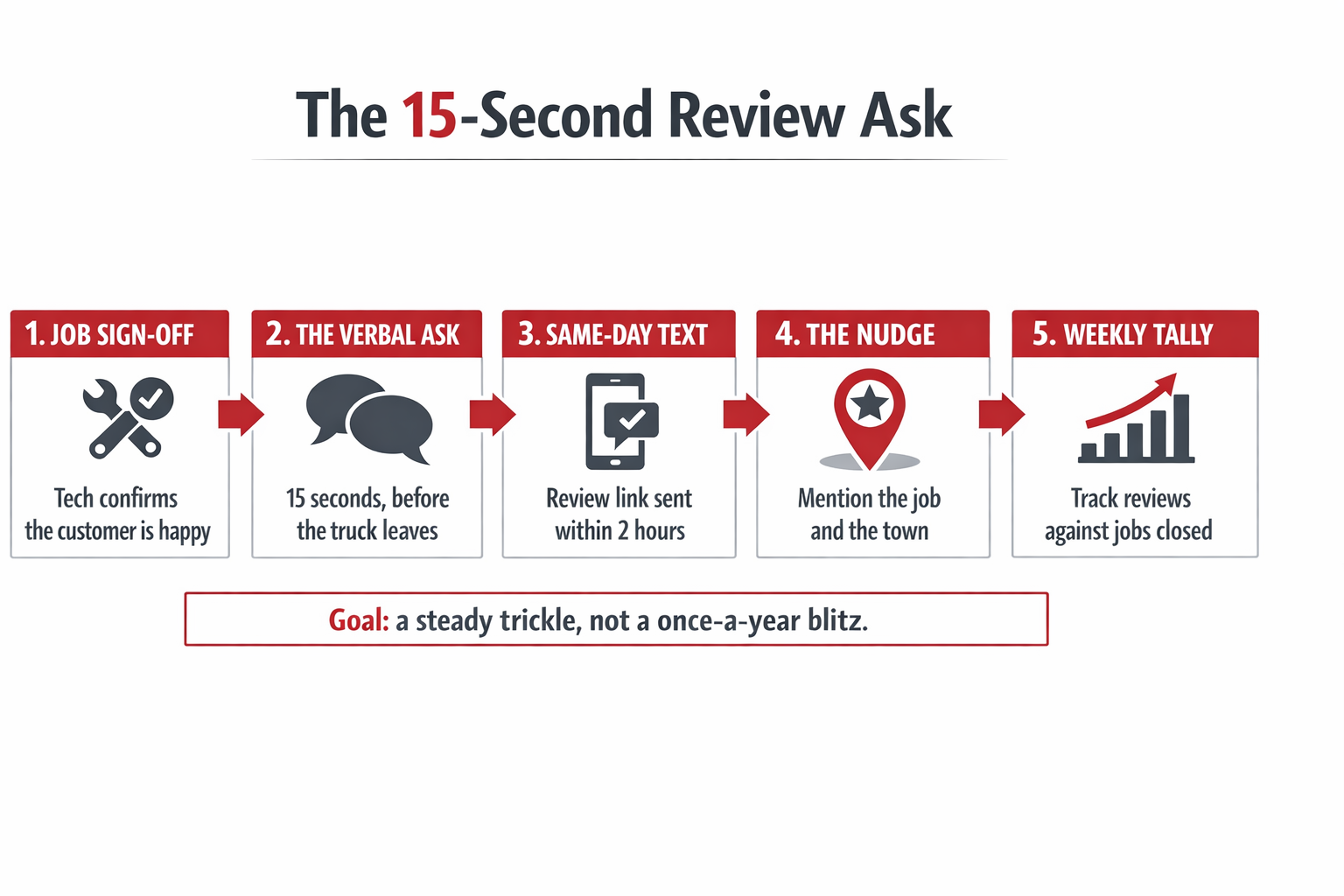
The 15-second review ask, start to finish
This is the whole loop, from the tech’s last five minutes on site to the review landing on your profile.
Step 3: Set a weekly target tied to job count
Almost every shop I have worked with has tried the blitz. Somebody pushes hard for a week, eight reviews come in, and then nothing for fourteen months.
That pattern actually works against you. BrightLocal’s February 2026 consumer survey reported that 74% of consumers only look at reviews from the last three months. Forty reviews from 2024 read as a company that was busy in 2024.
So stop setting a total. Set a rate.
Pick a number tied to how many jobs you actually close. If you run 25 jobs a week, two to four reviews a week is realistic and quiet. Nobody has to hustle for it.
Track it where you already work. A tally in your scheduling software, a column in the job sheet, or a sticky note on the office monitor all work fine. What matters is that somebody looks at it every Friday and notices when it goes to zero.
I dug into the recency problem in more detail in why your best reviews being from 2023 hurts you.
What a steady pace looks like by shop size
These are planning targets, not promises. Adjust them to your real job count and your own close rate.
| Jobs closed per week | Weekly review target | Where you land in 6 months |
|---|---|---|
| 10 to 15 | 1 to 2 | About 26 to 52 fresh reviews |
| 20 to 30 | 2 to 4 | About 52 to 104 fresh reviews |
| 40+ | 4 to 6 | About 104 to 156 fresh reviews |
| Any size, blitz approach | 8 in one week, then zero | A profile that looks abandoned |
Step 4: Build the fallback for when the crew forgets
They will forget. Some techs will never be comfortable asking, and that is fine. Plan for it instead of fighting it.
The backstop is a short block of office time, once or twice a week:
- Pull the list of jobs closed in the last three days, not three weeks.
- Text each customer a short message with the direct Google review link.
- Skip anyone with an open complaint or an unpaid balance you are still working out.
- Log who got asked so nobody gets a second text.
Twenty minutes on a Friday covers a week of jobs for most shops in Monterey County.
And if you need the two-line version to get your owner on board, it is this: reviews from the last ninety days are what Google and AI assistants weigh most, and the shops with fresh reviews are the ones getting called first. One sentence from your tech at job sign-off is the cheapest lead source you have.
The same goes for the questions customers ask on the phone. Those are worth capturing too, which I covered in why your phone calls make the best content you are not using.
Step 5: Do not shortcut it
Once a shop gets serious about reviews, somebody always floats a shortcut. Buy a batch. Offer a discount for a five star. Only send the link to customers you already know love you.
Skip all of it. Buying or incentivizing reviews violates Google’s policies and can get your profile penalized, and the FTC’s rule on consumer reviews and testimonials treats fake and paid reviews as a real enforcement matter.
The practical risk is worse than the legal one. A profile full of bought reviews reads wrong to a homeowner in Carmel who is comparing you against two other bids, and it reads wrong to the AI tools that now summarize who to call.
Google should be your first priority. But it is not the only place people check, which I get into in whether Yelp and Facebook reviews still matter.
Frequently Asked Questions About Getting More Google Reviews
How many Google reviews do I need to compete in Salinas or Monterey?
There is no magic number, and the total matters less than the pace. I would rather see a shop with 45 reviews and four from last month than one with 120 that all stopped in 2023. Look at the top three companies in your trade on the map in your town and match their recency first, then their volume.
Should the tech hand the customer a phone to leave the review right there?
I would not. It puts the customer on the spot, and reviews written with someone watching tend to be short and generic. The verbal ask on site plus a text link they open that evening gets you longer, more specific reviews.
What do I do about a bad review?
Respond within a day or two, keep it short, stay calm, and offer to take it offline. Future customers read the response more closely than the complaint. A steady flow of new reviews also pushes a bad one down the page naturally, which is another reason the weekly rhythm matters more than any single review.
Is it worth asking commercial or repeat customers, or just homeowners?
Ask everyone. Commercial customers often write the most detailed reviews because they describe scope and timelines. For repeat customers, ask once, then do not ask again on later jobs.
My reviews are good but I still am not showing up on the map. Why?
Reviews are one factor, not the whole thing. Profile categories, service areas, duplicate listings, and what is actually on your website all feed into it. A clean, accurate Google Business Profile paired with a site that clearly names your services and towns usually matters more than the review count alone.
Want to know where your review flow stands against your competition?
If you run an established home service company in Monterey County and your review count has gone quiet while the shop down the road keeps climbing the map, that is usually worth a closer look. We run a 30-minute strategy session with Phil Fisk’s team where we go through your market, your competitors, and whether your trade and service area are still open. You can request a market review or call us at (831) 789-9320.