Direct Answer: AI tools favor contractors with a high star average and reviews that name the trade, the city and the job. Generic five star praise gives a model nothing to repeat.
Contractors ask me the same thing almost every month. They rank fine in the map pack, they have decent reviews, and yet ChatGPT keeps naming somebody else when a homeowner asks who to call.
Usually the reviews are the reason. Not the count, not the stars alone, but what the reviews actually say.
I work with home service businesses from Salinas to Carmel Valley, and the pattern is consistent. A wall of “great service, highly recommend” reads fine to a human and means almost nothing to a model trying to decide who fits a specific job in a specific town.
Star average is working as a confidence filter in AI recommendations
Search Engine Land’s coverage of SOCi’s 2026 Local Visibility Index reported that locations recommended by ChatGPT averaged 4.3 stars. The write-up described AI behaving less like a ranking system and more like a confidence filter.
That framing matches what I see. A contractor sitting at 4.1 with 30 reviews and one sitting at 4.7 with 140 may both show up fine on Google Maps, but they are in different buckets when a model has to stake a recommendation on one name.
Think of it as a two step check:
- Does this business clear the bar? Star average and review volume answer that.
- Does this business fit the question? Review content answers that.
Most contractors in Monterey County are stuck at step one because of a handful of old one star reviews that were never answered. Volume is the fix there, not deletion. Twenty fresh reviews over a few months move a 4.2 more than arguing with a 2019 complaint ever will.
Once you clear the bar, the wording carries everything. I go deeper on that split in the two things that separate contractors AI recommends from contractors it skips.
What a review has to say to be useful
A model retrieves text. It cannot repeat information that is not in the text.
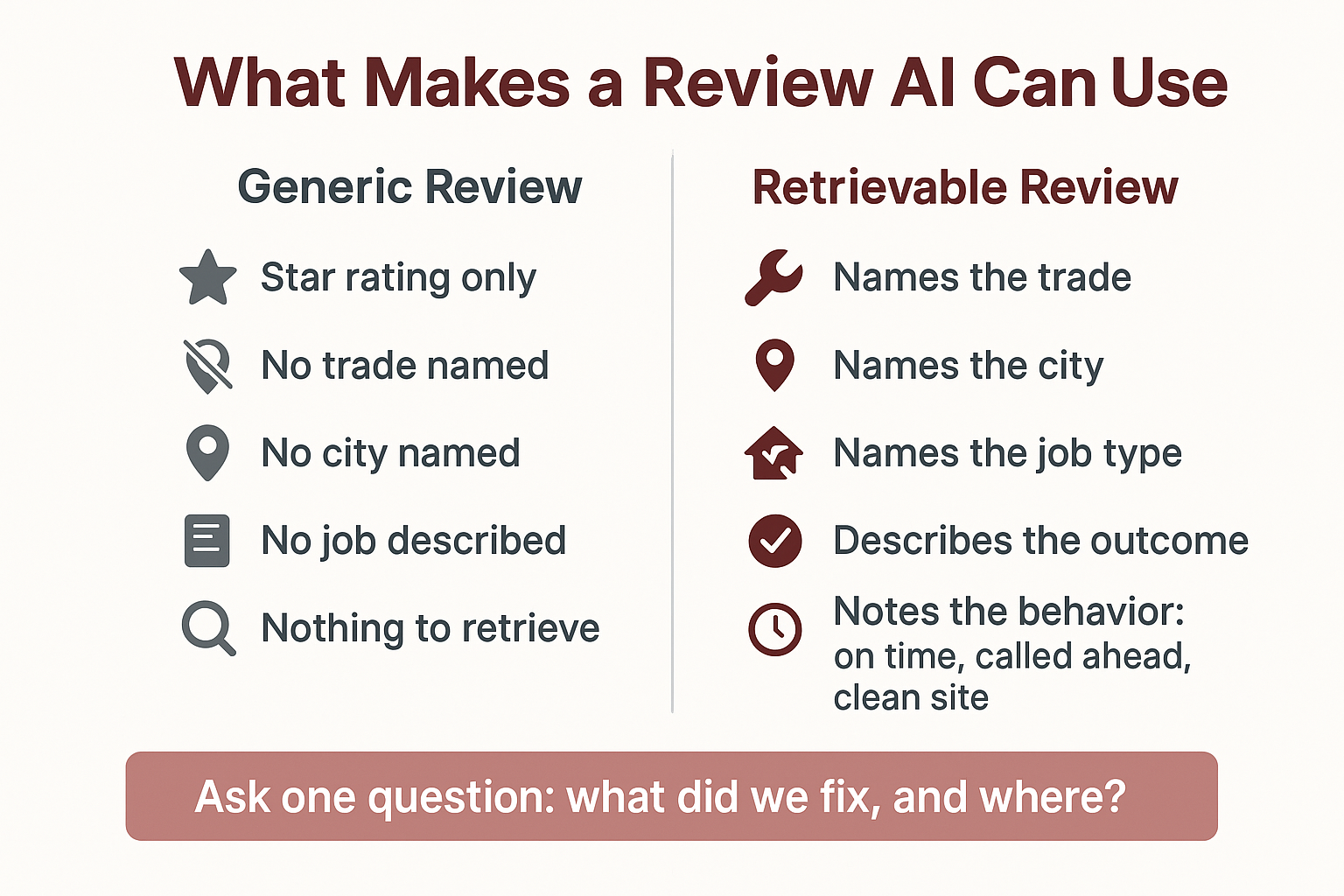
“Great service” gives it nothing. A review that names the trade, the city and the job type gives it something to pull and restate.
Compare these two. One is a five star line. The other is a five star line that can get a contractor named:
- “Really happy with the work, would use again.”
- “They replaced a collapsed storm drain pipe at our place in Carmel Valley and the drainage works perfectly now.”
The second one contains a job type, a material detail, a city, and an outcome. When somebody asks an AI tool who handles drainage problems in Carmel Valley, that sentence is retrievable. The first one is filler.
The details that carry weight in trade reviews:
- The specific job: tankless water heater swap, panel upgrade, roof tear off, gopher treatment
- The city or neighborhood: Seaside, Marina, Prunedale, Pacific Grove, Watsonville
- The problem that started it: water through the ceiling, both toilets backed up at once, tree overhanging the house
- The behavior that earned the stars: showed up in the window promised, called ahead, cleaned up
That last one matters twice. It feeds AI context and it is exactly what a skeptical homeowner reads before dialing.

How to get that language without scripting anyone
You cannot write the review yourself. The FTC’s rule on fake and deceptive reviews covers written-for-you testimonials and reviews traded for compensation, and the penalties are not worth it.
You also do not need to. You just have to ask better.
Three habits do the work:
1. Ask at the peak, not later. The best moment is standing in the driveway right after the customer sees the finished job. Not three days later by text, when the relief has worn off.
2. Ask one specific question. Instead of “could you leave us a review,” try “if you write one, would you mind saying what we fixed and where?” That single sentence is why a review comes back saying “tankless unit in Seaside” instead of “good job.”
3. Reply to every review and restate the work. Your reply is public and crawlable, same as the review. When you write “thanks for having us out for the storm drain replacement at your Carmel Valley property,” you have added your own words to theirs.
That third habit is the one contractors skip, and it is free. It is also the only part of the review page you fully control.
Generic review versus retrievable review
Here is the same five star rating written two ways, and what a model can actually do with each.
| Review text | What a model can pull from it | Chance of getting named |
|---|---|---|
| “Great service, highly recommend.” | A star rating and nothing else | Low |
| “Fast and professional plumber.” | Trade only, no city, no job | Low to moderate |
| “Fixed our water heater, showed up on time.” | Job type and a behavior signal | Moderate |
| “Replaced a tankless water heater at our Seaside home on a Friday night, called a half hour ahead.” | Job, city, urgency, behavior, outcome | High |
The four parts of a review AI can actually use
This breaks down the difference between a review that sits there and a review that feeds a recommendation.
Reviews are also the verification step now
Getting named by a chatbot is not the finish line. BrightLocal’s 2026 research found 97% of AI users sometimes double-check AI recommendations against real reviews, and 88% fact-check reviews cited by AI tools.
So the homeowner asks Perplexity who to call for a roof leak in Marina, gets your name, then goes straight to your Google profile to see if it holds up. If what they find is thin, stale or unanswered, you lost the lead twice.
That is why cadence beats a one time push. A blast of 15 reviews in one week followed by 11 months of silence looks worse than two a month, every month.
The same logic runs through how Perplexity decides which contractor to recommend. These tools pull live, they check, and they favor businesses that look currently active.
Where review wording connects to everything else
Review text is one of the three customer language sources I lean on, alongside inbound calls and form submissions. Callers and form fills tell you the problem language. Reviews tell you the outcome language.
When a homeowner writes that the crew called a half hour before arriving, that phrase belongs in more than a review reply. It belongs on the service page, in an ad headline, and in a profile post.
That is what AI Search Sync is built to do, keep the same real customer wording current across the website, the local listings, the ads and the answer engines. Reviews feed it, and the calls sitting in your voicemail feed the other half.
And if your profile itself is half filled out, fix that first. I covered that in the Google Business Profile mistake costing contractors AI visibility.
Frequently Asked Questions About Contractor Reviews and AI Recommendations
How many reviews do I need before AI tools start recommending me?
There is no published threshold, and anyone who quotes you one is guessing. What the data suggests is that star average acts as a filter, with ChatGPT-recommended locations averaging around 4.3 stars in SOCi’s 2026 index. A contractor with 140 reviews at 4.7 is treated with more confidence than one with 30 at 4.1. Steady volume plus a strong average is the goal, not a magic number.
Can I ask a customer to mention the city in their review?
You can ask them to describe the job and where it was, which is different from writing it for them. Something like “would you mind mentioning what we fixed and where?” is a fair request. What you cannot do is draft the review, offer payment for a positive one, or pressure someone into changing what they wrote.
Do my replies to reviews actually get read by AI tools?
Owner responses are public text on the same page as the review, so yes, they are available to be crawled and summarized. That is why I tell contractors to restate the work in the reply. If the customer wrote “great job,” your reply can add the trade, the job type and the town in plain language.
What do I do about the bad reviews already on my profile?
Answer them calmly, once, without arguing, and move on. A measured reply from the owner reads better to a homeowner than no reply at all. Then bury the average with new reviews, because a 2019 complaint next to 40 recent five star reviews carries far less weight than it does sitting alone.
How fast does better review wording show up in AI answers?
It is slower than a ranking change and faster than most people expect. Reviews have to be published, indexed, and then pulled the next time a model refreshes its picture of your business. I would judge it over two to three months of consistent asking and replying, not two weeks.
Want to know what your reviews are telling AI about you?
Most Monterey County contractors have never read their own review page the way a model would, and it is worth an hour of your time. If you want a second set of eyes on the wording, the cadence and the replies, Phil Fisk takes 30 minute discovery calls with local owners. The number here is (831) 789-9320.