
Direct Answer: A pay per click vendor is likely selling you nothing if they own your ad account, bundle spend with their fee, track no calls, and lock you into a 12 month auto renewing contract.
If you run a one truck plumbing business in Salinas, paint houses solo in Seaside, or handle handyman work around Prunedale, you have taken this call. Somebody says they can get your phone ringing on Google for a few hundred a month, and the number is small enough to say yes without thinking hard about it.
That is exactly why small trades get pitched the hardest. The ticket is low, the promise is big, and by the time you figure out nothing is happening, you are three invoices deep and locked into a contract you skimmed.
I have looked inside a lot of these arrangements for contractors around Monterey County. The bad ones share the same fingerprints, and every one of them is visible before you sign. Here are the seven signs, plus the one test that settles the argument in about ten minutes.
1. The Vendor Owns the Ad Account and Will Not Give You Admin Access
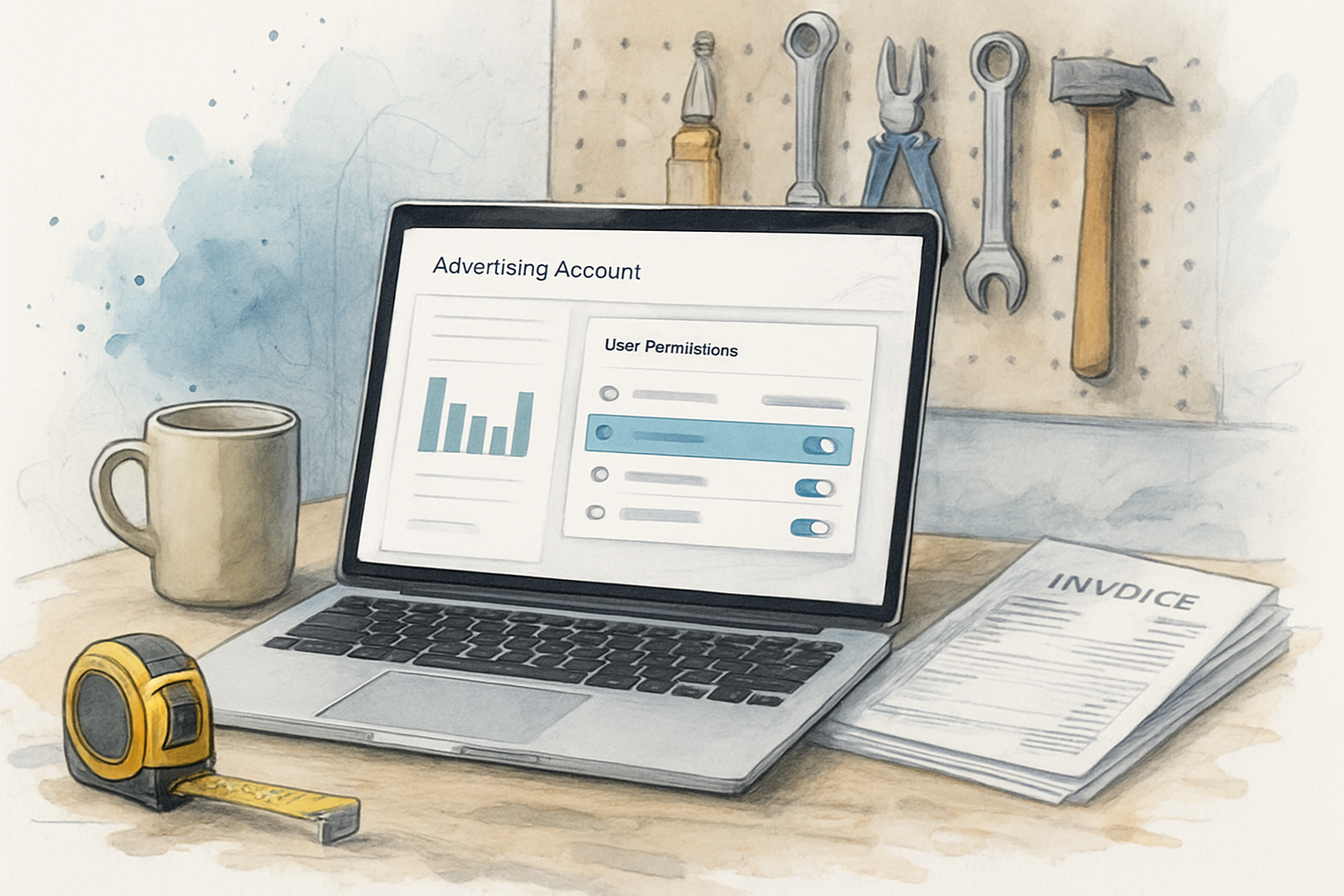
This is the first thing I check, and it tells me more than anything else on the list. If the Google Ads account lives under the vendor’s name instead of yours, you are renting your own marketing history.
When you leave, the ads stop, the keyword data goes with them, and the years of learning that make a campaign cheaper to run get erased. You start from zero with the next vendor.
What healthy looks like:
- The ad account is created under your business name and your billing
- You have admin access with your own login
- The vendor is added as a user, not the owner
- You can remove that access yourself, without asking anyone
Ask during the sales call, not after. If the answer involves the phrase “we manage that on our end,” ask again and watch what happens. A vendor with nothing to hide sets this up in five minutes on a screen share.
2. Ad Spend and Management Fee Are One Number With No Split
Small trades usually get pitched a single flat monthly price. It sounds clean. It also hides the only number that matters, which is how much of your money actually reached Google.
Management fees vary widely across the market. Some shops charge a flat fee, others a percentage of spend, and the right structure depends on your budget and how much work the account takes, so ask any vendor to break their own numbers down in writing before you compare quotes.
What you should see every month:
- Dollars paid to Google for clicks
- Dollars paid to the vendor for managing the account
- The two listed separately, not as one lump
When a handyman in Marina pays a flat monthly number and never sees the split, there is nothing stopping the vendor from pocketing most of it and running a trickle of ads. I have seen accounts where the actual spend was a fraction of what the owner assumed.
3. Nobody Set Up Call Tracking or Conversion Tracking
Home service leads come in as phone calls. If the vendor never installed call tracking or conversion tracking, they have no way of knowing which ad produced which call, and neither do you.
That is not a small oversight. It means the whole campaign is being run on guesswork, and guesswork is expensive when a single click for an emergency plumbing search can cost real money in a competitive county.
Call tracking is standard practice, not a luxury add-on. On our campaigns it runs through our call reporting, where every inbound call is recorded, transcribed, and reviewed so the caller’s own words feed back into the ads. The point is not the tool. The point is that somebody is listening to the calls the ads produced.
Ask a simple question: which ad generated my last five calls? If the vendor cannot answer, tracking was never set up.
4. The Report Shows Impressions and Clicks, Never Calls or Booked Jobs
Impressions are the easiest number in marketing to make look good. A report full of them is usually there to fill space.
What you actually need to know is short:
- How many calls came from the ads
- How many of those calls were real jobs in your service area
- What each booked job cost you in ad spend
Trade press and complaint records are full of owners saying the same thing in plain language, that they were getting absolutely nothing for their money and the leads were not legitimate or relevant. One widely covered case involved a tradesman who reported spending close to twenty thousand dollars and seeing a handful of views a month with zero sales.
A report that never mentions the phone is a report designed to avoid the subject. Same tell as a website filling up with filler content, which I wrote about in 5 signs your marketing agency is filling your site with AI slop.
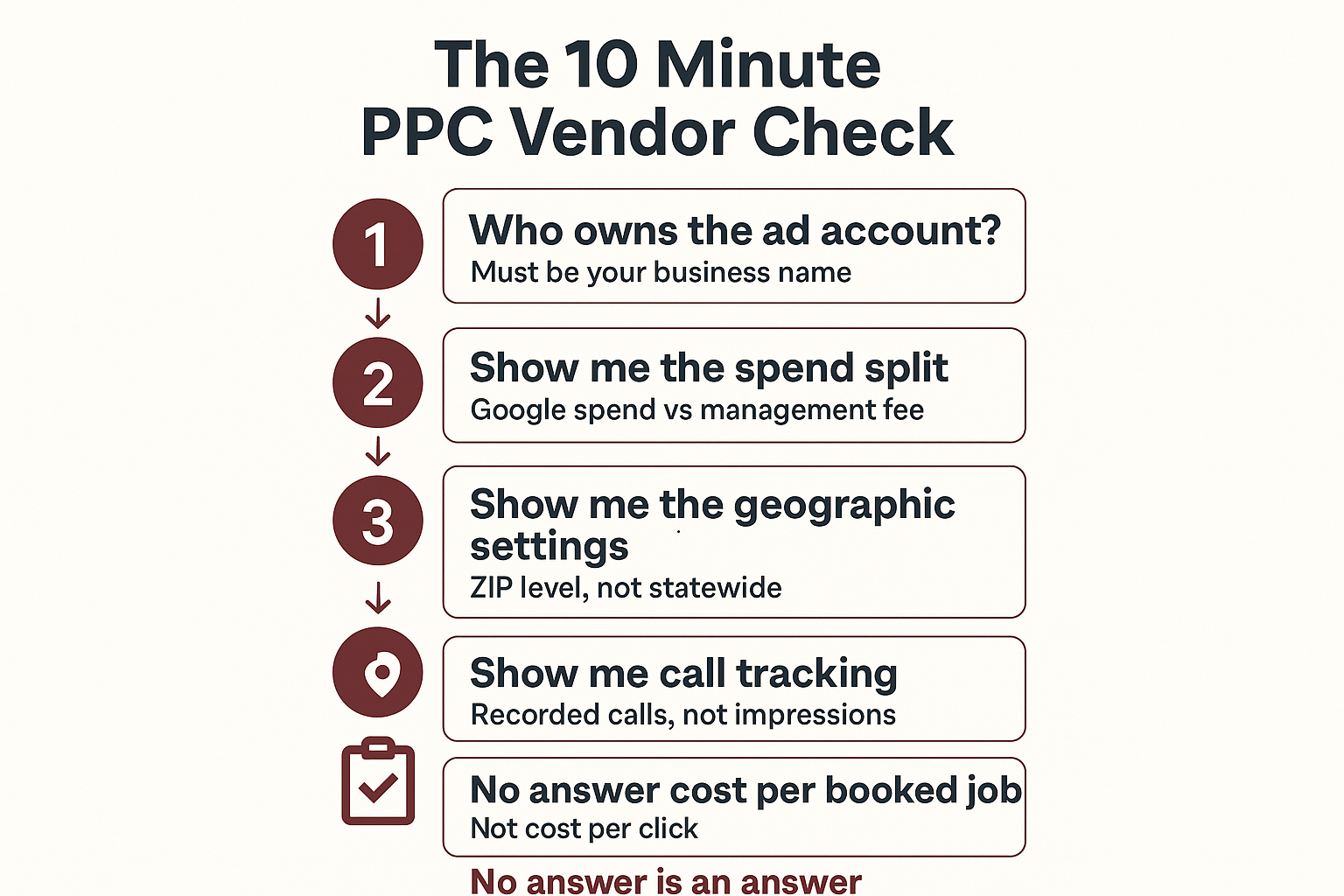
The 10 Minute Vendor Check, Before You Sign
Here is the sequence I walk through with contractors who are weighing a paid search proposal. It takes about ten minutes on a screen share.
5. The Contract Is 12 Months With Automatic Renewal
A long contract is not automatically a scam. But when it is paired with the other signs on this list, it is the mechanism that keeps a bad arrangement alive.
The pattern I see in complaint records is consistent. The owner realizes by month three that nothing is happening, calls to cancel, and finds out the term runs a full year with a renewal clause that already triggered.
Read for these three things before you sign:
- Term length and whether it renews on its own
- Notice window for cancellation, often 30 to 60 days in writing
- Whether the setup fee or account build is refundable
If the vendor’s confidence depends on you being unable to leave, that tells you what they think of the results. The Federal Trade Commission’s small business scam guidance covers this same pattern of high pressure terms aimed at owner operated companies.
6. The Same Leads Get Sold to Two or Three of Your Competitors
Some vendors are not running ads for your business at all. They are running ads for themselves, collecting form fills, and selling each one to multiple contractors.
You already know how this feels if you have bought from a lead aggregator. Three handymen in Watsonville get the same request, all three call within minutes, and the homeowner picks whoever answered first or quoted lowest.
The question to ask is blunt: are these leads exclusive to me, and are they generated on my own domain? If the ads point to the vendor’s landing page instead of your website, the lead belongs to them.
A real paid search campaign sends traffic to your site, your phone number, your brand. Everything else is a rental.
7. Targeting Is Broad Match Across the Whole State
This is where wasted money hides on the Central Coast, and it is the sign most owners never catch because it lives inside settings they cannot see.
A Salinas plumber paying for clicks out of San Jose, Fresno, or Paso Robles is buying traffic that will never book. Same for a Carmel Valley handyman showing up for searches in Bakersfield. Those clicks cost the same as local ones.
Ask the vendor to pull up the geographic settings on screen and show you:
- The exact cities or ZIP codes included
- Whether excluded areas are actually excluded
- Whether the setting targets people in your area or people merely interested in it
Broad keyword match makes it worse. “Repair” as a broad term in Monterey County can pull in auto repair, appliance repair, and phone screens. Your service area needs to be defined the same way you define it on your Google profile, which I covered in service area or storefront: what your Google profile should say.
What a Real Report Shows Versus What a Bad One Shows
Put your last vendor report next to this table. The left column is what most small trades get sent every month.
| What the report shows | What it actually tells you | What to ask for instead |
|---|---|---|
| Impressions | How many times an ad loaded, nothing about interest | Calls received from ads |
| Clicks | Somebody tapped, could be from anywhere | Calls from inside your service area |
| Click through rate | How the ad copy reads, not whether it sold work | Booked jobs traced to ads |
| One flat monthly total | Nothing about where your money went | Google spend and management fee, listed separately |
| “Campaign performing well” | An opinion | Cost per booked job, month over month |
The One Test That Settles It
If you only do one thing, do this. Ask for two items:
- Read-only access to the Google Ads account, under your own login
- A report showing cost per booked job, not cost per click
Read-only access costs the vendor nothing and risks nothing. They keep managing the account. You just get to look. A vendor who refuses is telling you the account will not survive being looked at.
The second item takes a little more work, because it means matching ad calls against jobs you actually closed. That is the whole job though. A contractor in Hollister does not need to know the click cost of a keyword. They need to know whether five hundred dollars in ads produced a two thousand dollar water heater install.
One review I appreciate from a contractor we work with put the standard plainly: “He explains everything in detail.” That is not a high bar. It is the floor.
Frequently Asked Questions About Pay Per Click Vendors
Is it normal for an agency to keep the ad account in its own name?
It happens, but I would not accept it. The account should be created under your business name and your billing, with the vendor added as a user. That way the campaign history stays yours if the relationship ends.
How much of my monthly payment should actually go to ad spend?
There is no single right split, and it depends on your budget, your trade, and how competitive your service area is. What matters is that you can see the two numbers separately. If a vendor will not break out spend from fee, that is the answer to the question.
Can I get my ad history back after I leave a bad vendor?
Sometimes, sometimes not. If the account was built under their name, they are not obligated to hand it over, and many will not. That is why I check ownership before anything else.
What is a fair contract length for a small handyman or one truck operation?
Month to month is reasonable and it exists in this market. If you sign a longer term, read the notice window and the renewal clause carefully, because those are where cancellation gets ugly.
How fast should I expect to see results from paid search?
Paid search shows data almost immediately, which is the point of it. Within the first two to four weeks you should be able to see which keywords produced calls. If a vendor asks for six months before showing you a single call, that is a different conversation.
Want a Second Opinion on Your Current Ad Setup?
If you are running paid search anywhere in Monterey County and something feels off, the fastest way to find out is to open the account and look at ownership, geography, and call data together. We work month to month with no 12 month contracts, which happens to answer several of the signs above on its own. Phil Fisk takes discovery calls directly at (831) 789-9320 if you want to talk through what you are seeing.