Direct Answer: A content engine turns your own phone calls, form submissions, and reviews into the month’s website pages, Google Business Profile posts, and ad headlines, so nobody writes from a blank page.
I have watched this same Sunday play out for years. An owner in Salinas or Marina blocks out the afternoon to finally write a blog post, opens a blank page, and closes the laptop an hour later with one paragraph about quality workmanship and pride in the work.
That is not a discipline problem. That is a blank page problem, and it is the whole reason most contractor blogs die after three posts.
A content engine for local service businesses solves it by making sure nobody ever starts from zero. The month’s material is already sitting in your phone system, your contact form inbox, and your review profile. Below is what a real month of that looks like, in order.
The inputs already exist before the month starts
Every home service business in Monterey County is generating writing material daily and throwing most of it away. Three places hold it:
- Inbound phone calls, where you hear the questions and objections that come up before someone books
- Website form submissions, where people type out their problem in their own words
- Customer reviews, where people tell you which parts of the job they valued enough to write down
The mix shifts with the season here. After a storm rolls through the Salinas Valley, tree and roofing calls change shape overnight. In late summer, pest and HVAC questions look nothing like they did in February.
A keyword tool will not catch any of that in time. Your call log catches it the same week it happens.
So the month does not begin with brainstorming. It begins with reading. That single change is what separates a site that keeps growing from one that goes flat, which I wrote about in why some contractor websites keep growing and others go flat.
Week one: read last month’s calls and count the repeats
The first working days of the month go to transcripts. Not skimming them. Reading them and tallying which questions keep showing up.
What I am counting is simple:
- Questions asked before anyone agreed to a price
- Objections raised on calls that never turned into jobs
- The exact phrasing people use for their problem
- How often each one repeats
The two or three questions with the highest counts become the pages written that month. Not the topics that sound impressive. The ones that came up eleven times.
Here is the part most people skip. The page gets written in the caller’s phrasing, not the trade’s phrasing. Homeowners in Prunedale do not search for “hydro jetting services.” They search for something closer to what they said out loud on the phone.
Then the same language goes into Google Business Profile posts and paid search headlines for the month. When every channel says what customers actually said, the whole thing pulls in one direction. That alignment is also what Google’s own guidance on helpful, people-first content has been pointing at for years.

Form submissions read like search queries with a roof over them
Calls and forms are not the same input, and treating them the same wastes half the value. People talk one way and type another.
When someone fills out a contact form, they are typing under pressure, the same way they type into a search bar. Across home service businesses, those descriptions come in blunt and specific:
- Water coming through the ceiling from upstairs
- Both toilets backing up at the same time
- A collapsed storm drain pipe causing draining problems
- A tree that has “seen better days”
Read those again. Every one of them is a search query with a roof over it. Nobody types “declining tree health” into Google. They type what they would say to a neighbor over the fence.
So form text gets mined for headings, page titles, and the first sentence of a page, where matching the reader’s words matters most. The phone transcripts, meanwhile, are better for the middle of a page, where you answer follow-up questions and handle the objection that killed the last estimate.
I broke down how each source maps to a different job in three sources, three jobs.
The monthly loop, start to finish
Here is the sequence a content engine runs every month, in the order it actually happens.
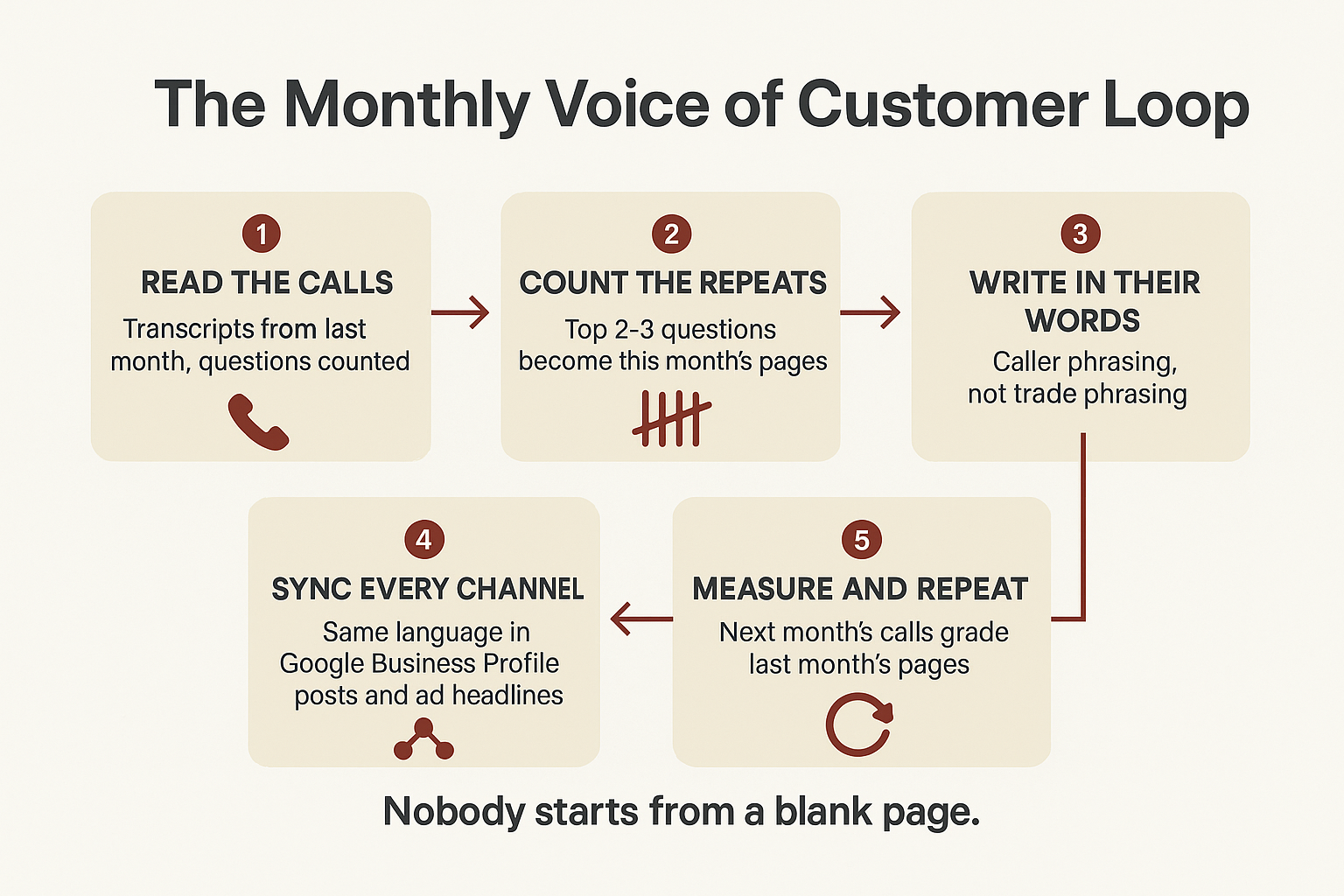
Reviews tell you which outcomes people cared enough to write down
Reviews are the third input, and the only one you can quote word for word. Calls and form submissions always get paraphrased and stripped of anything identifying.
What makes reviews useful is not the star rating. It is the detail people choose to include when nobody asked them to.
One homeowner writing about a plumbing company put it this way: “They showed up exactly when they said they would, and even gave a courtesy call a half hour before.”
Notice what that praise is about. Not pipe brands. Not certifications. Showing up in the window promised, a heads-up call thirty minutes out, and a price that did not move at the end.
Those three things belong on your service pages, in your ad copy, and in your Google Business Profile posts, because they are the things customers already decided mattered. Writing about anything else is guessing.
Across the trades we work with on the Monterey Peninsula, the review language also flags what people were afraid of before they called. Mess in the house. Getting upsold. Nobody answering on a Friday night.
What each input is actually good for
The three sources do different jobs. Using only one is the most common mistake I see.
| Input | Best at revealing | Where the language ends up |
|---|---|---|
| Phone calls | Objections and follow-up questions before booking | Body copy, FAQ sections, objection pages |
| Form submissions | How people type their problem under pressure | Page titles, H1s, opening lines |
| Reviews | Which outcomes customers valued enough to write down | Service page proof points, ad headlines, GBP posts |
Why this beats planning content from a keyword tool
Most agencies plan a contractor’s content calendar off a volume report. It is fast, it looks organized in a spreadsheet, and it misses the point.
A keyword tool can tell you how many people in Monterey County searched a phrase last month. That is real information and I use it.
But it cannot tell you:
- The objection that killed your last three estimates
- The question every caller asks before they will book
- The words people use for the problem when they are stressed
- Which of your competitors they already called first
That objection is usually the single most valuable page on the site, and it will never appear in a volume report because almost nobody types their hesitation into a search bar. They say it on the phone.
There is also a supply problem now. Every trade in Seaside, Watsonville, and Hollister can produce a thousand generic words in ten seconds. The only content input your competitors cannot copy is your own customer data. I covered that pressure in more competitors, more AI content, same customers.
Honest expectations: month one versus month four
I am not going to tell you the phone floods in week two. It does not work that way.
What I can say is what we see in practice. Core6 typically sees first measurable ranking movement within 30 days of launch, on specific pages and specific phrases, not sitewide.
Month one is mostly foundation. You have a handful of pages built from real caller language and the first Google Business Profile posts that match them.
By month three or four, something different is happening. The pages you wrote in month one start pulling calls, those calls generate new transcripts, and the new transcripts tell you the next question to answer. The engine starts feeding itself.
That compounding is the actual product. A one-off batch of ten blog posts does not compound, it just sits there getting older, which is why some sites keep climbing while others flatten.
So judge it on the trend across four months, not on week two.
Frequently Asked Questions About Running a Content Engine
How many calls a month do I need for this to work?
Fewer than you think. If you take even 20 to 30 inbound calls a month, the same three or four questions will repeat clearly enough to build a content plan on. Volume helps, but repetition is what you are looking for, and repetition shows up fast.
What if most of my calls are price shoppers?
Then price is your content. If callers keep asking what a job runs before they will schedule, a page that explains what drives the cost, what changes it, and why estimates vary will do more for you than another general service page. Price objections are the most under-served pages on almost every contractor site I look at in Monterey County.
Can I do this without recording calls?
You can start with form submissions and reviews, since both are already written down. It works, just slower. Without recordings you lose the objections, and objections are where the best pages come from.
Does this replace keyword research?
No. I still check search volume to decide how to phrase a title and which version of a term to lead with. The difference is the customer data picks the topic and the keyword data helps with the wording, not the other way around.
How much of my own time does this take each month?
Realistically, a short conversation. The reading, counting, and writing is the work being done for you. What nobody else can supply is your judgment on whether a page reads like something you would actually say to a customer standing in their driveway.
Curious what your own call log would say?
Core6 Clarity records and transcribes every inbound call and turns it into a plain English report on the first business day of the month, with three prioritized action items. It comes with active SEO and Google Ads campaigns rather than being sold as an extra. If you run a home service business in Monterey County and want to see what a month of your own customer language would produce, Phil Fisk handles those discovery calls himself at (831) 789-9320.