
Direct Answer: Under SB 122, California sales and use tax applies to prewritten software, including SaaS, for subscription periods beginning on or after January 1, 2027, even if you signed the contract earlier.
Your monthly software bills are about to get a new line on them. Starting January 1, 2027, California sales and use tax applies to prewritten software, including the cloud tools you access remotely. That reaches the CRM, the scheduling app, the call tracking, the hosting, and most of the smaller tools running your shop.
For most owner-operated shops in Salinas, Monterey, Seaside, and Marina, the tax itself is not going to break the budget. The bigger problem is that almost nobody has a clean list of what they are paying for every month.
My position here is simple. Do not wait for your accountant to flag this in March. Pull your software list and your renewal dates in the next 60 days, because renewal timing decides which subscription periods get taxed first.
What SB 122 Changes About California Sales Tax on Software Subscriptions in 2027
California used to tax things you could see and touch. Electronically delivered software and cloud access generally sat outside that.
SB 122, signed by Governor Gavin Newsom on June 29, 2026, changed the definition of tangible personal property to include certain digital products, specifically prewritten (canned) computer software, regardless of how it is delivered. Beginning January 1, 2027, that software is treated as taxable property. Tax analysts at PwC summarized the change in July 2026, and the Sales Tax Institute has been tracking updates since.
Two details matter most for a contractor:
- It covers software transferred on tangible media, transferred electronically, or accessed remotely. Cloud subscriptions are in scope.
- Per the CDTFA discussion paper published September 1, 2026 and the interested parties meeting held September 10, 2026, subscription periods beginning on or after January 1, 2027 are taxable even if you signed the contract earlier.
That second point is the one owners miss. Locking in a 12-month deal in December 2026 does not freeze the tax treatment of periods that start after the first of the year. The agency writing the rules is the California Department of Tax and Fee Administration, and their CDTFA site is where the draft regulations and current local rates live.

Which Lines on Your Monthly Stack This Likely Touches
Most shops I talk to in Monterey County are running somewhere between six and fifteen paid tools. Owners can usually name four of them off the top of their head.
The ones that tend to show up on a contractor’s card every month:
- CRM and job management software
- Scheduling and dispatch apps
- Call tracking and phone systems
- Website hosting and security monitoring
- Estimating and invoicing tools
- Review request and texting platforms
- Storage, email, and design subscriptions nobody remembers signing up for
If a tool is prewritten software you access remotely, it is likely in scope. Where it gets less clear is mixed invoices, where software access and human work are bundled into one monthly number.
I am a marketer, not your CPA, and I will not pretend to know how every vendor’s invoice gets treated. What I do know is that the vendors who separate software from service on the invoice are going to have an easier January than the ones who do not. Ask yours how they plan to bill it.
Your Software Stack: What to Check Before January
Use this as a worksheet. One row per monthly line item, and one question per vendor.
| Monthly line item | Why it may be in scope | What to ask the vendor |
|---|---|---|
| CRM / job management | Prewritten software accessed remotely | Will tax be added, and on which billing date? |
| Scheduling and dispatch app | Cloud subscription, per-seat | Does the rate follow my shop address? |
| Call tracking | Software plus usage charges | Are software and usage billed separately? |
| Website hosting and care plan | Mixed software and service | How is the invoice broken out? |
| Review or texting platform | Prewritten software, monthly term | When does my next subscription period start? |
| Annual prepaid tools | Periods beginning after Jan 1, 2027 | Does my prepay cover a taxable period? |
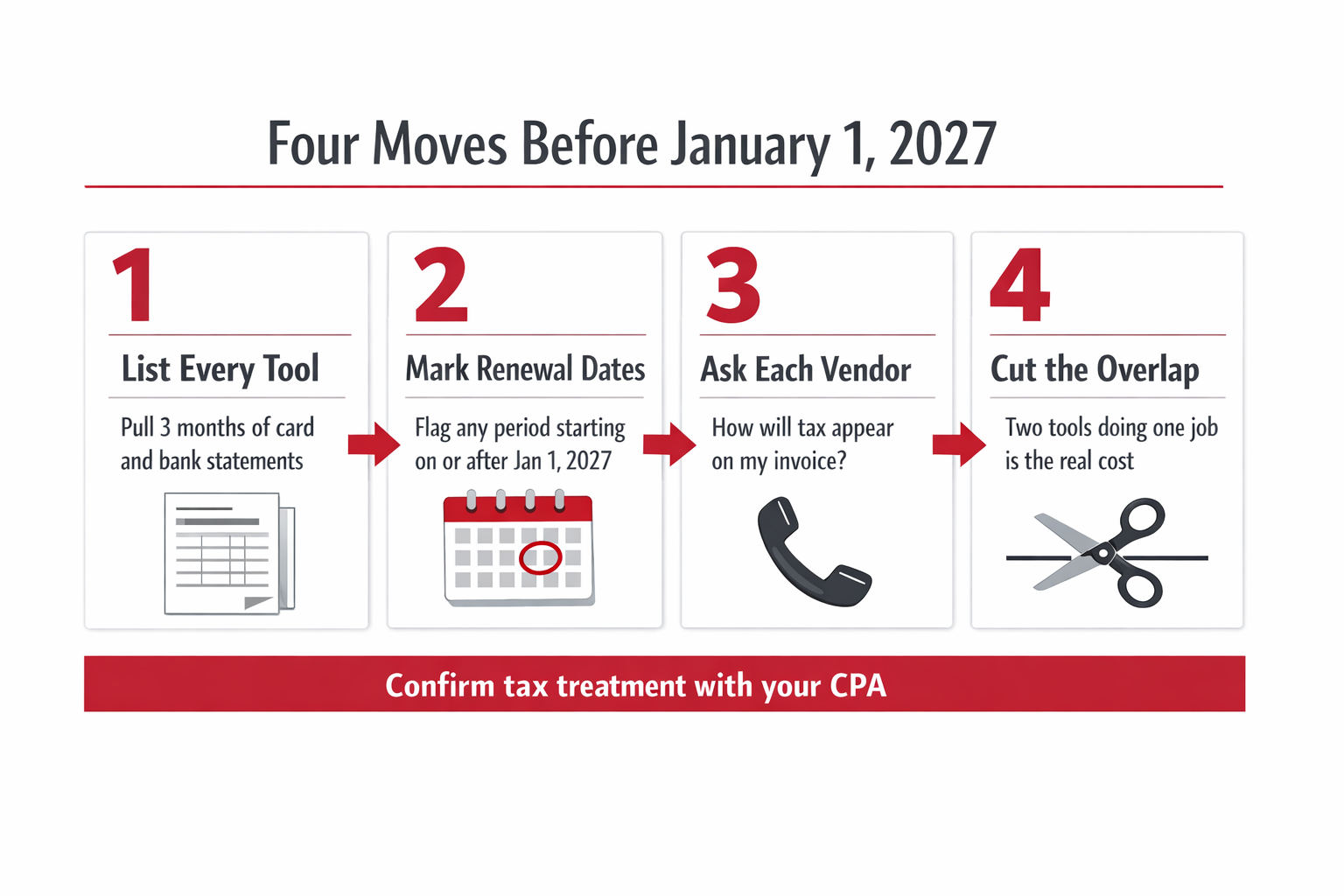
Four Moves Before January 1
Here is the order I would work through it, start to finish, in under two hours.
The Real Dollar Math for a Salinas or Monterey Shop
Let me put rough numbers on it so you can size this against everything else on your plate.
Combined state and local sales tax rates across Monterey County cities generally land in the 9 percent range, and they vary by city and change over time, so check the current rate for your address with the CDTFA. Say your shop pays somewhere around $900 to $1,500 a month across CRM, scheduling, hosting, call tracking, and a handful of smaller tools.
At roughly 9 percent, that is about $80 to $135 a month, or somewhere near $1,000 to $1,600 a year. Real money, and close to nothing next to one lost reroof or repipe.
So here is where I think the usual advice falls short. The common take is “audit your software and cut costs before the tax hits.” Cutting spend is not the win. Cutting the overlap is.
Almost every stack I see has two tools doing one job: two places sending review requests, two systems holding customer records, a hosting plan on top of a hosting plan. You were paying twice before the tax. Now you are paying tax twice too.
Don’t Cut the Things That Make the Phone Ring
The risk in any budget review is that an owner trims the line he understands least, which is usually the marketing line. I have watched shops pull hosting, drop call tracking, or let a site go stale to save a hundred bucks, then wonder why the phone went quiet by spring.
If you are deciding what stays and what goes, judge it by booked jobs, not by the monthly price. Cost per lead is the wrong number to make that call with, because the cheapest leads are often the ones that never close.
A few things worth knowing as you sort the list:
- Ownership beats renting. If you own your website outright, you are not paying a monthly platform fee for the right to keep it. Worth knowing who owns the website and ad account before you change anything.
- Shared lead fees are a different animal. If you are buying shared leads from Angi or HomeAdvisor, that spend has its own math problem, and it has nothing to do with SB 122.
- Know what you should be paying. If you are not sure whether your monthly number is fair, here is how the local SEO number gets set for a contractor in this county.
Run the list, talk to your CPA about treatment, and go into January knowing exactly what you pay for and what each line brings back.
Frequently Asked Questions About California Software Sales Tax in 2027
I already signed a two-year software contract. Am I grandfathered in?
Not based on what the CDTFA published. Their September 1, 2026 discussion paper and the September 10, 2026 interested parties meeting confirmed that subscription periods beginning on or after January 1, 2027 are taxable even when the contract was signed earlier. Signing early does not lock in the old treatment.
Does this mean my monthly marketing management fee gets taxed too?
SB 122 expanded the definition of taxable property to cover prewritten (canned) computer software, regardless of how it is delivered or accessed. Work performed by people is a different thing from software. How your specific invoice gets treated depends on how it is structured and on the final CDTFA rules, so ask your vendor how they are breaking it out and confirm with your CPA.
What sales tax rate would apply to my software in Salinas or Monterey?
Combined state and local rates in Monterey County cities generally sit in the 9 percent range, but they differ by city and they change. Look up the current rate for your business address on the CDTFA site rather than guessing from a neighboring city.
Should I prepay a year of software in December 2026 to avoid the tax?
I would not build a plan around that. The published guidance points to the start date of the subscription period, not the date you paid or signed, so a prepay covering 2027 months may still be taxable. Talk to your accountant before you move money for tax reasons.
What is the single most useful thing to do right now?
Pull three months of card and bank statements and write down every recurring software charge with its renewal date. Most owners find at least one tool they forgot about and one job being done twice. That list is worth more than the tax savings.
Going into 2027 with a clear picture of your marketing spend
If you are sorting through your 2027 budget and cannot tell which lines are bringing in booked work, that is a worthwhile hour of conversation. We run a 30-minute strategy session with Phil Fisk’s team where we look at your market, your competitors, and where growth is being left on the table here in Monterey County. You can reach us at (831) 789-9320, and we work with one company per trade in each service area, so availability depends on your trade and city.