Direct Answer: A service area business hides its address but must be exhaustively consistent everywhere else, then prove with real content that it actually works in each town it wants to rank for.
Your yard is in Salinas. You have three trucks, and in a normal week they run to Marina, Carmel Valley, and out toward Hollister. There is no lobby, no walk-in traffic, and no good reason to publish your home address on the internet.
So you guess. You guess at how to set up your Google Business Profile, guess at what to put on your contact page, and guess at whether you should build a page for every town you serve.
I take a version of this call almost every month from owners in Monterey County. Below is how I explain it: how the profile side actually works, why a Salinas company struggles to show up in Carmel searches, and what separates a real service area page from ten copies of the same page with the city name swapped.
Why service area business local SEO on the Central Coast is its own problem
Most local SEO advice was written for businesses with a front door. A dental office in Pacific Grove has an address, a map pin, and a stream of patients who live within a few miles of it.
A plumber does not work that way. Your customer never sees your building, and your service radius can stretch 45 minutes in three directions.
That creates a specific set of problems:
- You cannot rely on proximity to a map pin, because your pin sits in one town and your jobs are spread across six
- Your address is hidden, so search engines have fewer easy signals to verify you are legitimate
- Competitors physically located in Carmel or Seaside get a head start on searches in those towns
- The towns you want most are often the ones farthest from your yard
The Central Coast makes this sharper than most markets. Monterey County is not one connected metro, it is a string of separate towns with their own housing stock, their own building departments, and their own search behavior.
A homeowner in Carmel Valley searching for help is not thinking about Salinas. They are thinking about who is close, who is trusted, and who has done work near them. Your online setup has to answer all three of those without an address doing the work for you.
Hiding your address does not mean hiding everything else
This is where I see the most damage. Owners hide the address, then get sloppy with the rest of the details because it feels like the whole thing is private anyway.
Google’s own guidance is direct about it: businesses with complete and accurate profile information are more likely to show in local results, and verified profiles are more likely to appear at all. Recent local visibility research points the same direction, finding that incomplete or conflicting business information can take a company out of AI consideration entirely.
So a service area business has to be more consistent than a storefront, not less. Every detail that is public has to match everywhere it appears:
- Business name written identically, no extra keywords stuffed after it
- Phone number matched across your site, your profile, and every directory that has ever listed you
- Service areas set as the towns you actually drive to, not every city within two hours
- Categories picked to match the work you want, primary category first
- Hours, including whether you genuinely answer after hours
One stale phone number on an old directory listing is enough to create doubt. I have cleaned up profiles for contractors where the biggest single fix was a disconnected number sitting on a listing nobody had looked at since 2014. If you want the profile side in more detail, I broke it down in Service Area or Storefront: What Your Google Profile Should Say.

Distance versus relevance: the part owners get wrong
Here is the split that decides how far outside your radius you can realistically win.
In the classic map pack, proximity still carries real weight. If a homeowner in Carmel searches for an electrician, Google leans toward businesses close to that searcher. A company based in Salinas is fighting uphill on distance alone, and no amount of clever writing changes the mileage.
AI systems weigh things differently. Tools like ChatGPT, Perplexity, and Google’s AI answers care much more about relevance and trust than raw distance. They are trying to answer a question well, not plot a pin on a map.
That gives you a real opening. What moves the needle there is on-page evidence that you genuinely work in a town:
- Jobs you have completed in that area, described specifically
- Honest response times from your yard to that town
- Local details only someone who works there would know
- Reviews from customers who live in that area and say so
I have watched this play out with contractors across the county. The company that publishes actual evidence of Carmel Valley work starts getting recommended for Carmel Valley questions, even while a closer competitor with a thin site holds the map pack. Those are two different games, and you can win the second one from a yard in Salinas. I covered the mechanics of that in what AI-powered local SEO actually checks before recommending a contractor.
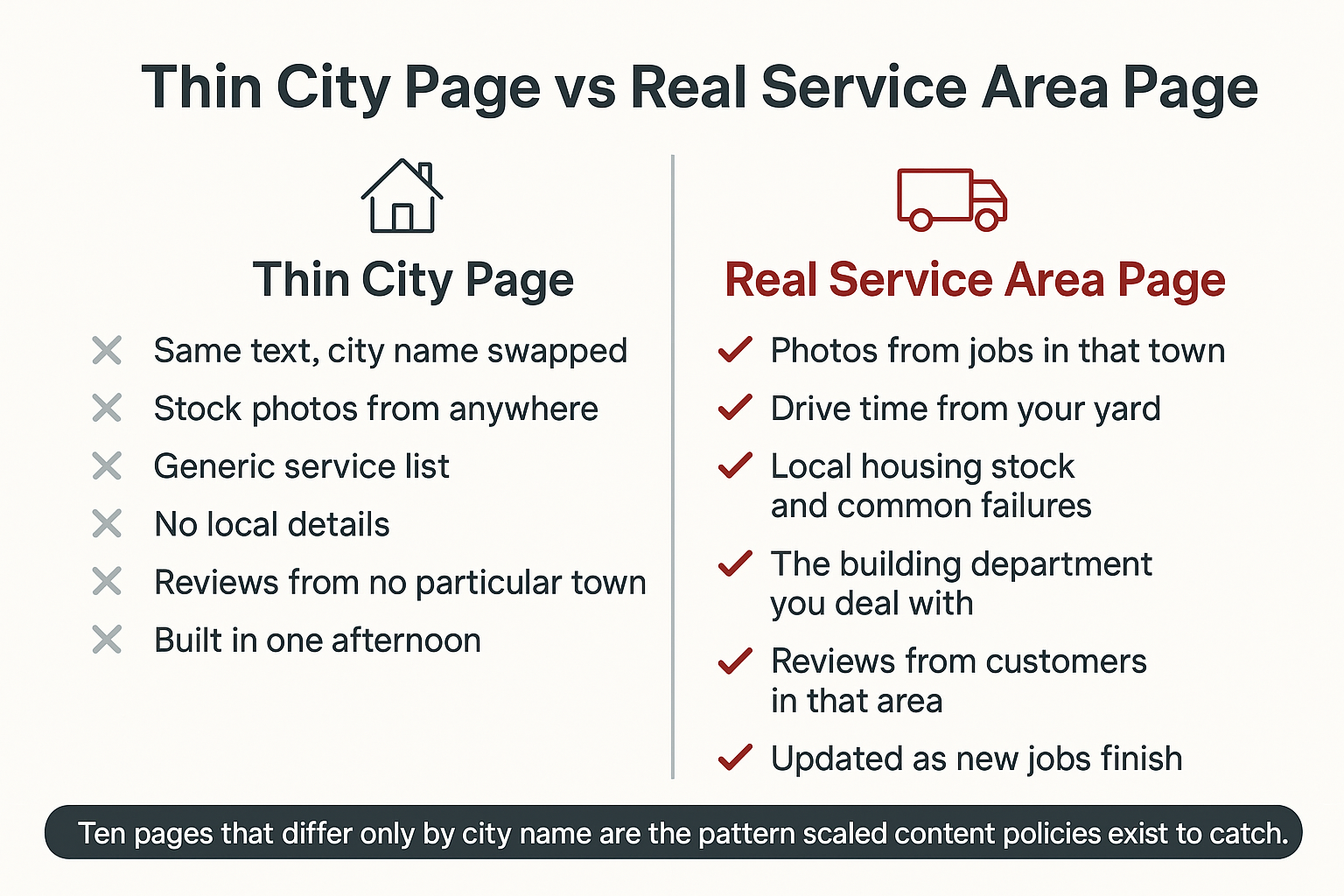
Thin City Page or Real Service Area Page
The difference between a page that earns visibility in a town and one that gets ignored comes down to what is actually on it.
What makes a service area page real
A service area page earns its place when a reader in that town would recognize it as being about their town. That is the whole test.
What belongs on it:
- Photos from jobs you actually did there, not stock images
- Drive time from your yard, stated plainly, because that answers a question people are already asking
- The housing stock and common failure patterns in that town, which differ a lot between older Pacific Grove homes and newer builds in Marina
- The local building department you pull permits through, if permits are part of your work
- Reviews from customers in that area, quoted as written
What does not belong: ten pages that differ only by city name. That is exactly the pattern Google’s scaled content policy exists to catch, and it has gotten better at catching it.
I would rather see a contractor publish three real pages for the three towns that drive the most revenue than twelve hollow ones. Three real pages give AI systems something to cite. Twelve hollow ones give them a reason to skip you.
The raw material is usually already sitting in your business. Your customers describe their problems in their own words, and homeowners across these trades tend to say things like “I had a collapsed storm drain pipe on my property that was causing serious draining problems.” That phrasing, repeated back on the right page, does more work than any keyword list. I wrote more about that in Your Customers Already Wrote Your Best SEO Content.
Two Kinds of Searches, Two Different Fixes
Most advice on AI visibility treats it as a national discipline and never addresses the service area business, even though that describes most home service companies. These two search types behave differently, and they need different work.
| Search Example | Where It Gets Decided | What Actually Moves It |
|---|---|---|
| roof repair Salinas | Google map pack, proximity heavy | Complete profile, consistent name and phone everywhere, review volume |
| emergency plumber near Marina | Map pack plus mobile speed | Service areas set correctly, after-hours accuracy, fast mobile site |
| how much does it cost to replace roof decking near Monterey | AI answers and long-form results | A page that answers the cost question with local specifics and real ranges |
| most reliable HVAC company in Carmel Valley | AI recommendation, trust heavy | Brand mentions elsewhere, reviews naming the town and the job type |
Why the fix has to be one system, not three tasks
The mistake I see most often is treating this as a to-do list. Somebody cleans up the Google profile in March. Somebody else adds schema markup in July. City pages get written whenever there is a slow week.
Each piece checks its own box, and none of them agree with each other. The profile says one service area, the site lists another, and an old directory still has the number from your last truck.
A service area business cannot afford that gap, because the address is not there to hold it all together. Consistency is your verification. When your profile fields, your name-address-phone data across hundreds of directories, and your on-page schema all say the same thing, search engines and AI tools stop guessing about you.
Contractors notice the difference when it lands. One client put it simply in a review: “Phil has done an excellent job handling our marketing and SEO, we’ve increased our visibility and been able to grow our business significantly.”
And the timeline is not as long as most owners expect. We typically see first measurable ranking movement inside 30 days, mostly because the profile and consistency work fixes problems that were actively holding a business back.
Frequently Asked Questions About Service Area Business Local SEO
Should I list my home address on Google if I run the business out of my house?
No. Set the profile as a service area business and hide the address. Google still needs the address privately for verification, but it will not display publicly, and hiding it does not hurt your rankings. What hurts is hiding it and then leaving inconsistent details everywhere else.
How many cities should I list as service areas?
List the towns you actually drive to and turn a profit in. Stacking every city within two hours does not extend your reach, and it dilutes how clearly search engines understand where you work. For most Monterey County contractors, that is a handful of towns, not fifteen.
Can a Salinas contractor really rank for Carmel searches?
In the map pack, it is hard. Proximity is a real factor and a Carmel-based competitor has an advantage you cannot erase.
In AI answers and longer search results, yes. Those systems weigh relevance and trust more than distance, so a page with real Carmel job evidence, honest drive times, and reviews from that area can compete.
What does this kind of work usually cost on the Central Coast?
It varies more than owners expect, and I would not trust anyone who quotes a flat number before looking at your setup. Cost is driven by how many towns you are targeting, how much cleanup your existing listings need, how many service area pages get built, and whether paid search runs alongside it. Ask for an exact quote based on your own situation rather than a published range.
How long until I see something change?
Profile and consistency fixes tend to show first, often within the first 30 days. Content-driven visibility in towns outside your immediate radius takes longer, because you are building evidence, not flipping a switch.
Want a Look at How Your Service Area Is Set Up?
AI Search Sync is how we handle profile fields, name-address-phone consistency across hundreds of directories, and schema markup as one connected system instead of three unrelated tasks. For Monterey County owners who want a straight read on how their current setup looks to Google and AI tools, discovery calls with Phil Fisk are available at (831) 789-9320.