Direct Answer: Referrals are a great start, but they create feast-and-famine revenue cycles and miss emergency searchers entirely. Contractors who add search visibility get more consistent call volume year-round.
Referrals got most of us here. A neighbor tells a neighbor, a remodeling job turns into three more on the same street, and before long you have a reputation in your corner of Salinas or Pacific Grove without ever spending a dollar on advertising. That feels like the system working.
But I’ve watched enough contractor businesses on the Central Coast hit a ceiling, or worse, hit a wall, to know that referral-only growth has a structural problem baked into it. It’s not a question of whether the problem shows up. It’s a question of when.
This article is about the specific gaps that word-of-mouth can’t cover, why those gaps are getting wider in 2026, and what a more durable lead mix actually looks like for a home service contractor in Monterey County.
The Feast-and-Famine Pattern Is Not a Seasonal Quirk
Here’s what referral-dependent scheduling looks like in practice on the Central Coast. Spring hits, neighbors start talking, you book out six weeks. Summer stays strong. Then October arrives, the conversations slow down, and by November your schedule has holes you can’t explain.
Most contractors I talk to chalk this up to seasonality. And there is some truth to that, weather and home project timing play a role. But the deeper issue is structural: your lead volume is entirely controlled by how much your past customers happen to be talking about you at any given moment.
When a key referral source, a real estate agent, a general contractor, a neighbor who recommended you six times, moves, retires, or simply stops mentioning your name, there is no pipeline to fall back on. You haven’t built one. That inconsistency makes it nearly impossible to plan payroll, take on a helper, or make any forward-looking decision about the business.
A balanced lead mix for a Monterey County contractor in 2026 looks more like:
– 30-40% from organic search and Google Business Profile
– 20-40% from paid channels like Google Ads
– 20% or less from referrals and repeat customers combined
Contractors who have that mix in place are the ones who can actually turn down jobs they don’t want. The ones running on referrals alone are taking every call they get, because they have to.

The Calls Referrals Can’t Win You
The single biggest gap in a referral-only business is emergency search behavior. When a pipe bursts at midnight in Salinas or a furnace goes out on a cold January morning in Monterey, that homeowner is not calling a neighbor for a recommendation. They’re opening Google or asking ChatGPT who can come right now.
These are often the highest-value calls of the year. The job is urgent, price sensitivity drops, and the customer is ready to book on the spot. A contractor who has never invested in search visibility simply isn’t in the running for those jobs, no matter how strong their reputation is in their own network.
And this isn’t a niche scenario. It’s a significant share of inbound call volume for plumbers, HVAC companies, and electricians across Monterey County. The How AI Search Is Changing Who Gets Called for Home Repairs piece goes deeper on how AI platforms are now making those first-call decisions, and it’s worth understanding before assuming Google results are the only thing that matters.
The point is simple: referrals reach the people who already know someone who knows you. Search reaches the people who need someone right now and have never heard of you. Those are two completely different audiences, and the second one is larger.
Referrals Still Have to Survive the Google Check
Consumer behavior around personal recommendations has shifted in ways most contractors haven’t fully absorbed. Research from BrightLocal shows that 49% of consumers now trust online reviews as much as personal recommendations, and 41% say they always read reviews when searching, up from 29% the prior year.
That means even when a referral comes through, the homeowner is still checking your Google Business Profile, reading your reviews, and comparing you to the next contractor before they pick up the phone. If your profile has four reviews from 2021 and nothing since, the referral doesn’t automatically convert the way it used to.
I’ve seen this play out with contractors in Seaside and Marina who had excellent reputations but thin online presence. A referral came in, the homeowner went to look them up, found an outdated profile and a competitor with 80 recent reviews, and called the competitor instead. The referral was real. The conversion just didn’t happen.
Your Google Business Profile is now functioning more like an AI feed than a static listing, which means how you manage and update it directly affects whether AI platforms recommend you at all. Referrals can start the consideration process. But your online presence has to close it.
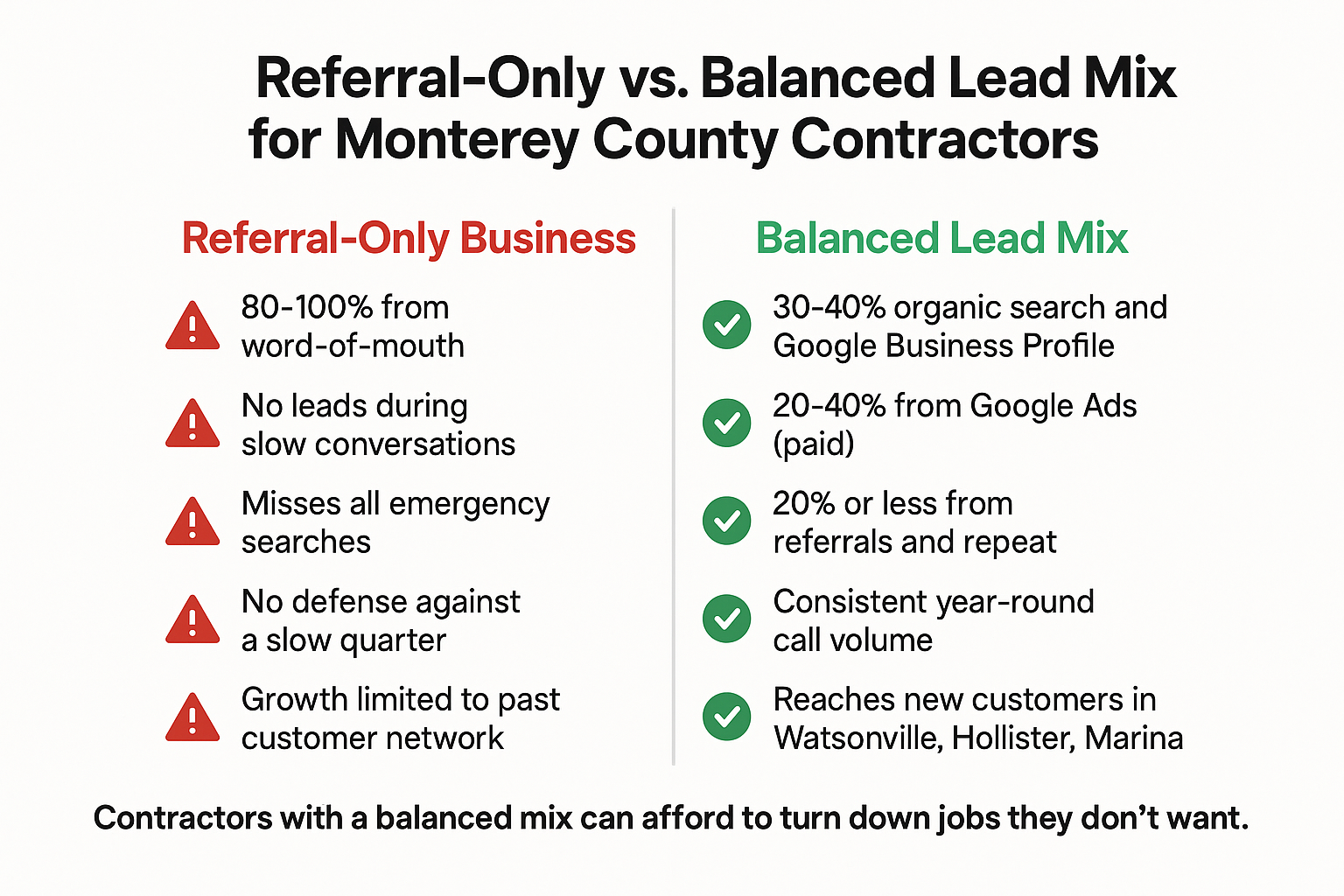
What a Balanced Lead Mix Looks Like vs. Referral-Only
This comparison shows the difference between a referral-dependent lead structure and a diversified one for a typical Monterey County home service contractor.
Why Slow Quarters Get Worse Without a Pipeline
Here’s a pattern I see consistently: a referral-dependent contractor hits a slow stretch in November. Revenue dips. The natural instinct is to pull back on any spending, including marketing, because there was never a marketing channel to begin with. But cutting back means no pipeline is being built and no visibility is accumulating.
When spring returns and the conversations pick back up, the contractor is still exactly where they were. Nothing changed. They’re still at the mercy of whoever happens to mention their name at the right moment.
The contractors who invest in local SEO during a slow period come out of it with rankings and reviews that didn’t exist before. A 30-day window to first measurable ranking improvement is realistic, which means starting during a slow stretch isn’t wasted effort. It’s actually good timing. You’re building while you have bandwidth, and the results compound into the busy season.
For contractors in Hollister, Watsonville, or King City who have never had a presence beyond their immediate referral network, this is exactly the window to change that. The How Local SEO Actually Works for Home Service Contractors on the Central Coast piece breaks down the mechanics if you want to understand what that process actually involves.
Visibility Is Only Half the Problem
I want to make one thing clear before you walk away thinking search rankings are the whole answer: getting found and getting called are two different problems. And contractors who come from a referral-only background often have a gap in the second one.
Referral calls come from people who already know you or know someone who does. They’re warm. They expect you to answer. When someone finds you through Google or an AI platform, they’re a stranger in a moment of need, and they will move on to the next result within minutes if no one picks up.
Industry data from 2025 and 2026 consistently points to 30% or more of contractor calls going unanswered. That’s a real problem when you’ve just spent time and money building visibility. A basic call-capture discipline doesn’t have to be complicated:
- Answer every call during business hours, even if you’re mid-job (step away for 60 seconds)
- Use a dedicated tracking number so you can review missed calls and call recordings
- Return missed calls within 15 minutes during business hours
- Check voicemail same day and return anything that sounds like a new inquiry
The calls sitting in your voicemail are worth more than most contractors realize. Building search visibility without tracking and answering those calls is only solving half the problem. The visibility gets you in the room. What happens when the phone rings determines whether you get the job.
Referral-Only vs. Search-Visible: How the Business Behaves Differently
This table shows how the two models play out across the areas that matter most to an owner-operator on the Central Coast.
| Business Area | Referral-Only | Search-Visible |
|---|---|---|
| Lead source control | None, depends on others talking | Active, rankings and ads run independently |
| Emergency call capture | Near zero | High, shows up when homeowner searches |
| Revenue predictability | Feast-and-famine cycles | More consistent month to month |
| Reach into new areas | Limited to existing network | Watsonville, Marina, Hollister, and beyond |
| Slow quarter defense | No pipeline to fall back on | Rankings and visibility keep accumulating |
| Review impact | Weak, referrals may still convert | Strong, thin profiles lose referrals too |
Frequently Asked Questions About the Pitfalls of Relying on Referrals Alone
My referrals have kept me busy for years. Why change what’s working?
It’s working until it stops. The problem isn’t that referrals are bad, they’re great leads when they come in. The problem is that you have no control over the volume or timing. When a key referral source retires, moves, or just stops recommending you, there’s nothing to replace it. Contractors who build search visibility alongside referrals don’t have to worry about that. The ones who don’t are one slow season away from a real problem.
How much of my leads should realistically come from search vs. referrals?
A healthy mix for a Monterey County home service contractor in 2026 looks like 30-40% from organic search and Google Business Profile, 20-40% from paid channels, and 20% or less from referrals and repeat customers combined. That ratio gives you consistent scheduling, reach into new areas, and a real defense when any single channel slows down.
Do I need to be on AI search platforms, or is Google enough?
Google is still the starting point, but AI platforms like ChatGPT and Perplexity are now a meaningful part of how homeowners find contractors, especially for first-time searches in a new area. How ChatGPT Decides Which Plumber or Roofer to Recommend walks through exactly how those recommendations get made and what you need in place to show up.
What if I don’t have time to manage calls from strangers on top of running my jobs?
That’s a real constraint, and it’s worth solving before you invest in visibility. The minimum is a dedicated tracking number, a habit of returning missed calls within 15 minutes during business hours, and checking voicemail the same day. It doesn’t have to be a full call center setup. But an unanswered call from a Google search is a lead you paid for and gave away for free.
My reviews are pretty thin. Can I still rank well on Google?
Thin reviews won’t stop you from ranking, but they will hurt your conversion rate. Even if you rank well, a homeowner who sees three reviews from 2020 next to a competitor with 60 recent ones is probably calling the competitor. Ranking and converting are two separate problems, and reviews sit right in the middle of both.
Ready to Build a Lead System That Doesn’t Depend on Who’s Talking About You?
If you’re a home service contractor on the Monterey Bay Area or Central Coast and you’ve been running primarily on referrals, we’re happy to show you what a more durable lead mix looks like for your specific trade and service area. Core6 Marketing has been working with owner-operated contractors in this market for more than 20 years, and the work is done locally. You can book a 30-minute Discovery Call with Phil directly at https://calendly.com/core6-marketing/30min.