Direct Answer: A discounted website might look fine, but it won’t rank locally, won’t convert visitors into calls, and has no understanding of your market — which means your competitors get the jobs you should be getting.
A lot of contractors in Salinas and across Monterey County have a website. Most of them paid somewhere between $300 and $600 for it, or had a nephew build it, or used one of those drag-and-drop site builders that promises a professional look in an afternoon. And for a while, that feels fine — the site exists, it has a phone number, it’s technically there.
But if your phone isn’t ringing consistently, and you’re still relying on referrals or paying for shared leads through Angi or HomeAdvisor, your website isn’t doing its job. A cheap site isn’t neutral. It’s actively costing you work every single week.
This article breaks down what actually separates a $500 website from one built to generate calls — and why the difference shows up in your call volume before it ever shows up in your bank account.
What a $500 Website Actually Gets You
There’s nothing fraudulent about a cheap website. You get a homepage, maybe a services page, a contact form, and a phone number. It loads on a phone. It doesn’t crash.
What it doesn’t have is any understanding of your business, your trade, your market, or the specific customers in Monterey County who are searching for what you do right now. That’s not something a template can know. It’s not something AI can generate from a one-page brief.
Here’s what’s typically missing from a low-cost contractor site:
- No local keyword structure — the site doesn’t tell Google you serve Salinas, Marina, Seaside, or Carmel Valley specifically
- No schema markup — search engines can’t read your business type, service area, or contact details properly
- No location pages — if you work across multiple cities, those cities don’t exist on your site
- No conversion architecture — visitors land on the page and have no clear reason to call instead of leaving
- No competitive positioning — there’s nothing that tells a prospect why they should choose you over the three other contractors showing up in the same search
For a plumber in Salinas or an HVAC company serving the Monterey Peninsula, that missing structure is the difference between ranking and not ranking — and between a visitor calling or bouncing. If you want to understand what local search visibility actually requires for electricians, the gap becomes even clearer.

What Actually Happens Before a Single Page Gets Designed
The reason a properly built contractor website costs more than $500 isn’t because of design software or fancy fonts. It’s because of what happens before the design starts.
AI tools can generate a good-looking website fast. What they can’t do is understand your trade, your local competition in Monterey County, and where the content gaps are that nobody else has filled. That research is what makes a site worth anything in search.
Here’s the work that happens before a single layout is sketched:
01 — Market Intelligence Audit
Every public piece of information about your business gets pulled — reviews, citations, how you’re currently described online, and where your information is wrong or missing. You review it. You correct it. The site gets built from verified fact, not guesswork.
02 — Brand Voice and Messaging
This defines how you talk, what you stand for, and what makes you the clear choice in your market. It becomes the locked content baseline for your website and every piece that follows. Once you approve it, work moves without you weighing in on every sentence.
03 — Competitor Gap Analysis
The top competitors in your trade and your specific market get audited. Where are their sites thin? What questions aren’t they answering? What trust signals are they missing? That’s where the content advantage gets built — not by copying what’s already ranking, but by filling what nobody else has addressed.
For a roofing contractor in Salinas competing against three other local roofers, that gap analysis often surfaces entire topic areas — specific roof types, insurance claim processes, storm damage questions — that competitors have completely ignored. That’s free ranking territory, and a $500 template will never find it.
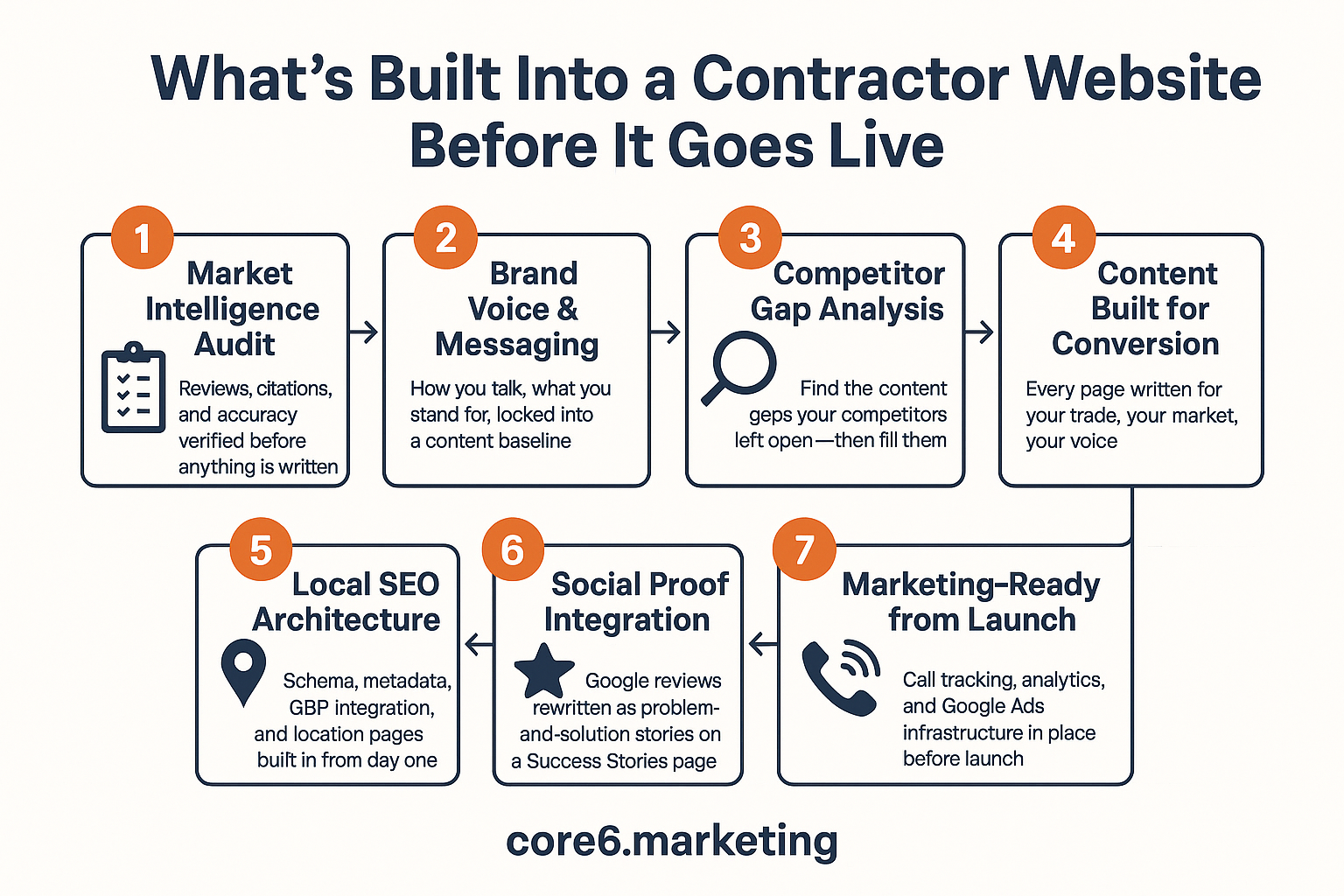
What’s Built Into a Contractor Site Before Launch Day
This shows the seven layers of work that go into a contractor website built to generate local calls — not just exist online.
The Specific Parts That Make a Site Generate Calls
Once the research is done, the build itself works very differently from a template project. Every decision is made against a single question: will this help a contractor in Monterey County get found and get called?
Content built for conversion means every page is written for your trade, your specific service area, and your actual sales process. If you serve Salinas, Seaside, Marina, and Watsonville, those cities each get their own location page — because a person in Watsonville searching for a plumber isn’t looking for a Salinas page, and Google knows the difference.
Local SEO architecture gets wired in from day one — schema markup, metadata, Google Business Profile integration, RankMath Pro configuration, and location pages for every city in your service area. You’re not bolting SEO on after launch as an afterthought. If you’ve ever read about what it actually takes to improve Google rankings for contractors, you know that structure is most of the battle.
Social proof integration means your Google reviews don’t just sit on a sidebar widget. Each one gets rewritten as a problem-and-solution story on a dedicated Success Stories page — the kind of content that speaks directly to the next customer deciding whether to call you.
And the whole thing is marketing-ready from launch day: call tracking integration, conversion-optimized layout, Google Analytics, and the technical foundation for SEO and paid ads already in place. When you’re ready to run a Google Ads campaign, nothing needs to be rebuilt. For a full breakdown of what this looks like in practice, see the contractor website design page.
For HVAC companies on the Monterey Peninsula, this matters a lot — if your site isn’t structured to answer the questions people ask before they call an HVAC tech, you’re losing those calls before you ever know they happened. We’ve written about exactly how that plays out for HVAC websites in Monterey County.
Cheap Website vs. Built-to-Convert Website: What You’re Actually Comparing
Here’s a side-by-side look at what’s typically included — and what’s typically missing — at each price tier for contractor websites in Monterey County.
| Feature | $300–$600 Template Site | Conversion-Focused Contractor Site |
|---|---|---|
| Market Intelligence Audit | None | Full audit before build begins |
| Competitor Gap Analysis | None | Top local competitors researched |
| Location Pages (Multi-City) | Rarely included | Built for every city you serve |
| Local SEO Architecture | Minimal or none | Schema, metadata, GBP integration built in |
| Content Written for Your Trade | Generic copy | Trade-specific, market-specific writing |
| Social Proof / Reviews Page | Widget at best | Dedicated Success Stories page |
| Call Tracking Integration | Not included | Included at launch |
| Google Analytics Setup | Basic or missing | Full conversion tracking configured |
| Time to First Ranking Improvement | Months or never | Measurable improvement within 30 days |
| Cost Range | $300–$600 | Quoted based on scope — not a guessing game |
The Real Cost Isn’t the Build — It’s What You’re Losing Every Month
A cheap website feels like savings. But if a roofing contractor in Santa Cruz County or a landscaper in Carmel Valley is losing three to five jobs a month because their site doesn’t rank, doesn’t convert, and doesn’t answer the questions buyers are asking — that’s not a $500 savings. That’s thousands of dollars walking out the door every single month.
Local search in Monterey County is competitive. HVAC companies, plumbers, electricians, and general contractors are all fighting for the same first-page positions. The ones winning those spots aren’t winning because they have prettier logos. They’re winning because their sites are structured correctly, their content is specific, and their local signals are consistent.
If your competitors are showing up in Google and you’re not — or worse, if they’re showing up in AI search tools like ChatGPT and Perplexity while you’re invisible — a template site won’t fix that. Understanding why your competitor showed up in ChatGPT when you didn’t is a good place to start if that situation sounds familiar.
For landscapers specifically, low-ball leads are often a website problem — not a market problem. The site is attracting the wrong buyer because it’s sending the wrong signals.
Frequently Asked Questions About Contractor Website Costs
What does a contractor website actually cost in Monterey County?
It depends on the scope — number of service pages, location pages, and whether call tracking and SEO architecture are included. A properly built contractor site isn’t a fixed price because it’s built around your specific trade, service area, and competitive landscape. What we can tell you is that the full breakdown of contractor website design costs gives you a realistic range and explains what drives the differences.
Can’t I just use a website builder like Wix or Squarespace?
You can build something that looks fine. The problem is those platforms aren’t built for local search, and they don’t do the market research, competitor analysis, or content strategy that makes a site generate calls. You’ll have a digital business card — not a lead machine.
How long before a new contractor website starts ranking?
When a site is built with local SEO architecture from day one — proper schema, location pages, Google Business Profile integration, and accurate citations — measurable ranking improvement typically shows up within 30 days. Sites that bolt SEO on after the fact take much longer because the foundation has to be corrected first.
Does the website design include content, or do I have to write it?
Every page is written for you — in your trade, in your market, in your voice. That’s part of the process. The brand voice and messaging work at the start means the content gets approved once, then moves. You’re not rewriting sentences back and forth through three rounds of revisions.
What if I serve multiple cities across the Central Coast?
Each city gets its own location page. A plumber who serves Salinas, Seaside, Marina, and Watsonville should have a page for each — because the people searching in those cities are looking for local results, and Google serves them accordingly. A single generic site with no location pages won’t rank in any of those cities consistently.
What’s the difference between a website that looks good and one that actually generates calls?
A site that looks good is designed for the owner’s approval. A site that generates calls is designed for the search engine and the buyer simultaneously. That means clear service and location structure, content that answers buyer questions, trust signals placed where buyers look for them, and a phone number that’s impossible to miss on a mobile screen. Most cheap sites pass the visual test and fail every other one.
Ready to See What Your Website Is Actually Costing You?
Core6 Marketing works exclusively with home service contractors on the Central Coast — from Salinas and the Monterey Peninsula to Santa Cruz and San Benito County. If you want to know exactly where your current site is losing you jobs, and what it would take to fix it, book a 30-minute Discovery Call with Phil Fisk at https://calendly.com/core6-marketing/30min. No pitch deck, no agency speak — just a straight conversation about your market, your competition, and what’s actually worth doing.