Direct Answer: Ask any SEO agency what they track, how they build content, and whether they know your local market. If they can’t answer those questions specifically, move on.
I’ve talked with contractors across Monterey County who’ve spent $10,000, $15,000, even close to $20,000 on SEO — and had almost nothing to show for it. One contractor told me his agency’s monthly report showed rankings and impressions while his phone sat quiet for three months straight. Another described getting ‘four views per month and zero sales‘ after a year of paying for content. The complaint I hear consistently isn’t about SEO as a concept — it’s that the agency was measuring things that don’t pay bills.
Before any contractor on the Central Coast hands over a marketing budget, there are five questions worth asking. Not about tools. Not about tactics. About accountability — what gets measured, how content gets built, and whether the agency actually knows this market.
I’ll walk through each one here. Some of the answers will help you spot a good agency. Others will help you spot what I’ve started calling AI slop — generic, machine-generated content dressed up as local expertise. There’s a real difference, and it’s worth knowing how to tell them apart.
Question 1: What Exactly Will You Measure — and How Often?
This is the first thing I ask when I look at any agency’s reporting setup. An agency that reports impressions, keyword positions, and traffic volume — without connecting any of it to inbound calls and booked estimates — is measuring the wrong things.
Traffic doesn’t pay invoices. Neither do rankings on their own. What matters is whether the phone rings with people who are ready to hire.
The minimum I’d expect from any reputable agency:
– Call tracking with dedicated numbers, so you know which page or campaign drove each call
– Recorded calls so you can hear whether the leads are qualified
– Cost-per-acquisition data — what did it cost to get one booked job, not one click
– Monthly reporting that ties specific keywords and pages to real calls
If an agency can’t show you which search term drove a specific call last Tuesday, they can’t tell you whether the money is working. That’s not a minor gap — that’s the whole question.
We cover some of this in more depth in how local SEO actually works for home service contractors on the Central Coast, but the short version is this: visibility without attribution is just a guess.
Question 2: How Do You Actually Build Content for My Business?
This one separates real local SEO from what I’d call scaled content factories. Ask any agency this directly: where does the information in your blog posts and service pages come from?
The right answer involves your trade knowledge — interviews with you, job notes, call recordings, real customer questions from your actual market. The wrong answer is a content calendar with 12 to 15 posts per month and no apparent source beyond a generic prompt.
Google’s spam systems are now explicitly targeting content generated at scale without real-world input. I’ve watched pages built with zero subject matter expertise drop out of rankings inside 90 days. But here’s the part agencies don’t mention: that same content also fails to convert the homeowners who do find it. A Seaside homeowner searching for a licensed roofer isn’t going to call based on a 600-word article that could have been written about any city in any state.
The tell-tale signs of AI slop content:
– Generic descriptions that apply to every city — not your specific service area
– No mention of local permit offices, seasonal patterns, or neighborhood-specific context
– Blog posts that read like a first draft from someone who has never visited Monterey County
– No quotes, no job examples, no real customer language — just polished paragraphs about nothing specific
If you want to see what content that actually converts looks like for a trade business, what contractor websites that generate calls have in common shows the pattern clearly. The difference between a page that ranks and a page that rings is specificity.

Question 3: Do You Actually Know This Market?
This is the question most contractors forget to ask — and the one that reveals the most.
I’ve been doing local marketing on the Central Coast for over 20 years. I know that ‘roof repair in Salinas’ and ‘how much does roof replacement cost in Monterey County’ behave very differently as search terms. I know that HVAC demand spikes inland in the Salinas Valley during summer heat — not on the Monterey Peninsula, where the marine layer keeps temperatures mild well into August. I know that ADU permit approvals in Seaside go through a different office than unincorporated Monterey County, which matters when a general contractor is writing content about addition work.
An agency doing real local SEO knows those things. An agency doing generic SEO with your city name dropped in does not.
Here’s a simple test. Ask the agency you’re interviewing:
– What’s the permit process for a bathroom remodel in Pacific Grove versus Carmel Valley?
– How does search behavior differ between Salinas residents and Monterey Peninsula residents for the same service?
– What seasonal patterns should we build our content calendar around for this specific trade in this market?
If the answers are vague or deflected toward tools and platforms, that’s your answer. Local knowledge isn’t a nice-to-have — it’s the whole point of local SEO. How AI search is changing who gets called for home repairs gets into why hyper-local specificity matters even more now than it did two years ago.
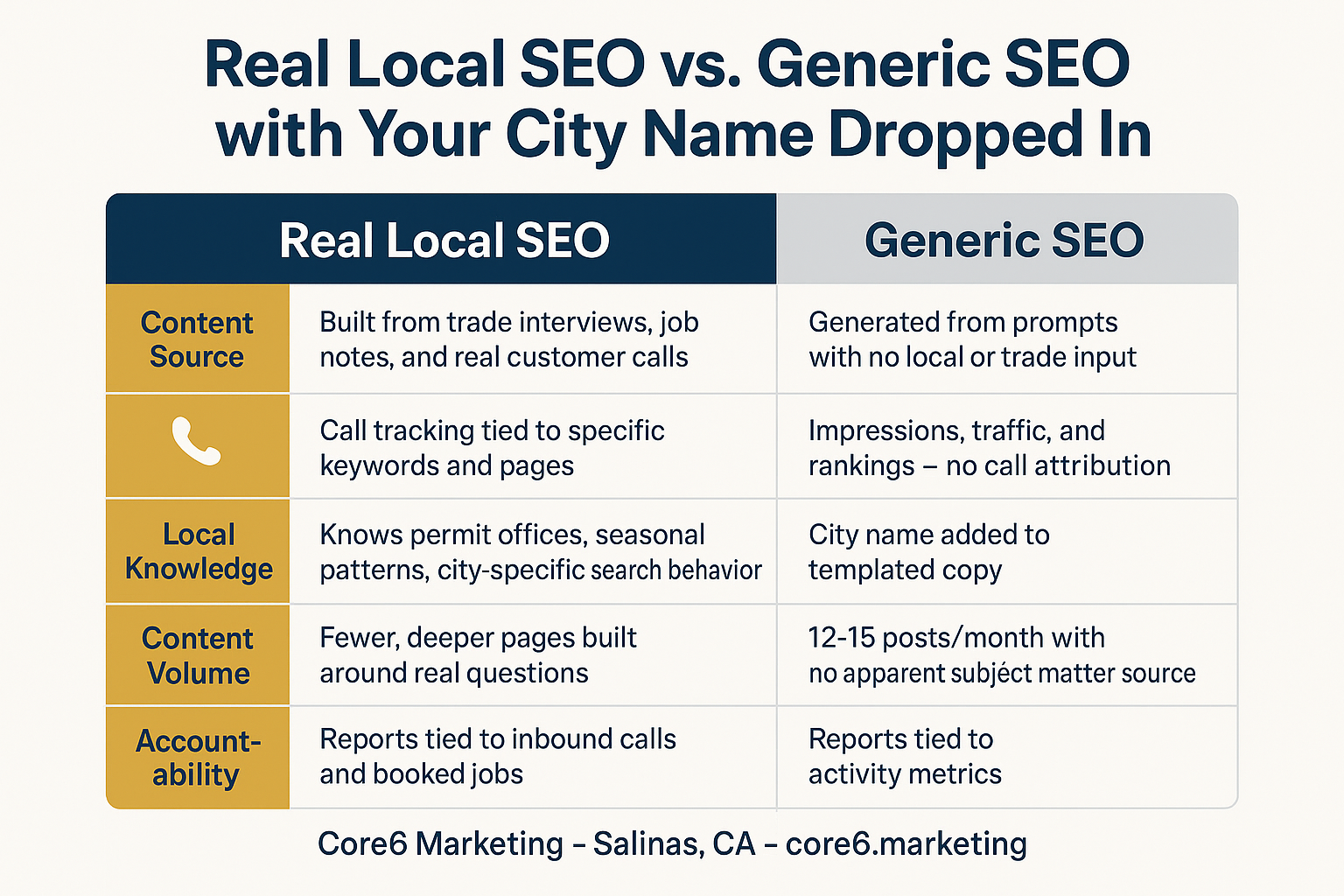
The Difference Between Real Local SEO and Generic SEO with Your City Name In It
This comparison shows the specific ways a locally-grounded SEO agency differs from one running a templated playbook.
Question 4: Can I Verify Your Track Record Independently?
Testimonials on an agency’s own website prove nothing. Anyone can write those. What matters is whether you can verify their credentials somewhere else.
I’d check three things before signing with any agency:
- BBB Accreditation — not just a listing, but actual accreditation with a clean complaint history
- Chamber of Commerce memberships — an agency active in local business communities has roots in the market, not just a mailing address
- Named local clients in your trade — not logos, not case studies with the business name hidden. Actual contractors in Monterey County or Santa Cruz County you can call
Core6 Marketing is veteran-owned, BBB Accredited, and a member of both the Salinas Valley and Pajaro Valley Chambers of Commerce. We’ve worked with 200+ contractor clients on the Central Coast over more than two decades — and none of that work is outsourced overseas. Those are things you can check on your own, outside of anything we publish.
An agency that can’t point you to independently verifiable trust signals is asking you to take their word for it. That’s a reasonable thing to be skeptical about.
Question 5: What Happens in the First 30 to 90 Days?
SEO takes time — that’s true. But ‘it takes time’ is also the most common excuse agencies use to delay accountability indefinitely. Before you sign anything, get a clear answer about what you should expect in the first 30 to 90 days and how you’ll know it’s working.
A legitimate agency should be able to tell you:
– What gets built or fixed first, and why
– When you’ll see the first measurable ranking movement — not a promise, but a reasonable expectation based on your starting point
– What the reporting cadence looks like and who you talk to if results aren’t showing up
For context, our AI Search Sync methodology — which covers Google Business Profile, citations, on-page SEO, and visibility across AI platforms like ChatGPT and Perplexity — typically shows first measurable ranking improvement within 30 days for new clients. That’s not a guarantee for every situation, but it’s a specific benchmark we’re willing to own.
If an agency can’t tell you what to expect in the first month, they’re either not confident in their process or they don’t have one. Neither is a good sign. Why most contractor websites rank but don’t ring explains why the early technical work matters as much as content — and why the sequence of what gets done first is more important than most contractors realize.
Red Flags vs. Green Flags When Evaluating an SEO Agency
Use this as a quick reference when you’re in conversations with any agency — before you sign anything.
| What They Say or Do | Red Flag | Green Flag |
|---|---|---|
| Reporting focus | Impressions, rankings, and traffic volume | Call tracking tied to specific keywords and pages |
| Content process | High-volume posting with no interview or trade input | Content built from your job knowledge and customer language |
| Local knowledge | Uses your city name but can’t answer market-specific questions | Knows permit offices, seasonal demand, and local search behavior |
| Verification | Testimonials only on their own website | BBB Accreditation, Chamber memberships, named local clients |
| Timeline expectations | “SEO takes time” with no specific benchmarks | Clear 30-to-90-day milestones with accountable reporting |
| AI content use | No disclosure about how content is generated | Transparent about process — trade input drives every page |
Frequently Asked Questions About Choosing an SEO Agency
How do I know if an agency is using AI-generated content for my website?
Ask them directly: where does the information in our service pages and blog posts come from? If the answer doesn’t involve interviews with you, job notes, or real customer language, it’s likely being generated from prompts. You can also read the content yourself — AI slop reads vague and generic. If a page about water heater repair in Salinas could have been written about water heater repair in Phoenix or Portland without changing a word, it wasn’t written for your market.
What’s the difference between SEO rankings and leads?
Rankings show where your page appears in search results. Leads are the calls and form submissions that come from people who found you and decided to reach out. You can rank on page one and still get zero calls if the page doesn’t match what the searcher actually needs, or if it doesn’t give them a clear reason to call. Rankings matter — but only as a step toward calls, not as an end goal.
Is call tracking really necessary, or is it an upsell?
It’s necessary. Without call tracking, you genuinely cannot tell which page, keyword, or campaign drove a specific call. You’re flying blind on budget decisions. Core6 Clarity, our call tracking add-on, runs $497/month and includes dedicated tracking numbers, call recording and transcription, a live dashboard, and a monthly Call Intelligence Report. For any contractor spending real money on SEO or ads, that data pays for itself quickly.
How long should I give an SEO agency before expecting results?
For competitive keywords in a market like Monterey County, meaningful ranking movement typically takes three to six months. But you should see early signs of progress within the first 30 days — Google Business Profile improvements, technical fixes indexed, initial citation cleanup complete. If an agency can’t show you anything measurable in the first month, ask why.
Does it matter if an agency is local to the Central Coast?
For generic technical SEO tasks, location matters less. But for local SEO — the kind that gets a Salinas HVAC company or a Watsonville roofer found by people actually in those cities — local knowledge is the product. An agency that doesn’t know the Monterey Peninsula from the Salinas Valley is going to produce generic content that looks local and performs like it’s not.
Ready to See What Accountable Local SEO Actually Looks Like?
If you’re a contractor on the Central Coast — in Salinas, Monterey, Seaside, Watsonville, or anywhere in between — and you’ve been burned by an agency that reported activity while your phone stayed quiet, we’re happy to take a look at what you’ve got and give you an honest read. Phil Fisk offers a 30-minute discovery call with no pitch agenda — just a straight conversation about what’s working, what isn’t, and what a real local marketing system would look like for your trade. You can book directly at https://calendly.com/core6-marketing/30min.