Direct Answer: AI generated content helps when a human supplies real job details, caller questions, and local context first. It backfires when AI writes generic advice from a keyword list alone.
A general contractor in Salinas asked me a fair question last year: his agency was using AI to write his blog posts, and he wanted to know if he should be worried. He was not asking a philosophy question. He wanted to know if it was going to cost him calls.
That is the right way to ask it. The question is not whether AI content is good or bad. It is when it helps and when it quietly works against you, based on how Google and tools like ChatGPT, Perplexity, and Gemini actually evaluate contractor pages right now.
I am going to walk through the line Google draws, the exact kind of post that gets buried, and the one question you can ask your agency this week that tells you almost everything.
What Google Actually Says About AI Generated Content for Contractors
Let me clear up the biggest myth first. Google does not prohibit AI content. Its own guidance says content produced with AI assistance is acceptable, and that its ranking systems reward content that is helpful to people regardless of how it was made.
You can read Google’s own wording on this in its guidance on creating helpful content. Nothing in there bans a machine from touching your blog.
The line Google draws is between AI used to assist human expertise and AI used to produce volume without adding anything. For a contractor, that line is easier to see than it is for most businesses.
Here is what puts a post on the right side of it:
- A real job detail from work you actually performed
- A local reference a stranger could not fake, like salt air on Pacific Grove roofs or gopher pressure in Carmel Valley yards
- A specific answer to a question homeowners actually ask you on the phone
- Pricing context framed by what drives the number, not a made-up figure
And here is what puts a post on the wrong side: rephrased general trade advice that could have been written for a plumber in Ohio, in Oregon, or anywhere else. If you swapped the city name and nothing else changed, that is the problem. I cover the broader shift in what Google’s 2026 updates actually mean for contractor content.

Where AI Content Backfires: The Generic Informational Post
The riskiest category on a contractor site is the informational blog post answering a common question everyone else has already answered. Those are exactly the pages AI Overviews summarize and serve directly, which removes the click entirely.
Picture a roofing contractor in Salinas publishing “how to know if your roof needs replacement.” No local detail. No job examples. No trade-level specifics about what actually fails on a Central Coast roof.
That page did not become a source. It became raw material. Google reads it, answers the homeowner on the results page, and nobody visits the site.
The test I use is simple: does this page contain something only this contractor could have written? If the answer is no, it will get answered on behalf of, not cited.
What usually goes missing:
- The actual failure pattern the crew sees in that specific area, like wind-driven rain along the Marina and Seaside coastline
- What the last twelve similar jobs cost and why the range moved
- The objection homeowners raise right before they say no
- The seasonal timing that matters here, not nationally
Stack up thirty of those posts and you do not get thirty chances to rank. You get a site full of pages that signal low value in bulk. I broke down that outcome in detail in what happens to contractor websites stuffed with AI content.
Same Topic, Two Very Different Posts
Both posts below cover roof replacement timing. One gets summarized and forgotten. The other gets cited and called.
| Element | The Version That Gets Skipped | The Version That Gets Cited |
|---|---|---|
| Opening | General advice about roof age and shingle wear | What fails first on homes near the Monterey Bay coastline and why |
| Job detail | None | A recent tear-off where decking damage was hidden under intact shingles |
| Cost talk | A national average pulled from nowhere | The factors that move the number locally, with a range framed as an estimate |
| Customer language | Written from a keyword list | Built from real caller questions and review wording |
| Local proof | City name inserted once | Neighborhood, weather, and permit realities specific to the area |
The Helpful Side and the Hollow Side
This is the same split I use when reviewing a contractor’s blog archive before we touch anything.
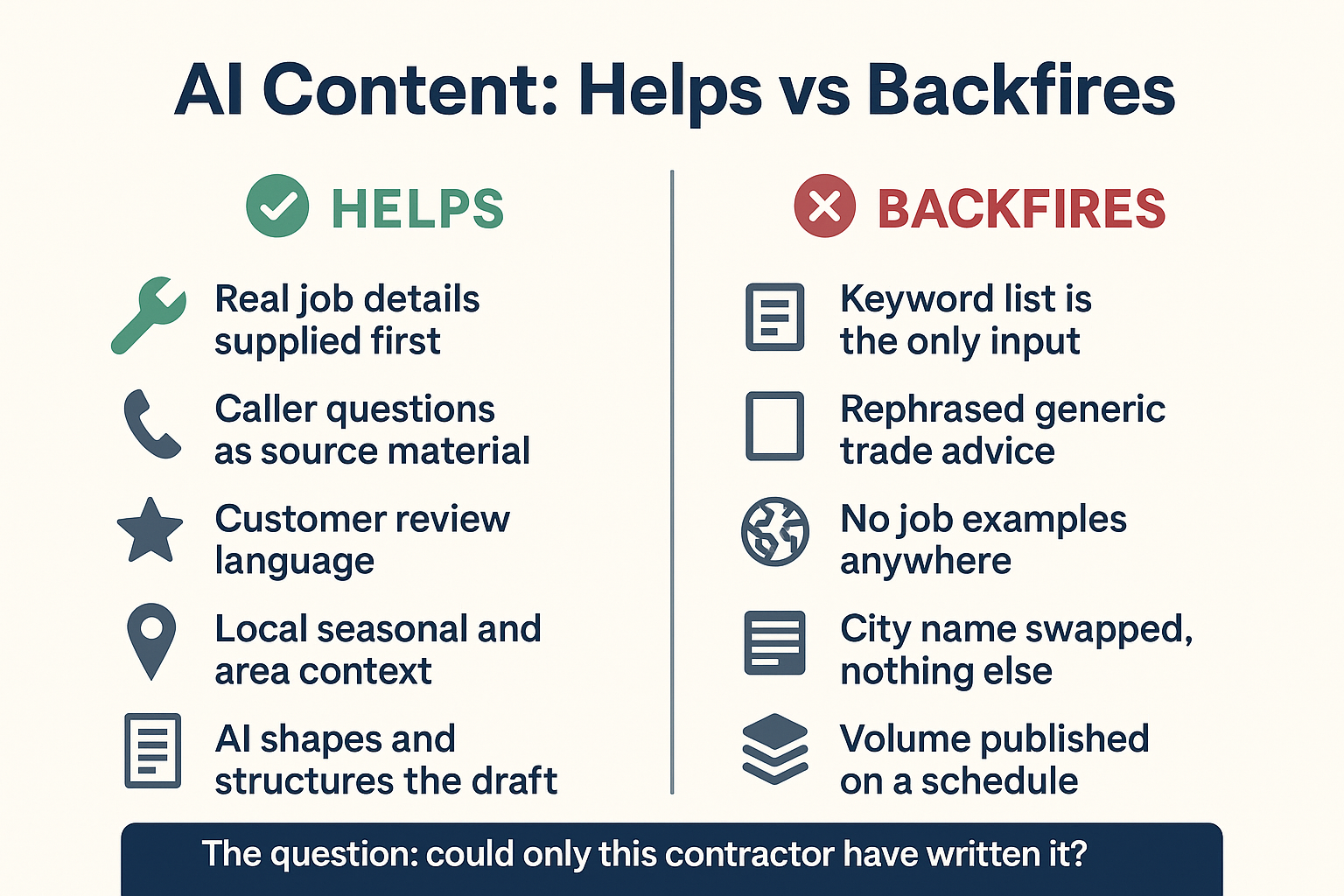
Where AI Genuinely Helps: Production, Not Knowledge
Now the other side, because I am not anti-AI. I use it every week.
AI is good at shaping raw material into a readable, well-organized post. It is not good at knowing anything about your business. That distinction is the whole ballgame.
If a contractor can hand over the inputs, AI can turn them into a finished draft far faster than writing from a blank page. Inputs that actually work:
- Specific job details from the last month of work orders
- The questions callers ask before they book, pulled from recorded calls
- The way homeowners describe the problem in their own words on your contact form
- Review language showing which outcomes customers actually valued
- Local seasonal context, like the pre-rain roofing rush from October into November
That is the Voice of Customer approach we build content on, and your customers have already written most of it for you. I made that case in your customers already wrote your best SEO content.
The failure happens when an agency skips the input-gathering step completely. They feed a model a keyword and a word count, and publish whatever comes back. No human knowledge ever entered the process.
That is a production shortcut dressed up as a content strategy. It fills a calendar. It does not build anything.
The One Question to Ask Your Agency
If you only do one thing after reading this, do this. Email your agency and ask: “Where does the information in my blog posts come from?”
The answer sorts everything. If it is a keyword list and a model, you have a volume operation. If it is call recordings, customer reviews, and knowledge of your service area, you have a process that compounds.
Here is the part that trips up owners. In the first sixty days, the two look almost identical. Both produce posts. Both fill a report. Both use headings and bullet points.
The trajectories separate around the six month mark. One site keeps gaining ground because it holds information nobody else has. The other flattens out because nothing on it is worth citing.
A few other tells worth watching:
- Nobody from the agency has asked you a single question about a job in three months
- Every post is roughly the same length and structure
- Your service area cities appear, but no streets, neighborhoods, or local conditions do
- You could not point to one sentence on the blog that came from your own mouth
If several of those ring true, read 5 signs your marketing agency is filling your site with AI slop. And if you want to understand what it looks like when it goes right, when AI Overviews name a contractor explains why some businesses get pulled into AI answers by name.
That visibility across ChatGPT, Perplexity, Gemini, and Google is what AI Search Sync is built around, and the content feeding it has to be real for any of it to hold.
Frequently Asked Questions About AI Generated Content for Contractors
Will Google penalize my site for using AI to write blog posts?
Not for using AI. Google’s guidance says AI-assisted content is acceptable, and its systems target content that fails to help people, however it was produced. The penalty risk comes from publishing generic, low-value pages in volume, which AI just makes easier to do.
How can I tell if my current blog posts are hurting me?
Read three of them and ask whether a competitor in Watsonville or Hollister could publish the exact same post by changing the phone number. If yes, those pages are not earning anything. Check your analytics too: pages with almost no impressions after six months are usually the generic ones.
Is it worth writing informational blog posts at all if AI Overviews answer the question?
Yes, but only the version that contains something original. AI systems still need sources, and they pull from pages with specifics they cannot generate themselves. A post about slab leak signs in older Seaside homes, with real job examples, gets cited. A post about slab leaks in general gets summarized and skipped.
How long before better content shows results?
We typically see first measurable ranking movement within about 30 days, though that depends heavily on your starting point and how competitive your trade is locally. The bigger gains show up between months four and eight, once enough real material has accumulated.
Can I supply the inputs myself instead of paying for interviews?
Absolutely, and the contractors who do this get the best results. Five minutes of voice notes after a job, forwarded customer emails, or a screenshot of a review is usually enough raw material for a strong post. The work is capturing it, not writing it.
Want a Straight Read on Your Existing Blog Content?
We work with home service contractors across Monterey County, CA, from Salinas and the Monterey Peninsula up through Watsonville and Santa Cruz County, and reviewing an existing blog archive is usually the first thing we do. If you want a second opinion on whether your current content is building something or just filling a calendar, Phil Fisk keeps a few discovery call slots open each week at https://calendly.com/core6-marketing/30min. No pressure either way, and you will leave the call knowing which of your pages are worth keeping.