
Is your marketing a smart investment or just another expense? Answering that question is simple: for every dollar you spend on marketing, are you getting more than one dollar back? Measuring your return on marketing investment is how you find out.
For a busy local business owner, this process is key. It helps you see exactly what’s working, so you can turn your marketing from a guess into a predictable way to get more customers. This guide will show you how to do just that.
Your Blueprint for Measuring Marketing Investment

For any business in Monterey County, from the ag-tech hub of Salinas to the coastal shops of Santa Cruz, every marketing dollar counts. You're not just buying ads; you're investing in your company’s future.
But how do you know if that investment is paying off? That’s where measuring your Return on Marketing Investment, or ROMI, comes in.
Don't worry about complex spreadsheets. At its core, ROMI is a simple formula that shows how effective your marketing is. It helps you answer the big questions and make smart choices for your business.
The Basic ROMI Formula
The formula is easy enough to write on a napkin: (Sales Growth – Marketing Cost) / Marketing Cost = ROMI.
Let's use a real-world example. Imagine a local retailer spent $2,000 on a social media campaign targeting shoppers in Monterey and Carmel-by-the-Sea. That campaign brought in $10,000 in new sales.
- Calculation: ($10,000 – $2,000) / $2,000 = 4
Your ROMI is 4, or a 400% return. This means for every $1 you invested, you got $4 back in revenue. It's a powerful number that gives you the confidence to do more of what works.
Why This Matters for Your Local Business
Tracking ROMI is one of the most important things you can do to grow your business in the competitive Monterey Bay Area. Without it, you’re flying blind. You might feel busy, but you won't know if that activity is actually making you money.
By learning the basics of measuring marketing effectiveness, you take control of your lead generation and your bottom line.
Knowing your numbers lets you make decisions based on facts, not feelings. It’s the difference between guessing which ads bring in customers and knowing precisely which ones attract high-value clients in San Benito County.
This guide is your blueprint. We’ll walk you through how to turn marketing data into your best asset. Let’s start with the tools you need to get the right information.
Building a Rock-Solid Tracking Foundation
Before you can see which marketing dollars bring in sales, you need the right tools in place. Think of it like building a house—you wouldn't start without a solid foundation. In marketing, that foundation is how you track everything.
Setting this up isn’t about being a tech expert. It’s about using a few simple systems that work. These tools help you connect a click on your website to a real, paying customer in places like Gilroy or Watsonville.
First Steps in Digital Measurement
Your journey to a clear ROI starts on your website. It’s the online front door for your business, whether you're a retailer in Seaside or a service provider covering all of Santa Cruz County. The most important first step is installing Google Analytics 4 (GA4).
GA4 is a free tool from Google that acts like a visitor counter for your website. It shows you who is visiting, how they found you, and what they do on your site. Setting it up allows you to track key actions, like when a customer fills out a contact form.
Another must-have for many local businesses is call tracking. Many of your best leads come from a phone call. A potential customer in Hollister with an urgent need is not going to fill out a form; they’re going to call the first qualified business they find.
By using unique phone numbers for different ads—one for Google, another for Facebook—you can see exactly which marketing effort made the phone ring. This simple step can completely change how you see your marketing.
To get a better handle on this, check out our guide on what call tracking is and how it works. It's a game-changer for proving what works.
Tagging Your Campaigns for Clarity
Once you have analytics and call tracking set up, the next step is to add more detail. This is where Urchin Tracking Module (UTM) parameters come in. That sounds technical, but the idea is simple.
UTMs are small bits of code you add to the end of a URL. They tell Google Analytics more about where a visitor came from. Think of them as little name tags for your marketing.
Here’s what you can track:
- Source: Where the traffic came from (e.g.,
google,facebook,newsletter). - Medium: The type of traffic (e.g.,
cpcfor paid ads,email,social). - Campaign: The specific promotion you’re running (e.g.,
spring_sale,holiday_special).
For example, if you run an email promotion for customers in Salinas, you can tag the link to see exactly how many website visits and leads that one email created. This level of detail is key for measuring return on marketing investment. To ensure your data is trustworthy, using strong Financial Reporting Best Practices is also a smart move.
By putting these foundational pieces in place—GA4, call tracking, and UTMs—you create a system that captures the data you need. This isn't just about collecting numbers; it's about building a framework that connects every marketing dollar to a real result.
Connecting Digital Clicks to Real-World Jobs
A website visit from someone in Pacific Grove is a good start, but it doesn't pay the bills. A final sale does. This is where you connect your online marketing efforts to the real-world sales that grow your business.
The key is figuring out which marketing effort gets the credit for the final sale.
This process is called attribution. It’s about giving value to the different touchpoints a customer interacts with on their way to buying from you. For a small purchase, that journey might be short. For a larger one, it could take weeks.
Getting this right is essential to accurately measuring your return on marketing investment.
It helps you understand the story behind each new customer. Did that big sale in Hollister start with a Google search? Or was it the follow-up email that sealed the deal? Answering these questions helps you invest your marketing dollars much more wisely.
Choosing the Right Attribution Model
Not all attribution models are the same. The right one for your business in Santa Cruz County depends on your typical sales process. Think of these models as different ways of telling the story of how you won a new customer.
Here's a look at the most common ones:
- First-Touch Attribution: This gives 100% of the credit to the very first marketing channel a customer used. If someone first finds your site through a blog post, that blog post gets all the credit.
- Last-Touch Attribution: This is the opposite. It gives 100% of the credit to the final touchpoint before the customer bought something. If they made a purchase after clicking a Google Ad, the ad gets all the credit. This is the default model in tools like Google Analytics.
- Linear Attribution: This model spreads the credit out equally across all touchpoints. If a customer saw four different ads before buying, each ad gets 25% of the credit.
For many local businesses, a last-touch or linear model is a great place to start. Last-touch is easy to track and tells you what’s closing deals right now. A linear model gives a more balanced view, showing how multiple interactions lead to a sale.
To help you decide, here’s a quick comparison.
Choosing the Right Attribution Model for Your Business
| Attribution Model | How It Works | Best For… |
|---|---|---|
| First-Touch | Gives 100% credit to the first interaction. | Businesses with short sales cycles or a focus on building initial awareness. |
| Last-Touch | Gives 100% credit to the final interaction. | Businesses focused on what’s closing deals now. It’s simple and easy to track. |
| Linear | Distributes credit equally across all touchpoints. | Businesses with longer sales cycles where multiple marketing touches contribute to the final decision. |
The goal is to pick a model that reflects how your customers in Monterey County actually find and choose you.
From Website Lead to Final Invoice
Understanding attribution is one part of the puzzle; tracking the customer's entire journey is the other. This is where a Customer Relationship Management (CRM) system is a game-changer. A CRM is a tool that helps you manage all your interactions with customers.
It doesn’t need to be complex or expensive. A well-organized spreadsheet can work when you're starting out. The goal is to have one place to track a lead from their first contact—a website form, a phone call—all the way to the final sale.
This diagram shows a simple flow of how all that tracking data comes together.
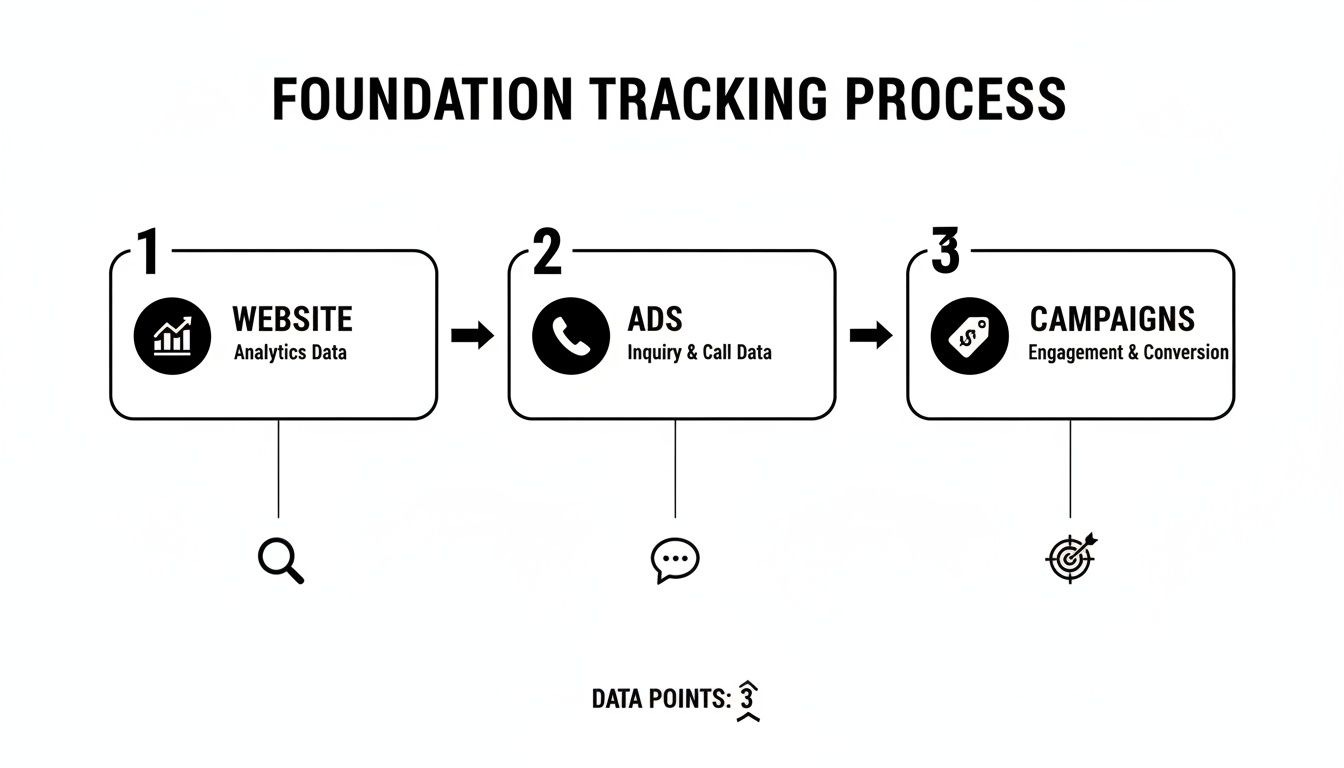
This visual highlights how different marketing activities all feed into one system. This allows you to connect the dots between your spending and your results.
By connecting your website leads with a CRM, you create a powerful feedback loop. You’ll know exactly which marketing channels deliver not just leads, but profitable customers. For businesses trying to improve lead generation in Salinas, this kind of system gives you the data you need to make smart decisions.
Our guide on what conversion tracking is provides more detail on how to set up these systems. This is how you stop guessing and start building a predictable flow of profitable work.
Calculating Your True Marketing ROI and Customer Value

You've done the hard work of getting your tracking in place. Now it’s time for the payoff. This is where we look at the data to find out what's really working.
We're moving past simple numbers and looking at the two that matter most: Return on Marketing Investment (ROMI) and Customer Lifetime Value (LTV).
Knowing these figures is the difference between business owners who hope their marketing works and those who know it does. It's how a smart business in Monterey County can confidently invest in a campaign, knowing what they’ll get back.
The Nuts and Bolts of ROMI Calculation
At its core, measuring return on marketing investment is a simple comparison: what did you spend, and what did you get back? The basic formula is the perfect place to start: (Sales Growth – Marketing Cost) / Marketing Cost.
Let's use some real numbers.
Imagine your business in Salinas spends $3,000 on a targeted Google Ads campaign for one month. Your CRM shows that campaign directly led to $18,000 in new sales.
Here’s the math:
- Your Calculation: ($18,000 – $3,000) / $3,000 = 5
That simple calculation gives you a ROMI of 5:1, or 500%. For every dollar you put into that campaign, you got five dollars back. This kind of hard data makes budget decisions easy. If you want to learn more about content-specific returns, this guide on measuring content marketing ROI is a great resource.
Key Takeaway: Don’t just look at your total revenue. Calculate ROMI for each marketing channel. You might find your SEO agency in Salinas is bringing in a 7:1 return, while a local print ad is only at 2:1. This is how you find your winners.
Moving Beyond a Single Job to Customer Lifetime Value
ROMI on one campaign is a great snapshot, but the best business owners play the long game. They know that a new customer is worth much more than just their first purchase. This is where Customer Lifetime Value (LTV) changes your perspective.
LTV is an estimate of the total money you can expect from a single customer over your entire relationship with them.
Think about it. The new customer you just won in Carmel-by-the-Sea could become a loyal, repeat buyer for years. That one sale could turn into thousands more in future revenue.
Here’s a simple way to start calculating LTV:
- Average Sale Value: What’s the average amount a customer spends?
- Purchase Frequency: How many times does a typical customer buy from you per year?
- Customer Lifespan: On average, how many years do customers stay with you?
Formula: (Average Sale Value) x (Purchase Frequency) x (Customer Lifespan) = LTV
Understanding LTV is a huge advantage. It tells you exactly how much you can afford to spend to get a new customer. If you know the average customer is worth $5,000 over their lifetime, spending $300 to acquire them through digital marketing for Santa Cruz retailers suddenly looks like an incredible deal. You can learn more about this in our guide on cost per acquisition calculation.
Using Data to Optimize Your Marketing for Growth
Having the numbers is a huge win. But the real power comes from using that data to make smarter decisions that grow your business. This is where you move from just measuring to actively improving.
Using your Return on Marketing Investment (ROMI) data is how you build a reliable way to get new customers. It's how you figure out what worked, what didn't, and where to spend your next marketing dollar—whether you're targeting customers in Hollister or Santa Cruz.
This creates a cycle that should be at the heart of your marketing strategy: measure, analyze, improve, and repeat.
Setting Your Local Benchmarks
One of the first questions business owners in the Monterey Bay Area ask is, "What's a 'good' number?" The truth is, benchmarks can be very different even within our local market. A good cost-per-lead for a business in a busy area like Marina might be different from one in a quieter part of Seaside.
Your own past data is the best place to start. But here are a few things to keep in mind:
- Service or Product Type: High-urgency leads will almost always cost more to get than leads for a planned purchase.
- Seasonality: The cost to get a lead in Monterey County will naturally be higher during peak seasons, like the holidays for retailers.
- Competition: The more businesses are bidding on keywords like "restaurants in Salinas," the higher the cost per click and cost per lead.
Don't get too caught up in national averages. Focus on improving your own numbers month after month. That's the real sign of a healthy business.
Reallocating Your Budget for Maximum Impact
Once you have a clear picture of which channels are working best, the next step is simple but powerful: put more money into what works. This is called reallocating your budget, and it’s one of the fastest ways to improve your overall marketing ROI.
Imagine your data shows that your SEO efforts are bringing in leads for $50 each, while your local print ads bring them in for $200 each. The choice is clear. You can shift some of that print budget to your digital marketing and get four times the leads for the same cost.
This isn't about quitting channels completely, but about making smart adjustments. The data gives you the insight to ask the right questions and test new ideas.
Creating Your Continuous Feedback Loop
The improvement process should never stop. The market is always changing, and new competitors pop up. That’s why setting up a continuous feedback loop is so important for long-term success.
Here's what that cycle looks like:
- Measure: Keep pulling data from your website, call tracking, and CRM.
- Analyze: Once a month, review the numbers. Which channels brought in the most profitable customers?
- Optimize: Based on your review, make strategic changes. Move your budget, change your ad copy, or test a new offer.
- Repeat: Start the cycle all over again.
By creating a system like this, you ensure your marketing strategy is always getting smarter. A great way to keep this information organized is with a central dashboard. You can learn how to build one in our guide to setting up a marketing performance dashboard. This structured approach is key to measuring return on marketing investment and turning those insights into steady growth.
By Phil Fisk, CEO, Core6 Marketing
Phil Fisk is the founder of Core6 Marketing, a digital marketing agency based in Salinas, CA. He specializes in helping local businesses across the Monterey Bay Area generate more leads and grow with data-driven strategies.
Core6 Marketing
1628 N. Main St #263, Salinas, CA 93906
831-789-9320
[email protected]
https://core6.marketing/
Common Questions About Measuring Marketing ROI
We get it—looking at the numbers behind your marketing can feel like a lot. As a local marketing agency in Salinas, we hear the same questions from business owners all over the Monterey Bay Area. So, let's answer a few of the most common ones.
How Often Should I Calculate My Marketing ROI?
For most local businesses, a balanced approach is best. We suggest reviewing key numbers weekly but saving the full ROI calculation for a monthly review.
A quick weekly check lets you spot any immediate problems. Think of it as a pulse check on things like website traffic from Monterey County, contact form submissions, or call volume.
The monthly review gives you enough data to see real trends without getting lost in daily changes. Of course, for big seasonal campaigns, you’ll want to run a full ROI calculation once the campaign ends to see how it really did.
What Is a Good Marketing ROI for a Local Business?
This is the big question. A healthy benchmark for a strong marketing ROI is 5:1. That means you’re bringing in $5 in revenue for every $1 you spend. An amazing result would be 10:1 or higher.
But here's the most important part: your own profit margin.
A 3:1 ROI might be great for a high-margin service, but it could be a loss for a lower-margin product. What matters most is that your ROI is above 1:1 and leaves you with a healthy profit after covering all your costs.
How Can I Track Word-of-Mouth Referrals?
Don't forget your offline marketing. Tracking it is very important, especially in our close-knit communities. Word-of-mouth is powerful, and you need to know where it's coming from.
The easiest and best way? Train your team—especially whoever answers the phone—to always ask, "How did you hear about us?"
Here are a few ways to capture that information:
- Add it to your intake forms. Put a "How did you hear about us?" field on your forms with a dropdown menu of choices (e.g., Google, Friend, Truck Sign).
- Use tracking numbers. Put a unique call tracking phone number on your trucks, yard signs, or mailers. This lets you measure how many calls these offline efforts are actually bringing in.
- Create special offers. Launch a referral program with unique codes. When a new customer uses a code from a friend, you know exactly who sent them.
By tracking these offline sources, you get a full, accurate picture of what really drives your business. It helps you make smart decisions based on all your marketing efforts.
Ready to stop guessing and start knowing your true marketing ROI? The team at Core6 Marketing can help you set up a solid tracking system that connects every dollar to a result.