
If you're spending money on marketing, you need to know if it's actually making you money. The answer isn't buried in complex reports—it's found in one powerful number: your Cost Per Acquisition (CPA). Understanding the cost per acquisition calculation is one of the most important steps you can take to ensure your marketing dollars are working as hard as you do.
This guide breaks down the cost per acquisition calculation specifically for business owners across Monterey County, helping you understand your true marketing ROI and make smarter financial decisions.

Why CPA Is Your Most Important Marketing Metric
In the world of marketing, it’s easy to get lost in a sea of metrics. Clicks, impressions, website traffic—these numbers feel good, but they don't tell the most important story: how much it actually costs to land a new, paying customer.
That's where your Cost Per Acquisition, or CPA, becomes your most valuable tool.
Think of it this way: if you’re a contractor in Salinas, you wouldn’t buy a new truck without knowing its price. Your marketing should be no different. CPA is the price tag on each new customer you win through your advertising efforts.
The Power of Knowing Your Numbers
Understanding your CPA is absolutely critical for any business owner in Santa Cruz County, whether you're a retailer in the city of Santa Cruz or a home services pro in Watsonville. Without it, you're essentially marketing with a blindfold on.
A clear CPA calculation empowers you to:
- Measure True ROI: Finally move past vanity metrics and see which campaigns are actually turning into profitable jobs.
- Make Smarter Budget Decisions: Confidently shift more funds to channels that deliver low-cost customers and pull back on those that drain your wallet.
- Improve Profit Margins: By lowering the cost to acquire each customer, you directly increase the profitability of every single job you land.
- Scale with Confidence: Knowing your acquisition cost gives you a predictable model for growth. Need 10 new customers next month? You'll know exactly what you need to invest to get them.
Expert Take: Many local businesses focus on getting more leads, but the most successful ones focus on getting more profitable customers. Your CPA is the bridge between a lead and a profitable customer, showing you the real-world efficiency of every marketing dollar you spend.
Before You Calculate: CPA vs. CPL—A Crucial Distinction
It’s incredibly common to mix up CPA with CPL (Cost Per Lead), but they are worlds apart. A lead is just a potential customer—someone who filled out a form or made a call. An acquisition is a paying customer who has signed a contract and handed over their money.
Your CPA will almost always be higher than your CPL because, let's be honest, not every lead turns into a sale.
Focusing on CPA ensures you’re measuring the final, money-in-the-bank outcome, not just an intermediate step. This distinction is vital for accurately gauging the health of your marketing, especially in our competitive coastal economy. As you get better at this, you'll find that modern tools can help you fine-tune your ad spend to lower both metrics. You can learn more about how AI can enhance your digital marketing efforts in our detailed guide.
Gathering the Right Data for an Accurate CPA
A reliable Cost Per Acquisition (CPA) calculation starts with good, clean data. As the old saying goes, garbage in, garbage out. It’s not about just yanking random numbers from your ad accounts; it's about truly understanding what those figures mean for your business, whether you’re serving clients in Pacific Grove or all over San Benito County.
To get a real number, you have to look beyond what you paid for an ad. Your true marketing costs are a mix of several factors. Honestly, building this solid data foundation is the most critical part of the whole process.
Identifying Your Total Marketing Costs
First up, let's tally every single dollar you're spending to bring in customers. For a specific campaign (like a Google Ads push for a new service), you’ll want to gather all the related expenses over a set time, say, one month.
Your cost calculation should include a few things:
- Direct Ad Spend: This one's the most obvious. It's the total amount you paid directly to platforms like Google, Meta (Facebook/Instagram), or Yelp for your advertisements.
- Agency or Freelancer Fees: If you're working with a marketing partner like Core6 Marketing, their management fee is a direct cost of that campaign and absolutely must be included.
- Software and Tool Subscriptions: Using any special software for call tracking, landing pages, or analytics? A slice of that subscription cost needs to be allocated right here.
- Internal Team Time: This is the one everyone forgets, but it's huge. If your office manager in Gilroy spends five hours a week managing social media ads, the value of their time is a marketing cost. Just calculate their hourly wage multiplied by the time they spent.
By adding up these "hidden" costs, you get a much more realistic picture of your investment. A campaign that looks profitable based on ad spend alone might actually be a money-loser once you factor in management fees and internal time.
Tracking Your Actual Conversions
Once you have your total costs sorted, the next move is to count your acquisitions. And remember, an acquisition is a new, paying customer—not just a lead. This is exactly where many businesses in the Monterey Bay Area trip up; they count every form submission but have no idea which ones actually signed a contract.
For an accurate cost per acquisition calculation, you have to track the final outcome. Here’s how you can nail this down for different channels:
- Website Forms: A good CRM (Customer Relationship Management) tool is your best friend here. Use it to follow a lead from the moment they fill out a form all the way to a signed contract and a paid invoice. This is how you connect the initial click to the final revenue.
- Phone Calls: You've got to implement call tracking software. This tech assigns a unique phone number to each of your ad campaigns. When a customer calls the number from your Google Ad, you know precisely which campaign generated that new job. No guesswork.
- Direct Sales & Referrals: Always, always ask new customers, "How did you hear about us?" While it’s not purely digital, this simple question helps you attribute sales that might have been influenced by your online efforts, especially long-term strategies like SEO. For instance, strong organic visibility is a journey, and understanding how SEO can transform your company is key to appreciating its role in generating those "word-of-mouth" clients who really found you online first.
By meticulously tracking both your total costs and your true acquisitions, you build a data set you can finally trust. That's the only way to get a CPA that genuinely reflects how your business is performing.
The Simple Formula for Calculating Your Local CPA
Now that you have your key numbers gathered, it’s time to get to the good stuff—the actual cost per acquisition calculation. The best part? The formula itself is refreshingly simple. No confusing algebra, just basic division that tells a powerful story about your marketing's real-world performance.
Here’s the core formula: Total Marketing & Sales Costs ÷ Total New Customers = Cost Per Acquisition (CPA)
This elegant little equation cuts right through the noise. It takes your total investment and measures it against the only result that truly matters: a new paying customer. This visual breaks it down perfectly.
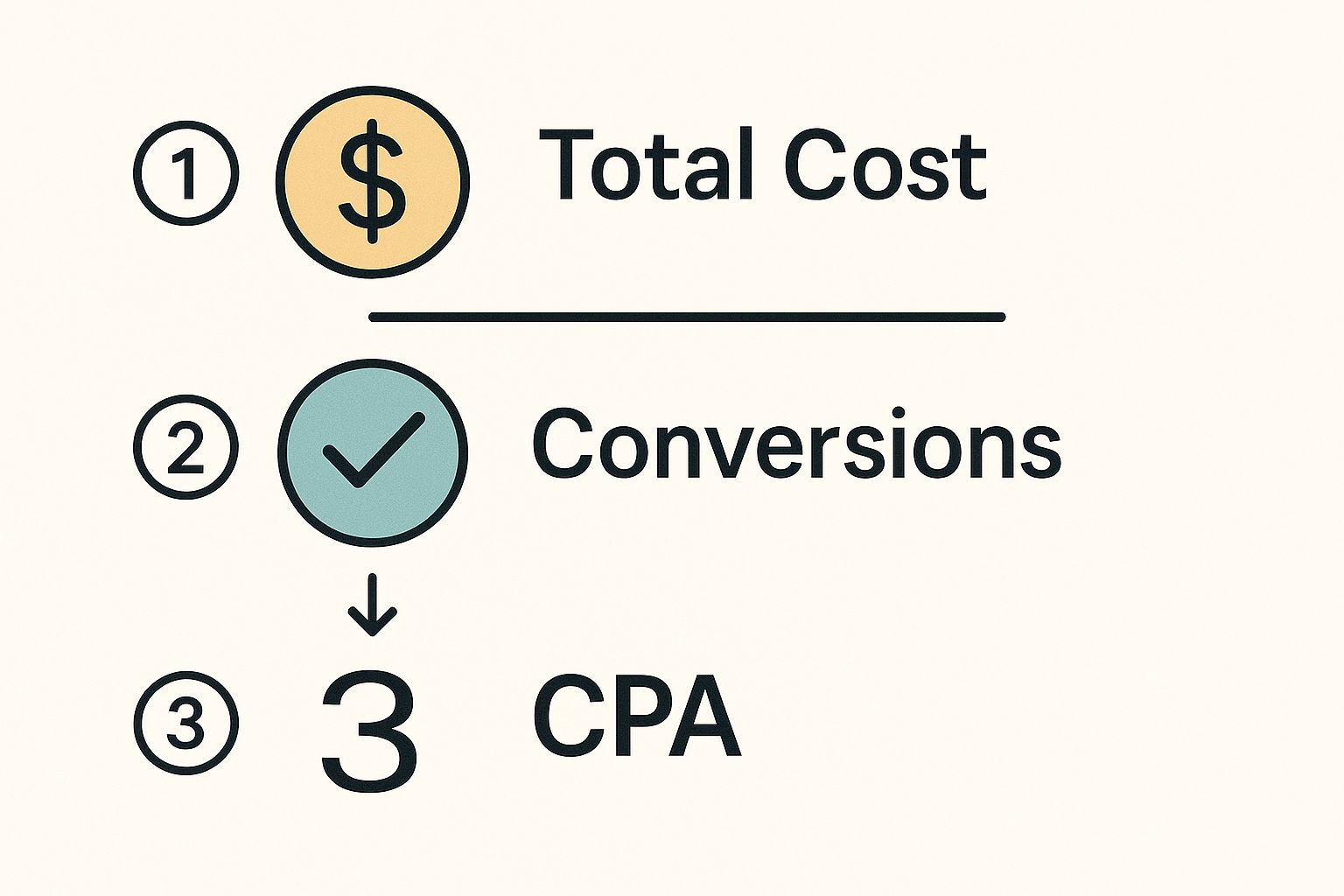
As you can see, it’s a direct line from what you spend to what you get. This is how you turn abstract marketing expenses into a concrete metric you can actually use.
A Local Example in Action
Let's make this real. Imagine a home services company based right here in Watsonville that wants to figure out how its marketing performed in April. Their goal was to land new clients across the Monterey Bay Area, so they ran a focused Google Ads campaign.
Here’s how their numbers broke down for the month:
- Google Ads Spend: They invested $2,000 directly into their ad campaign.
- Agency Management Fee: They paid their marketing agency a $500 fee to manage it all.
- Total New Customers: That specific campaign brought them 10 brand-new, paying customers.
With this data, we can plug the numbers straight into our formula.
Putting the Formula to Work
First things first, we need to calculate the total marketing cost. This isn't just what you paid Google; it has to include everything, like that agency fee.
$2,000 (Ad Spend) + $500 (Management Fee) = $2,500 (Total Marketing Costs)
Now that we have the total investment, we can finish the CPA calculation. We just take that total cost and divide it by the number of new customers they won.
$2,500 (Total Costs) ÷ 10 (New Customers) = $250 CPA
The result is crystal clear: it cost the Watsonville company exactly $250 to acquire each new customer in April. This single number is incredibly powerful. It’s no longer a vague feeling of "we spent some money and got some jobs." It's a precise figure they can now use to judge profitability and make smarter decisions for future campaigns targeting clients in Monterey County.
For contractors, truly understanding these numbers is what separates the businesses that grow from the ones that stagnate. To dive deeper into specific lead generation strategies, check out our guide on how to generate leads for home builders and general contractors. This process gives you a repeatable, reliable method for finding your own CPA—turning pure guesswork into actionable business intelligence.
Is My CPA Any Good? Understanding Local Benchmarks
Alright, you’ve run the numbers and calculated your first cost per acquisition. You’re staring at a figure—let's say it's $250—and you're asking the big question: "Is that any good?"
The honest answer we give our clients is always the same: it really depends.
A $50 CPA could be a massive win for a high-end home remodeler in Carmel-by-the-Sea, but a total disaster for a handyman handling small repairs in Marina. Your industry, profit margins, and the lifetime value of a customer are what turn your CPA from just a number into a true measure of your marketing's health.
Context is everything. Without it, you’re just guessing whether your campaigns are a cause for celebration or a reason to go back to the drawing board.
Benchmarks and Local Realities
While every business here in Santa Cruz County is different, we can look at broader industry data to get a solid starting point. This gives us a baseline to measure against before we start factoring in our local economy and your specific business goals.
For example, national data shows a huge difference in acquisition costs across home service trades.
In the B2C world, customer acquisition costs can swing wildly. Legal services, for instance, have an average organic CAC of $189, but that skyrockets to $457 with paid ads. Funnily enough, HVAC services often see the opposite, where paid ads can actually be more efficient and bring in a lower cost per lead than organic efforts. You can dig deeper into these industry-specific acquisition costs to see where your trade fits.
This proves that what works for a plumber in Salinas might completely flop for a roofer just a few miles away. You can't just copy what a competitor is doing; you have to understand the unique economics of your own trade.
From Averages to Actionable Goals
Knowing the benchmarks is the first step. The next, and most important, is connecting them to your own business so you can define what a "good" CPA truly means for you.
Here’s how you can set a target CPA that actually makes sense for your bottom line:
-
Know Your Average Job Value: What’s the typical ticket price for a new customer? A landscaper pulling in $5,000 on a project has a lot more room to spend on acquisition than an electrician handling a $300 repair call.
-
Calculate Your Profit Margin: Out of that job value, how much is actual profit? If you have a 20% profit margin on that $5,000 landscaping job, your gross profit is $1,000. Your CPA needs to be comfortably below that number for your marketing to be sustainable.
-
Consider Customer Lifetime Value (LTV): Does one job often lead to more? Maybe that $300 electrical repair client signs up for an annual service contract worth $500/year for the next five years. Suddenly, their LTV makes a higher initial CPA look like a brilliant investment.
At the end of the day, a "good" CPA is simply one that lets your business grow profitably. It's the number that leaves you with enough room for profit after all your marketing and operational costs are covered. By combining national benchmarks with your own financial realities, you can finally judge your marketing performance with real confidence.
Using Your CPA to Sharpen Your Marketing Strategy
Your Cost Per Acquisition (CPA) is way more than just a number on a spreadsheet—it's your strategic compass. It's what moves you from just spending money on marketing to strategically investing it. Knowing this number gives you the power to make sharp, data-driven decisions that grow your home service business right here in the Monterey Bay Area.
A clear CPA turns vague questions into concrete answers. It's the tool that shows you which marketing channels are your true workhorses and which ones are quietly draining your budget. This is where raw data becomes a real competitive edge for an SEO agency in Salinas or any local business.
Compare Channels to Find Your Winners
One of the most powerful things you can do with your CPA is to compare the performance of your different marketing channels. You should be running a separate cost per acquisition calculation for every platform you use. This is how you find out which ones are actually efficient at bringing you paying customers.
For example, you might discover your Google Ads campaign targeting homeowners in Salinas has a CPA of $150, while your Facebook ads aimed at customers in Seaside come in at $300. This insight is pure gold.
Armed with this knowledge, you can confidently shift a larger portion of your budget from the higher-CPA channel to the lower-CPA one. This simple move can dramatically lower your overall acquisition cost without spending a single extra dollar.
Keep in mind, the marketing world is always shifting. Market dynamics can change in a hurry, so monitoring your CPA regularly is crucial for success, especially for digital marketing for Santa Cruz retailers who face seasonal trends.
Connect CPA to Customer Lifetime Value
A low CPA is great, but it isn't the whole story. The real goal is to acquire profitable customers. This is where Customer Lifetime Value (LTV)—the total profit you expect to make from a customer over your entire relationship—comes into play.
A high CPA might look scary at first, but it could be a brilliant investment if it brings in loyal, high-spending clients.
Let's look at two scenarios for a business in Monterey County:
- Channel A: Delivers customers at a low CPA of $100. These are typically one-and-done clients who call for a single, small repair, generating about $300 in revenue.
- Channel B: Has a much higher CPA of $400. But these customers are homeowners who sign up for annual service contracts, bringing in $3,000 in revenue over three years.
In this case, the channel with the higher CPA is far more valuable to your business's long-term health. Understanding this relationship helps you look beyond the initial cost and focus on acquiring the right kind of customers. The business landscape is always in flux, and adapting your strategy is key, as we've seen in our guide on marketing your home services business post-crisis.
Did You Know?
Monterey County's agriculture sector, known as the "Salad Bowl of the World," is a powerhouse of innovation. According to the Monterey Bay Economic Partnership, our region's AgTech industry is a significant driver of the local economy, blending our deep farming roots with cutting-edge technology. This same spirit of data-driven growth can be applied to your own marketing.
Frequently Asked Questions About CPA
Even with a solid formula in hand, questions about cost per acquisition always pop up. It’s a concept that’s simple on the surface but has a lot of nuance.
Here are a few of the most common questions we get from home service business owners across the Monterey Bay Area. Getting these answers straight will help you use CPA with more confidence and drive real, measurable growth for your business.
How Often Should I Calculate My CPA?
This is a fantastic and practical question. The answer really depends on the type of marketing you’re running.
For your steady, always-on efforts—like a long-term Google Ads campaign—checking your CPA on a monthly basis is usually the sweet spot. This gives you enough data to see real trends without getting bogged down by tiny day-to-day blips.
But what if you're running a shorter, more intense campaign, like a seasonal special for homes in Hollister? In that case, you might want to pull the numbers weekly. The most important thing is consistency. A regular review cadence lets you track performance over time, see what’s actually working, and make smart tweaks to your strategy.
What Is the Difference Between CPA and CPL?
It's incredibly common to mix these two up, but they measure two very different—and equally important—parts of your marketing funnel.
Cost Per Lead (CPL) tells you how much it costs to get a potential customer’s contact info. Think of it as the cost of getting someone to raise their hand and say, "I'm interested." This could be a form submission or a phone call.
Cost Per Acquisition (CPA), on the other hand, measures the total cost to land an actual paying customer. This is someone who has signed a contract, paid a deposit, and is officially on your project schedule.
Your CPA will pretty much always be higher than your CPL. Why? Because not every lead you get will turn into a closed deal. Tracking both metrics gives you a complete picture of your funnel's health, from the first click to the final handshake.
My CPA Is Too High What Should I Do First?
Seeing a high CPA can definitely be a gut-punch, but don't panic. Think of it as a signal—an opportunity to find and fix a weak link in your process.
Before you do anything else, start by looking at your ad targeting. Are you really reaching the right people in the right Salinas zip codes? Or is your budget getting eaten up by clicks from outside your service area or from people who aren't your ideal customer?
Next, take a hard, honest look at your ad copy and your website's landing page. Is your message crystal clear? Does your page quickly show why a homeowner should choose you? Is it dead simple for them to take the next step and contact you? Often, small tweaks to your ad's headline or improving the user experience on your site can dramatically lower your CPA.
Remember, your online reputation plays a huge role here, too. A great ad can be completely undermined by a poor reputation. You can learn more about how online reviews affect your contractor business and see just how much it impacts whether a lead decides to trust you with their project.
Take Control of Your Marketing ROI Today
Calculating your CPA is the first step toward building a more predictable, profitable, and scalable business. Stop guessing and start knowing exactly what your marketing efforts are worth.
If you’re ready to dive into your numbers but aren't sure where to start, our team at Core6 Marketing is here to help. We provide local businesses with the clarity they need to grow.
Schedule a strategy session today or give us a call at 831-789-9320 to discover what a data-driven marketing strategy can do for you.
By Phil Fisk, CEO, Core6 Marketing
Phil Fisk is the founder and CEO of Core6 Marketing, a digital marketing agency dedicated to helping local businesses in the Monterey Bay Area thrive. With over a decade of experience, Phil specializes in turning marketing data into measurable growth for his clients.
Core6 Marketing
1628 N. Main St #263, Salinas, CA 93906
831-789-9320
[email protected]
https://core6.marketing/