Direct Answer: Fix your storm service pages, Google Business Profile hours and service area, and review language by early November. Search rankings take about 30 days to move, so September and October work is what pays in December.
Every wet winter on the Central Coast follows the same pattern. The phone goes quiet for months, then rings 40 times in a day, and the contractors who get those calls are the ones who were already showing up in search before the first atmospheric river landed.
NOAA’s Climate Prediction Center has put the odds of a very strong El Nino holding through January above 60%, which would rank among the largest events in the record going back to 1950. Modeling from the European forecasting center, cited by climate scientist Daniel Swain, points to 70% to 100% odds of above average precipitation in California this winter.
No seasonal model can promise a flood year. But the odds have tilted, and the online side of a contracting business is far easier to fix in September than during a flood warning. Here is the checklist I work through with Monterey County clients, ordered the way storm demand actually arrives.
1. Read the Forecast Honestly, Then Work Backward From November
The forecast does not tell you how many jobs you will book. It tells you the probability curve moved, and that is enough to justify a few weeks of prep work.
What it also does is give you a deadline. If December and January are the months that generate the calls, then early November is your finish line, not January.
We already have a local reference point for what a wet stretch looks like here. In the January 2026 storms, portions of the route from Highway 68 to Highway 1 in Monterey closed from flooding, and sandbags were handed out at fire stations in Monterey, Pacific Grove and Carmel-by-the-Sea.
Monterey County also runs roughly 50 remote ALERT sites measuring rainfall and water levels across the Pajaro, Carneros Creek and Elkhorn Slough watersheds. You can see the county’s own storm preparedness and flood alert guidance for how that system works.
Read that as a demand map. Where the water goes, the calls follow.
2. Publish Your Storm Pages in September and October, Not the Morning of the Warning
This is the single most common mistake I see. A contractor writes a solid page about emergency tarping or collapsed storm drains the morning a flood watch hits, publishes it, and gets nothing that week.
Indexing is not instant. Our working benchmark is first measurable ranking movement inside about 30 days, and competitive storm terms often take longer than that.
So the calendar matters more than the copy. A page published in mid September has time to get crawled, indexed and settled before anyone in Salinas or Watsonville is searching for it in a panic.
Start with the pages you know you will need:
- A dedicated emergency or after hours service page, separate from your main service page
- One page per storm specific job type you actually want to sell
- A service area page for the towns you will realistically drive to in bad weather
- An FAQ page answering the questions callers ask before they book
Write them once. Update them every fall.
3. Fix the First Hour Pages First: Roofing and Tree Service
Storm demand does not arrive all at once. Roofers and tree crews take the first calls, sometimes while the wind is still blowing, and those searches are decided fast.
Somebody with water coming through a bedroom ceiling at 9 p.m. is not comparing four bids. They are calling whoever appears first and answers.
For those two trades, I prioritize:
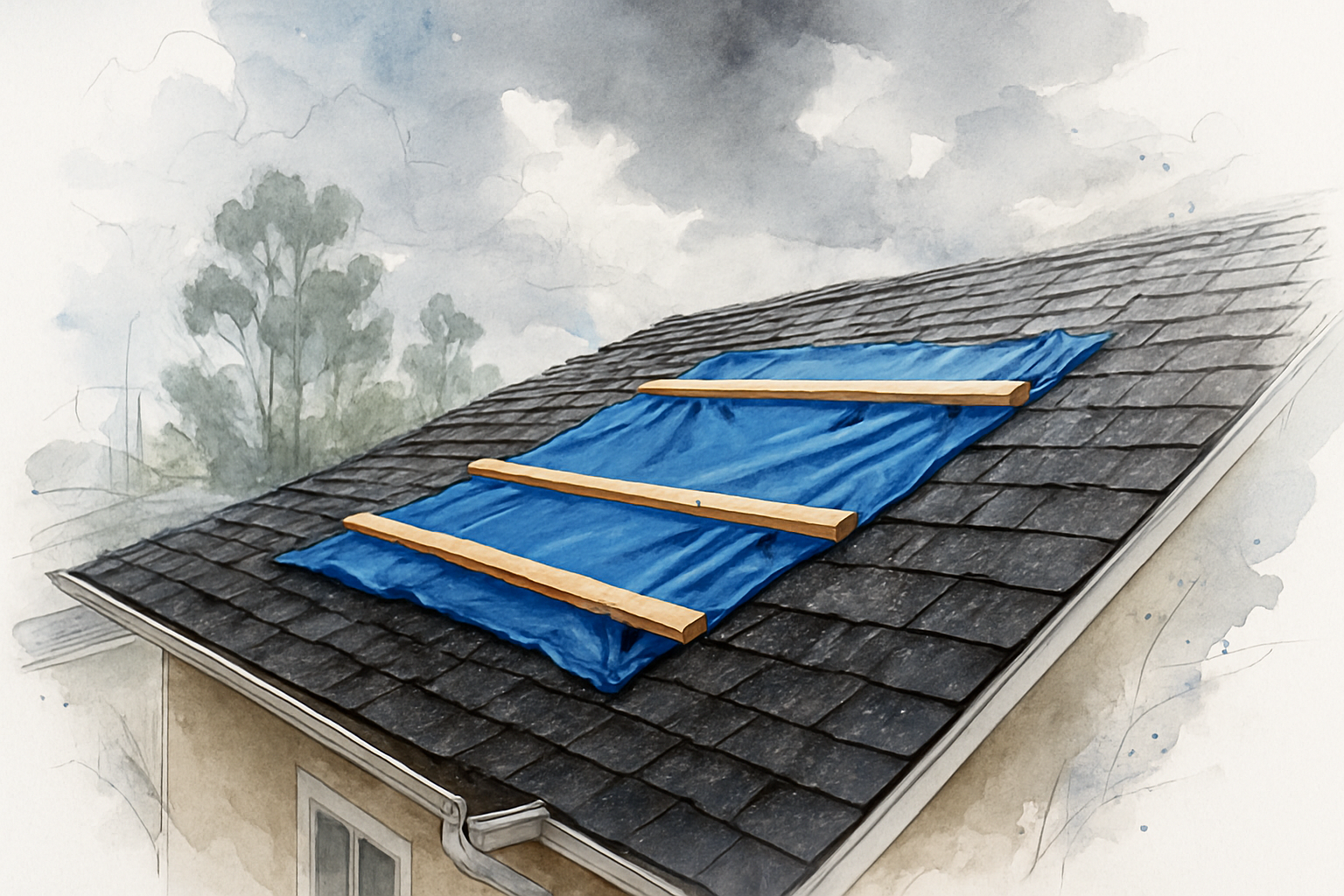
- Emergency tarping and temporary roof repair, written as its own page
- Storm damage assessment, including what you can tell from photos before an on site visit
- Downed limb and hazard tree removal, with the towns named
- Insurance documentation and reports, since homeowners ask for these constantly
That last one matters more here than people expect. Tree care callers on the Central Coast regularly say some version of “my insurance is threatening to cancel because of overhanging trees” or “I need someone who can write a report for the city.”
Those are search terms sitting in plain sight. Most competitor sites never put them on a page.
4. Get the Second Wave Ready: Plumbing and Drainage
A few days into a wet stretch, the ground saturates and the calls change. Now it is plumbers, sewer crews and drainage contractors.
The language shifts too. Homeowners in this situation do not search for “lateral line inspection.” They describe what they are looking at.
Real Central Coast service calls sound like this: sewage backing up into the shower and tub, both toilets backed up at the same time, or a collapsed storm drain pipe causing serious drainage problems on the property. One commercial caller described a parking lot torn up by tree roots.
Those phrases belong in your H2 headings and FAQ blocks, word for word. Not the trade version of them.
For drainage and underground work, add pages covering:
- Standing water and yard flooding after heavy rain
- Collapsed or crushed storm drain replacement
- Sewer camera inspection and what it actually shows
- Same day availability and how your pricing is quoted
On the plumbing side, availability and upfront pricing are the two things callers raise most before they commit.
5. Plan for the Slow Wave: Water Damage, Remodels and Flooring
The third wave shows up weeks after the storm, and it is the most profitable one. General contractors, renovators and flooring installers pick up the repair and replacement work once insurance adjusters have come and gone.
These buyers behave completely differently. They research for weeks, read reviews carefully and want to see finished work before they call.
So the content job is different too. Instead of emergency pages, you need:
- Project galleries with real photos of water damage repair and flooring replacement
- Pages explaining the sequence of a repair job, from dry out through finish work
- Honest content about timelines and what drives cost, without quoting a number you cannot stand behind
- Warranty and callback policy stated plainly on the site
That last item shows up in reviews constantly. One homeowner described hating construction after past experiences with unreliable, messy crews, then praised a contractor who showed up on time and cleaned up daily.
Another wrote about two issues arising after the job, out of warranty, and the contractor resolving both without hesitation. Homeowners in Carmel Valley and Salinas read that kind of thing closely before they call anyone.
How Storm Demand Arrives by Trade on the Central Coast
Use this to sequence your content work. Fix the pages for your wave first, then build out the rest.
| Wave | Trades | When Calls Hit | Pages That Must Already Exist |
|---|---|---|---|
| First hour | Roofers, tree services | During and immediately after the storm | Emergency tarping, hazard tree removal, after hours availability |
| Days 1-7 | Plumbers, drainage, sewer crews | As ground saturates and lines back up | Sewer backup, yard flooding, collapsed storm drain, same day service |
| Weeks 2-8 | General contractors, remodelers, flooring | After insurance adjusters visit | Water damage repair, project galleries, warranty and process pages |
| All season | Electricians, handymen, cleaning | Power issues, small repairs, cleanup | Storm outage service, task specific pages, service area pages |
6. Write the Pages in Homeowner Words, Not Trade Words
Storm season produces a very specific kind of search. People ask questions rather than typing product terms.
That matters because of how AI answers behave. Local Falcon’s study of 60,000 queries found AI Overviews appearing on about 40% of local business searches overall, but on 59.9% of reason style questions compared with only 17.2% of commercial ones.
Storm season is almost entirely reason style questions. “Why is water coming through my ceiling.” “Why is my yard flooding.” “What do I do about a backed up sewer line.”
So build FAQ blocks that use the real phrasing, and answer in two or three sentences before you sell anything. If you want to understand why that phrasing choice moves the needle, read what AI-powered local SEO actually checks before recommending a contractor.
The fastest source of that language is your own phone. The calls sitting in your voicemail contain better keyword research than any tool will give you.
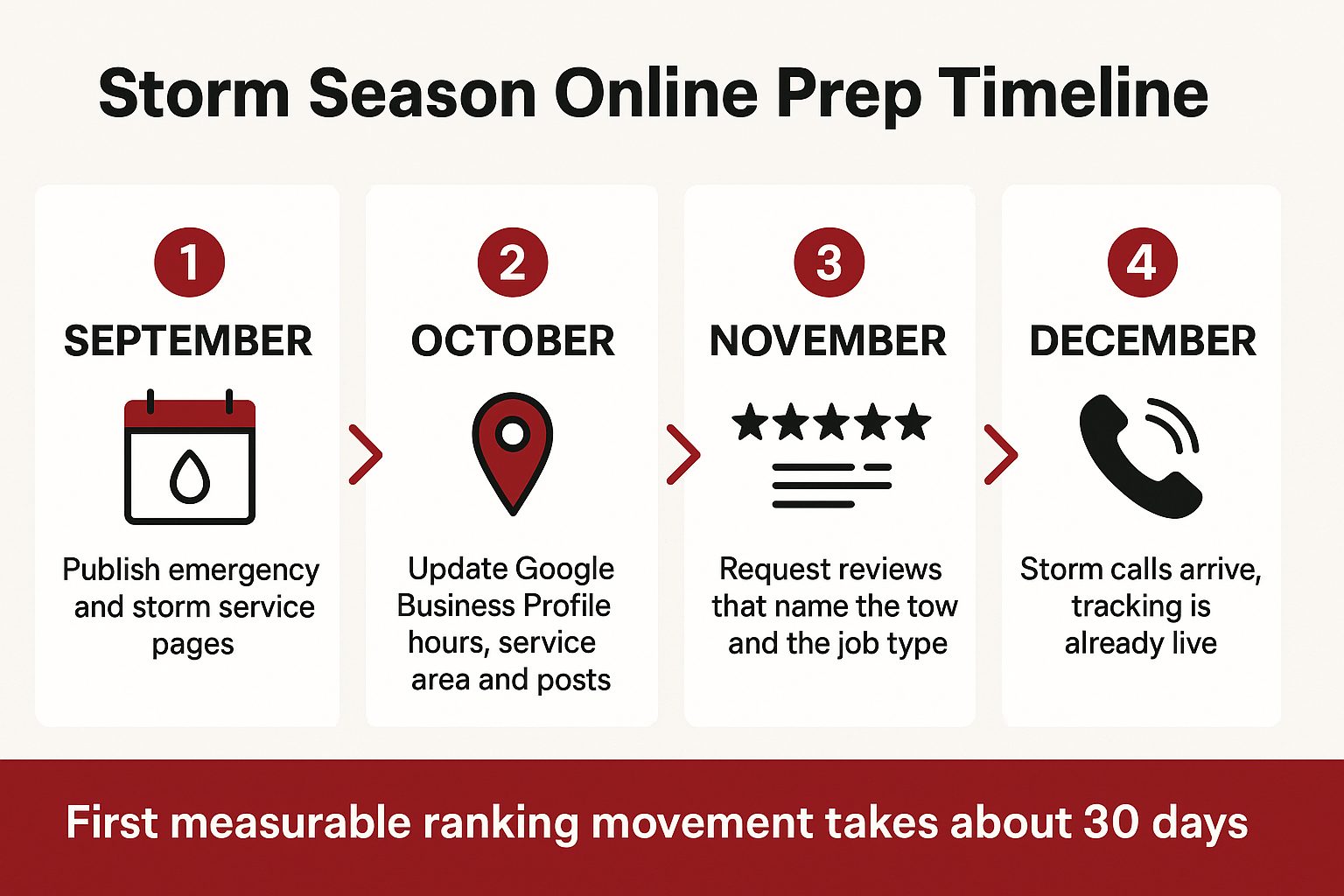
Your September to November Storm Prep Timeline
Here is the sequence I run with contractor clients, mapped to the months that matter.
7. Clean Up the Google Business Profile Before the Rain Starts
This is where storm readiness is weakest on almost every contractor account I audit. The website gets attention. The profile sits untouched since setup.
Emergency and after hours availability, current hours, accurate service area and recent posts all feed the same data AI tools check before naming anybody. SOCi’s 2026 research found that incomplete or conflicting business information can drop a company out of AI recommendations even when its Google rankings look fine.
Before November, verify:
- Hours, including whether you actually answer after hours during storms
- Service area listing the towns you will drive to in bad weather, not aspirational ones
- Phone number matching what is on your website and every directory
- Recent posts, since a profile that went silent in June looks abandoned in December
That consistency work is the backbone of AI Search Sync, which keeps website content, local SEO, ad headlines and call data saying the same thing across every channel. More detail on the profile side is in the Google Business Profile mistake costing contractors AI visibility.
8. Build Reviews That Name the Town and the Job Type
After any real weather event, out of area crews flood local search. Roofers know this better than anyone. Storm chasers show up, run ads, and disappear by March.
The defense is reviews that prove you are actually from here. A review that says “replaced our roof in Watsonville after the January storms” does work that a generic five star rating cannot.
So when you ask, ask specifically:
- Prompt customers to mention the town or neighborhood
- Prompt them to mention the job type in plain words
- Ask within 48 hours of finishing, while details are fresh
- Never script the review, just point at what to include
One home service owner we work with put it this way after a launch: “Core6 built our website and launched an SEO campaign that has improved our rankings quickly.” Reviews with that level of specificity feed AI context the same way page content does.
More on the review and mention side in the two things that separate contractors AI recommends from contractors it skips.
9. Make Sure Every Storm Call Gets Captured and Reviewed
Storm weeks are the worst time to guess where calls came from. Volume spikes, the crew is stretched, and calls get missed or misrouted.
Call tracking with recording and transcription fixes two problems at once. You find out which pages and ads actually produced booked work, and you get a transcript of exactly how people described the emergency.
That second part feeds next season’s content. Core6 Clarity exists for this reason, turning caller questions into FAQ content and caller phrasing into ad headlines and profile posts.
Set it up in October so December data is clean. A month of storm call transcripts is the best planning document you will get all year, and it costs you nothing extra to collect while the phone is already ringing.
Frequently Asked Questions About Storm Season Marketing Prep
Is it too late if I start in November?
Not useless, but you lose the best window. Ranking movement generally takes about 30 days to show up, so November work mostly pays off in January and February. If November is where you are, prioritize the Google Business Profile fixes and review requests, since those move faster than new page content.
Should I run Google Ads during storm season instead of waiting on SEO?
Many contractors run both, and paid search is the one lever that works the same day. The catch is that storm week cost per click climbs, so geo-targeting down to the ZIP codes you actually service matters more than usual. Costs vary a lot by trade and by how many out of area advertisers show up, so ask for a look at your specific numbers rather than trusting a published average.
How many storm pages do I actually need?
Fewer than most agencies will sell you. Three or four genuinely useful pages covering the jobs you want beat fifteen thin ones, and thin pages can hurt you. Pick the storm jobs with the best margin and write those properly.
Does any of this help if I only serve one town?
Yes, and it usually helps more. A single town focus makes your service area, reviews and page content agree with each other, which is exactly the consistency AI tools check. A roofer who clearly serves King City and nowhere else beats a vague regional listing for local searches.
What if the El Nino forecast does not pan out?
Then you have a stronger site, a clean profile and better reviews going into spring. None of this work is wasted in a dry year, which is why I treat it as annual maintenance rather than a weather bet.
Getting Ready for a Wet Winter in Monterey County
The practical value of local help before a storm season is having someone who already knows which pages, profile fields and ad headlines need to be live by November, and who is here in Monterey County when the rain starts. Our work is owner led, month to month, with nothing outsourced overseas. Phil Fisk at Core6 Marketing takes discovery calls if you want a second set of eyes on your storm season setup before December.